


Fan Lau

Encyclopedia
Islands and peninsulas of Hong Kong
Hong Kong comprises the Kowloon peninsula and 263 islands over 500 m2, the largest being Lantau Island and the second largest being Hong Kong Island. Ap Lei Chau is one of the most densely populated islands in the world....
and area in the southwest tip of Lantau Island
Lantau Island
Lantau Island , based on the old local name of Lantau Peak , is the largest island in Hong Kong, located at the mouth of the Pearl River. Administratively, most of Lantau Island is part of the Islands District of Hong Kong...
in Hong Kong
Hong Kong
Hong Kong is one of two Special Administrative Regions of the People's Republic of China , the other being Macau. A city-state situated on China's south coast and enclosed by the Pearl River Delta and South China Sea, it is renowned for its expansive skyline and deep natural harbour...
. It is also the southwest end the territory of Hong Kong. The very end of the tip is Fan Lau Kok (分流角). The peninsula separates water into Fan Lau Tung Wan (分流東灣, lit. "East Bay") in the east, and Fan Lau Sai Wan (分流西灣, lit. "West Bay") and Fan Lau Miu Wan (分流廟灣; lit. "Temple Bay") in the west.
Fan Lau Tsuen
Fan Lau Tsuen (分流村) is a village on the flat land between the peninsula and the main trunk of Lantau Island. It is located on the west bank of Fan Lau, facing Fan Lau Sai Wan. The village was previously named Shek Sun Village (石筍村, "Village of Stone Shoots") and there were not more than 200 people in the village in the hey days. Most of the villagers have moved out of the village and some stayed in Tai OTai O
Tai O is a fishing town, partly located on an island of the same name, on the western side of Lantau Island in Hong Kong.-Geography:On the main part of Lantau Island, a river splits to the north and west and at this fork lies the island referred to as Tai O. Two pedestrian bridges cross the river...
and Pui O
Pui O
Pui O , formerly Lo Pui O , is an area on Lantau Island in Hong Kong. It is a popular destination for holiday camping in Hong Kong. Visitors may also rent village houses for leisure. Located in the South Lantau, there are four main villages in Pui O, they are Lo Wai , San Wai , Lo Uk , and Ham Tin...
of Lantau Island
Features
Fan Lau is a Cantonese name that means separating water flows. The tip points to Lantau ChannelLantau Channel
Lantau Channel is a channel south of Fan Lau Kok of Lantau Island in Hong Kong. The channel is also on the water boundary between Hong Kong and mainland China...
dividing the current from Pearl River
Pearl River (China)
The Pearl River or less commonly, the "Guangdong River" or "Canton River" etc., , is an extensive river system in southern China. The name Pearl River is usually used as a catchment term to refer to the watersheds of the Xi Jiang , the Bei Jiang , and the Dong Jiang...
and the water of South China Sea
South China Sea
The South China Sea is a marginal sea that is part of the Pacific Ocean, encompassing an area from the Singapore and Malacca Straits to the Strait of Taiwan of around...
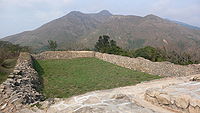
. Due to its military strategic position, Fan Lau Fort
Fan Lau Fort
Fan Lau Fort is a fort in Fan Lau, the southwest corner of Lantau Island in Hong Kong. It is a declared a monument of Hong Kong.-History:...
was built in Qing Dynasty
Qing Dynasty
The Qing Dynasty was the last dynasty of China, ruling from 1644 to 1912 with a brief, abortive restoration in 1917. It was preceded by the Ming Dynasty and followed by the Republic of China....
to defense the territory.
Another archaeological founding on the peninsula is a stone circle
Stone Circles (Hong Kong)
Stone Circles can be found in Hong Kong as Hong Kong is rich in Neolithic and Bronze Age artifacts.-Lo Ah Tsai Stone Circle:Lo Ah Tsai Stone Circle was discovered in the northern part of Lamma Island by K M A Barnett, District Commissioner of the New Territories in 1956...
of Neolithic
Neolithic
The Neolithic Age, Era, or Period, or New Stone Age, was a period in the development of human technology, beginning about 9500 BC in some parts of the Middle East, and later in other parts of the world. It is traditionally considered as the last part of the Stone Age...
and Bronze Age
Bronze Age
The Bronze Age is a period characterized by the use of copper and its alloy bronze as the chief hard materials in the manufacture of some implements and weapons. Chronologically, it stands between the Stone Age and Iron Age...
with unidentified purpose. The Stone Circle and Fan Lau Fort are both declared monuments of Hong Kong
Declared monuments of Hong Kong
Declared monuments of Hong Kong are places, structures or buildings legally declared to be "protected". In Hong Kong, declaring a monument requires consulting the Antiquities Advisory Board, the approval of the Chief Executive as well as the publication of the notice in government gazette.As of 12...
.
There is also a Tin Hau Temple
Tin Hau temples in Hong Kong
Over 70 temples are dedicated to Tin Hau in Hong Kong. They include:* Tin Hau temple, located at 10 Tin Hau Temple Road, Causeway Bay, east of Victoria Park, in Eastern District, on Hong Kong Island. It is a declared monument. The temple has given its name to the MTR station serving it .* The Tin...
in Fan Lau Miu Wan. It was probably erected in 1820 and it is a Grade III historic building since 1985.
There is a lighthouse at Fan Lau Kok.
Access
Fan Lau is part of the Lantau South Country ParkLantau South Country Park
Lantau South Country Park is one of two rural parks on Lantau Island, the other one being Lantau North Country Park and its extension.Lantau South Country Park is located on the south side of the island. It was designated in 1978...
. The stage 7 of Lantau Trail
Lantau Trail
The Lantau Trail , opened on 4 December, 1984, is a long-distance footpath on Lantau Island in the New Territories of Hong Kong. The 70 km trail is circular, starting and finishing in Mui Wo. The Lantau Trail has good visitor facilities along the way, and the route is well marked. There are...
passes near the peninsula. Following the Fan Lau Country Trail allows for the exploration of Fan Lau.