

European emission standards

Encyclopedia
European Union directive
A directive is a legislative act of the European Union, which requires member states to achieve a particular result without dictating the means of achieving that result. It can be distinguished from regulations which are self-executing and do not require any implementing measures. Directives...
s staging the progressive introduction of increasingly stringent standards.
Currently, emissions of nitrogen oxides (NOx), total hydrocarbon
Hydrocarbon
In organic chemistry, a hydrocarbon is an organic compound consisting entirely of hydrogen and carbon. Hydrocarbons from which one hydrogen atom has been removed are functional groups, called hydrocarbyls....
(THC), non-methane hydrocarbons (NMHC), carbon monoxide
Carbon monoxide
Carbon monoxide , also called carbonous oxide, is a colorless, odorless, and tasteless gas that is slightly lighter than air. It is highly toxic to humans and animals in higher quantities, although it is also produced in normal animal metabolism in low quantities, and is thought to have some normal...
(CO) and particulate matter (PM) are regulated for most vehicle types, including cars, lorries, trains, tractors and similar machinery, barge
Barge
A barge is a flat-bottomed boat, built mainly for river and canal transport of heavy goods. Some barges are not self-propelled and need to be towed by tugboats or pushed by towboats...
s, but excluding seagoing ships and aeroplanes. For each vehicle type, different standards apply. Compliance is determined by running the engine at a standardised test cycle
Emission test cycle
An emission test cycle, also known as a 'smog check', is a specified procedure for measuring pollutant emissions of engines. For emission measurements to be comparable for different engines in a category, the measurements are performed under a specific operating pattern, or 'test cycle' of...
. Non-compliant vehicles cannot be sold in the EU, but new standards do not apply to vehicles already on the roads. No use of specific technologies is mandated to meet the standards, though available technology is considered when setting the standards. New models introduced must meet current or planned standards, but minor lifecycle model revisions may continue to be offered with pre-compliant engines.
In the early 2000s, Australia began harmonising
Harmonisation
Harmonisation may refer to:* In music, the implementation of harmony, usually by using chords, including harmonized scales* Harmonisation of law, the process of establishing common laws and standards across the European Union...
Australian Design Rule certification for new motor vehicle emissions with Euro categories. Euro III was introduced on 1 January 2006 and is progressively being introduced to align with European introduction dates.
Also see the EU-mandated European on-board diagnostics
On-board diagnostics
On-Board Diagnostics, or OBD, in an automotive context, is a generic term referring to a vehicle's self-diagnostic and reporting capability. OBD systems give the vehicle owner or a repair technician access to state of health information for various vehicle sub-systems...
.
CO2 emission
Within the European UnionEuropean Union
The European Union is an economic and political union of 27 independent member states which are located primarily in Europe. The EU traces its origins from the European Coal and Steel Community and the European Economic Community , formed by six countries in 1958...
, road transport is responsible for about 20% of all CO2
Carbon dioxide
Carbon dioxide is a naturally occurring chemical compound composed of two oxygen atoms covalently bonded to a single carbon atom...
emissions, with passenger cars contributing about 12%.
The target fixed at Kyoto Protocol
Kyoto Protocol
The Kyoto Protocol is a protocol to the United Nations Framework Convention on Climate Change , aimed at fighting global warming...
was an 8% reduction of emissions in all sectors of the economy compared to 1990 levels by 2008-2012.
Relative CO2
Carbon dioxide
Carbon dioxide is a naturally occurring chemical compound composed of two oxygen atoms covalently bonded to a single carbon atom...
emissions from transport have risen rapidly in recent years, from 21% of the total in 1990 to 28% in 2004, but currently there are no standards for limits on CO2 emissions from vehicles.
EU transport emissions of CO2 currently account for about 3.5% of total global CO2 emissions.
Obligatory labelling
The purpose of Directive 1999/94/EC of the European Parliament and the Council of 13 December 1999 relating to the availability of consumer information on fuel economy and CO2 emissions in respect of the marketing of new passenger cars is to ensure that information relating to the fuel economyFuel economy in automobiles
Fuel usage in automobiles refers to the fuel efficiency relationship between distance traveled by an automobile and the amount of fuel consumed....
and CO2 emissions of new passenger cars offered for sale or lease in the Community is made available to consumers in order to enable consumers to make an informed choice.
In the United Kingdom
United Kingdom
The United Kingdom of Great Britain and Northern IrelandIn the United Kingdom and Dependencies, other languages have been officially recognised as legitimate autochthonous languages under the European Charter for Regional or Minority Languages...
, the initial approach was deemed ineffective. The way the information was presented was too complicated for consumers to understand. As a result, car manufacturers in the United Kingdom voluntarily agreed to put a more “consumer-friendly,” colour-coded label displaying CO2 emissions on all new cars beginning in September 2005, with a letter from A (<100 CO2 g/km) to F ( 186+ CO2 g/km) . The goal of the new “green label” is to give consumers clear information about the environmental performance of different vehicles.
Other EU member countries are also in the process of introducing consumer-friendly labels.
Non-existent obligatory vehicle emission limits
The CO2 emissions generated by vehicles are nowadays subject to a voluntary agreement (in this differ from the obligatory limits in the U.S. CAFECafé
A café , also spelled cafe, in most countries refers to an establishment which focuses on serving coffee, like an American coffeehouse. In the United States, it may refer to an informal restaurant, offering a range of hot meals and made-to-order sandwiches...
legislation) between the EU and the automanufacturers (see ACEA agreement
ACEA agreement
The ACEA agreement refers to a voluntary agreement between the European Automobile Manufacturers Association and the European Commission to limit the amount of carbon dioxide emitted by passenger cars sold in Europe...
). The ultimate EU target with voluntary agreements are to contribute, is to reach an average CO2 emission (as measured according to Commission Directive 93/116/EC) The application for EC type-approval for a vehicle type with regard to CO2 emissions must be submitted by the manufacturer. CO2 emissions is measured in g/km. of 120 g/km for all new passenger cars by 2012.
However, as it becomes increasingly clear that the agreement will not deliver (having achieved only 160 g/km in 2005, from 186 g/km in 1995) lawmakers have started considering regulation.
In late 2005, the European Parliament
European Parliament
The European Parliament is the directly elected parliamentary institution of the European Union . Together with the Council of the European Union and the Commission, it exercises the legislative function of the EU and it has been described as one of the most powerful legislatures in the world...
passed a resolution in support for mandatory CO2 emission standards to replace current voluntary commitments by the auto manufacturers and labelling.
In late 2006, in response to a new report, by the European Federation for Transport and Environment
European Federation for Transport and Environment
The European Federation for Transport and Environment is a European umbrella for non-governmental organisations working in the field of transport and the environment, promoting sustainable transport in Europe; which means an approach to transport that is environmentally responsible, economically...
documenting lack of progress on the voluntary targets, the European Commission
European Commission
The European Commission is the executive body of the European Union. The body is responsible for proposing legislation, implementing decisions, upholding the Union's treaties and the general day-to-day running of the Union....
announced that it was working on a proposal for legally binding limit CO2 emissions from cars. According to the mentioned European Federation for Transport and Environment
European Federation for Transport and Environment
The European Federation for Transport and Environment is a European umbrella for non-governmental organisations working in the field of transport and the environment, promoting sustainable transport in Europe; which means an approach to transport that is environmentally responsible, economically...
study, Fiat
Fiat
FIAT, an acronym for Fabbrica Italiana Automobili Torino , is an Italian automobile manufacturer, engine manufacturer, financial, and industrial group based in Turin in the Italian region of Piedmont. Fiat was founded in 1899 by a group of investors including Giovanni Agnelli...
is the best performer in Europe.
On 7 February 2007 the European Commission published its key draft proposal (COM 2007 0019) EC legislation to limit average CO2 emissions from the European fleet of cars to 120 g CO2/km. Some people interpreted this as meaning that all manufacturers would have to average 120 g for their fleet, but this is not the case. Some volume manufacturers of smaller cars such as Fiat, Renault and Peugeot-Citroen are already quite close to the target whilst smaller volume manufacturers of higher emissions cars such as BMW, Mercedes, Audi, Saab and Porsche are a long way from reaching this target. Not surprisingly the French and Italian manufacturers want a blanket target whereas the German manufacturers feel a blanket target would destroy their industries.
The environmental group T&E insists on the need for a longer-term target that doubles fuel efficiency
Fuel efficiency
Fuel efficiency is a form of thermal efficiency, meaning the efficiency of a process that converts chemical potential energy contained in a carrier fuel into kinetic energy or work. Overall fuel efficiency may vary per device, which in turn may vary per application, and this spectrum of variance is...
of new cars over the next decade, 80 g/km by 2020. It says new-car emissions from European producers slipped to 160 grammes per kilometre (g/km) on average last year (reduced only 0.2 percent in 2006), still way off a voluntary goal of 140 g/km by 2008.
Toxic emission: stages and legal framework
The stages are typically referred to as Euro 1, Euro 2, Euro 3, Euro 4 and Euro 5 fuels for Light Duty Vehicle standards. The corresponding series of standards for Heavy Duty Vehicles use Roman, rather than Indian numerals (Euro I, Euro II, etc.)The legal framework consists in a series of directives, each amendments to the 1970 Directive 70/220/EEC. The following is a summary list of the standards, when they come into force, what they apply to, and which EU directives provide the definition of the standard.
- Euro 1 (1993):
- For passenger cars - 91/441/EEC.
- Also for passenger cars and light truckLight truckLight truck or light duty truck is a U.S. classification for trucks or truck-based vehicles with a payload capacity of less than 4,000 pounds...
s - 93/59/EEC.
- Euro 2 (1996) for passenger cars - 94/12/EC (& 96/69/EC)
- For motorcycle - 2002/51/EC (row A) - 2006/120/EC
- Euro 3 (2000) for any vehicle - 98/69/EC
- For motorcycle - 2002/51/EC (row B) - 2006/120/EC
- Euro 4 (2005) for any vehicle - 98/69/EC (& 2002/80/EC)
- Euro 5 (2008/9) and Euro 6 (2014) for light passenger and commercial vehicles - 715/2007/EC
These limits supersede the original directive on emission limits 70/220/EEC.
The classifications for vehicle category
Vehicle category
A vehicle category classifies a land vehicle for regulatory purposes.- EU classification :In Europe, the classifications for vehicle category are defined by:...
are defined by:
- Commission Directive 2001/116/EC of 20 December 2001, adapting to technical progress Council Directive 70/156/EEC on the approximation of the laws of the Member States relating to the type-approval of motor vehicles and their trailers
- Directive 2002/24/EC of the European Parliament and of the Council of 18 March 2002 relating to the type-approval of two or three-wheeled motor vehicles and repealing Council Directive 92/61/EEC
In the area of fuels, the 2001 Biofuels Directive requires that 5.75% of all transport fossil fuels (petrol and diesel) should be replaced by biofuels by 31 December 2010, with an intermediate target of 2% by the end of 2005. However, MEPS have since voted to lower this target in the wake of new scientific evidence about the sustainability of biofuels and the impact on food prices. In a vote in Strasbourg, the European parliament’s environment committee supported a plan to curb the EU target for renewable sources in transport to 4% by 2015. They also said that a thorough review would be required in 2015 before the EU could progress to an 8-10% mark by 2020.
Emission standards for passenger cars
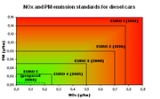
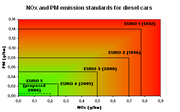
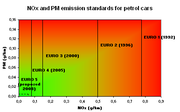
Emission standards for passenger cars and light commercial vehicles are summarised in the following tables. Since the Euro 2 stage, EU regulations introduce different emission limits for diesel and petrol vehicles. Diesels have more stringent CO standards but are allowed higher NOx emissions. Petrol-powered vehicles are exempted from particulate matter (PM) standards through to the Euro 4 stage, but vehicles with direct injection engines will be subject to a limit of 0.005 g/km for Euro 5 and Euro 6. A particulate number standard (P) or (PN) is part of Euro 5 and 6, but is not final. The standard is to be defined as soon as possible and at the latest upon entry into force of Euro 6.All dates listed in the tables refer to new type approvals. The EC Directives also specify a second date — one year later — which applies to first registration (entry into service) of existing, previously type-approved vehicle models.
European emission standards for passenger cars
Automobile
An automobile, autocar, motor car or car is a wheeled motor vehicle used for transporting passengers, which also carries its own engine or motor...
(Category M*), g/km
| Tier | Date | CO Carbon monoxide Carbon monoxide , also called carbonous oxide, is a colorless, odorless, and tasteless gas that is slightly lighter than air. It is highly toxic to humans and animals in higher quantities, although it is also produced in normal animal metabolism in low quantities, and is thought to have some normal... |
THC Hydrocarbon In organic chemistry, a hydrocarbon is an organic compound consisting entirely of hydrogen and carbon. Hydrocarbons from which one hydrogen atom has been removed are functional groups, called hydrocarbyls.... |
NMHC | NOx | HC+NOx | PM | P*** |
|---|---|---|---|---|---|---|---|---|
| Diesel | ||||||||
| Euro 1† | July 1992 | 2.72 (3.16) | - | - | - | 0.97 (1.13) | 0.14 (0.18) | - |
| Euro 2 | January 1996 | 1.0 | - | - | - | 0.7 | 0.08 | - |
| Euro 3 | January 2000 | 0.64 | - | - | 0.50 | 0.56 | 0.05 | - |
| Euro 4 | January 2005 | 0.50 | - | - | 0.25 | 0.30 | 0.025 | - |
| Euro 5 | September 2009 | 0.500 | - | - | 0.180 | 0.230 | 0.005 | - |
| Euro 6 (future) | September 2014 | 0.500 | - | - | 0.080 | 0.170 | 0.005 | - |
| Petrol (Gasoline) | ||||||||
| Euro 1† | July 1992 | 2.72 (3.16) | - | - | - | 0.97 (1.13) | - | - |
| Euro 2 | January 1996 | 2.2 | - | - | - | 0.5 | - | - |
| Euro 3 | January 2000 | 2.3 | 0.20 | - | 0.15 | - | - | - |
| Euro 4 | January 2005 | 1.0 | 0.10 | - | 0.08 | - | - | - |
| Euro 5 | September 2009 | 1.000 | 0.100 | 0.068 | 0.060 | - | 0.005** | - |
| Euro 6 (future) | September 2014 | 1.000 | 0.100 | 0.068 | 0.060 | - | 0.005** | - |
| * Before Euro 5, passenger vehicles > 2500 kg were type approved as light commercial vehicle Light commercial vehicle Light commercial vehicles is a commercial carrier vehicles with a Gross vehicle weight of up to 3.5 tonnes. The formal term within the European Union is Light commercial vehicles. Vehicles which qualify in this category are pickup trucks, vans and 3 wheelers all commercially based goods or... s N1-I ** Applies only to vehicles with direct injection engines *** A number standard is to be defined as soon as possible and at the latest upon entry into force of Euro 6 † Values in brackets are conformity of production (COP) limits |
||||||||
Emission standards for light commercial vehicles
European emission standards for light commercial vehicleLight commercial vehicle
Light commercial vehicles is a commercial carrier vehicles with a Gross vehicle weight of up to 3.5 tonnes. The formal term within the European Union is Light commercial vehicles. Vehicles which qualify in this category are pickup trucks, vans and 3 wheelers all commercially based goods or...
s ≤1305 kg (Category N1-I), g/km
| Tier | Date | CO Carbon monoxide Carbon monoxide , also called carbonous oxide, is a colorless, odorless, and tasteless gas that is slightly lighter than air. It is highly toxic to humans and animals in higher quantities, although it is also produced in normal animal metabolism in low quantities, and is thought to have some normal... |
THC Hydrocarbon In organic chemistry, a hydrocarbon is an organic compound consisting entirely of hydrogen and carbon. Hydrocarbons from which one hydrogen atom has been removed are functional groups, called hydrocarbyls.... |
NMHC | NOx | HC+NOx | PM | P |
|---|---|---|---|---|---|---|---|---|
| Diesel | ||||||||
| Euro 1 | October 1994 | 2.72 | - | - | - | 0.97 | 0.14 | - |
| Euro 2 | January 1998 | 1.0 | - | - | - | 0.7 | 0.08 | - |
| Euro 3 | January 2000 | 0.64 | - | - | 0.50 | 0.56 | 0.05 | - |
| Euro 4 | January 2005 | 0.50 | - | - | 0.25 | 0.30 | 0.025 | - |
| Euro 5 | September 2009 | 0.500 | - | - | 0.180 | 0.230 | 0.005 | - |
| Euro 6 (future) | September 2014 | 0.500 | - | - | 0.080 | 0.170 | 0.005 | - |
| Petrol (Gasoline) | ||||||||
| Euro 1 | October 1994 | 2.72 | - | - | - | 0.97 | - | - |
| Euro 2 | January 1998 | 2.2 | - | - | - | 0.5 | - | - |
| Euro 3 | January 2000 | 2.3 | 0.20 | - | 0.15 | - | - | - |
| Euro 4 | January 2005 | 1.0 | 0.10 | - | 0.08 | - | - | - |
| Euro 5 | September 2009 | 1.000 | 0.100 | 0.068 | 0.060 | - | 0.005* | - |
| Euro 6 (future) | September 2014 | 1.000 | 0.100 | 0.068 | 0.060 | - | 0.005* | - |
| * Applies only to vehicles with direct injection engines | ||||||||
European emission standards for light commercial vehicle
Light commercial vehicle
Light commercial vehicles is a commercial carrier vehicles with a Gross vehicle weight of up to 3.5 tonnes. The formal term within the European Union is Light commercial vehicles. Vehicles which qualify in this category are pickup trucks, vans and 3 wheelers all commercially based goods or...
s 1305 kg – 1760 kg (Category N1-II), g/km
| Tier | Date | CO Carbon monoxide Carbon monoxide , also called carbonous oxide, is a colorless, odorless, and tasteless gas that is slightly lighter than air. It is highly toxic to humans and animals in higher quantities, although it is also produced in normal animal metabolism in low quantities, and is thought to have some normal... |
THC Hydrocarbon In organic chemistry, a hydrocarbon is an organic compound consisting entirely of hydrogen and carbon. Hydrocarbons from which one hydrogen atom has been removed are functional groups, called hydrocarbyls.... |
NMHC | NOx | HC+NOx | PM | P |
|---|---|---|---|---|---|---|---|---|
| Diesel | ||||||||
| Euro 1 | October 1994 | 5.17 | - | - | - | 1.4 | 0.19 | - |
| Euro 2 | January 1998 | 1.25 | - | - | - | 1.0 | 0.12 | - |
| Euro 3 | January 2001 | 0.80 | - | - | 0.65 | 0.72 | 0.07 | - |
| Euro 4 | January 2006 | 0.63 | - | - | 0.33 | 0.39 | 0.04 | - |
| Euro 5 | September 2010 | 0.630 | - | - | 0.235 | 0.295 | 0.005 | - |
| Euro 6 (future) | September 2015 | 0.630 | - | - | 0.105 | 0.195 | 0.005 | - |
| Petrol (Gasoline) | ||||||||
| Euro 1 | October 1994 | 5.17 | - | - | - | 1.4 | - | - |
| Euro 2 | January 1998 | 4.0 | - | - | - | 0.6 | - | - |
| Euro 3 | January 2001 | 4.17 | 0.25 | - | 0.18 | - | - | - |
| Euro 4 | January 2006 | 1.81 | 0.13 | - | 0.10 | - | - | - |
| Euro 5 | September 2010 | 1.810 | 0.130 | 0.090 | 0.075 | - | 0.005* | - |
| Euro 6 (future) | September 2015 | 1.810 | 0.130 | 0.090 | 0.075 | - | 0.005* | - |
| * Applies only to vehicles with direct injection engines | ||||||||
European emission standards for light commercial vehicle
Light commercial vehicle
Light commercial vehicles is a commercial carrier vehicles with a Gross vehicle weight of up to 3.5 tonnes. The formal term within the European Union is Light commercial vehicles. Vehicles which qualify in this category are pickup trucks, vans and 3 wheelers all commercially based goods or...
s >1760 kg max 3500 kg
Large Goods Vehicle
A large goods vehicle , is the European Union term for any truck with a gross combination mass of over...
. (Category N1-III & N2), g/km
| Tier | Date | CO Carbon monoxide Carbon monoxide , also called carbonous oxide, is a colorless, odorless, and tasteless gas that is slightly lighter than air. It is highly toxic to humans and animals in higher quantities, although it is also produced in normal animal metabolism in low quantities, and is thought to have some normal... |
THC Hydrocarbon In organic chemistry, a hydrocarbon is an organic compound consisting entirely of hydrogen and carbon. Hydrocarbons from which one hydrogen atom has been removed are functional groups, called hydrocarbyls.... |
NMHC | NOx | HC+NOx | PM | P |
|---|---|---|---|---|---|---|---|---|
| Diesel | ||||||||
| Euro 1 | October 1994 | 6.9 | - | - | - | 1.7 | 0.25 | - |
| Euro 2 | January 1998 | 1.5 | - | - | - | 1.2 | 0.17 | - |
| Euro 3 | January 2001 | 0.95 | - | - | 0.78 | 0.86 | 0.10 | - |
| Euro 4 | January 2006 | 0.74 | - | - | 0.39 | 0.46 | 0.06 | - |
| Euro 5 (future) | September 2010 | 0.740 | - | - | 0.280 | 0.350 | 0.005 | - |
| Euro 6 (future) | September 2015 | 0.740 | - | - | 0.125 | 0.215 | 0.005 | - |
| Petrol (Gasoline) | ||||||||
| Euro 1 | October 1994 | 6.9 | - | - | - | 1.7 | - | - |
| Euro 2 | January 1998 | 5.0 | - | - | - | 0.7 | - | - |
| Euro 3 | January 2001 | 5.22 | 0.29 | - | 0.21 | - | - | - |
| Euro 4 | January 2006 | 2.27 | 0.16 | - | 0.11 | - | - | - |
| Euro 5 (future) | September 2010 | 2.270 | 0.160 | 0.108 | 0.082 | - | 0.005* | - |
| Euro 6 (future) | September 2015 | 2.270 | 0.160 | 0.108 | 0.082 | - | 0.005* | - |
| * Applies only to vehicles with direct injection engines | ||||||||
Emission standards for lorries and buses
Whereas for passenger cars, the standards are defined by vehicle driving distance, g/km, for lorries (trucks) they are defined by engine energyEnergy
In physics, energy is an indirectly observed quantity. It is often understood as the ability a physical system has to do work on other physical systems...
output, g/kWh, and are therefore in no way comparable. The following table contains a summary of the emission standards and their implementation dates. Dates in the tables refer to new type approvals; the dates for all type approvals are in most cases one year later (EU type approvals are valid longer than one year).
The official category name is heavy-duty diesel engines, which generally includes lorries and buses.
EU Emission Standards for HD Diesel Engines, g/kWh (smoke in m−1)
| Tier | Date | Test cycle Emission test cycle An emission test cycle, also known as a 'smog check', is a specified procedure for measuring pollutant emissions of engines. For emission measurements to be comparable for different engines in a category, the measurements are performed under a specific operating pattern, or 'test cycle' of... |
CO Carbon monoxide Carbon monoxide , also called carbonous oxide, is a colorless, odorless, and tasteless gas that is slightly lighter than air. It is highly toxic to humans and animals in higher quantities, although it is also produced in normal animal metabolism in low quantities, and is thought to have some normal... |
HC Hydrocarbon In organic chemistry, a hydrocarbon is an organic compound consisting entirely of hydrogen and carbon. Hydrocarbons from which one hydrogen atom has been removed are functional groups, called hydrocarbyls.... |
NOx Nitrogen oxide Nitrogen oxide can refer to a binary compound of oxygen and nitrogen, or a mixture of such compounds:* Nitric oxide, also known as nitrogen monoxide, , nitrogen oxide* Nitrogen dioxide , nitrogen oxide... |
PM | Smoke |
|---|---|---|---|---|---|---|---|
| Euro I | 1992, < 85 kW | ECE R-49 |
4.5 | 1.1 | 8.0 | 0.612 | |
| 1992, > 85 kW | 4.5 | 1.1 | 8.0 | 0.36 | |||
| Euro II | October 1996 | 4.0 | 1.1 | 7.0 | 0.25 | ||
| October 1998 | 4.0 | 1.1 | 7.0 | 0.15 | |||
| Euro III | October 1999 EEVs only | ESC & ELR | 1.0 | 0.25 | 2.0 | 0.02 | 0.15 |
| October 2000 | ESC & ELR |
2.1 | 0.66 | 5.0 | 0.10 0.13* |
0.8 | |
| Euro IV | October 2005 | 1.5 | 0.46 | 3.5 | 0.02 | 0.5 | |
| Euro V | October 2008 | 1.5 | 0.46 | 2.0 | 0.02 | 0.5 | |
| Euro VI | January 2013 | 1.5 | 0.13 | 0.4 | 0.01 | ||
| * for engines of less than 0.75 dm Litre pic|200px|right|thumb|One litre is equivalent to this cubeEach side is 10 cm1 litre water = 1 kilogram water The litre is a metric system unit of volume equal to 1 cubic decimetre , to 1,000 cubic centimetres , and to 1/1,000 cubic metre... ³ swept volume per cylinder and a rated power speed of more than 3,000 per minute. EEV is "Enhanced environmentally friendly vehicle". |
|||||||
Emission standards for Large Goods Vehicles
| Standard | Date | CO Carbon monoxide Carbon monoxide , also called carbonous oxide, is a colorless, odorless, and tasteless gas that is slightly lighter than air. It is highly toxic to humans and animals in higher quantities, although it is also produced in normal animal metabolism in low quantities, and is thought to have some normal... (g/kWh) |
NOx Nitrogen oxide Nitrogen oxide can refer to a binary compound of oxygen and nitrogen, or a mixture of such compounds:* Nitric oxide, also known as nitrogen monoxide, , nitrogen oxide* Nitrogen dioxide , nitrogen oxide... (g/kWh) |
HC Hydrocarbon In organic chemistry, a hydrocarbon is an organic compound consisting entirely of hydrogen and carbon. Hydrocarbons from which one hydrogen atom has been removed are functional groups, called hydrocarbyls.... (g/kWh) |
PM (g/kWh) |
|---|---|---|---|---|---|
| Euro 0 | 1988–1992 | 12.3 | 15.8 | 2.6 | none |
| Euro I | 1992–1995 | 4.9 | 9.0 | 1.23 | 0.40 |
| Euro II | 1995–1999 | 4.0 | 7.0 | 1.1 | 0.15 |
| Euro III | 1999–2005 | 2.1 | 5.0 | 0.66 | 0.1 |
| Euro IV | 2005–2008 | 1.5 | 3.5 | 0.46 | 0.02 |
| Euro V | 2008–2012 | 1.5 | 2.0 | 0.46 | 0.02 |
| Standard | Date | CO Carbon monoxide Carbon monoxide , also called carbonous oxide, is a colorless, odorless, and tasteless gas that is slightly lighter than air. It is highly toxic to humans and animals in higher quantities, although it is also produced in normal animal metabolism in low quantities, and is thought to have some normal... (g/kWh) |
NOx Nitrogen oxide Nitrogen oxide can refer to a binary compound of oxygen and nitrogen, or a mixture of such compounds:* Nitric oxide, also known as nitrogen monoxide, , nitrogen oxide* Nitrogen dioxide , nitrogen oxide... (g/kWh) |
HC Hydrocarbon In organic chemistry, a hydrocarbon is an organic compound consisting entirely of hydrogen and carbon. Hydrocarbons from which one hydrogen atom has been removed are functional groups, called hydrocarbyls.... (g/kWh) |
PM (g/kWh) |
|---|---|---|---|---|---|
| Euro 0 | 1988–1992 | 11.2 | 14.4 | 2.4 | none |
| Euro I | 1992–1995 | 4.5 | 8.0 | 1.1 | 0.36 |
| Euro II | 1995–1999 | 4.0 | 7.0 | 1.1 | 0.15 |
Enhanced environmentally friendly vehicle
Enhanced environmentally friendly vehicle or EEV is a term used in the European emission standards for the definition of a "clean vehicle" > 3.5 tonneTonne
The tonne, known as the metric ton in the US , often put pleonastically as "metric tonne" to avoid confusion with ton, is a metric system unit of mass equal to 1000 kilograms. The tonne is not an International System of Units unit, but is accepted for use with the SI...
in the category M2 and M3. The standard lies between the levels of Euro V and Euro VI.
Cycle beating
For the emission standards to deliver real emission reductions it is crucial to use a test cycle that reflects real-world driving style. It was discovered that engine manufacturers would engage in what was called 'cycle beating' to optimise emission performance to the test cycle, while emissions from typical driving conditions would be much higher than expected, undermining the standards and public health. In one particular instance, research from two German technology institutes found that for diesel cars no 'real' NOx reductions have been achieved after 13 years of stricter standards (2006 report).Electrification
As Europe's requirements for its vehicle fleets head toward a goal of 98 grams of per kilometer by 2020, Christian Maloney of the German office of consulting group McKinsey & Co. says the only way the automakers can get there and make money is with plug-in vehiclePlug-in vehicle
Plug-in vehicle may refer to:* Plug-in all-electric vehicle * Plug-in electric vehicle includes electric chargable vehicles such as BEVs and PHEVs*Plug-in hybrid electric vehicle...
s.
Many EU member states have responded to this problem by exploring the possibility of including electric vehicle-related infrastructure into their existing road traffic system, with some even having begun implementation. The UK has begun its "plugged-in-places" scheme which sees funding go to several areas across the UK in order to create a network of charging points for electric vehicles.
See also
- ACEA agreementACEA agreementThe ACEA agreement refers to a voluntary agreement between the European Automobile Manufacturers Association and the European Commission to limit the amount of carbon dioxide emitted by passenger cars sold in Europe...
(the voluntary agreement with auto manufacturers to limit CO2 emissions) - Biofuels Directive
- Emission standards
- Energy policy of the European UnionEnergy policy of the European UnionAlthough the European Union has legislated in the area of energy policy for many years, and evolved out of the European Coal and Steel Community, the concept of introducing a mandatory and comprehensive European energy policy was only approved at the meeting of the European Council on 27 October...
- European Common Transport Policy
- European Federation for Transport and EnvironmentEuropean Federation for Transport and EnvironmentThe European Federation for Transport and Environment is a European umbrella for non-governmental organisations working in the field of transport and the environment, promoting sustainable transport in Europe; which means an approach to transport that is environmentally responsible, economically...
- European Union Emission Trading SchemeEuropean Union Emission Trading SchemeThe European Union Emissions Trading Scheme also known as the European Union Emissions Trading System, was the first large emissions trading scheme in the world. It was launched in 2005 to combat climate change and is a major pillar of EU climate policy...
- Life cycle assessmentLife cycle assessmentA life-cycle assessment is a technique to assess environmental impacts associated with all the stages of a product's life from-cradle-to-grave A life-cycle assessment (LCA, also known as life-cycle analysis, ecobalance, and cradle-to-grave analysis) is a technique to assess environmental impacts...
- Motor vehicle emissionsMotor vehicle emissionsMotor vehicle emissions are composed of the by-products that comes out of the exhaust systems or other emissions such as gasoline evaporation...
- National Emission Ceiling
- Portable Emissions Measurement System (PEMS)
- Type approvalType approvalType Approval is granted to a product that meets a minimum set of regulatory, technical and safety requirements. Generally, type approval is required before a product is allowed to be sold in a particular country, so the requirements for a given product will vary around the world...
- World Forum for Harmonization of Vehicle RegulationsWorld Forum for Harmonization of Vehicle RegulationsThe World Forum for Harmonization of Vehicle Regulations is a working party of the United Nations Economic Commission for Europe...
(United Nations Economic Commission for Europe (UNECE))
External links
- European emission standards.
- European Environment AgencyEuropean Environment AgencyEuropean Environment Agency is an agency of the European Union. Its task is to provide sound, independent information on the environment. It is a major information source for those involved in developing, adopting, implementing and evaluating environmental policy, and also the general public...
- EurActiv.com - Euro 5 emissions standards for cars
- Dieselnet: EU emission standards
- Netherlands Environmental Assessment Agency The Impact of Euro 5 - Facts and figures.
- Commission proposal for Euro 5
- T&E: No diesel NOX reduction in 13 years due to cycle beating
- COM 2007/19 Results of the review of the Community Strategy to reduce CO2 emissions from passenger cars and light-commercial vehicles
- European Commission conference (2003): Options to Reduce Greenhouse Gas Emissions due to Mobile Air Conditioning
In the media
- 2007-07-02, Auto Industry: ACEA welcomes EU Environment Council’s recognition of need for integrated approach to CO2 reduction
- February 7, 2007, BBCBBCThe British Broadcasting Corporation is a British public service broadcaster. Its headquarters is at Broadcasting House in the City of Westminster, London. It is the largest broadcaster in the world, with about 23,000 staff...
: EU car CO2 fight only beginning - February 7, 2007, European CommissionEuropean CommissionThe European Commission is the executive body of the European Union. The body is responsible for proposing legislation, implementing decisions, upholding the Union's treaties and the general day-to-day running of the Union....
: EU plans legislation to cut CO2 emissions from cars - February 6, 2007, International Herald TribuneInternational Herald TribuneThe International Herald Tribune is a widely read English language international newspaper. It combines the resources of its own correspondents with those of The New York Times and is printed at 38 sites throughout the world, for sale in more than 160 countries and territories...
: EU to compromise on auto emissions - January 31, 2007, Transport & Environment: Europe set to clean up fuels but stalls on cars
- January 31, 2007, European CommissionEuropean CommissionThe European Commission is the executive body of the European Union. The body is responsible for proposing legislation, implementing decisions, upholding the Union's treaties and the general day-to-day running of the Union....
: EU proposes stricter fuel standards to cut CO2 emissions - January 24, 2007, The GuardianThe GuardianThe Guardian, formerly known as The Manchester Guardian , is a British national daily newspaper in the Berliner format...
: Grand plan for a low-carbon Europe goes up in smoke - October 19, 2004: European Environment AgencyEuropean Environment AgencyEuropean Environment Agency is an agency of the European Union. Its task is to provide sound, independent information on the environment. It is a major information source for those involved in developing, adopting, implementing and evaluating environmental policy, and also the general public...
: Poor European test standards understate air pollution from cars