
All Topics  
Emperor Moth

 
Emperor Moth

   Email Print
   Bookmark   Link


Emperor Moth


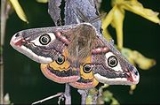
The Small Emperor Moth (Pavonia pavonia) is a moth
Moth

A moth is an insect closely related to the butterfly, both being of the Order Lepidoptera. The differences between butterflies and moths are more than just taxonomy....
 of the family Saturniidae
Saturniidae

The Saturniidae, commonly known as saturniids, are among the largest and most spectacular of the moths. They form a family of Lepidoptera, with an estimated 1,300 to 1,500 described species worldwide....
. It is sometimes placed in the genus Saturnia
Saturnia (moth)

Saturnia is a genus of moths in the family Saturniidae. They are large moths, commonly called emperors. Most are Palearctic, but three species occur in the chaparral of California ....
. It occurs throughout the Palearctic
Palearctic

The Palearctic or Palaearctic is one of the eight ecozones dividing the Earth surface.Physically, the Palearctic is the largest ecozone....
 region and is the only member of its family to be found in the British Isles
British Isles

The British Isles are a group of islands off the northwest coast of continental Europe that include Great Britain and Ireland, and numerous smaller islands....
.

The male has a wingspan
Wingspan

The wingspan of an fixed-wing aircraft or a bird, is the distance from the left wingtip to the right wingtip. For example, the Boeing 777 has a wingspan of about 60 m ....
 of about 60 mm with brown and white forewings marked with red and orange fascia
Fascia

Fascia , pl. fas?ci?ae , adj. fascial is the soft tissue component of the connective tissue system that permeates the human body....
 and a bold black and orange eye-spot. The hindwings are orange with a similar eye-spot.


Discussion
Ask a question about 'Emperor Moth'
Start a new discussion about 'Emperor Moth'
Answer questions from other users
Full Discussion Forum


Recent Posts


Encyclopedia


The Small Emperor Moth (Pavonia pavonia) is a moth
Moth

A moth is an insect closely related to the butterfly, both being of the Order Lepidoptera. The differences between butterflies and moths are more than just taxonomy....
 of the family Saturniidae
Saturniidae

The Saturniidae, commonly known as saturniids, are among the largest and most spectacular of the moths. They form a family of Lepidoptera, with an estimated 1,300 to 1,500 described species worldwide....
. It is sometimes placed in the genus Saturnia
Saturnia (moth)

Saturnia is a genus of moths in the family Saturniidae. They are large moths, commonly called emperors. Most are Palearctic, but three species occur in the chaparral of California ....
. It occurs throughout the Palearctic
Palearctic

The Palearctic or Palaearctic is one of the eight ecozones dividing the Earth surface.Physically, the Palearctic is the largest ecozone....
 region and is the only member of its family to be found in the British Isles
British Isles

The British Isles are a group of islands off the northwest coast of continental Europe that include Great Britain and Ireland, and numerous smaller islands....
.

The male has a wingspan
Wingspan

The wingspan of an fixed-wing aircraft or a bird, is the distance from the left wingtip to the right wingtip. For example, the Boeing 777 has a wingspan of about 60 m ....
 of about 60 mm with brown and white forewings marked with red and orange fascia
Fascia

Fascia , pl. fas?ci?ae , adj. fascial is the soft tissue component of the connective tissue system that permeates the human body....
 and a bold black and orange eye-spot. The hindwings are orange with a similar eye-spot. The female is larger (wingspan about 80 mm) but less brightly coloured than the male, being generally grey and white but has all wings marked with eye-spots similar to the male.

The male flies rapidly during the day in April and May, looking for the rather sluggish females, which usually only fly at night. The species inhabits a range of habitats but is most often associated with heathland and moorland
Moorland

File:Pennine scenery.jpgMoorland or moor is a type of Habitat found in upland areas, characterised by low growing vegetation on acidic soils....
.

The caterpillar
Caterpillar

Caterpillars are the larval form of a member of the order Lepidoptera . They are mostly phytophagous in food habit, with some species being entomophagous....
 is black and orange at first, later becoming green with black rings and yellow and red spots. The commonest food plant
Plant

Plants are Life organisms belonging to the Kingdom Plantae. They include familiar organisms such as trees, herbs, bushes, grasses, vines, ferns, mosses, and green algae....
 is heather
Calluna

Calluna vulgaris, Common Heather, ling, or simpy "heather" is a heather, the sole species in the genus Calluna in the family Ericaceae....
 but the species has also been recorded feeding on a huge range of other plants (see list below). The species overwinters as a pupa
Pupa

A pupa is the life stage of some insects undergoing transformation. The pupal stage is found only in Holometabolism insects, those that undergo a complete metamorphosis, going through four life stages; embryo, larva, pupa and imago....
 within a fibrous cocoon.

  1. The flight season refers to the British Isles
    British Isles

    The British Isles are a group of islands off the northwest coast of continental Europe that include Great Britain and Ireland, and numerous smaller islands....
    . This may vary in other parts of the range.


Recorded food plants


  • Alchemilla
    Alchemilla

    Alchemilla is a genus of herbaceous perennial plants in the Rosaceae, and a popular garden herb with the common name Lady's mantle. There are about 300 species, the majority native to cool temperate and subarctic regions of Europe and Asia, with a few species native to the mountains of Africa, North America and South America....
  • Alnus – Alder
  • Arbutus
    Arbutus

    Arbutus is a genus of at least 14 species of flowering plants in the family Ericaceae, native to warm temperate regions of the Mediterranean region, western Europe, and North America....
     – Strawberry Tree
  • Betula – Birch
  • Calluna
    Calluna

    Calluna vulgaris, Common Heather, ling, or simpy "heather" is a heather, the sole species in the genus Calluna in the family Ericaceae....
     – Heather
  • Cornus – Dogwood
  • Crataegus
    Crataegus

    Hawthorn is a large genus of shrubs and trees in the rose family, Rosaceae, native to temperate regions of the Northern Hemisphere in Europe, Asia and North America....
     – Hawthorn
  • Erica
    Erica

    Erica is a genus of over 700 species of flowering plants in the family Ericaceae. The English common names "heath" and "heather" are shared by some closely related genera of similar appearance....
  • Fagus
    Beech

    Beech is a genus of ten species of deciduous trees in the family Fagaceae, native to temperate Europe and North America.The leaf of beech trees are entire or sparsely toothed, from 5–15 cm long and 4–10 cm broad....
     – Beech
  • Filipendula
    Filipendula

    Filipendula is a genus of 12 species of perennial plant herbaceous flowering plants in the family Rosaceae, native to the temperate regions of the Northern Hemisphere....
     – Meadowsweet
  • Fragaria – Strawberry
  • Fraxinus – Ash
  • Hippophae – Sea-buckthorn
  • Humulus – Hop
  • Juglans – Walnut
  • Lythrum
    Lythrum

    Lythrum is a genus commonly known as loosestrife. It is one of 32 genera of the family Lythraceae.Lythrum species are used as food plants by the larvae of some Lepidoptera species including Pavonia pavonia, Engrailed , Hebrew Character and V-pug....
     – Purple loosestrife
  • Malus
    Malus

    Malus, the apples, is a genus of about 30?35 species of small deciduous trees or shrubs in the family Rosaceae. Other studies go as far as 55 species including the domesticated Apple, or Table apple as it was formerly called ....
     – Apple
  • Myrica gale
    Myrica gale

    Myrica gale is a species of flowering plant in the genus Myrica, native to northern and western Europe and parts of northern North America....
  • Pistacia
    Pistacia

    Pistacia is a genus of ten species in the family Anacardiaceae, native to the Canary Islands, northwest Africa, southern Europe, central and eastern Asia, and North America ....
     – Terebinth
  • Populus
    Poplar

    Populus is a genus of between 25?35 species of deciduous flowering plants in the family Salicaceae, native to most of the Northern Hemisphere....
     – Aspen
  • Potentilla
    Potentilla

    Potentilla is the genus of typical cinquefoils, containing about 500 species of Annual plant, Biennial plant and Perennial plant herbaceouss in the rose family Rosaceae....
  • Prunus
    Prunus

    Prunus is a genus of trees and shrubs, including the plums, cherry, peaches, apricots and almonds. It is traditionally placed within the rose family Rosaceae as a subfamily, the Prunoideae , but sometimes placed in its own family, the Prunaceae ....
  • Pyrus – Pear
  • Quercus – Oak
  • Rhamnus
    Rhamnus

    [Image:0029MAN-Themis.jpg|thumb|Themis, signed "Chairestratos", and dedicated by Megacles, ca
    300BCE :For the genus of plants called Rhamnus, see Buckthorn....
     – Buckthorn
  • Rosa
    Rosa

    The name Rosa could refer to:*The Latin and botanic name of the flowering shrub Rose*The now defunct Houston, TX folk punk band Rosa...
     – Rose
  • Rubus
    Rubus

    Rubus is a large genus of flowering plants in the rose family, Rosaceae, subfamily Rosoideae. Raspberry, Blackberry, and Dewberry are common, widely distributed members of the genus....
  • Rumex
    Rumex

    The docks and sorrels, genus Rumex Carolus Linnaeus, are a genus of about 200 species of Annual plant, Biennial plant and perennial plant herbs in the buckwheat family Polygonaceae....
  • Salix – Willow
  • Sambucus – Elder
  • Schinus
    Schinus

    Schinus is a genus of trees and tall shrubs in the family Anacardiaceae comprising the pepper trees, most notably Schinus molle, the Peruvian Pepper tree, and Schinus terebinthifolius, the Brazilian Pepper tree or Christmasberry the source of the spice commonly known as pink peppercorns....
     – Brazilian pepper
  • Sorbus
    Sorbus

    Sorbus is a genus of about 100?200 species of trees and shrubs in the subfamily Maloideae of the Rose family Rosaceae. Species of Sorbus are commonly known as whitebeam, rowan, service tree, and Sorbus aucuparia....
  • Spiraea
    Spiraea

    'Spiraea' is a genus of about 80-100 species of shrubs in the Rosaceae, subfamily Spiraeoideae. They are native to the temperate Northern Hemisphere, with the greatest diversity in eastern Asia....
  • Ulmus – Elm
  • Vaccinium
    Vaccinium

    Vaccinium is a genus of shrubs or dwarf shrubs in the plant Family Ericaceae. The fruit of many species are eaten by humans and some are of commercial importance, including the cranberry, blueberry, bilberry or whortleberry, lingonberry or cowberry, and huckleberry ....


Additional photos


External links