

Enolase

Encyclopedia
Enolase, also known as phosphopyruvate dehydratase, is a metalloenzyme responsible for the catalysis of the conversion of 2-phosphoglycerate
(2-PG) to phosphoenolpyruvate
(PEP), the ninth and penultimate step of glycolysis
. Enolase belongs to the class Lyase
. Enolase can also catalyze the reverse reaction, depending on environmental concentrations of substrates. The optimum pH for this enzyme is 6.5. Enolase is present in all tissues and organisms capable of glycolysis or fermentation
. The enzyme was discovered by Lohmann and Meyerhof
in 1934, and has since been isolated from a variety of sources including human muscle and erythrocytes.
, β
, and γ
, each encoded by a separate gene that can combine to form five different isoenzymes: αα, αβ, αγ, ββ, and γγ. Three of these isoenzymes (all homodimers) are more commonly found in adult human cells than the others:
in orientation so that Glu20 of one subunit forms an ionic bond with Arg
414 of the other subunit. Each subunit has two distinct domains. The smaller N-terminal domain consists of three α-helices
and four β-sheets
. The larger C-terminal domain starts with two β-sheets followed by two α-helices and ends with a barrel composed of alternating β-sheets and α-helices arranged so that the β-beta sheets are surrounded by the α-helices. The enzyme’s compact, globular structure results from significant hydrophobic interactions between these two domains.
Enolase is a highly conserved enzyme with five active-site residues being especially important for activity. When compared to wild-type enolase, a mutant enolase that differs at either the Glu168, Glu211, Lys
345, or Lys396 residue has an activity level that is cut by a factor of 105. Also, changes affecting His
159 leave the mutant with only 0.01% of its catalytic activity. An integral part of enolase are two Mg2+ cofactors in the active site, which serve to stabilize negative charges in the substrate.
 Using isotopic probes, the overall mechanism for converting 2-PG to PEP is proposed to be an E1cb elimination reaction involving a carbanion intermediate. The following detailed mechanism is based on studies of crystal structure and kinetics
. When the substrate, 2-phosphoglycerate, binds to α-enolase, its carboxyl group coordinates with two magnesium ion cofactors in the active site. This stabilizes the negative charge on the deprotonated oxygen while increasing the acidity of the alpha hydrogen. Enolase’s Lys345 deprotonates the alpha hydrogen, and the resulting negative charge is stabilized by resonance to the carboxylate oxygen and by the magnesium ion cofactors. Following the creation of the carbanion intermediate, the hydroxide on C3 is eliminated as water with the help of Glu211, and PEP is formed.
Additionally, conformational changes occur within the enzyme that aid catalysis. In human α-enolase, the substrate is rotated into position upon binding to the enzyme due to interactions with the two catalytic magnesium ions, Gln
167, and Lys396. Movements of loops Ser
36 to His43, Ser158 to Gly
162, and Asp255 to Asn
256 allow Ser39 to coordinate with Mg2+ and close off the active site. In addition to coordination with the catalytic magnesium ions, the pKa of the substrate’s alpha hydrogen is also lowered due to protonation of the phosphoryl group by His159 and its proximity to Arg374. Arg374 also causes Lys345 in the active site to become deprotonated, which primes Lys345 for its role in the mechanism.
more strongly correlated to low-grade astrocytoma
than did other enzymes tested (aldolase
, pyruvate kinase
, creatine kinase
, and lactate dehydrogenase
). The same study showed that the fastest rate of tumor growth occurred in patients with the highest levels of CSF enolase.
Increased levels of enolase have also been identified in patients who have suffered a recent myocardial infarction
or cerebrovascular accident. It has been inferred that levels of CSF neuron-specific enolase, serum
NSE, and creatine kinase (type BB) are indicative in the prognostic assessment of cardiac arrest victims. Other studies have focused on the prognostic value of NSE values in cerebrovascular accident victims.
Autoantibodies to alpha-enolase are associated with the rare syndrome called Hashimoto's encephalopathy
.
is a known competitor of enolase’s substrate 2-PG. The fluoride is part of a complex with magnesium and phosphate, which binds in the active site instead of 2-PG. As such, drinking fluoridated water
provides fluoride at a level that inhibits oral bacteria enolase activity without harming humans. Disruption of the bacteria’s glycolytic pathway - and, thus, its normal metabolic functioning - prevents dental caries
from forming.
2-Phosphoglycerate
2-Phosphoglyceric acid , or 2-phosphoglycerate, is a glyceric acid which serves as the substrate in the ninth step of glycolysis. It is catalyzed by enolase into phosphoenolpyruvate , the penultimate step in the conversion of glucose to pyruvate.-In Glycolysis: -References:...
(2-PG) to phosphoenolpyruvate
Phosphoenolpyruvate
Phosphoenolpyruvic acid , or phosphoenolpyruvate as the anion, is an important chemical compound in biochemistry. It has the high-energy phosphate bond found in living organisms, and is involved in glycolysis and gluconeogenesis...
(PEP), the ninth and penultimate step of glycolysis
Glycolysis
Glycolysis is the metabolic pathway that converts glucose C6H12O6, into pyruvate, CH3COCOO− + H+...
. Enolase belongs to the class Lyase
Lyase
In biochemistry, a lyase is an enzyme that catalyzes the breaking of various chemical bonds by means other than hydrolysis and oxidation, often forming a new double bond or a new ring structure...
. Enolase can also catalyze the reverse reaction, depending on environmental concentrations of substrates. The optimum pH for this enzyme is 6.5. Enolase is present in all tissues and organisms capable of glycolysis or fermentation
Fermentation (biochemistry)
Fermentation is the process of extracting energy from the oxidation of organic compounds, such as carbohydrates, using an endogenous electron acceptor, which is usually an organic compound. In contrast, respiration is where electrons are donated to an exogenous electron acceptor, such as oxygen,...
. The enzyme was discovered by Lohmann and Meyerhof
Otto Fritz Meyerhof
-External links:* *...
in 1934, and has since been isolated from a variety of sources including human muscle and erythrocytes.
Isozymes
There are three subunits of enolase, αAlpha-enolase
Enolase 1, more commonly known as alpha-enolase, is a glycolytic enzyme expressed in most tissues, one of the isozymes of enolase. It is a homodimer composed of 2 alpha subunits.-Relationship to Myc-binding protein-1:...
, β
Enolase 2
Gamma-enolase, also known as enolase 2 or neuron specific enolase , is an enzyme that in humans is encoded by the ENO2 gene. Gamma-enolase is a phosphopyruvate hydratase....
, and γ
ENO3
Beta-enolase is an enzyme that in humans is encoded by the ENO3 gene.-Further reading:...
, each encoded by a separate gene that can combine to form five different isoenzymes: αα, αβ, αγ, ββ, and γγ. Three of these isoenzymes (all homodimers) are more commonly found in adult human cells than the others:
- αα or non-neuronal enolase (NNE), which is found in a variety of tissues, including liver, brain, kidney, spleen, adipose. Also known as enolase 1Alpha-enolaseEnolase 1, more commonly known as alpha-enolase, is a glycolytic enzyme expressed in most tissues, one of the isozymes of enolase. It is a homodimer composed of 2 alpha subunits.-Relationship to Myc-binding protein-1:...
- ββ or muscle specific enolase (MSE). Also known as enolase 3ENO3Beta-enolase is an enzyme that in humans is encoded by the ENO3 gene.-Further reading:...
. - γγ or neuron-specific enolase (NSE). Also known as enolase 2Enolase 2Gamma-enolase, also known as enolase 2 or neuron specific enolase , is an enzyme that in humans is encoded by the ENO2 gene. Gamma-enolase is a phosphopyruvate hydratase....
.
Structure
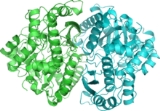
Enolase has a molecular weight of 82,000-100,000 Daltons depending on the isoform. In human alpha enolase, the two subunits are antiparallelAntiparallel (biochemistry)
In biochemistry, two molecules are antiparallel if they run side-by-side in opposite directions or when both strands are complimentary to each other....
in orientation so that Glu20 of one subunit forms an ionic bond with Arg
Arginine
Arginine is an α-amino acid. The L-form is one of the 20 most common natural amino acids. At the level of molecular genetics, in the structure of the messenger ribonucleic acid mRNA, CGU, CGC, CGA, CGG, AGA, and AGG, are the triplets of nucleotide bases or codons that codify for arginine during...
414 of the other subunit. Each subunit has two distinct domains. The smaller N-terminal domain consists of three α-helices
Alpha helix
A common motif in the secondary structure of proteins, the alpha helix is a right-handed coiled or spiral conformation, in which every backbone N-H group donates a hydrogen bond to the backbone C=O group of the amino acid four residues earlier...
and four β-sheets
Beta sheet
The β sheet is the second form of regular secondary structure in proteins, only somewhat less common than the alpha helix. Beta sheets consist of beta strands connected laterally by at least two or three backbone hydrogen bonds, forming a generally twisted, pleated sheet...
. The larger C-terminal domain starts with two β-sheets followed by two α-helices and ends with a barrel composed of alternating β-sheets and α-helices arranged so that the β-beta sheets are surrounded by the α-helices. The enzyme’s compact, globular structure results from significant hydrophobic interactions between these two domains.
Enolase is a highly conserved enzyme with five active-site residues being especially important for activity. When compared to wild-type enolase, a mutant enolase that differs at either the Glu168, Glu211, Lys
Lysine
Lysine is an α-amino acid with the chemical formula HO2CCH4NH2. It is an essential amino acid, which means that the human body cannot synthesize it. Its codons are AAA and AAG....
345, or Lys396 residue has an activity level that is cut by a factor of 105. Also, changes affecting His
Histidine
Histidine Histidine, an essential amino acid, has a positively charged imidazole functional group. It is one of the 22 proteinogenic amino acids. Its codons are CAU and CAC. Histidine was first isolated by German physician Albrecht Kossel in 1896. Histidine is an essential amino acid in humans...
159 leave the mutant with only 0.01% of its catalytic activity. An integral part of enolase are two Mg2+ cofactors in the active site, which serve to stabilize negative charges in the substrate.
Mechanism
Chemical kinetics
Chemical kinetics, also known as reaction kinetics, is the study of rates of chemical processes. Chemical kinetics includes investigations of how different experimental conditions can influence the speed of a chemical reaction and yield information about the reaction's mechanism and transition...
. When the substrate, 2-phosphoglycerate, binds to α-enolase, its carboxyl group coordinates with two magnesium ion cofactors in the active site. This stabilizes the negative charge on the deprotonated oxygen while increasing the acidity of the alpha hydrogen. Enolase’s Lys345 deprotonates the alpha hydrogen, and the resulting negative charge is stabilized by resonance to the carboxylate oxygen and by the magnesium ion cofactors. Following the creation of the carbanion intermediate, the hydroxide on C3 is eliminated as water with the help of Glu211, and PEP is formed.
Additionally, conformational changes occur within the enzyme that aid catalysis. In human α-enolase, the substrate is rotated into position upon binding to the enzyme due to interactions with the two catalytic magnesium ions, Gln
Glutamine
Glutamine is one of the 20 amino acids encoded by the standard genetic code. It is not recognized as an essential amino acid but may become conditionally essential in certain situations, including intensive athletic training or certain gastrointestinal disorders...
167, and Lys396. Movements of loops Ser
Serine
Serine is an amino acid with the formula HO2CCHCH2OH. It is one of the proteinogenic amino acids. By virtue of the hydroxyl group, serine is classified as a polar amino acid.-Occurrence and biosynthesis:...
36 to His43, Ser158 to Gly
Glycine
Glycine is an organic compound with the formula NH2CH2COOH. Having a hydrogen substituent as its 'side chain', glycine is the smallest of the 20 amino acids commonly found in proteins. Its codons are GGU, GGC, GGA, GGG cf. the genetic code.Glycine is a colourless, sweet-tasting crystalline solid...
162, and Asp255 to Asn
Asparagine
Asparagine is one of the 20 most common natural amino acids on Earth. It has carboxamide as the side-chain's functional group. It is not an essential amino acid...
256 allow Ser39 to coordinate with Mg2+ and close off the active site. In addition to coordination with the catalytic magnesium ions, the pKa of the substrate’s alpha hydrogen is also lowered due to protonation of the phosphoryl group by His159 and its proximity to Arg374. Arg374 also causes Lys345 in the active site to become deprotonated, which primes Lys345 for its role in the mechanism.
Diagnostic Uses
In recent medical experiments, enolase concentrations have been sampled in an attempt to diagnose certain conditions and their severity. For example, higher concentrations of enolase in cerebrospinal fluidCerebrospinal fluid
Cerebrospinal fluid , Liquor cerebrospinalis, is a clear, colorless, bodily fluid, that occupies the subarachnoid space and the ventricular system around and inside the brain and spinal cord...
more strongly correlated to low-grade astrocytoma
Astrocytoma
Astrocytomas are a type of neoplasm of the brain. They originate in a particular kind of glial-cells, star-shaped brain cells in the cerebrum called astrocytes. This type of tumor does not usually spread outside the brain and spinal cord and it does not usually affect other organs...
than did other enzymes tested (aldolase
Aldolase
Aldolase A is an enzyme that catalyses a reverse aldol reaction: The substrate, fructose 1,6-bisphosphate is broken down into glyceraldehyde 3-phosphate and dihydroxyacetone phosphate . This reaction is a part of glycolysis. Three aldolase isozymes , encoded by three different genes, are...
, pyruvate kinase
Pyruvate kinase
Pyruvate kinase is an enzyme involved in glycolysis. It catalyzes the transfer of a phosphate group from phosphoenolpyruvate to ADP, yielding one molecule of pyruvate and one molecule of ATP.-Reaction:The reaction with pyruvate kinase:...
, creatine kinase
Creatine kinase
Creatine kinase , also known as creatine phosphokinase or phospho-creatine kinase , is an enzyme expressed by various tissues and cell types. CK catalyses the conversion of creatine and consumes adenosine triphosphate to create phosphocreatine and adenosine diphosphate...
, and lactate dehydrogenase
Lactate dehydrogenase
Lactate dehydrogenase is an enzyme present in a wide variety of organisms, including plants and animals.Lactate dehydrogenases exist in four distinct enzyme classes. Two of them are cytochrome c-dependent enzymes, each acting on either D-lactate or L-lactate...
). The same study showed that the fastest rate of tumor growth occurred in patients with the highest levels of CSF enolase.
Increased levels of enolase have also been identified in patients who have suffered a recent myocardial infarction
Myocardial infarction
Myocardial infarction or acute myocardial infarction , commonly known as a heart attack, results from the interruption of blood supply to a part of the heart, causing heart cells to die...
or cerebrovascular accident. It has been inferred that levels of CSF neuron-specific enolase, serum
Blood plasma
Blood plasma is the straw-colored liquid component of blood in which the blood cells in whole blood are normally suspended. It makes up about 55% of the total blood volume. It is the intravascular fluid part of extracellular fluid...
NSE, and creatine kinase (type BB) are indicative in the prognostic assessment of cardiac arrest victims. Other studies have focused on the prognostic value of NSE values in cerebrovascular accident victims.
Autoantibodies to alpha-enolase are associated with the rare syndrome called Hashimoto's encephalopathy
Hashimoto's encephalopathy
Hashimoto's Encephalopathy is a very rare condition associated with Hashimoto's thyroiditis. It was first described in 1966. It is classified as a neuroendocrine disorder....
.
Fluoride Inhibition
FluorideFluoride
Fluoride is the anion F−, the reduced form of fluorine when as an ion and when bonded to another element. Both organofluorine compounds and inorganic fluorine containing compounds are called fluorides. Fluoride, like other halides, is a monovalent ion . Its compounds often have properties that are...
is a known competitor of enolase’s substrate 2-PG. The fluoride is part of a complex with magnesium and phosphate, which binds in the active site instead of 2-PG. As such, drinking fluoridated water
Water fluoridation
Water fluoridation is the controlled addition of fluoride to a public water supply to reduce tooth decay. Fluoridated water has fluoride at a level that is effective for preventing cavities; this can occur naturally or by adding fluoride...
provides fluoride at a level that inhibits oral bacteria enolase activity without harming humans. Disruption of the bacteria’s glycolytic pathway - and, thus, its normal metabolic functioning - prevents dental caries
Dental caries
Dental caries, also known as tooth decay or a cavity, is an irreversible infection usually bacterial in origin that causes demineralization of the hard tissues and destruction of the organic matter of the tooth, usually by production of acid by hydrolysis of the food debris accumulated on the...
from forming.