

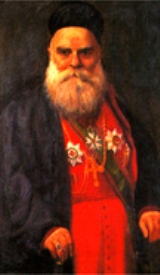
Elias Peter Hoayek

Encyclopedia
Elias Peter Hoayek
(1843–1931), (or Hoyek, Hwayek, Huayek, Juayek, Hawayek) was Patriarch of Antioch for the Maronites, the largest Christian community in the Middle East from 1898 to 1931 when he died.
He is hailed as the father of Lebanonism and the founder of the modern Lebanese state. The Lebanese people of all sects hailed his patriotism, followed his example and maintain it to this day. Hoayek
is considered one of the four founders of Lebanon: Fakhr el Din II
, Bashir II
, Youssef Beik Karam
and Patriarch Hoayek
.
was born in Helta, Batroun, North Lebanon
in the year 1843. He studied at the Seminary College of St. John Maroun in North Lebanon. He later went to the Jesuit seminary of Ghazir in 1859, where he studied the languages (French, Arabic, Syriac, Latin
, Greek
) as well as philosophy. In 1866 he went to Rome to study theology
. In 1870, he was made a Catholic
priest and returned to Lebanon. Upon his return he taught theology at his old school the Seminary of St. John Maroun. He was appointed secretary and moved to the patriarchal residence in 1872 where he remained until 1898 when he was elected Patriarch
. He was consecrated titular bishop
of Arca on December 14, 1889 by Patriarch Paul Peter Massad
.
in 1898; Monsenieur Hoayek
was requested to return to Lebanon from a trip to Rome. On January 6, he was elected Patriarch.
Hoayek
adopted the middle name Peter (Boutros) to signify him being the successor to St. Peter first Bishop of Antioch.
Patriarch Hoayek
’s residence was simple, consisting of three rooms: a bedroom/office, a reception room and a chapel. He was known to particularly revere the readings of the confessions of St. Augustine
, the Eternal Maxims and the Imitation of Christ
.
in 1904.
He was founder of the church in Cyprus
, delegating Shikrallah Khoury and Peter Chebly.
He was the founder of the independent dioneces in the United States of America
and in Argentina
in 1920.
were killed by Ottoman
forces in the war. The Ottoman Empire was allied to Germany. The Ottomans (upon German request) set up a blockage of the Lebanese and Syrian coast line. As a result, a third of the Lebanese population died of famine. Jamal Pasha, Ottoman military governor took steps to exile Hoayek
because of his relations with France.
In 1915, the blockade as well as a large locust infestation had resulted in deplenished food supplies. This situation continued until 1919. The Patriarch received funds from Lebanese Diaspora and the French government. Again, Jamal Pasha attempted to exile the Patriarch.
while the Ottoman (and their German allies) retreated to the North. This ended four hundred years of Ottoman rule in Lebanon. A transitional governance body was installed by the allied British and French forces.
in Versailles.
King Faisal
had hopes for an Arab kingdom to encompass Lebanon, Syria, Iraq, Palestine and the Arabian Peninsula. Patriarch Hoayek fought to be able to see Lebanon free from the Ottoman Empire and had no desire to see it become part of Faisal's empire. King Faisal
went on to accept the Balfour Declaration on a condition to be given his Arab state (minus Palestine) of Greater Syria
. This he did in 1919, with Dr. Chaim Weizmann
, President of the World Zionist Organization and was called the Faisal-Weizmann Agreement.
The Lebanese delegation led by Hoayek
presented the Lebanese aspirations as follows:
On October 27, he presented the assembly of the Peace Congress
with this memorandum. This proposal was accepted and approved by Clemenceau
in a statement issued on November 10, 1919.
announced a declaration by France of the independence of Lebanon on September 1, 1920. He outlined the nation's boundaries to include the area from Ras-al-Naqurah (Naqurah peninsula) in the South to Nahr-el-Kabir
(The Large River) in the North and from the summits of the Anti-Lebanon mountain in the East to the Mediterranean sea in the West. This was the first time Lebanon had these boundaries and was called The State of Greater Lebanon.
Hawayek
The surname Howayek, Hawayek and its variants are common in the Christian Catholic Maronite clan from Lebanon. The majority of the members live in three Lebanese towns Bdadoun, Hsarat and Helta as well as some other smaller towns in Lebanon and Syria in addition to the family members who have...
(1843–1931), (or Hoyek, Hwayek, Huayek, Juayek, Hawayek) was Patriarch of Antioch for the Maronites, the largest Christian community in the Middle East from 1898 to 1931 when he died.
He is hailed as the father of Lebanonism and the founder of the modern Lebanese state. The Lebanese people of all sects hailed his patriotism, followed his example and maintain it to this day. Hoayek
Hawayek
The surname Howayek, Hawayek and its variants are common in the Christian Catholic Maronite clan from Lebanon. The majority of the members live in three Lebanese towns Bdadoun, Hsarat and Helta as well as some other smaller towns in Lebanon and Syria in addition to the family members who have...
is considered one of the four founders of Lebanon: Fakhr el Din II
Fakhr-al-Din II
Emir Fakhr-al-Din ibn Maan was the 1st prince of the State of Lebanon which has self-governed under the Ottoman Empire between the 17th and 19th centuries. Son of Prince Qorqmaz ibn Maan and Sit Nasab of the Tanukhi family, he was given the title "Emir" or Prince in Arabic because the Maan...
, Bashir II
Bashir Shihab II
Bashir Chehab II was a Lebanese emir who ruled Lebanon in the first half of the 19th century.-Life:Bashir was born 2 January 1767 , son of Emir Qasim ibn Umar Chehab of the noble Chehab family which had came to power in 1697...
, Youssef Beik Karam
Youssef Karam
Youssef Beyk Karam , was a Lebanese nationalist leader who led the nationalist effort against the Ottoman Empire occupation.-The Karam family:...
and Patriarch Hoayek
Hawayek
The surname Howayek, Hawayek and its variants are common in the Christian Catholic Maronite clan from Lebanon. The majority of the members live in three Lebanese towns Bdadoun, Hsarat and Helta as well as some other smaller towns in Lebanon and Syria in addition to the family members who have...
.
Early life
Elias HoayekHawayek
The surname Howayek, Hawayek and its variants are common in the Christian Catholic Maronite clan from Lebanon. The majority of the members live in three Lebanese towns Bdadoun, Hsarat and Helta as well as some other smaller towns in Lebanon and Syria in addition to the family members who have...
was born in Helta, Batroun, North Lebanon
North Lebanon
North Lebanon may refer to:*North Lebanon Township, Pennsylvania*North Governorate, Lebanon...
in the year 1843. He studied at the Seminary College of St. John Maroun in North Lebanon. He later went to the Jesuit seminary of Ghazir in 1859, where he studied the languages (French, Arabic, Syriac, Latin
Latin
Latin is an Italic language originally spoken in Latium and Ancient Rome. It, along with most European languages, is a descendant of the ancient Proto-Indo-European language. Although it is considered a dead language, a number of scholars and members of the Christian clergy speak it fluently, and...
, Greek
Greek language
Greek is an independent branch of the Indo-European family of languages. Native to the southern Balkans, it has the longest documented history of any Indo-European language, spanning 34 centuries of written records. Its writing system has been the Greek alphabet for the majority of its history;...
) as well as philosophy. In 1866 he went to Rome to study theology
Theology
Theology is the systematic and rational study of religion and its influences and of the nature of religious truths, or the learned profession acquired by completing specialized training in religious studies, usually at a university or school of divinity or seminary.-Definition:Augustine of Hippo...
. In 1870, he was made a Catholic
Catholic
The word catholic comes from the Greek phrase , meaning "on the whole," "according to the whole" or "in general", and is a combination of the Greek words meaning "about" and meaning "whole"...
priest and returned to Lebanon. Upon his return he taught theology at his old school the Seminary of St. John Maroun. He was appointed secretary and moved to the patriarchal residence in 1872 where he remained until 1898 when he was elected Patriarch
Patriarch
Originally a patriarch was a man who exercised autocratic authority as a pater familias over an extended family. The system of such rule of families by senior males is called patriarchy. This is a Greek word, a compound of πατριά , "lineage, descent", esp...
. He was consecrated titular bishop
Titular bishop
A titular bishop in various churches is a bishop who is not in charge of a diocese.By definition a bishop is an "overseer" of a community of the faithful, so when a priest is ordained a bishop the tradition of the Roman Catholic and Orthodox churches is that he be ordained for a specific place...
of Arca on December 14, 1889 by Patriarch Paul Peter Massad
Paul Peter Massad
Paul I Peter Massad , , was the Maronite Patriarch of Antioch from 1854 until his death in 1890.-Life:...
.
Becoming Patriarch
The previous Patriarch, John el Hajj died on Christmas EveChristmas Eve
Christmas Eve refers to the evening or entire day preceding Christmas Day, a widely celebrated festival commemorating the birth of Jesus of Nazareth that takes place on December 25...
in 1898; Monsenieur Hoayek
Hawayek
The surname Howayek, Hawayek and its variants are common in the Christian Catholic Maronite clan from Lebanon. The majority of the members live in three Lebanese towns Bdadoun, Hsarat and Helta as well as some other smaller towns in Lebanon and Syria in addition to the family members who have...
was requested to return to Lebanon from a trip to Rome. On January 6, he was elected Patriarch.
Hoayek
Hawayek
The surname Howayek, Hawayek and its variants are common in the Christian Catholic Maronite clan from Lebanon. The majority of the members live in three Lebanese towns Bdadoun, Hsarat and Helta as well as some other smaller towns in Lebanon and Syria in addition to the family members who have...
adopted the middle name Peter (Boutros) to signify him being the successor to St. Peter first Bishop of Antioch.
Patriarch Hoayek
Hawayek
The surname Howayek, Hawayek and its variants are common in the Christian Catholic Maronite clan from Lebanon. The majority of the members live in three Lebanese towns Bdadoun, Hsarat and Helta as well as some other smaller towns in Lebanon and Syria in addition to the family members who have...
’s residence was simple, consisting of three rooms: a bedroom/office, a reception room and a chapel. He was known to particularly revere the readings of the confessions of St. Augustine
Augustine of Hippo
Augustine of Hippo , also known as Augustine, St. Augustine, St. Austin, St. Augoustinos, Blessed Augustine, or St. Augustine the Blessed, was Bishop of Hippo Regius . He was a Latin-speaking philosopher and theologian who lived in the Roman Africa Province...
, the Eternal Maxims and the Imitation of Christ
Imitation of Christ
In Christian theology, the Imitation of Christ is the practice of following the example of Jesus. In Eastern Christianity the term Life in Christ is sometimes used for the same concept....
.
Support for the Diaspora
He was behind the creation of a Patriarchal Vicariate in EgyptEgypt
Egypt , officially the Arab Republic of Egypt, Arabic: , is a country mainly in North Africa, with the Sinai Peninsula forming a land bridge in Southwest Asia. Egypt is thus a transcontinental country, and a major power in Africa, the Mediterranean Basin, the Middle East and the Muslim world...
in 1904.
He was founder of the church in Cyprus
Cyprus
Cyprus , officially the Republic of Cyprus , is a Eurasian island country, member of the European Union, in the Eastern Mediterranean, east of Greece, south of Turkey, west of Syria and north of Egypt. It is the third largest island in the Mediterranean Sea.The earliest known human activity on the...
, delegating Shikrallah Khoury and Peter Chebly.
He was the founder of the independent dioneces in the United States of America
United States
The United States of America is a federal constitutional republic comprising fifty states and a federal district...
and in Argentina
Argentina
Argentina , officially the Argentine Republic , is the second largest country in South America by land area, after Brazil. It is constituted as a federation of 23 provinces and an autonomous city, Buenos Aires...
in 1920.
Challenges of the First World War
The First World War saw a lot of persecution of the Christians in the Middle East. Some sources cite one and a half million of ArmeniansArmenians
Armenian people or Armenians are a nation and ethnic group native to the Armenian Highland.The largest concentration is in Armenia having a nearly-homogeneous population with 97.9% or 3,145,354 being ethnic Armenian....
were killed by Ottoman
Ottoman Empire
The Ottoman EmpireIt was usually referred to as the "Ottoman Empire", the "Turkish Empire", the "Ottoman Caliphate" or more commonly "Turkey" by its contemporaries...
forces in the war. The Ottoman Empire was allied to Germany. The Ottomans (upon German request) set up a blockage of the Lebanese and Syrian coast line. As a result, a third of the Lebanese population died of famine. Jamal Pasha, Ottoman military governor took steps to exile Hoayek
Hawayek
The surname Howayek, Hawayek and its variants are common in the Christian Catholic Maronite clan from Lebanon. The majority of the members live in three Lebanese towns Bdadoun, Hsarat and Helta as well as some other smaller towns in Lebanon and Syria in addition to the family members who have...
because of his relations with France.
In 1915, the blockade as well as a large locust infestation had resulted in deplenished food supplies. This situation continued until 1919. The Patriarch received funds from Lebanese Diaspora and the French government. Again, Jamal Pasha attempted to exile the Patriarch.
End of the War
The HM British army entered DamascusDamascus
Damascus , commonly known in Syria as Al Sham , and as the City of Jasmine , is the capital and the second largest city of Syria after Aleppo, both are part of the country's 14 governorates. In addition to being one of the oldest continuously inhabited cities in the world, Damascus is a major...
while the Ottoman (and their German allies) retreated to the North. This ended four hundred years of Ottoman rule in Lebanon. A transitional governance body was installed by the allied British and French forces.
Peace Congress in Versailles
In 1919, Patriarch Hoayek headed the Lebanese delegation at the Peace CongressParis Peace Conference, 1919
The Paris Peace Conference was the meeting of the Allied victors following the end of World War I to set the peace terms for the defeated Central Powers following the armistices of 1918. It took place in Paris in 1919 and involved diplomats from more than 32 countries and nationalities...
in Versailles.
King Faisal
Faisal I of Iraq
Faisal bin Hussein bin Ali al-Hashemi, was for a short time King of the Arab Kingdom of Syria or Greater Syria in 1920, and was King of the Kingdom of Iraq from 23 August 1921 to 1933...
had hopes for an Arab kingdom to encompass Lebanon, Syria, Iraq, Palestine and the Arabian Peninsula. Patriarch Hoayek fought to be able to see Lebanon free from the Ottoman Empire and had no desire to see it become part of Faisal's empire. King Faisal
Faisal I of Iraq
Faisal bin Hussein bin Ali al-Hashemi, was for a short time King of the Arab Kingdom of Syria or Greater Syria in 1920, and was King of the Kingdom of Iraq from 23 August 1921 to 1933...
went on to accept the Balfour Declaration on a condition to be given his Arab state (minus Palestine) of Greater Syria
Greater Syria
Greater Syria , also known simply as Syria, is a term that denotes a region in the Near East bordering the Eastern Mediterranean Sea or the Levant....
. This he did in 1919, with Dr. Chaim Weizmann
Chaim Weizmann
Chaim Azriel Weizmann, , was a Zionist leader, President of the Zionist Organization, and the first President of the State of Israel. He was elected on 1 February 1949, and served until his death in 1952....
, President of the World Zionist Organization and was called the Faisal-Weizmann Agreement.
The Lebanese delegation led by Hoayek
Hawayek
The surname Howayek, Hawayek and its variants are common in the Christian Catholic Maronite clan from Lebanon. The majority of the members live in three Lebanese towns Bdadoun, Hsarat and Helta as well as some other smaller towns in Lebanon and Syria in addition to the family members who have...
presented the Lebanese aspirations as follows:
- The extension of the frontiers of Lebanon to include the cities of BeirutBeirutBeirut is the capital and largest city of Lebanon, with a population ranging from 1 million to more than 2 million . Located on a peninsula at the midpoint of Lebanon's Mediterranean coastline, it serves as the country's largest and main seaport, and also forms the Beirut Metropolitan...
, Tyre, SidonSidonSidon or Saïda is the third-largest city in Lebanon. It is located in the South Governorate of Lebanon, on the Mediterranean coast, about 40 km north of Tyre and 40 km south of the capital Beirut. In Genesis, Sidon is the son of Canaan the grandson of Noah...
, TripoliTripoliTripoli is the capital and largest city in Libya. It is also known as Western Tripoli , to distinguish it from Tripoli, Lebanon. It is affectionately called The Mermaid of the Mediterranean , describing its turquoise waters and its whitewashed buildings. Tripoli is a Greek name that means "Three...
and the districts of Akkar, Beqaa, and Southern Lebanon. These cities and districts were natural parts of Lebanon, but were administratively separated by the Ottoman rule. - The recognition of Lebanon’s full independence
- The institution of a Parliament to represent the different sects
- The assistance of France in consolidating Lebanon’s independence.
On October 27, he presented the assembly of the Peace Congress
Paris Peace Conference, 1919
The Paris Peace Conference was the meeting of the Allied victors following the end of World War I to set the peace terms for the defeated Central Powers following the armistices of 1918. It took place in Paris in 1919 and involved diplomats from more than 32 countries and nationalities...
with this memorandum. This proposal was accepted and approved by Clemenceau
Clemenceau
Clemenceau may refer to:* Georges Clemenceau , French physician, journalist and statesman* Clemenceau , a French aircraft carrier* Mount Clemenceau, a mountain in the Canadian Rockies...
in a statement issued on November 10, 1919.
Lebanon's Independence
The French General GouraudHenri Gouraud (soldier)
Henri Joseph Eugène Gouraud was a French general, best known for his leadership of the French Fourth Army at the end of the World War I.-Early life:...
announced a declaration by France of the independence of Lebanon on September 1, 1920. He outlined the nation's boundaries to include the area from Ras-al-Naqurah (Naqurah peninsula) in the South to Nahr-el-Kabir
Nahr al-Kabir
Nahr al-Kabir al-Janoubi is a river in the Middle East flowing into the Mediterranean Sea. The river flows through the Homs Gap....
(The Large River) in the North and from the summits of the Anti-Lebanon mountain in the East to the Mediterranean sea in the West. This was the first time Lebanon had these boundaries and was called The State of Greater Lebanon.
Famous sayings
Hoyek wrote: "Both national feeling and religion make it an obligation for you to respect and love everybody whatever may be his belief. Reason leads you to fraternize with the person you live with under the same sky and on the same land" (Hoyek, Al-Zakhair Al-Saniyyat, Jounieh, 1931 p. 501).- "God", he used to say, "wants us to love our country" (Ibid p.792 Cf. p.588).
See also
- Biography of the patriarch Elias Hoayek by HARFOÛCHE, P. Ibrâhîm, Dalâ' it Al 'inâya el-Samdanyat, Lebanese Jounieh, Printing works Missionaries Maronites; 1934.
- La vérité sur l'histoire de la Montagne Libanaise (The Truth on the History of Mount Lebanon) by Patriarch Hoayek, Haqîqat Al-bayân 'year târikh Gabal Lubnân. Manuscript consulted at Sabeh Hoayek in BdadounBdadounBdadoun is a town in Mount Lebanon which makes up one of the 70 towns and villages in the district of Aley . It has an estimated population of 3000. It is 490 meters above sea level and 15 kilometres from the capital Beirut...
. - Inventing Lebanon: Nationalism and the State Under the Mandate - by Kais M. Firro
- Lebanon: A History of Conflict and Consensus - by Nadim Shehadi, Dana Haffar Mills
- The Formation of Modern Syria and Iraq - by Eliezer Tauber
- Monks and Monasteries of the Near East - by Jules Leroy
- The Maronite Patriarch Elias Butrus al-Howayyek and the Establishment of Greater Lebanon - by Samawil Bulus, Haifa University, 1987