


Egloshayle

Encyclopedia
Cornwall
Cornwall is a unitary authority and ceremonial county of England, within the United Kingdom. It is bordered to the north and west by the Celtic Sea, to the south by the English Channel, and to the east by the county of Devon, over the River Tamar. Cornwall has a population of , and covers an area of...
, England
England
England is a country that is part of the United Kingdom. It shares land borders with Scotland to the north and Wales to the west; the Irish Sea is to the north west, the Celtic Sea to the south west, with the North Sea to the east and the English Channel to the south separating it from continental...
, United Kingdom
United Kingdom
The United Kingdom of Great Britain and Northern IrelandIn the United Kingdom and Dependencies, other languages have been officially recognised as legitimate autochthonous languages under the European Charter for Regional or Minority Languages...
. The village is situated beside the River Camel
River Camel
The River Camel is a river in Cornwall, UK. It rises on the edge of Bodmin Moor and together with its tributaries drains a considerable part of North Cornwall. The river issues into the Celtic Sea area of the Atlantic Ocean between Stepper Point and Pentire Point having covered a distance of...
immediately southeast of Wadebridge
Wadebridge
Wadebridge is a civil parish and town in north Cornwall, England, United Kingdom. The town straddles the River Camel five miles upstream from Padstow....
. The civil parish extends southeast from the village and includes Washaway and Sladesbridge
Sladesbridge
Sladesbridge is a small village located near Wadebridge in Cornwall, England, UK. It is situated at the confluence of the River Allen and the Croan Stream about 1 km upstream of the confluence with the River Camel...
.
History
Egloshayle was a Bronze AgeBronze Age
The Bronze Age is a period characterized by the use of copper and its alloy bronze as the chief hard materials in the manufacture of some implements and weapons. Chronologically, it stands between the Stone Age and Iron Age...
settlement and later a river port, rivalling Padstow
Padstow
Padstow is a town, civil parish and fishing port on the north coast of Cornwall, England, United Kingdom. The town is situated on the west bank of the River Camel estuary approximately five miles northwest of Wadebridge, ten miles northwest of Bodmin and ten miles northeast of Newquay...
five miles downriver. The trade consisted of tin
Tin
Tin is a chemical element with the symbol Sn and atomic number 50. It is a main group metal in group 14 of the periodic table. Tin shows chemical similarity to both neighboring group 14 elements, germanium and lead and has two possible oxidation states, +2 and the slightly more stable +4...
, clay
Clay
Clay is a general term including many combinations of one or more clay minerals with traces of metal oxides and organic matter. Geologic clay deposits are mostly composed of phyllosilicate minerals containing variable amounts of water trapped in the mineral structure.- Formation :Clay minerals...
, wool
Wool
Wool is the textile fiber obtained from sheep and certain other animals, including cashmere from goats, mohair from goats, qiviut from muskoxen, vicuña, alpaca, camel from animals in the camel family, and angora from rabbits....
, and vegetable crops. Egloshayle is now a residential suburb of Wadebridge.
The town of Wadebridge developed in the parishes of Egloshayle and St Breock
St Breock
St Breock is a village and a civil parish in north Cornwall, United Kingdom. St Breock village is 1 mile west of Wadebridge immediately to the south of the Royal Cornwall Showground. The village lies on the eastern slope of the wooded Nansent valley...
. A Vicar of Egloshayle named Thomas Lovibond was responsible for the construction of the first bridge across the River Camel to replace a dangerous ford. Begun in 1468 and completed in 1485, the bridge was traditionally known as the "Bridge on Wool" because it was reputedly built on woolsack
Woolsack
The Woolsack is the seat of the Lord Speaker in the House of Lords, the Upper House of the Parliament of the United Kingdom. From the Middle Ages until 2006, the presiding officer in the House of Lords was the Lord Chancellor and the Woolsack was usually mentioned in association with the office of...
s. In fact, however, it has been proven to be founded directly on the underlying bedrock.
Churches
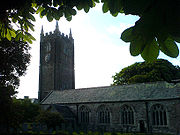
The parish church, named after St Petroc, is built almost entirely in the PerpendicularPerpendicular
In geometry, two lines or planes are considered perpendicular to each other if they form congruent adjacent angles . The term may be used as a noun or adjective...
style. It has a Norman
Norman architecture
About|Romanesque architecture, primarily English|other buildings in Normandy|Architecture of Normandy.File:Durham Cathedral. Nave by James Valentine c.1890.jpg|thumb|200px|The nave of Durham Cathedral demonstrates the characteristic round arched style, though use of shallow pointed arches above the...
font, a stone pulpit dating from the 15th century, and also has a fine monument to Dame Barbara Molesworth (ob. 1735). There is a peal of eight bells: the tenor bell weighs 12-1-25.
The Anglican chapel at Washaway, dating from 1882, has a font which is one of the earliest in the county. Langdon (1896) recorded that there were six stone crosses in the parish, including two in parish churchyard and one at Washaway.
The bell-ringers of the village are celebrated in the song The Ringers of Egloshayle. The ringers named in the song are all buried in the churchyard of the village church and their names may be seen on the headstones. The song has been recorded by, amongst others, the well-known Cornish singer Brenda Wootton
Brenda Wootton
Brenda Wootton was a Cornish poetess and folk singer and was seen as an ambassador for Cornish tradition and culture in all the Celtic nations and as far away as Australia and Canada....
.
Notable buildings and antiquities
Local private properties of interest include Pencarrow House (18th century) and Croan House (17th century), each of which have seven baysBay (architecture)
A bay is a unit of form in architecture. This unit is defined as the zone between the outer edges of an engaged column, pilaster, or post; or within a window frame, doorframe, or vertical 'bas relief' wall form.-Defining elements:...
.
Kelly Rounds
Kelly Rounds
Kelly Rounds, or Castle Killibury is an Iron Age hill fort in Cornwall, United Kingdom. It is situated beside the A39 trunk road approximately two miles east of Wadebridge....
(or Castle Killibury) is an Iron Age
Iron Age
The Iron Age is the archaeological period generally occurring after the Bronze Age, marked by the prevalent use of iron. The early period of the age is characterized by the widespread use of iron or steel. The adoption of such material coincided with other changes in society, including differing...
fort on the border of the parish and has been associated with the legend of King Arthur
King Arthur
King Arthur is a legendary British leader of the late 5th and early 6th centuries, who, according to Medieval histories and romances, led the defence of Britain against Saxon invaders in the early 6th century. The details of Arthur's story are mainly composed of folklore and literary invention, and...
.
Notable people
William LobbWilliam Lobb
William Lobb was a Cornish plant collector, employed by Veitch Nurseries of Exeter, who was responsible for the commercial introduction to England of Araucaria araucana from Chile and the massive Sequoiadendron giganteum from North America.He and his brother, Thomas Lobb, were the first...
, a plant collector spent his early life at Egloshayle.
Arthur Hamilton Norway (1859–1938), who became head of the post office in Ireland before the First World War, and the father of novelist Nevil Shute
Nevil Shute
Nevil Shute Norway was a popular British-Australian novelist and a successful aeronautical engineer. He used his full name in his engineering career, and 'Nevil Shute' as his pen name, in order to protect his engineering career from any potential negative publicity in connection with his novels.-...
, was born on the village.