

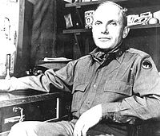
Edward Almond

Encyclopedia
Edward Mallory "Ned" Almond (December 12, 1892 – June 11, 1979) was a controversial United States Army
general best known as the commander of the Army's X Corps during the Korean War
.
, Almond graduated from the Virginia Military Institute
(VMI) in 1915 and became an infantry
officer in 1916, serving in France
with the 4th Division during the final months of World War I
. He graduated from the Command & General Staff School, Fort Leavenworth
, Kansas
, 1930. After a tour of duty in Philippines
he attended the Army War College in 1934. From 1934 to 1938 he was attached to intelligence
Division of the General Staff
. Promoted to Lieutenant Colonel
in September 1938, he completed the course at Naval War College
in 1940 and in January 1941 was assigned staff duty at VI Corps HQ, Providence, Rhode Island
. Promoted to the temporary ranks of Colonel
October 1941, Brigadier General
March 1942, when was named assistant commander of the 92nd Infantry Division located in Arizona.
, also a VMI graduate, who was Army Chief of Staff
during World War II
. This regard accounted in part for Almond's promotion to Major General
ahead of most of his peers and subsequent command of the 92nd Infantry Division, made of almost exclusively African-American soldiers, a position he held from its formation in October 1942 until August 1945. He led the division in combat in the Italian campaign of 1944-1945
. Although George Marshall picked Almond for this assignment because Marshall believed Almond would excel at this difficult assignment, the division performed poorly in combat. Almond blamed the division's poor performance on its largely African-American troops, echoing the widespread prejudice in the segregated
Army that blacks made poor soldiers--and went on to advise the Army against ever again using African-Americans as combat troops. Almond told confidants that the division's poor combat record had cheated him of higher command.
In 1946 Almond was transferred to Tokyo
as chief of personnel at General MacArthur's General Headquarters (GHQ). Normally a deadend job, Almond handled the sizable challenge of staffing the occupation forces in Japan as the American forces rapidly demobilized, standing out among MacArthur's lackluster staff officers. Having won MacArthur's confidence as a capable and loyal—beyond the point of sycophancy—staff officer, Almond was the logical choice to become GHQ Chief of Staff in January 1949, when the incumbent, Paul Mueller, rotated home. As chief of staff, Almond played the part of MacArthur's alter ego, allowing no daylight to separate him from his superior.
. Some saw MacArthur's appointment of Almond to command X Corps as a blatant attempt to improve Almond's prospects for a third star; the appointment became known as "Operation Three Star" among the dubious troops. Almond earned the scorn of Marine officers when, during the early phase of the Inchon landing, he asked if the amphibious tractors used to land the Marines could float. During this invasion Almond failed to capture most of the opposing North Korean Army as they retreated from the 38th parallel
to defensive positions above Seoul
.
During this time, Almond had many conflicts with Major General O. P. Smith, commander of the 1st Marine Division, which was part of X Corps (and therefore under Almond's overall command) from October until December 1950. Likewise Almond had a poor relationship with Lieutenant General Walton Walker
, commander of the 8th Army. Historians have criticized Almond for the wide dispersal of his units during the X Corps invasion of the north-eastern part of North Korea
, in November–December 1950. This dispersal contributed to the defeat of X Corps by Chinese troops
, including the destruction of Task Force Faith
, and the narrow escape of the Marines at the Battle of Chosin Reservoir
. Military historians believe that Marine Major General O.P. Smith's skill and caution was the major reason that X Corps had as many survivors as it did. Almond was very slow to recognize the scale of the Chinese attack on X Corps, urging Army and Marine units forward despite the huge Chinese forces arrayed against them. His lack of appreciation of the strength and skill of the Chinese forces, as well as his innate racism
, was on full display when he told his subordinate officers "The enemy who is delaying you for the moment is nothing more than remnants of Chinese divisions fleeing north. We're still attacking and we're going all the way to the Yalu
. Don't let a bunch of Chinese laundrymen stop you."
Despite his controversial reputation, and some suspect because of his well-known good relationship with General MacArthur, Almond was retained as X Corps commander by Lieutenant General Matthew Ridgway
when he took command of Eighth Army in December, which now included the X Corps. Although he was regarded by Ridgway as his only aggressive corps commander and took part in the defeat of the Chinese offensives during February and March 1951, as well as the Eighth Army's counter-offensive, Operation Killer
, his command was immediately severely reduced by Ridgway. Almond was promoted to Lieutenant General during this time.
. He retired in 1953 and worked in insurance
until his death in 1979.
Almond's decorations include the Distinguished Service Cross with oak leaf cluster
, the Distinguished Service Medal with oak leaf cluster, the Silver Star with oak leaf cluster and the Purple Heart.
He is buried at Arlington National Cemetery
.
United States Army
The United States Army is the main branch of the United States Armed Forces responsible for land-based military operations. It is the largest and oldest established branch of the U.S. military, and is one of seven U.S. uniformed services...
general best known as the commander of the Army's X Corps during the Korean War
Korean War
The Korean War was a conventional war between South Korea, supported by the United Nations, and North Korea, supported by the People's Republic of China , with military material aid from the Soviet Union...
.
Early Biography
Born in Luray, VirginiaLuray, Virginia
Luray is a town in Page County, Virginia, United States, in the Shenandoah Valley of the northern part of the state. It is also the county seat...
, Almond graduated from the Virginia Military Institute
Virginia Military Institute
The Virginia Military Institute , located in Lexington, Virginia, is the oldest state-supported military college and one of six senior military colleges in the United States. Unlike any other military college in the United States—and in keeping with its founding principles—all VMI students are...
(VMI) in 1915 and became an infantry
Infantry
Infantrymen are soldiers who are specifically trained for the role of fighting on foot to engage the enemy face to face and have historically borne the brunt of the casualties of combat in wars. As the oldest branch of combat arms, they are the backbone of armies...
officer in 1916, serving in France
France
The French Republic , The French Republic , The French Republic , (commonly known as France , is a unitary semi-presidential republic in Western Europe with several overseas territories and islands located on other continents and in the Indian, Pacific, and Atlantic oceans. Metropolitan France...
with the 4th Division during the final months of World War I
World War I
World War I , which was predominantly called the World War or the Great War from its occurrence until 1939, and the First World War or World War I thereafter, was a major war centred in Europe that began on 28 July 1914 and lasted until 11 November 1918...
. He graduated from the Command & General Staff School, Fort Leavenworth
Fort Leavenworth
Fort Leavenworth is a United States Army facility located in Leavenworth County, Kansas, immediately north of the city of Leavenworth in the upper northeast portion of the state. It is the oldest active United States Army post west of Washington, D.C. and has been in operation for over 180 years...
, Kansas
Kansas
Kansas is a US state located in the Midwestern United States. It is named after the Kansas River which flows through it, which in turn was named after the Kansa Native American tribe, which inhabited the area. The tribe's name is often said to mean "people of the wind" or "people of the south...
, 1930. After a tour of duty in Philippines
Philippines
The Philippines , officially known as the Republic of the Philippines , is a country in Southeast Asia in the western Pacific Ocean. To its north across the Luzon Strait lies Taiwan. West across the South China Sea sits Vietnam...
he attended the Army War College in 1934. From 1934 to 1938 he was attached to intelligence
Military intelligence
Military intelligence is a military discipline that exploits a number of information collection and analysis approaches to provide guidance and direction to commanders in support of their decisions....
Division of the General Staff
General Staff
A military staff, often referred to as General Staff, Army Staff, Navy Staff or Air Staff within the individual services, is a group of officers and enlisted personnel that provides a bi-directional flow of information between a commanding officer and subordinate military units...
. Promoted to Lieutenant Colonel
Lieutenant Colonel (United States)
In the United States Army, United States Air Force, and United States Marine Corps, a lieutenant colonel is a field grade military officer rank just above the rank of major and just below the rank of colonel. It is equivalent to the naval rank of commander in the other uniformed services.The pay...
in September 1938, he completed the course at Naval War College
Naval War College
The Naval War College is an education and research institution of the United States Navy that specializes in developing ideas for naval warfare and passing them along to officers of the Navy. The college is located on the grounds of Naval Station Newport in Newport, Rhode Island...
in 1940 and in January 1941 was assigned staff duty at VI Corps HQ, Providence, Rhode Island
Providence, Rhode Island
Providence is the capital and most populous city of Rhode Island and was one of the first cities established in the United States. Located in Providence County, it is the third largest city in the New England region...
. Promoted to the temporary ranks of Colonel
Colonel (United States)
In the United States Army, Air Force, and Marine Corps, colonel is a senior field grade military officer rank just above the rank of lieutenant colonel and just below the rank of brigadier general...
October 1941, Brigadier General
Brigadier general (United States)
A brigadier general in the United States Army, Air Force, and Marine Corps, is a one-star general officer, with the pay grade of O-7. Brigadier general ranks above a colonel and below major general. Brigadier general is equivalent to the rank of rear admiral in the other uniformed...
March 1942, when was named assistant commander of the 92nd Infantry Division located in Arizona.
World War II and Postwar Occupation in Japan
Almond was for a time highly regarded by George MarshallGeorge Marshall
George Catlett Marshall was an American military leader, Chief of Staff of the Army, Secretary of State, and the third Secretary of Defense...
, also a VMI graduate, who was Army Chief of Staff
Chief of Staff of the United States Army
The Chief of Staff of the Army is a statutory office held by a four-star general in the United States Army, and is the most senior uniformed officer assigned to serve in the Department of the Army, and as such is the principal military advisor and a deputy to the Secretary of the Army; and is in...
during World War II
World War II
World War II, or the Second World War , was a global conflict lasting from 1939 to 1945, involving most of the world's nations—including all of the great powers—eventually forming two opposing military alliances: the Allies and the Axis...
. This regard accounted in part for Almond's promotion to Major General
Major general (United States)
In the United States Army, United States Marine Corps, and United States Air Force, major general is a two-star general-officer rank, with the pay grade of O-8. Major general ranks above brigadier general and below lieutenant general...
ahead of most of his peers and subsequent command of the 92nd Infantry Division, made of almost exclusively African-American soldiers, a position he held from its formation in October 1942 until August 1945. He led the division in combat in the Italian campaign of 1944-1945
Italian Campaign (World War II)
The Italian Campaign of World War II was the name of Allied operations in and around Italy, from 1943 to the end of the war in Europe. Joint Allied Forces Headquarters AFHQ was operationally responsible for all Allied land forces in the Mediterranean theatre, and it planned and commanded the...
. Although George Marshall picked Almond for this assignment because Marshall believed Almond would excel at this difficult assignment, the division performed poorly in combat. Almond blamed the division's poor performance on its largely African-American troops, echoing the widespread prejudice in the segregated
Racial segregation in the United States
Racial segregation in the United States, as a general term, included the racial segregation or hypersegregation of facilities, services, and opportunities such as housing, medical care, education, employment, and transportation along racial lines...
Army that blacks made poor soldiers--and went on to advise the Army against ever again using African-Americans as combat troops. Almond told confidants that the division's poor combat record had cheated him of higher command.
In 1946 Almond was transferred to Tokyo
Tokyo
, ; officially , is one of the 47 prefectures of Japan. Tokyo is the capital of Japan, the center of the Greater Tokyo Area, and the largest metropolitan area of Japan. It is the seat of the Japanese government and the Imperial Palace, and the home of the Japanese Imperial Family...
as chief of personnel at General MacArthur's General Headquarters (GHQ). Normally a deadend job, Almond handled the sizable challenge of staffing the occupation forces in Japan as the American forces rapidly demobilized, standing out among MacArthur's lackluster staff officers. Having won MacArthur's confidence as a capable and loyal—beyond the point of sycophancy—staff officer, Almond was the logical choice to become GHQ Chief of Staff in January 1949, when the incumbent, Paul Mueller, rotated home. As chief of staff, Almond played the part of MacArthur's alter ego, allowing no daylight to separate him from his superior.
Korean War and X Corps
In 1950, MacArthur split X Corps from the 8th Army then placed Almond, who had no experience with amphibious operations, in command of the main landing force just before the amphibious invasions of Inchon and WonsanWonsan
Wŏnsan is a port city and naval base in southeastern North Korea. It is the capital of Kangwŏn Province. The population of the city is estimated to have been 331,000 in 2000. Notable people from Wŏnsan include Kim Ki Nam, diplomat and Secretary of the Workers' Party.- History :The original name of...
. Some saw MacArthur's appointment of Almond to command X Corps as a blatant attempt to improve Almond's prospects for a third star; the appointment became known as "Operation Three Star" among the dubious troops. Almond earned the scorn of Marine officers when, during the early phase of the Inchon landing, he asked if the amphibious tractors used to land the Marines could float. During this invasion Almond failed to capture most of the opposing North Korean Army as they retreated from the 38th parallel
38th parallel north
The 38th parallel north is a circle of latitude that is 38 degrees north of the Earth's equatorial plane. It crosses Europe, the Mediterranean Sea, Asia, the Pacific Ocean, North America, and the Atlantic Ocean...
to defensive positions above Seoul
Seoul
Seoul , officially the Seoul Special City, is the capital and largest metropolis of South Korea. A megacity with a population of over 10 million, it is the largest city proper in the OECD developed world...
.
During this time, Almond had many conflicts with Major General O. P. Smith, commander of the 1st Marine Division, which was part of X Corps (and therefore under Almond's overall command) from October until December 1950. Likewise Almond had a poor relationship with Lieutenant General Walton Walker
Walton Walker
Walton Harris Walker was an American army officer and the first commander of the U.S. Eighth Army during the Korean War.-Biography:...
, commander of the 8th Army. Historians have criticized Almond for the wide dispersal of his units during the X Corps invasion of the north-eastern part of North Korea
North Korea
The Democratic People’s Republic of Korea , , is a country in East Asia, occupying the northern half of the Korean Peninsula. Its capital and largest city is Pyongyang. The Korean Demilitarized Zone serves as the buffer zone between North Korea and South Korea...
, in November–December 1950. This dispersal contributed to the defeat of X Corps by Chinese troops
People's Volunteer Army
The Chinese People's Volunteer Army was the armed forces deployed by the People's Republic of China during the Korean War. Although all units in the Chinese People’s Volunteer Army belonged to the People's Liberation Army , the People's Volunteer Army was separately constituted in order to...
, including the destruction of Task Force Faith
Task Force Faith
Task Force Faith, also known as Task Force Maclean or the Polar Bear Regiment , was a United States Army unit destroyed in fighting at the Battle of Chosin Reservoir during the Korean War between 27 November - 2 December 1950...
, and the narrow escape of the Marines at the Battle of Chosin Reservoir
Battle of Chosin Reservoir
The Battle of Chosin Reservoir, also known as the Chosin Reservoir Campaign or the Changjin Lake Campaign ,Official Chinese sources refer to this battle as the Second Phase Campaign Eastern Sector . The Western Sector is the Battle of the Ch'ongch'on River. was a decisive battle in the Korean War...
. Military historians believe that Marine Major General O.P. Smith's skill and caution was the major reason that X Corps had as many survivors as it did. Almond was very slow to recognize the scale of the Chinese attack on X Corps, urging Army and Marine units forward despite the huge Chinese forces arrayed against them. His lack of appreciation of the strength and skill of the Chinese forces, as well as his innate racism
Racism
Racism is the belief that inherent different traits in human racial groups justify discrimination. In the modern English language, the term "racism" is used predominantly as a pejorative epithet. It is applied especially to the practice or advocacy of racial discrimination of a pernicious nature...
, was on full display when he told his subordinate officers "The enemy who is delaying you for the moment is nothing more than remnants of Chinese divisions fleeing north. We're still attacking and we're going all the way to the Yalu
Yalu River
The Yalu River or the Amnok River is a river on the border between North Korea and the People's Republic of China....
. Don't let a bunch of Chinese laundrymen stop you."
Despite his controversial reputation, and some suspect because of his well-known good relationship with General MacArthur, Almond was retained as X Corps commander by Lieutenant General Matthew Ridgway
Matthew Ridgway
Matthew Bunker Ridgway was a United States Army General. He held several major commands and was most famous for resurrecting the United Nations war effort during the Korean War. Several historians have credited Ridgway for turning around the war in favor of the UN side...
when he took command of Eighth Army in December, which now included the X Corps. Although he was regarded by Ridgway as his only aggressive corps commander and took part in the defeat of the Chinese offensives during February and March 1951, as well as the Eighth Army's counter-offensive, Operation Killer
Operation Killer
Operation Killer was the start of the second major counter offensive launched by United Nations forces against the People's Volunteer Army and the North Korean Army during the Korean War between 20 February and 6 March 1951...
, his command was immediately severely reduced by Ridgway. Almond was promoted to Lieutenant General during this time.
Post Korea
In July 1951, Almond became head of the U.S. Army War CollegeU.S. Army War College
The United States Army War College is a United States Army school located in Carlisle, Pennsylvania, on the 500 acre campus of the historic Carlisle Barracks...
. He retired in 1953 and worked in insurance
Insurance
In law and economics, insurance is a form of risk management primarily used to hedge against the risk of a contingent, uncertain loss. Insurance is defined as the equitable transfer of the risk of a loss, from one entity to another, in exchange for payment. An insurer is a company selling the...
until his death in 1979.
Almond's decorations include the Distinguished Service Cross with oak leaf cluster
Oak leaf cluster
An oak leaf cluster is a common device which is placed on U.S. Army and Air Force awards and decorations to denote those who have received more than one bestowal of a particular decoration. The number of oak leaf clusters typically indicates the number of subsequent awards of the decoration...
, the Distinguished Service Medal with oak leaf cluster, the Silver Star with oak leaf cluster and the Purple Heart.
 Distinguished Service CrossDistinguished Service Cross (United States)The Distinguished Service Cross is the second highest military decoration that can be awarded to a member of the United States Army, for extreme gallantry and risk of life in actual combat with an armed enemy force. Actions that merit the Distinguished Service Cross must be of such a high degree...
with oak leaf cluster Army Distinguished Service MedalDistinguished Service Medal (Army)The Distinguished Service Medal is a military award of the United States Army that is presented to any person who, while serving in any capacity with the United States military, has distinguished himself or herself by exceptionally meritorious service to the Government in a duty of great...
with oak leaf cluster Silver StarSilver StarThe Silver Star is the third-highest combat military decoration that can be awarded to a member of any branch of the United States armed forces for valor in the face of the enemy....
with oak leaf cluster Purple HeartPurple HeartThe Purple Heart is a United States military decoration awarded in the name of the President to those who have been wounded or killed while serving on or after April 5, 1917 with the U.S. military. The National Purple Heart Hall of Honor is located in New Windsor, New York...
He is buried at Arlington National Cemetery
Arlington National Cemetery
Arlington National Cemetery in Arlington County, Virginia, is a military cemetery in the United States of America, established during the American Civil War on the grounds of Arlington House, formerly the estate of the family of Confederate general Robert E. Lee's wife Mary Anna Lee, a great...
.
In popular culture
- In the novel series The Corps, General Almond is mentioned in the last two books: Under Fire and Retreat Hell! Almond is portrayed by the author (who served under Almond in Korea) in a positive light, with no reference made to his racial views.
- In James McBrideJames McBride (writer)James McBride is an American writer and musician whose compositions have been recorded by a variety of other musicians.-Early life:McBride's father, the late Rev. Andrew D...
's 2002 novel Miracle at St. Anna, the commanding general of the 92nd Infantry Division, General Allman, is based on Almond.
- In the 2008 Spike LeeSpike LeeShelton Jackson "Spike" Lee is an American film director, producer, writer, and actor. His production company, 40 Acres & A Mule Filmworks, has produced over 35 films since 1983....
film Miracle at St. AnnaMiracle at St. AnnaMiracle at St. Anna is a 2008 war film, directed by Spike Lee and written by James McBride, based on McBride's novel of the same name. The film was released on September 26, 2008, and is set during World War II, in fall of 1944 in Tuscany and in the winter of 1983 in New York City and Rome...
, Almond is portrayed by Robert John Burke.