
Home      Discussion      Topics      Dictionary      Almanac
Signup       Login
Battle of Chosin Reservoir

Battle of Chosin Reservoir

Overview
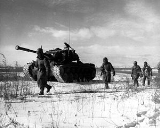
The Battle of Chosin Reservoir, also known as the Chosin Reservoir Campaign or the Changjin
Changjin
Changjin is a mountainous county in South Hamgyong province, North Korea.Changjin lies on the Rangrim and Pujonryong ranges, and most of the county sits atop the Kaema Plateau. Due to this location, Changjin has a particularly cold climate. The highest point is Ryonhwasan . The chief stream is...

 Lake Campaign
,Official Chinese sources refer to this battle as the Second Phase Campaign Eastern Sector (第二次战役东线). The Western Sector is the Battle of the Ch'ongch'on River
Battle of the Ch'ongch'on River
The Battle of the Ch'ongch'on River, also known as the Battle of the Ch'ongch'on or the Second Phase Campaign Western SectorThe Eastern Sector is the Battle of Chosin Reservoir. , was a decisive battle in the Korean War, and it took place from November 25 to December 2, 1950 along the Ch'ongch'on...

.
was a decisive battle in the Korean War
Korean War
The Korean War was a conventional war between South Korea, supported by the United Nations, and North Korea, supported by the People's Republic of China , with military material aid from the Soviet Union...

. Shortly after the People's Republic of China
People's Republic of China
China , officially the People's Republic of China , is the most populous country in the world, with over 1.3 billion citizens. Located in East Asia, the country covers approximately 9.6 million square kilometres...

 entered the conflict, the People's Volunteer Army
People's Volunteer Army
The Chinese People's Volunteer Army was the armed forces deployed by the People's Republic of China during the Korean War. Although all units in the Chinese People’s Volunteer Army belonged to the People's Liberation Army , the People's Volunteer Army was separately constituted in order to...

 9th ArmyIn Chinese military nomenclature, the term "Army" (军) means Corps
Corps
A corps is either a large formation, or an administrative grouping of troops within an armed force with a common function such as Artillery or Signals representing an arm of service...

, while the term "Army Group" (集团军) means Army
Field army
A Field Army, or Area Army, usually referred to simply as an Army, is a term used by many national military forces for a military formation superior to a corps and beneath an army group....

.
infiltrated the northeastern part of North Korea
North Korea
The Democratic People’s Republic of Korea , , is a country in East Asia, occupying the northern half of the Korean Peninsula. Its capital and largest city is Pyongyang. The Korean Demilitarized Zone serves as the buffer zone between North Korea and South Korea...

 and surprised the US X Corps at the Chosin Reservoir area. A brutal 17 day battle in freezing weather soon followed. In the period between 27 November and 13 December 1950, 30,000 United Nations
United Nations Command (Korea)
The United Nations Command is the unified command structure for the multinational military forces supporting the Republic of Korea during and after the Korean War...

 (UN) troops (nicknamed "The Chosin Few") under the command of Major General Edward Almond
Edward Almond
Edward Mallory "Ned" Almond was a controversial United States Army general best known as the commander of the Army's X Corps during the Korean War.-Early Biography:...

 were encircled by approximately 60,000 Chinese troops under the command of Song Shi-Lun
Song Shi-Lun
Song-Shilung , born in Hunan Province, was a general of the People's Liberation Army of the People's Republic of China. General Song had graduated from Whampoa Military Academy and participated in the Long March. He died September 17, 1991 in Shanghai.During the Korean War, General Song Shilun...

. Although Chinese troops managed to surround and outnumber the UN forces, the UN forces broke out of the encirclement while inflicting crippling losses on the Chinese. The evacuation of the X Corps from the port of Hungnam
Hungnam
Hŭngnam was the third largest city in North Korea.It is a port city on the eastern coast, in South Hamgyong Province, on the Sea of Japan . The city covers an area of 250 square kilometers...

 marked the complete withdrawal of UN troops from North Korea.
Discussion
Ask a question about 'Battle of Chosin Reservoir'
Start a new discussion about 'Battle of Chosin Reservoir'
Answer questions from other users
Full Discussion Forum
 
Unanswered Questions
Encyclopedia
The Battle of Chosin Reservoir, also known as the Chosin Reservoir Campaign or the Changjin
Changjin
Changjin is a mountainous county in South Hamgyong province, North Korea.Changjin lies on the Rangrim and Pujonryong ranges, and most of the county sits atop the Kaema Plateau. Due to this location, Changjin has a particularly cold climate. The highest point is Ryonhwasan . The chief stream is...

 Lake Campaign
,Official Chinese sources refer to this battle as the Second Phase Campaign Eastern Sector (第二次战役东线). The Western Sector is the Battle of the Ch'ongch'on River
Battle of the Ch'ongch'on River
The Battle of the Ch'ongch'on River, also known as the Battle of the Ch'ongch'on or the Second Phase Campaign Western SectorThe Eastern Sector is the Battle of Chosin Reservoir. , was a decisive battle in the Korean War, and it took place from November 25 to December 2, 1950 along the Ch'ongch'on...

.
was a decisive battle in the Korean War
Korean War
The Korean War was a conventional war between South Korea, supported by the United Nations, and North Korea, supported by the People's Republic of China , with military material aid from the Soviet Union...

. Shortly after the People's Republic of China
People's Republic of China
China , officially the People's Republic of China , is the most populous country in the world, with over 1.3 billion citizens. Located in East Asia, the country covers approximately 9.6 million square kilometres...

 entered the conflict, the People's Volunteer Army
People's Volunteer Army
The Chinese People's Volunteer Army was the armed forces deployed by the People's Republic of China during the Korean War. Although all units in the Chinese People’s Volunteer Army belonged to the People's Liberation Army , the People's Volunteer Army was separately constituted in order to...

 9th ArmyIn Chinese military nomenclature, the term "Army" (军) means Corps
Corps
A corps is either a large formation, or an administrative grouping of troops within an armed force with a common function such as Artillery or Signals representing an arm of service...

, while the term "Army Group" (集团军) means Army
Field army
A Field Army, or Area Army, usually referred to simply as an Army, is a term used by many national military forces for a military formation superior to a corps and beneath an army group....

.
infiltrated the northeastern part of North Korea
North Korea
The Democratic People’s Republic of Korea , , is a country in East Asia, occupying the northern half of the Korean Peninsula. Its capital and largest city is Pyongyang. The Korean Demilitarized Zone serves as the buffer zone between North Korea and South Korea...

 and surprised the US X Corps at the Chosin Reservoir area. A brutal 17 day battle in freezing weather soon followed. In the period between 27 November and 13 December 1950, 30,000 United Nations
United Nations Command (Korea)
The United Nations Command is the unified command structure for the multinational military forces supporting the Republic of Korea during and after the Korean War...

 (UN) troops (nicknamed "The Chosin Few") under the command of Major General Edward Almond
Edward Almond
Edward Mallory "Ned" Almond was a controversial United States Army general best known as the commander of the Army's X Corps during the Korean War.-Early Biography:...

 were encircled by approximately 60,000 Chinese troops under the command of Song Shi-Lun
Song Shi-Lun
Song-Shilung , born in Hunan Province, was a general of the People's Liberation Army of the People's Republic of China. General Song had graduated from Whampoa Military Academy and participated in the Long March. He died September 17, 1991 in Shanghai.During the Korean War, General Song Shilun...

. Although Chinese troops managed to surround and outnumber the UN forces, the UN forces broke out of the encirclement while inflicting crippling losses on the Chinese. The evacuation of the X Corps from the port of Hungnam
Hungnam
Hŭngnam was the third largest city in North Korea.It is a port city on the eastern coast, in South Hamgyong Province, on the Sea of Japan . The city covers an area of 250 square kilometers...

 marked the complete withdrawal of UN troops from North Korea.

Background


By mid-1950, after the successful landing at Inchon
Battle of Inchon
The Battle of Inchon was an amphibious invasion and battle of the Korean War that resulted in a decisive victory and strategic reversal in favor of the United Nations . The operation involved some 75,000 troops and 261 naval vessels, and led to the recapture of the South Korean capital Seoul two...

 by the US X Corps and the subsequent destruction of the Korean People's Army
Korean People's Army
The Korean People's Army , also known as the Inmin Gun, are the military forces of the Democratic People's Republic of Korea. Kim Jong-il is the Supreme Commander of the Korean People's Army and Chairman of the National Defence Commission...

, the Korean War appeared to be all but over. United Nations
United Nations Command (Korea)
The United Nations Command is the unified command structure for the multinational military forces supporting the Republic of Korea during and after the Korean War...

 (UN) forces advanced rapidly into North Korea
North Korea
The Democratic People’s Republic of Korea , , is a country in East Asia, occupying the northern half of the Korean Peninsula. Its capital and largest city is Pyongyang. The Korean Demilitarized Zone serves as the buffer zone between North Korea and South Korea...

 with the intention of reuniting North and South Korea before the end of 1950. North Korea is divided through the center by the impassable Taebaek Mountains
Taebaek Mountains
The Taebaek Mountains are a mountain range in both North Korea and South Korea. They form the main ridge of the Korean peninsula.-Geography:...

, separating the UN forces into two groups. The US Eighth Army advanced north through the western coast of the Korean Peninsula, while the Republic of Korea (ROK) I Corps
I Corps (South Korea)
I Corps was created July 24, 1950, just before the Battle of Pusan Perimeter.I Corps consisted of the 8th Infantry Division and the Capital Division....

 and the US X Corps advanced north on the eastern coast.

At the same time, the People's Republic of China
People's Republic of China
China , officially the People's Republic of China , is the most populous country in the world, with over 1.3 billion citizens. Located in East Asia, the country covers approximately 9.6 million square kilometres...

 entered the conflict after issuing several warnings to the United Nations. On 19 October 1950, large formations of Chinese troops, dubbed the People's Volunteer Army
People's Volunteer Army
The Chinese People's Volunteer Army was the armed forces deployed by the People's Republic of China during the Korean War. Although all units in the Chinese People’s Volunteer Army belonged to the People's Liberation Army , the People's Volunteer Army was separately constituted in order to...

 (PVA), secretly crossed the border and into North Korea. One of the first Chinese units to reach the Chosin Reservoir area was the PVA 42nd Corps
42nd Army (People's Republic of China)
The 42nd Army is a group army - a roughly corps-sized military formation - of the Chinese People's Liberation Army, active since the late 1940s.-History:...

, and it was tasked with stopping the eastern UN advances. On 25 October, the advancing ROK I Corps made contact with the Chinese and halted at Funchilin Pass, south of the Chosin Reservoir. After the landing at Wonsan
Wonsan
Wŏnsan is a port city and naval base in southeastern North Korea. It is the capital of Kangwŏn Province. The population of the city is estimated to have been 331,000 in 2000. Notable people from Wŏnsan include Kim Ki Nam, diplomat and Secretary of the Workers' Party.- History :The original name of...

, the US 1st Marine Division of the X Corps engaged the defending PVA 124th Division
124th Division (People's Republic of China)
The 124th Division was a division deployed by the People's Republic of China. During the Korean War, it was the first Chinese unit to cross the Yalu River.-History:...

 on 2 November, and the ensuing battle caused heavy casualties among the Chinese. On 6 November, the PVA 42nd Corps ordered a retreat to the north with the intention of luring the UN forces into the Chosin Reservoir. By 24 November, the 1st Marine Division occupied both Sinhung-niNot to be confused with another Sinhung-ni located near Yudami-ni. on the eastern side of the reservoir, and Yudami-ni on the west side of the reservoir.

Faced with the sudden attacks by Chinese forces in the Eighth Army sector, General Douglas MacArthur
Douglas MacArthur
General of the Army Douglas MacArthur was an American general and field marshal of the Philippine Army. He was a Chief of Staff of the United States Army during the 1930s and played a prominent role in the Pacific theater during World War II. He received the Medal of Honor for his service in the...

 ordered the Eighth Army to launch the Home-by-Christmas Offensive
Battle of the Ch'ongch'on River
The Battle of the Ch'ongch'on River, also known as the Battle of the Ch'ongch'on or the Second Phase Campaign Western SectorThe Eastern Sector is the Battle of Chosin Reservoir. , was a decisive battle in the Korean War, and it took place from November 25 to December 2, 1950 along the Ch'ongch'on...

. To support the offensive, MacArthur ordered the X Corps to attack west from the Chosin Reservoir and to cut the vital Manpojin—Kanggye—Huichon supply line. As a response, Major General Edward M. Almond, commander of the US X Corps, formulated a plan on 21 November. It called for the US 1st Marine Division to advance west through Yudami-ni, while the US 7th Infantry Division would provide a regimental combat team
Regimental combat team
A regimental combat team was a provisional major infantry unit of the United States Army during the World War II and the Korean War, and of the U.S. Marine Corps to the present day...

 to protect the right flank at Sinhung-ni. The US 3rd Infantry Division would also protect the left flank while providing security in the rear area. By then the X Corps was stretched thin along a 400 miles (643.7 km) front.

Surprised by the Marine landing at Wonsan, China's Chairman Mao Zedong
Mao Zedong
Mao Zedong, also transliterated as Mao Tse-tung , and commonly referred to as Chairman Mao , was a Chinese Communist revolutionary, guerrilla warfare strategist, Marxist political philosopher, and leader of the Chinese Revolution...

 called for the immediate destruction of the ROK Capital Division, ROK 3rd Infantry Division
3rd Infantry Division (South Korea)
-History:The 3rd Infantry Division is a unit of the Republic of Korea Army. First formed as the 3rd brigade on December 1, 1947. On December 24 1949, the division conducted Mungyeong massacre...

, US 1st Marine Division, and US 7th Infantry Division in a telegraph to CommanderThe Chinese military did not have military rank
Military rank
Military rank is a system of hierarchical relationships in armed forces or civil institutions organized along military lines. Usually, uniforms denote the bearer's rank by particular insignia affixed to the uniforms...

s during the 1950s.
Song Shi-Lun
Song Shi-Lun
Song-Shilung , born in Hunan Province, was a general of the People's Liberation Army of the People's Republic of China. General Song had graduated from Whampoa Military Academy and participated in the Long March. He died September 17, 1991 in Shanghai.During the Korean War, General Song Shilun...

 of the PVA 9th Army on 31 October. Under Mao's urgent orders, the 9th Army was rushed into North Korea on 10 November. Undetected by UN intelligence, the 9th Army quietly entered the Chosin Reservoir area on 17 November, with the 20th Corps
20th Army (People's Republic of China)
The 20th Army was a military formation of the People's Volunteer Army during the Korean War.-Organization:...

 of the 9th Army relieving the 42nd Corps near Yudami-ni.

Location, terrain and weather


Chosin Reservoir is a man-made lake located in the northeast of the Korean peninsula. The name Chosin is the Japanese rendition of the Korean place name Changjin
Changjin
Changjin is a mountainous county in South Hamgyong province, North Korea.Changjin lies on the Rangrim and Pujonryong ranges, and most of the county sits atop the Kaema Plateau. Due to this location, Changjin has a particularly cold climate. The highest point is Ryonhwasan . The chief stream is...

, and the name stuck due to the outdated Japanese maps used by UN forces. The battle's main focus was around the 78 miles (125.5 km) long road that connects Hungnam
Hungnam
Hŭngnam was the third largest city in North Korea.It is a port city on the eastern coast, in South Hamgyong Province, on the Sea of Japan . The city covers an area of 250 square kilometers...

 and Chosin Reservoir, which served as the only retreat route for the UN forces. Through this road, Yudami-ni and Sinhung-ni, located at the west and east side of the reservoir respectively, are connected at Hagaru-ri. From there, the road passes through Koto-ri and eventually leads to the port of Hungnam. The area around the Chosin Reservoir was sparsely populated.

The battle was fought over some of the roughest terrain during some of the harshest winter weather conditions of the Korean War. The road was created by cutting through the hilly terrain of Korea, with steep climbs and drops. Dominant peaks, such as the Funchilin Pass and the Toktong Pass, overlook the entire length of the road. The road's quality was poor, and in some places it was reduced to a one lane gravel trail. On 14 November, a cold front from Siberia descended over the Chosin Reservoir, and the temperature plunged to as low as -35 °F. The cold weather was accompanied by frozen ground, creating considerable danger of frostbite
Frostbite
Frostbite is the medical condition where localized damage is caused to skin and other tissues due to extreme cold. Frostbite is most likely to happen in body parts farthest from the heart and those with large exposed areas...

 casualties, icy roads, and weapon malfunctions.

Forces and strategies


Although the 1st Marine Division landed at Wonsan as part of Almond's US X Corps, Almond and Major General Oliver P. Smith of the 1st Marine Division shared a mutual loathing of each other that dated back to a meeting before the landing at Inchon, during which Almond had spoken of how easy amphibious landings are even though he had never been involved in one. Smith believed that there were large numbers of Chinese forces in North Korea despite the fact that higher headquarters in Tokyo
Tokyo
, ; officially , is one of the 47 prefectures of Japan. Tokyo is the capital of Japan, the center of the Greater Tokyo Area, and the largest metropolitan area of Japan. It is the seat of the Japanese government and the Imperial Palace, and the home of the Japanese Imperial Family...

 had said otherwise, while Almond felt Smith was overly cautious. The mutual distrust between the two commanders made Smith slow the 1st Marine Division's advance towards the Chosin Reservoir against Almond's instructions. Along the way Smith established supply points and airfields at Hagaru-ri and Koto-ri.

While the US X Corps was pushing towards the reservoir, the Chinese formulated their strategy based on their experiences in the Chinese Civil War
Chinese Civil War
The Chinese Civil War was a civil war fought between the Kuomintang , the governing party of the Republic of China, and the Communist Party of China , for the control of China which eventually led to China's division into two Chinas, Republic of China and People's Republic of...

. Working from the assumption that only a light UN presence would be at the reservoir, the 9th Army was to first destroy the UN garrisons at Yudami-ni and Sinhung-ni, then push towards Hagaru-ri. Believing that the bulk of the US X Corps would scramble to rescue the destroyed units, the 9th Army would then block and trap the main UN forces on the road between Hagaru-ri and Hungnam. The 9th Army initially committed six divisions for the battle, with most of the forces concentrated at Yudami-ni and Sinhung-ni.

The flaw in the Chinese plan was a lack of accurate intelligence on the UN forces. Although the US X Corps was stretched thin over northeast Korea, the slow Marine advance allowed the bulk of the US 1st Marine Division, including the 5th, 7th and 11th Marines, to be concentrated at Yudami-ni. Conversely, the strategically important Hagaru-ri, which contained an airfield and a supply dump, was not a priority for the Chinese despite being lightly defended by the 1st and the 7th Marines. Only the Regimental Combat Team 31
Task Force Faith
Task Force Faith, also known as Task Force Maclean or the Polar Bear Regiment , was a United States Army unit destroyed in fighting at the Battle of Chosin Reservoir during the Korean War between 27 November - 2 December 1950...

, an understrength and hastily formed regimental combat team
Regimental combat team
A regimental combat team was a provisional major infantry unit of the United States Army during the World War II and the Korean War, and of the U.S. Marine Corps to the present day...

 of the US 7th Infantry Division, was thinly spread along the eastern bank of the reservoir. Those units would later take the brunt of the Chinese assaults. As for the UN strength, the 1st Marine Division had an effective strength of 25,473 men at the start of the battle, and it was further reinforced by the British 41 Royal Marine Commando
41 Commando
41 Commando or No. 41 Commando was a unit of Royal Marines trained as Commandos during the Second World War. They were part of the all Royal Marine 4th Special Service Brigade that took part in the Normandy Landings in June 1944 and later that served in World War II, the Korean War, and in...

 and the equivalent strength of two regiments from the 3rd and the 7th Infantry Division. Thus the UN forces had an approximate strength of 30,000 during the course of the battle. The UN forces at Chosin were also supported by one of the greatest concentrations of air power during the Korean War, in which the 1st Marine Air Wing stationed at Yonpo and five aircraft carriers from the US Navy Task Force 77 were able to launch 230 sortie
Sortie
Sortie is a term for deployment or dispatch of one military unit, be it an aircraft, ship, or troops from a strongpoint. The sortie, whether by one or more aircraft or vessels, usually has a specific mission....

s daily to provide close air support
Close air support
In military tactics, close air support is defined as air action by fixed or rotary winged aircraft against hostile targets that are close to friendly forces, and which requires detailed integration of each air mission with fire and movement of these forces.The determining factor for CAS is...

 during the battle, while the US Air Force Far East Combat Cargo Command in Japan reached the capacity of airdropping 250 tons of supplies per day to resupply the trapped UN forces.

Although the 9th Army was one of China's elite formations composed of veterans and former POW
Prisoner of war
A prisoner of war or enemy prisoner of war is a person, whether civilian or combatant, who is held in custody by an enemy power during or immediately after an armed conflict...

s from the Huaihai Campaign
Huaihai Campaign
Huaihai Campaign or Battle of Hsupeng was a military action during 1948 and 1949 that was the determining battle of the Chinese Civil War. It was one of the few conventional battles of the war. 550,000 troops of the Republic of China were surrounded in Xuzhou and destroyed by the communist...

, several deficiencies hampered its ability during the battle. Initially the 9th Army was intended to be outfitted in Manchuria
Manchuria
Manchuria is a historical name given to a large geographic region in northeast Asia. Depending on the definition of its extent, Manchuria usually falls entirely within the People's Republic of China, or is sometimes divided between China and Russia. The region is commonly referred to as Northeast...

 during November, but Mao suddenly ordered it into Korea before that could happen. As the result, the 9th Army received almost no winter gear for the harsh Korean winter. Similarly, poor logistics
Military logistics
Military logistics is the discipline of planning and carrying out the movement and maintenance of military forces. In its most comprehensive sense, it is those aspects or military operations that deal with:...

 forced the 9th Army to abandon heavy artillery, while working with little food and ammunition. The food shortage forced the 9th Army to station a third of its strength away from the Chosin Reservoir, and starvation and exposure soon broke out among the Chinese units as foraging was not an option at the sparsely populated reservoir. By the end of the battle, more Chinese troops died from the cold than from combat and air raids. As for the Chinese strength, it is normally assumed that the Chinese had 120,000 troops for the battle, due to the fact that the 9th Army were composed of 12 divisions with a nominal strength of 10,000 men per division. But during the course of the battle, the 9th Army employed only eight divisions, while all divisions were at 65 to 70 percent strength at the start of the battle. Thus the actual Chinese strength for the battle was approximately 60,000.

Battle


On the night of 27 November, the PVA 20th and 27th Corps
27th Army (People's Republic of China)
The 27th Group Army is a military formation of China's People's Liberation Army and one of three active group armies belonging to the Beijing Military Region. It is based in Shijiazhuang, Hebei and is composed of one armored brigade, two motorized infantry brigades, one artillery brigade, and an...

 of the 9th Army launched multiple attacks and ambushes along the road between the Chosin Reservoir and Koto-ri. At Yudam-ni, the 5th, 7th and 11th Marines were surrounded and attacked by the PVA 59th
59th Division (People's Republic of China)
-History:The 59th Division was a military formation of the People's Volunteer Army during the Korean War...

, 79th
79th Division (People's Republic of China)
The 79th Division was a military formation of the People's Volunteer Army during the Korean War. They were a component of the 27th Army....

 and 89th Division
89th Division (People's Republic of China)
-History:The 89th Division was a military formation of the People's Volunteer Army during the Korean War. They were a component of the 30th Army, composed of the 265th, 266th, and 267th Regiments...

. Similarly, RCT-31 was isolated and ambushed at Sinhung-ni by the PVA 80th
80th Division (People's Republic of China)
-History:The 80th Division was a military formation of the People's Volunteer Army during the Korean War. They were a component of the 27th Army....

 and the 81st Division
81st Division (People's Republic of China)
The 81st Division was a military formation of the People's Volunteer Army during the Korean War. They were a component of the 27th Army....

. Finally, the PVA 60th Division
60th Division (People's Republic of China)
-History:The 60th Division was a military formation of the People's Volunteer Army during the Korean War...

 surrounded elements of the 1st Marines at Kotor-ri from the north. Caught by complete surprise, the UN forces were cut off at Yudam-ni, Sinhung-ni, Hagaru-ri and Kotor-ri by 28 November.

Actions at Yudam-ni


Acting on Almond's instruction, Smith ordered the 5th Marines to attack west toward Mupyong-ni on 27 November. The attack was soon stalled by the PVA 89th Division and forced the Marines to dig in on the ridges surrounding Yudam-ni. As night came, five Chinese battalions of the 79th Division attacked the ridges on the north and northwest of Yudam-ni, hoping to annihilate the garrison in one stroke. Close range fighting soon developed as the attackers infiltrated Marine positions, but the 5th and 7th Marines managed to hold the line despite suffering heavy casualties. As day broke on 28 November, all five Chinese battalions were rendered combat ineffective.

While the battle was underway at Yudam-ni, the PVA 59th Division blocked the road between Yudam-ni and Hagaru-ri by attacking the defending Charlie and Fox Companies of the 7th Marines. The successful assault forced Charlie Company to retreat into Yudam-ni which left Fox Company trapped in Toktong Pass, a vital pass that controlled the road. On 29 November, several efforts by the 7th Marines failed to rescue Fox Company despite inflicting heavy casualties on the Chinese. Aided by artillery from Hagaru-ri and Marine Corsair fighter
F4U Corsair
The Vought F4U Corsair was a carrier-capable fighter aircraft that saw service primarily in World War II and the Korean War. Demand for the aircraft soon overwhelmed Vought's manufacturing capability, resulting in production by Goodyear and Brewster: Goodyear-built Corsairs were designated FG and...

s, Fox Company managed to hold out for five days while enduring constant attacks by the PVA 59th Division.

After the devastating losses suffered by the PVA 79th Division at Yudam-ni, 9th Army headquarters realized that the bulk of the 1st Marine Division was stationed at Yudam-ni, with a garrison strength that was double the initial estimate. Believing that any further assaults would be futile, Song Shi-Lun ordered the 9th Army to switch their main attacks toward Sinhung-ni and Hagaru-ri, leaving Yudam-ni alone from 28 November to 30 November. At the same time, the US Eighth Army on the Korean western front was forced into full retreat at the Battle of the Ch'ongch'on River
Battle of the Ch'ongch'on River
The Battle of the Ch'ongch'on River, also known as the Battle of the Ch'ongch'on or the Second Phase Campaign Western SectorThe Eastern Sector is the Battle of Chosin Reservoir. , was a decisive battle in the Korean War, and it took place from November 25 to December 2, 1950 along the Ch'ongch'on...

, and MacArthur ordered Almond to withdraw the US X Corps to the port of Hungnam. Acting on the instruction of Almond and Smith, Lieutenant Colonel Raymond L. Murray and Colonel Homer L. Litzenberg
Homer Litzenberg
Homer Laurence Litzenberg was a decorated Lieutenant General in the United States Marine Corps, serving in Haiti, World War II, and the Korean War. His final rank was awarded at his retirement for valor in battle. He retired from the post of Inspector General of the Marine Corps on May 31, 1959,...

, commanders of the 5th and 7th Marines, respectively, issued a joint order to break out from Yudam-ni to Hagaru-ri on 30 November. Faced with tough fighting between the blocking Chinese divisions and the withdrawing Marines, Smith remarked: "Retreat, hell! We're not retreating, we're just advancing in a different direction."

For the breakout, the Marines formed into a convoy with a single M4A3 Sherman tank
M4 Sherman
The M4 Sherman, formally Medium Tank, M4, was the primary tank used by the United States during World War II. Thousands were also distributed to the Allies, including the British Commonwealth and Soviet armies, via lend-lease...

 as the lead. The plan was to have 3rd Battalion, 5th Marines
3rd Battalion 5th Marines
3rd Battalion 5th Marines is an infantry battalion in the United States Marine Corps. The battalion, nicknamed "Dark Horse", is based out of Marine Corps Base Camp Pendleton, California and consists of approximately 1,000 Marines and Sailors...

 (3/5) as the vanguard of the convoy, with three battalions covering the rear. At the same time, 1st Battalion, 7th Marines
1st Battalion 7th Marines
The 1st Battalion, 7th Marines is an infantry battalion of the United States Marine Corps. They are based at the Marine Corps Air Ground Combat Center Twentynine Palms and consist of approximately 1000 Marines. Famous Marines who have served in 1/7 include Chesty Puller and John Basilone...

 (1/7) would attack towards Fox Company in order to open the road at Toktong Pass. To start the breakout, 3rd Battalion, 7th Marines
3rd Battalion 7th Marines
The 3rd Battalion 7th Marine Regiment is an infantry battalion of the United States Marine Corps. They are based at the Marine Corps Air Ground Combat Center Twentynine Palms and consist of approximately 800 Marines. The battalion falls under the command of the 7th Marine Regiment and the 1st...

 (3/7) had to first attack south and capture Hill 1542 and Hill 1419 in order to cover the road from Chinese attacks. The breakout was carried out under the air cover of the 1st Marine Air Wing.
On the morning of 1 December, 3rd Battalion, 7th Marines (3/7) engaged the PVA 175th Regiment of the 59th Division at Hill 1542 and Hill 1419. The tenacious Chinese defenders soon forced the Marines to dig in on the slopes between the road and the peaks when the convoy passed 3/7's position by the afternoon. With Hagaru-ri still not captured, the PVA High Command scrambled the 79th Division to resume attacks on Yudam-ni while the 89th Division rushed south towards Koto-ri. The Chinese struck at night, and the ferocious fighting forced the rear covering forces to call in night fighter
Night fighter
A night fighter is a fighter aircraft adapted for use at night or in other times of bad visibility...

s to suppress the attacks. The fighting lasted well into the morning of 2 December until all the Marines managed to withdraw from Yudam-ni.

At the same time, 1st Battalion, 7th Marines (1/7) also tried to break the Chinese blockade at Hill 1419 on 1 December. Despite being badly reduced by combat, hunger and frostbite, the PVA 59th Division sent in its last five platoons and refused to yield. As night approached, 1/7 finally captured the peak and started to march through the hills on the east side of the road. Relying on the element of surprise, 1/7 managed to destroy several Chinese positions along the road. On the morning of 2 December, a joint attack by Fox Company and 1/7 secured the Toktong Pass, thus opening the road between Yudam-ni and Hagaru-ri.

Although the road had been opened between Yudam-ni and Hagaru-ri, the convoy still had to fight through the numerous Chinese positions on the hills overlooking the road. On the first night of the retreat, the Chinese struck the convoy in force and inflicted heavy casualties upon 3rd Battalion, 5th Marines (3/5). Although strong air cover suppressed most of the Chinese forces for the rest of the march, the cold weather, harassing fire, raiding parties, and road blocks slowed the retreat to a crawl while inflicting numerous casualties. Despite those difficulties, the convoy reached Hagaru-ri in an orderly fashion on the afternoon of 3 December, with the withdrawal completed on 4 December.

East of the reservoir


Regimental Combat Team 31 (RCT-31), later known as "Task Force Faith", was a hastily formed regimental combat team from the 7th Infantry Division that guarded the right flank of the Marine advance towards Mupyong-ni. Before the battle, RCT-31 was spread thin with main elements separated on the hills north of Sinhung-ni, the inlet west of Sinhung-ni, and the town of Hudong-ni south of Sinhung-ni. Although the Chinese believed RCT-31 to be a reinforced regiment
Regiment
A regiment is a major tactical military unit, composed of variable numbers of batteries, squadrons or battalions, commanded by a colonel or lieutenant colonel...

, the task force was actually under strength with one battalion
Battalion
A battalion is a military unit of around 300–1,200 soldiers usually consisting of between two and seven companies and typically commanded by either a Lieutenant Colonel or a Colonel...

 missing, due to the bulk of the 7th Infantry Division being scattered over northeast Korea.

On the night of 27 November, three regiments from the 80th Division attacked the northern hills and the inlets, completely surprising the defenders. The ensuing battle inflicted heavy casualties on the 1st Battalion, 32nd Infantry
32d Infantry Regiment (United States)
The 32nd Infantry Regiment is a formation of the United States Army.-History:The 32nd Regiment was first organized on 7 August 1916, on Oahu, Hawaii, Hawaii from elements of the 1st and 2nd Infantry Regiments...

 to the north of Sinhung-ni, while the 57th Field Artillery Battalion and the 3rd Battalion, 31st Infantry were almost overrun at the inlet. The Chinese also sent the 242nd Regiment of the 81st Division towards Hill 1221, an undefended hill that controlled the road between Sinhung-ni and Hudong-ni. As the night's fighting ended, RCT-31 was separated into three elements.

Believing that the defenders were completely destroyed at the inlet, the Chinese stopped their attacks and proceeded to loot the US positions for food and clothing. As the morning came on 28 November, the 3rd Battalion, 31st Infantry counterattacked the PVA 239th Regiment at the inlet, sending the surprised Chinese back in a complete rout. In the afternoon, Almond flew into the perimeter of RCT-31, convinced that RCT-31 was strong enough to begin its attack north and deal with whatever "remnants" of Chinese forces that were in their way. Almond ordered Colonel Allan D. Maclean, the commander of RCT-31, to resume the offensive north while presenting Silver Star
Silver Star
The Silver Star is the third-highest combat military decoration that can be awarded to a member of any branch of the United States armed forces for valor in the face of the enemy....

s to three of Maclean's officers. In disgust, Lieutenant Colonel Don C. Faith, Jr.
Don C. Faith, Jr.
Don Carlos Faith, Jr. was a soldier in the United States Army during the Korean War. He posthumously received the Medal of Honor for his actions from November 27, through December 1, 1950. In 1976 Lieutenant Colonel Faith was posthumously inducted into the U.S...

, the commander of the 1st Battalion, 32nd Infantry, threw his medal into the snow.
On the night of 28 November, the PVA 80th Division attacked again with three regiments. At the inlet, the Chinese assault became a disaster as communications broke down while devastating fire from the anti-aircraft (AA) guns attached to the 57th Field Artillery Battalion swept the Chinese ranks.RCT-31's anti-aircraft guns were from D Battery, 15th Antiaircraft Battalion, which was attached to the 57th Field Artillery Battalion during the entire battle. See Appleman 1990, p. 82. In the aftermath of the fighting, the PVA 238th and the 239th Regiment together had less than 600 soldiers. The attacks by PVA 240th Regiment, on the other hand, forced Maclean to order a retreat from the northern hills towards the inlet. On 29 November, the 1st Battalion managed to break through the Chinese blockade and reached the inlet, but Maclean disappeared as he mistook some Chinese soldiers as American.Maclean's final fate is disputed among Chinese and US sources. Although both sides agreed that Maclean was shot numerous times while running towards the Chinese soldiers, Chinese sources claim that Maclean was shot dead on the spot, while UN POWs state that Maclean later died from his wounds in a Chinese POW camp. See Guang 2007, p. 32. The Chinese finally stopped their attacks on the night of 29 November while waiting for fresh reinforcements.

While RCT-31 was under siege, Almond finally instructed the 1st Marine Division to rescue RCT-31 by breaking out of Yudam-ni—an impossible order for Smith to implement. Only the 31st Tank Company tried to rescue RCT-31 by attacking Hill 1221, but without infantry support, the two armored attacks on 28 and 29 November were stalled by slippery roads, rough terrain, and close infantry assaults. By 30 November the US forces evacuated Hudong-ni in order to defend Hagaru-ri, leaving the rest of RCT-31 completely stranded.

On 30 November, Major General David G. Barr, the commander of the 7th Infantry Division, flew into the Sinhung-ni inlet and met with Faith, who by now had assumed command of RCT-31. Faith expressed the difficulties for a breakout, particularly the 500 wounded that RCT-31 had to carry. On the same day, the PVA 94th DivisionMisidentified as the 90th Division by UN intelligence. See Guang 2007, p. 36. arrived as reinforcements for the 80th Division. By midnight, four Chinese regiments renewed their attacks and Zhan Danan, the commander of the 80th Division, ordered the complete destruction of RCT-31 before dawn. Again, the 57th Battalion's AA guns held the Chinese at bay, but the shell supplies were running desperately low. On the day of 1 December, Faith finally ordered RCT-31 to breakout from Sinhung-ni and withdraw to Hagaru-ri.
The breakout began as soon as the weather allowed the 1st Marine Air Wing to provide air cover on 1 December. As the soldiers formed a convoy and tried to leave the perimeter, the PVA 241st Regiment immediately swarmed over the American forces, with three other regiments closing in. Left with no choice, the covering aircraft dropped napalm
Napalm
Napalm is a thickening/gelling agent generally mixed with gasoline or a similar fuel for use in an incendiary device, primarily as an anti-personnel weapon...

 right in front of RCT-31, causing casualties among both Chinese and US troops. The resulting firestorm wiped out the blocking Chinese company, allowing the convoy to advance. As the front of RCT-31 made their way forward, heavy small arms fire caused many members of the rear guard to seek shelter below the road instead of protecting the trucks. Chinese fire also killed or wounded those already in the trucks as well as the drivers, who viewed the job as a form of suicide. Slowly, the convoy approached a roadblock under Hill 1221 in the late afternoon. Several parties tried to clear Hill 1221, but after taking part of the hill, the leaderless soldiers continued out onto the frozen reservoir instead of returning to the column. As Faith led an assault on the roadblock, he was hit by a Chinese grenade and subsequently died of his wounds. The convoy managed to fight past the first road block, but as it reached the second at Hudong-ni, RCT-31 disintegrated under Chinese attacks. About 1,050 soldiers out of the original 2,500 managed to reach Hagaru-ri, and only 385 survivors were deemed able-bodied. The remnants of RCT-31 were formed into a provisional army battalion for the rest of the battle.

Actions at Hagaru-ri


To support the Marine attack towards Mupyong-ni, Hagaru-ri became an important supply dump with an airfield under construction. Smith and 1st Marine Division headquarters were also located at Hagaru-ri. With the bulk of the 1st Marine Division gathered at Yudam-ni, Hagaru-ri was lightly defended by two battalions from the 1st and 7th Marines, the rest of the garrison being composed of engineers and rear support units from both the Army and the Marine Corps.

The original Chinese plan called for the 58th Division to attack Hagaru-ri on the night of 27 November, but the division became lost in the countryside due to the outdated Japanese maps it used. It was not until the dawn of 28 November that the 58th Division arrived at Hagaru-ri. Meanwhile, from the fighting and ambushes that had occurred the previous night, the garrison at Hagaru-ri noticed the Chinese forces around them. Lieutenant Colonel Thomas L. Ridge, commander of 3rd Battalion, 1st Marines (3/1), predicted the Chinese attack would come on the night of 28 November. Almost everyone, including rear support units with little combat training, was pressed into the front line due to the manpower shortage, and the entire perimeter was on full alert by 21:30.

It was not long before the PVA 173rd Regiment attacked the western and the southern perimeter, while the 172nd Regiment struck the hills on the northern perimeter. Despite the preparations, the understrength garrison was overwhelmed, with the Chinese opening several gaps in the defenses and reaching the rear areas. The resulting chaos, however, caused a breakdown in discipline among the Chinese soldiers, who began looting food and clothing instead of exploiting the situation. The defending Americans managed to destroy the Chinese forces in counterattacks, while a breakdown of communications between the Chinese regiments allowed the gaps to close. When the fighting stopped, the Chinese had only gained the East Hill on the northern perimeter. Another attack was planned for the night of 29 November, but air raids by VMF-542
VMA-542
Marine Attack Squadron 542 is a United States Marine Corps fixed wing attack squadron that consists of AV-8B Harrier jets. The squadron is based at Marine Corps Air Station Cherry Point, North Carolina and falls under the command of Marine Aircraft Group 14 and the 2nd Marine Aircraft Wing...

 broke up the Chinese formations before it could be carried out.
Given the critical manpower shortage at Hagaru-ri, Smith ordered a task force to be sent north from Koto-ri to open the road south of Hagaru-ri. In response, a task force was formed with 921 troops from the 41 Royal Marine Commando, G Company of the 1st Marines and B Company of the 31st Infantry. The task force was dubbed "Task Force Drysdale" after its commander Lieutenant Colonel Douglas B. Drysdale, who also commanded 41 Commando. On the afternoon of 29 November, Task Force Drysdale pushed north from Koto-ri while under constant attack from the PVA 60th Division. The task force's harrowing experience later earned the road the nickname "Hell Fire Valley". As the Chinese attacks dragged on, the task force became disorganized, and a destroyed truck in the convoy later split the task force into two segments. Although the lead segment of the task force fought its way into Hagaru-ri on the night of 29 November, the rear segment was destroyed. Despite suffering 159 wounded and 162 dead and missing, the task force managed to bring in 300 badly needed infantrymen for the defense at Hagaru-ri.

As more reinforcements arrived from Hudong-ni on 30 November, the garrisons attempted to recapture the East Hill. All efforts failed despite the destruction of a Chinese company. When darkness settled, the PVA 58th Division gathered its remaining 1,500 soldiers in a last ditch attempt to capture Hagaru-ri. The reinforced defenders annihilated most of the attacking forces, with only the defences around the East Hill giving way. As the Chinese tried to advance from the East Hill, they were cut down by the 31st Tank Company.

By 1 December, the PVA 58th Division was virtually destroyed, with the remainder waiting for reinforcements from the 26th Corps
26th Army (People's Republic of China)
The 26th Army was a military formation of the People's Volunteer Army of the IX Army Group during the Korean War, and was commanded by Lieutenant General Zhang Renchu....

 of the 9th Army. But much to the frustration of Song Shi-Lun, the 26th Corps did not arrive before the Marines broke out of Yudam-ni. The airfield was opened to traffic on 1 December, allowing UN forces to bring in reinforcements and to evacuate the dead and the wounded. With the Marines at Yudam-ni completing their withdrawal on 4 December, the trapped UN forces could finally start their breakout towards the port of Hungnam.

Breakout


After a short period of rest, the breakout began on 6 December with the 7th Marines as the vanguard of the retreating column while the 5th Marines covered the rear. At the same time, the much-delayed PVA 26th Corps arrived at Hagaru-ri with its 76th
76th Division (People's Republic of China)
The 76th Division was a military formation of the People's Volunteer Army during the Korean War. They were a component of the 26th Army, consisting of the 226th, 227th, and the 228th Regiments....

 and 77th Division
77th Division (People's Republic of China)
-History:The 77th Division was a military formation of the People's Volunteer Army during the Korean War. They were a component of the 26th Army, consisting of the 229th, 230th, and the 231st Regiments....

 relieving the 58th and 60th Divisions. As the 7th Marines pushed aside the PVA 76th Division south of Hagaru-ri, the 5th Marines took over the Hagaru-ri perimeter and recaptured the East Hill from the 76th Division. In a last effort to stop the breakout, the customary Chinese night attack returned with the 76th and 77th Division striking the Hagaru-ri perimeter from all directions. The Marines repulsed the Chinese attacks, inflicting heavy casualties.

Meanwhile, the 7th Marines opened the road between Hagaru-ri and Koto-ri by capturing the high ground surrounding the road. But as soon as the marines pulled out, the 77th Division returned to the peaks and attacked the column. Chaotic fighting broke out within the column and the retreat was slowed to a crawl. The Marine night fighters, however, returned to subdue the Chinese forces, and the fighting destroyed most of the blocking troops. On 7 December, the rest of the column managed to reach Koto-ri with little difficulty with the last elements arrived at Koto-ri that night.

After the failure of the 26th Corps at Hagaru-ri, the PVA High Command ordered the 26th and the 27th Corps to chase the escaping UN force with the 20th Corps blocking the escape route. But with most of the 20th Corps destroyed at Yudam-ni and Hagaru-ri, the only forces between Koto-ri and Hungnam were the remnants of the 58th and the 60th Divisions. In desperation, Song Shi-Lun ordered these troops to dig in at Funchilin Pass while blowing up the vital treadway bridge, hoping the terrain and obstacles would allow the 26th and the 27th Corps to catch up with the retreating UN forces. The PVA 180th Regiment that occupied Hill 1081 blew up the original concrete bridge and two improvised replacements in succession, believing the bridge was rendered irreparable. In response, 1st Battalion, 1st Marines (1/1) attacked Hill 1081 from the south, and the hill was captured on 9 December after the defenders fought to the last man. At the same time, the 7th Marines and RCT-31 attacked the treadway bridge from the north, only to encounter defenders that were already frozen in their foxholes.

With the path to Hungnam blocked at Funchilin Pass, eight C-119 Flying Boxcar
C-119 Flying Boxcar
The Fairchild C-119 Flying Boxcar was an American military transport aircraft developed from the World War II-era Fairchild C-82 Packet, designed to carry cargo, personnel, litter patients, and mechanized equipment, and to drop cargo and troops by parachute...

s flown by the US 314th Troop Carrier Wing were used to drop portable bridge sections
Bailey bridge
The Bailey bridge is a type of portable, pre-fabricated, truss bridge. It was developed by the British during World War II for military use and saw extensive use by both British and the American military engineering units....

 by parachute. The bridge, consisting of eight separate 18 ft (5.5 m) long, 2900 lb (1,315.4 kg) sections, was dropped one section at a time, using a 48 ft (14.6 m) parachute on each section. Four of these sections, together with additional wooden extensions were successfully reassembled into a replacement bridge by Marine Corps combat engineers and the US Army 58th Engineer Treadway Bridge Company on 9 December, enabling U.N. forces to proceed. Outmaneuvered, the PVA 58th and 60th Divisions still tried to slow the UN advance with ambushes and raids, but after weeks of non-stop fighting, the two Chinese divisions combined had only 200 soldiers left. The last UN forces left Funchilin Pass by 11 December.

One of the last engagements during the withdrawal was an ambush at Sudong by the pursuing PVA 89th Division, which Task Force Dog of the 3rd Infantry Division repulsed with little difficulty. The trapped UN forces finally reached the Hungnam perimeter by 21:00 on 11 December.

Evacuation at Hungnam


By the time the UN forces arrived at Hungnam
Hungnam
Hŭngnam was the third largest city in North Korea.It is a port city on the eastern coast, in South Hamgyong Province, on the Sea of Japan . The city covers an area of 250 square kilometers...

, MacArthur had already ordered the evacuation of the US X Corps on 8 December in order to reinforce the US Eighth Army, which by then was badly depleted and retreating rapidly towards the 38th parallel
38th parallel north
The 38th parallel north is a circle of latitude that is 38 degrees north of the Earth's equatorial plane. It crosses Europe, the Mediterranean Sea, Asia, the Pacific Ocean, North America, and the Atlantic Ocean...

. Following his orders, the ROK I Corps, the ROK 1st Marine Regiment, the US 3rd Infantry Division and the US 7th Infantry Division had also set up defensive positions around the port. Some skirmishes broke out between the defending US 7th
7th Infantry Regiment (United States)
The United States Army's 7th Infantry Regiment, known as "The Cottenbalers" from an incident that occurred during the Battle of New Orleans, while under the command of Andrew Jackson, when soldiers of the 7th Infantry Regiment held positions behind a breastwork of bales of cotton during the...

, 17th
17th Infantry Regiment (United States)
The 17th Infantry Regiment is a United States Army infantry regiment. While the 17th Infantry Regiment was organized on January 11, 1812, it was consolidated with the 3rd Infantry due to extremely heavy losses at Frenchtown, and lost its identity two years later until May 3, 1861, when it was...

 and 65th Infantry
65th Infantry Regiment (United States)
The 65th Infantry Regiment, nicknamed "The Borinqueneers," was an all-volunteer Puerto Rican regiment of the United States Army. Its motto was Honor et Fidelitas, Latin for Honor and Fidelity. It participated in World War I, World War II, and the Korean War...

 and the pursuing PVA 27th Corps, but against the strong naval fire support provided by US Navy Task Force 90
Task Force 90
Task Force 90 was a United States Navy command during the Korean War that controlled the amphibious forces in theatre. It reported directly to Commander Naval Forces Far East. Its most high profile operation was the Incheon amphibious assault, Operation Chromite.It was later active during Operation...

, the badly mauled 9th Army was in no shape to approach the Hungnam perimeter. In what US historians called the "greatest evacuation movement by sea in US military history", a 193-ship armada assembled at the port and evacuated not only the UN troops, but also their heavy equipment and the Korean refugees. The last UN unit left at 14:36 on 24 December, and the port was destroyed to deny its use to the Chinese and North Korean forces. The PVA 27th Corps entered Hungnam on the morning of 25 December.

Aftermath

"...Casualties had reached a 40,000 high. The Central [Government] expresses its deepest sorrow..."
Mao ZedongMao's original telegraph was "......减员达4万人之多。中央对此极为怀念。......", Roe translated the second half of the telegraph as "expresses its deepest sorrow". See Roe 2000, p. 394.


While the US X Corps was being evacuated from the eastern front, the US Eighth Army had already retreated to the 38th parallel on the western front in the aftermath of the Battle of the Ch'ongch'on River. With the entire UN front collapsing, the race to the Yalu
Yalu River
The Yalu River or the Amnok River is a river on the border between North Korea and the People's Republic of China....

 was ended with the communist forces of China recapturing much of North Korea. The Korean War would drag on for another two and a half years before the armistice was signed on 27 July 1953. Besides the loss of North Korea, the US X Corps and the ROK I Corps later reported a total of 10,495 battle casualties, of which 4,385 were from the US Marines, 3,163 were from the US Army, 78 were from the British Royal Marines and 2,812 were from South Koreans attached to American formations. Outside of the combat losses, the 1st Marine Division also reported 7,338 non-battle casualties due to the cold weather.

Despite the losses, the US X Corps preserved much of its strength. About 105,000 soldiers, 98,000 civilians, 17,500 vehicles, and 350,000 tons of supplies were shipped from Hungnam to Pusan, and they would later rejoin the war effort in Korea. Smith was credited for saving the US X Corps from destruction, while the 1st Marine Division, the 41 Royal Marine Commando and the Army's RCT-31 were awarded the Presidential Unit Citation for their tenacity during the battle. About 14 Marines, two Soldiers and one Navy pilot received the Medal of Honor
Medal of Honor
The Medal of Honor is the highest military decoration awarded by the United States government. It is bestowed by the President, in the name of Congress, upon members of the United States Armed Forces who distinguish themselves through "conspicuous gallantry and intrepidity at the risk of his or her...

, and all of the UN troops that served at Chosin were later honored with the nickname "The Chosin Few". On 15 September 2010, the Veterans of the Korean War Chosin Reservoir Battle memorial was unveiled by the United States Marine Corps Commandant General James T. Conway
James T. Conway
James Terry Conway is a retired United States Marine Corps four-star general who was the 34th Commandant of the Marine Corps...

 at Camp Pendleton
Marine Corps Base Camp Pendleton
Marine Corps Base Camp Pendleton is the major West Coast base of the United States Marine Corps and serves as its prime amphibious training base...

.

China was also catapulted into the status of a major military power following the victory at Chosin, but the victory came with a staggering cost. With the escape of the US X Corps and the ROK I Corps, Mao's vision for Chosin was not realized, and the failure caused Song Shi-Lun to offer his resignation. At the same time, heavy casualties caused by both combat and poor logistical support destroyed much of the eight elite divisions under the 20th and the 27th Corps. Of those eight divisions, two divisions were forced to disband, and not until March 1951 did the 9th Army return to its normal strength and become combat effective. With the absence of nearly 40 percent of the Chinese forces in Korea in early 1951, the heavy Chinese losses at Chosin ultimately enabled the UN forces to maintain a foothold in Korea.

Operation Glory


During the battle, UN casualties were buried at temporary grave sites along the road. Operation Glory took place between July to November 1954, during which the dead of each side were exchanged. The remains of 4,167 US Soldiers and Marines were exchanged for 13,528 North Korean and Chinese dead. In addition, 546 civilians who died in UN prisoner of war camps were turned over to the South Korean government. After Operation Glory, 416 Korean War "unknowns" were buried in the Punchbowl Cemetery. According to a Defense Prisoner of War/Missing Personnel Office (DPMO) white paper, 1,394 names were also transmitted during "Operation Glory" from the Chinese and North Koreans, of which 858 proved to be correct. The 4,167 returned remains were found to be 4,219 individuals, of whom 2,944 were found to be Americans, with all but 416 identified by name. Of the 239 Korean War unaccounted for, 186 are not associated with the Punchbowl unknowns.176 were identified and of the remaining 10 cases, four were non-Americans of Asiatic descent; one was British; three were identified and two cases unconfirmed. See "DPMO White Paper, Punch Bowl 239". Washington, D.C.: United States Department of Defense. Retrieved 2009-08-27. From 1990 to 1994 North Korea excavated and returned more than 208 sets of remains which possibly include 200 to 400 US servicemen, but very few have been identified due to the co-mingling of remains. From 2001 to 2005, more remains were recovered from the Chosin Battle site, and around 220 were recovered near the Chinese border between 1996 to 2006.

See also


  • History of the People's Liberation Army
    History of the People's Liberation Army
    The history of the People's Liberation Army began in 1927 with the start of the Chinese Civil War and spans to the present, having developed from a peasant guerrilla force into the largest armed force in the world.-Historical background:...

  • History of the United States Army
    History of the United States Army
    From its formation in 1775, the United States Army has been the primary land based portion of the United States military. Though not solely used as a military force, sometimes helping in domestic violence and disaster situations, the Army's primary responsibility has been the fighting of land...

  • History of the United States Marine Corps
    History of the United States Marine Corps
    The history of the United States Marine Corps began with the founding of the Continental Marines on November 10, 1775 to conduct ship-to-ship fighting, provide shipboard security and discipline enforcement, and assist in landing forces. Its mission evolved with changing military doctrine and...


Further reading


  • Simmons, Edwin H. (2002). Frozen Chosin (Part 1, Part 2, Part 3, Part 4, Part 5, Part 6). Quantico, VA: United States Marine Corps
    United States Marine Corps
    The United States Marine Corps is a branch of the United States Armed Forces responsible for providing power projection from the sea, using the mobility of the United States Navy to deliver combined-arms task forces rapidly. It is one of seven uniformed services of the United States...

    History Division. PCN 19000410000.

External links