

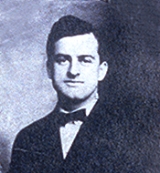
Eddie Cochems

Encyclopedia
Edward Bulwer "Eddie" Cochems (ˈkoʊkəmz; February 4, 1877 – April 9, 1953) was an American football
player and coach. He played football for the University of Wisconsin from 1898 to 1901 and was the head football coach at North Dakota State
(1902–1903), Clemson
(1905), Saint Louis University (1906–1908), and Maine (1914). During his three years at St. Louis, he was the first football coach to build an offense around the forward pass
, which became a legal play in the 1906 college football season
. Using the forward pass, Cochems' 1906 team compiled an undefeated 11–0 record, led the nation in scoring, and outscored opponents by a combined score of 407 to 11. He is considered by some to be the "father of the forward pass" in American football.
, the county seat of Door County
on Wisconsin
's Door Peninsula
. He was one of 11 children, and "the smallest of seven brothers." His older brother, Henry Cochems, preceded him at the University of Wisconsin-Madison, where he was a star football player and shotput thrower. Cochems also had a twin brother, Carl Cochems (1877–1954), who became a noted opera singer.
in football, baseball
and track. He was the captain of the 1901 Wisconsin baseball team, but he gained his greatest acclaim as a football player. Cochems began playing at the left end position, but was moved to the left halfback
position for the 1900 and 1901 seasons. The Badgers football team posted a 35–4–1 record during his four seasons of play. Together with Norsky Larson and Keg Driver, Cochems reportedly made up "the most feared backfield trio in the middle west."
Max Loeb, a classmate, remembered Cochems as "one of the most spectacular men of my time ... [w]onderfully built, handsome and affable ..." After Cochem's death, another classmate, O.G. Erickson, wrote:
After Cochems helped the Badgers to a 50–0 win over Kansas in 1901, the Chicago Daily Tribune
reported, "Larson and Cochems again and again skirted the Kansas ends for gains of forty, fifty, sixty and seventy yards. Nothing approaching the play of the Badgers trio of backs, Larson, Driver and Cochems, has ever been seen on Randall Field
."
On November 28, 1901, in his final game as a Wisconsin football player, Cochems ran back a kickoff for a touchdown against Amos Alonzo Stagg
's Chicago Maroons
. According to a contemporaneous press account, the touchdown run came late in the game with Wisconsin already leading 29 to 0: "The Maroons appeared to be demoralized, and on the kick-off Cochems caught the ball on his own twelve-yard line and ran ninety-eight yards for a touchdown, the Chicago players making little or no effort to stop him." Twelve years later, football historian and former University of Wisconsin coach Parke H. Davis
described the same run more colorfully, reporting that Cochems "dashed and dodged, plunged and writhed through all opponents for a touch-down... Cochem's great flight presented all of the features of speed, skill, and chance which must combine to, make possible the full-field run... he boldly laid his course against the very center of Chicago's oncoming forwards, bursting their central bastion, and then cleverly sprinting and dodging the secondary defenders." According to Cochems' obituary in the Wisconsin alumnus, his kickoff return against Chicago in 1901 "brought him undying fame as a gridder."
Cochems also scored two touchdowns in a 39–5 victory over Chicago in November 1900, and has been credited with four touchdowns in a 54–0 win against Notre Dame
in 1900.
Cochems was also a bicycling enthusiast who gained attention for a 1900 bicycle trip across Europe with classmate George Mowry. The pair left Wisconsin on August 1, 1900, and rode through England, Scotland, Belgium, Holland, France, Germany, Austria, Italy and Spain. Their cyclometers were stolen after they had completed 1,500 miles, and they had no record of the full distance they covered. The entire trip cost each of the two $125. On their return to Wisconsin, they were dressed in "well-worn knickerbockers" that "gave plain evidence of much exposure to variable weather and of hard riding."
at North Dakota Agricultural College (now North Dakota State University
) at Fargo
. He led the North Dakota Aggies to an undefeated and unscored upon record in 1902, outscoring opponents by a combined 168 to 0. His 1903 team at North Dakota finished with five wins and one loss.
In January 1904, the University of Wisconsin athletic board voted to select Cochems to serve as the school's assistant football coach at a salary of $800. Cochems returned to Madison
in 1904 as both assistant football coach and assistant athletic director.
In December 1904, the selection of a new head coach at Wisconsin was put to a straw vote with Cochems running against Phil King and two other candidates. King received 215 of the 325 votes cast.
Having lost his bid for the head coaching job, Cochems signed in February 1905 to become the head football coach at Clemson
. In the 1905 football season, Cochems led Clemson to shutout wins over Georgia (35–0), Alabama
(25–0), and Auburn
(6–0), but closed the season with consecutive losses to Vanderbilt
and Georgia Tech
, for a 3–2–1 record.
. Cochems had reportedly long been an enthusiast of the forward pass.
Like Cochems, Robinson was fascinated by the potential of the forward pass. Robinson was introduced to the forward pass in 1904 by Wisconsin teammate, H.P. Savage, who threw the ball overhand almost as far as Robinson was punting it to him. Savage taught Robinson how to throw a spiral pass, and the forward pass thereafter became Robinson's "football hobby."
To prepare for the first season under the new rules, Cochems convinced the university to allow him to take his team to a Jesuit sanctuary at Lake Beulah in southern Wisconsin for "the sole purpose of studying and developing the pass." Newbery Medal
winning author Harold Keith
wrote in Esquire
magazine that it was at Lake Beulah in August 1906 that "the first, forward pass system ever devised" was born.
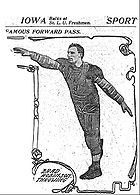 On September 5, 1906, in the first game of the 1906 season, St. Louis faced Carroll College
, and it was in that game that Robinson threw football's first legal forward pass to Jack Schneider.
Cochems reportedly did not start calling pass plays in the Carroll game until after he had grown frustrated with the failure of his offense to move the ball on the ground. After an initial pass attempt from Robinson to Schneider fell incomplete (resulting in a turnover
to Carroll under the 1906 rules), Cochems called for his team to again execute the play he called the "air attack" or the "projectile pass." Robinson threw the fat, rugby
-style ball for a 20-yard touchdown
pass to Schneider. St. Louis won the game by a score of 22–0.
threw a 67-yard pass, and Jack Schneider threw a 65-yard pass. In his book on the history of the sport, David Nelson wrote, "Considering the size, shape and weight of the ball, these were extraordinary passes."
The highlight of the 1906 season was St. Louis' 31–0 win against Iowa
. St. Louis completed eight of ten pass attempts (for an average of 20 yards) against Iowa, and four of the passes resulted in touchdowns. On the last play of the game, St. Louis threw a final pass 25 yards in the air to a receiver who caught the ball "on the dead run" for a touchdown. Cochems said that Iowa's poor showing in the game "resulted from its use of the old style play and its failure to effectively use the forward pass", as Iowa attempted only "two basketball
-style forward passes."
 The 1906 Iowa game was refereed by one of the top football officials in the country, West Point's Lt. Horatio B. "Stuffy" Hackett, who became a member of the American Intercollegiate Football Rules Committee in December 1907. Hackett later told a reporter, "It was the most perfect exhibition... of the new rules ... that I have seen all season and much better than that of Yale and Harvard. St. Louis' style of pass differs entirely from that in use in the east. ... The St. Louis university players shoot the ball hard and accurately to the man who is to receive it ... The fast throw by St. Louis enables the receiving player to dodge the opposing players, and it struck me as being all but perfect."
Knute Rockne biographer, Ray Robinson, wrote, "The St. Louis style of forward pass, as implemented by Cochems, was different from the pass being thrown by eastern players. Cochems did not protect his receiver by surrounding him with teammates, as was the case in the East."
" in the 1907 edition of Spalding's How to Play Foot Ball (edited by Walter Camp
). Cochems explained in words and photographs (of Robinson) how the forward pass could be thrown and how passing skills could be developed. "[T]he necessary brevity of this article will not permit of a detailed discussion of the forward pass," Cochems lamented. "Should I begin to explain the different plays in which the pass... could figure, I would invite myself to an endless task."
In December 1909, The Washington Post
published Cochems comments on the game under the headline, "FOOTBALL LIKE AN AIRSHIP WOULD OPEN UP THE GAME." Cochems advocated the redesign of the football to render it more aerodynamic and easy to handle:
Cochems' recommendations essentially describe the modern football. In 1909, he had accurately predicted, "With the new ball, deeper offensive formations could be logically planned and carried into execution."
In a 1932 interview with a Wisconsin sports columnist, Cochems claimed that Yale
, Harvard
and Princeton
(the so-called "Big Three" football powers in the early decades of the sport) all called him in having him explain the forward pass to them.
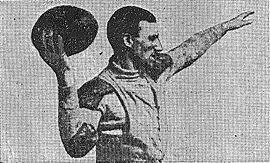 Cochems was disappointed that his pass-oriented offense did not catch on quickly. In 1907, after the first season of the forward pass, one football writer noted that, "with the single exception of Cochems, football teachers were groping in the dark."
Cochems was mistaken. It would be seven years before Knute Rockne
began to follow Cochems' example at Notre Dame
. Rockne acknowledged Cochems as the early leader in the use of the pass, observing, "One would have thought that so effective a play would have been instantly copied and become the vogue. The East, however, had not learned much or cared much about Midwest and western football; ondeed, the East scarcely realized that football existed beyond the Alleghanies ..."
In his history of the game, College Football Hall of Fame
coach and football authority David M. Nelson
echoed Rockne's point, noting that "eastern football had little respect for football west of Carlise, Pennsylvania
... [they] may not have recognized what was happening in the West, but the new forward-passing game was off to an impressive start."
Author Murray Greenberg, in his biography of 1920s passing sensation Benny Friedman
, agreed that the passing game as Cochems implemented it just did not catch on: "Cochems and his St. Louis eleven aside, rarely during the early part of the century's second decade did a team try to dominate the game through the air."
on November 28, 1907 by a score of 34 to 0. Cochems took his team to the West Coast for a Christmas Day game against Washington State College
. St. Louis lost the game by a score of 11 to 0.
After the 1907 season, charges that Cochems was using professional players were made. Several Midwestern universities, including Kansas
, Missouri
, Iowa
and Wisconsin
, refused to schedule games with St. Louis for the 1908 season, "claiming the team is tainted with professionals."
In 1908, Cochems' team compiled a record of 7-2-1, defeating the Arkansas Razorbacks
(24-0), but losing games to Pitt (13-0) and the Carlisle Indian School (17-0) and playing Sewanee to a tie.
On January 1, 1909, Cochems coached a St. Louis all-star football team against a Chicago all-star football game coached by Walter Eckersall
. The game drew extensive publicity when St. Louis Browns pitcher Rube Waddell
asked Cochems to play on the St. Louis team, and Cochems agreed. The Chicago team won by a score of 12 to 4.
In March 1909, The New York Times reported that St. Louis University had accepted Cochems' resignation as athletic coach. One writer noted that "the circumstances of his departure from SLU are murky."
In the fall of 1910, Cochems was reportedly coaching the Barnes University football team, playing its games at Handland Park in St. Louis. He also coached a Missouri "all-star" team that played against Frank Longman
's Notre Dame team at Sportsman's Park in St. Louis on Christmas Day 1910. Notre Dame won the game by a score of 12 to 0, and one newspaper called the game a "fiasco" and reported there was "not much that would indicate all star football" in the play of Cochems' team.
In January 1911, Cochems was considered for the position of football coach at the University of Wisconsin, but did not get the job. He moved to New York in 1911.
Cochems briefly returned to coaching in 1914 as the head football coach for the University of Maine
. He led Maine to a 6–3 record in 1914.
After he left coaching, Cochems continued to be connected to the sport and interacted with its leading figures. He attended meetings of the Rules Committee with the likes of Walter Camp
and John Heisman
. In 1911, he proposed a "radical" change in the rules, allowing each team a single set of five downs within which to score. He also became a well-known game official. In 1921, he was the umpire for the Notre Dame
– Army
game played at West Point
.
, and again in 1916 during the Charles Evans Hughes
campaign. He also worked in the campaigns of Calvin Coolidge
and Herbert Hoover
.
During World War I
, he served as civilian aide to the adjutant general at Long Island.
He was a national organizer for the American Commission for Relief in Belgium.
Cochems led an effort to end Prohibition
as the president of the Association of American Rights—Repeal of the Eighteenth Amendment
.
He also served on the staff of the Gibson Private Relief Association of New York.
.
Cochems died after a long illness on April 9, 1953 in the same Madison hospital in which his 14th grandchild had been born a week earlier.
Following the first season in which the play was legal, Walter Camp
chose Cochems to write the only article on the forward pass in the 1907 edition of Spalding's How to Play Foot Ball, which Camp edited.
Some have advocated for recognition of Cochems as the "father of the forward pass." As early as 1909, a writer in The Post-Standard (Syracuse, New York
) wrote: "Cochems was tha first coach to grasp the possibilities of the forward pass. He is a tricky and resourceful gridiron master with a large repertoire of plays and a dynamic personality." In 1920, a syndicated story on Cochems' becoming the head of the "Order of Camels" referred to him as "the famous daddy of the forward pass."
St. Louis Post Dispatch sports columnist Ed Wray was one of the earliest advocates for Cochems' role in developing the forward pass. In a 1940 column, Wray described Cochems' 1906 offensive scheme:
In a November 1944 article in Esquire
(entitled "Pioneer of the Forward Pass"), Newbery Award-winning author Harold Keith
concluded that Cochems was "unquestionably the father of the forward pass."
After Cochems' death in 1953, Philip A. Dynan, then serving as the publicity director at St. Louis University, became an advocate for Cochems' claim to be the father of the forward pass. In October 1954, an Associated Press sports writer reported on Dynan's efforts on behalf of Cochems:
Dynan unsuccessfully lobbied to have Cochems inducted into the College Football Hall of Fame
in the 1960s, and published an article on Cochems in 1967 titled "Father of the Forward Pass."
In his book The Anatomy of a Game: Football, the Rules, and the Men Who Made the Game, Coach Nelson
, the secretary-editor of the NCAA Football Rules Committee starting in 1962, stated that "E. B. Cochems is to forward passing what the Wright brothers
are to aviation and Thomas Edison
is to the electric light."
In 2009, SI.com and Sports Illustrated Kids listed Cochems' development of the forward pass as the first of 13 "Revolutionary Moments in Sports."
. In Allison Danzig
's book, "The History of American Football," Stagg said: "I have seen statements giving credit to certain people originating the forward pass. The fact is that all coaches were working on it. The first season, 1906, I personally had sixty-four different forward pass patterns." In 1954, Stagg told a reporter, "Eddie Cochems, who coached at St. Louis University in 1906, also claimed to have invented the pass as we know it today ... It isn't so, because after the forward pass was legalized in 1906, most of the schools commenced experimenting with it and nearly all used it." Stagg asserted that, as far back as 1894, before the rules committee even considered the forward pass, one of his players used to throw the ball "like a baseball pitcher."
After reviewing a letter from Stagg in 1948 asserting that "Eddie Cochems was not the originator of the long spiral pass," Deke Houlgate, author of "The Football Thesaurus", retracted a credit previously given to Cochems in his book:
Cochems' own star, Bradbury Robinson, also disputed Cochems' claim to be the developer of the forward pass. In a 1940 letter to Ed Wray, Robinson wrote :
In a 2006 feature story on the 100th anniversary of the forward pass, St. Louis Post-Dispatch writer Vahe Gregorian staked out a middle ground, noting, "While Cochems was the first to harness the potential of the newly legalized pass, he hardly was its architect or inventor."
in which Notre Dame's Knute Rockne
was portrayed as the originator of the forward pass.
Another factor that may have contributed to Cochems' story fading from the public's memory was the decision of St. Louis University to discontinue intercollegiate football in 1949.
New York Times columnist Arthur Daley, the first sportswriter to win the Pulitzer Prize
, wrote in 1949 that Rockne and Gus Dorais
, "caught a much larger share of immortality than they actually deserve, including credit for inventing the forward pass. That, of course, belongs to Eddie Cochems of St. Louis."
In 1952, Dorais himself tried to set the record straight (as Rockne had more than 20 years earlier), telling the United Press that "Eddie Cochems of the St. Louis University team of 1906-07-08 deserves the full credit."
Tampa Bay newspaper columnist Bob Driver wrote in 2006, "Cochems' name is mostly a footnote in football history, despite his achievements as the forward-pass pioneer." Driver concluded his column writing, "So there you have it, sports fans – a quickie history of the forward pass. Feel free to clip this column and keep it with you. It could help you win a bet, next time you encounter a sports know-it-all who believes the Knute Rockne movie version."
, the last time in 1965, but was not elected. Neither was Robinson. In 1967, former St. Louis University publicity director Philip Dynan wrote in his article, "Father of the Forward Pass", that "it's about time that somebody voted Edward B. Cochems into the Football Hall of Fame." But it never happened. Nor has he been inducted into the Missouri Sports Hall of Fame
.
Even at St. Louis University, Cochems was not inducted into the St. Louis Billiken Hall of Fame until 1994, 18 years after it was established in 1976. He was inducted into the University of Wisconsin Athletics Hall of Fame in 1994 and the Madison Sports Hall of Fame in 1968.
In December 1999, Cochems was ranked 29th in Sports Illustrated
s list of the 50 greatest sports figures in Wisconsin history.
Since 1994, the St. Louis-Tom Lombardo Chapter of the National Football Foundation
has recognized "Outstanding Contribution to Amateur Football" with the Eddie Cochems Award.
In 2010, Complex magazine ranked Cochems' 1906 St. Louis squad 38th among the "The 50 Most Badass College Football Teams" in history. Complex said it chose the teams based on "style, guts, amazing plays, and players and coaches that did things that just hadn’t been done before."
In 2011, Amy Lamare, writing on Bleacher Report
, named St. Louis' 1906 game at Carroll College one of "The 50 Most Historically Significant Games in College Football."
American football
American football is a sport played between two teams of eleven with the objective of scoring points by advancing the ball into the opposing team's end zone. Known in the United States simply as football, it may also be referred to informally as gridiron football. The ball can be advanced by...
player and coach. He played football for the University of Wisconsin from 1898 to 1901 and was the head football coach at North Dakota State
North Dakota State Bison football
The North Dakota State Bison football program represents North Dakota State University in college football at the NCAA Division I Football Championship Subdivision level and competes in the Missouri Valley Football Conference. From 2004 to 2007, the Bison were members of the Great West Football...
(1902–1903), Clemson
Clemson Tigers football
The Clemson Tigers football team is an American football team from Clemson University in South Carolina. It competes in the NCAA Division I Football Bowl Subdivision and the Atlantic Division of the Atlantic Coast Conference...
(1905), Saint Louis University (1906–1908), and Maine (1914). During his three years at St. Louis, he was the first football coach to build an offense around the forward pass
Forward pass
In several forms of football a forward pass is when the ball is thrown in the direction that the offensive team is trying to move, towards the defensive team's goal line...
, which became a legal play in the 1906 college football season
1906 college football season
The 1906 college football season was the first in which the forward pass was permitted. Although there was no national championship, there were two teams that had won all nine of their games as the 1906 season drew to a close, the Princeton Tigers and the Yale Bulldogs, and on November 17, 1906,...
. Using the forward pass, Cochems' 1906 team compiled an undefeated 11–0 record, led the nation in scoring, and outscored opponents by a combined score of 407 to 11. He is considered by some to be the "father of the forward pass" in American football.
Early life
Cochems was born in 1877 at Sturgeon BaySturgeon Bay, Wisconsin
Sturgeon Bay is a city in and the county seat of Door County, Wisconsin, United States. The population was 9,437 at the 2000 census. It is located at the natural end of Sturgeon Bay, although the Sturgeon Bay Ship Canal was built across the remainder of the Door Peninsula.-Geography:Sturgeon Bay is...
, the county seat of Door County
Door County, Wisconsin
Door County is a county in the U.S. state of Wisconsin. As of 2000, the population was 27,961. Its county seat is Sturgeon Bay. Door County is a popular vacation and tourist destination, especially for residents of Wisconsin and Illinois....
on Wisconsin
Wisconsin
Wisconsin is a U.S. state located in the north-central United States and is part of the Midwest. It is bordered by Minnesota to the west, Iowa to the southwest, Illinois to the south, Lake Michigan to the east, Michigan to the northeast, and Lake Superior to the north. Wisconsin's capital is...
's Door Peninsula
Door Peninsula
The Door Peninsula is a peninsula in eastern Wisconsin, separating the southern part of the Green Bay from Lake Michigan. The peninsula begins in northern Brown and Kewaunee counties and proceeds northeast to include all of Door County. It is the western portion of the Niagara Escarpment. Well...
. He was one of 11 children, and "the smallest of seven brothers." His older brother, Henry Cochems, preceded him at the University of Wisconsin-Madison, where he was a star football player and shotput thrower. Cochems also had a twin brother, Carl Cochems (1877–1954), who became a noted opera singer.
Athlete at Wisconsin
Cochems attended the University of Wisconsin-Madison, where he competed for the BadgersWisconsin Badgers
The Wisconsin Badgers are the collegiate athletic teams from the University of Wisconsin–Madison. This NCAA Division I athletic program has teams in football, basketball, ice hockey, volleyball, soccer, cross country, tennis, swimming, wrestling, track and field, rowing, golf, and softball...
in football, baseball
Baseball
Baseball is a bat-and-ball sport played between two teams of nine players each. The aim is to score runs by hitting a thrown ball with a bat and touching a series of four bases arranged at the corners of a ninety-foot diamond...
and track. He was the captain of the 1901 Wisconsin baseball team, but he gained his greatest acclaim as a football player. Cochems began playing at the left end position, but was moved to the left halfback
Halfback (American football)
A halfback, sometimes referred to as a tailback, is an offensive position in American football, which lines up in the backfield and generally is responsible for carrying the ball on run plays. Historically, from the 1870s through the 1950s, the halfback position was both an offensive and defensive...
position for the 1900 and 1901 seasons. The Badgers football team posted a 35–4–1 record during his four seasons of play. Together with Norsky Larson and Keg Driver, Cochems reportedly made up "the most feared backfield trio in the middle west."
Max Loeb, a classmate, remembered Cochems as "one of the most spectacular men of my time ... [w]onderfully built, handsome and affable ..." After Cochem's death, another classmate, O.G. Erickson, wrote:
"While well muscled and compactly built, Cochems never weighed more than 165 pounds, but I never saw another player who made better use of his poundage. He played four years of 70-minute football (a game then consisted of two 35-minute halves), and I don't remember him ever being taken out of a game because of injuries."
After Cochems helped the Badgers to a 50–0 win over Kansas in 1901, the Chicago Daily Tribune
Chicago Tribune
The Chicago Tribune is a major daily newspaper based in Chicago, Illinois, and the flagship publication of the Tribune Company. Formerly self-styled as the "World's Greatest Newspaper" , it remains the most read daily newspaper of the Chicago metropolitan area and the Great Lakes region and is...
reported, "Larson and Cochems again and again skirted the Kansas ends for gains of forty, fifty, sixty and seventy yards. Nothing approaching the play of the Badgers trio of backs, Larson, Driver and Cochems, has ever been seen on Randall Field
Camp Randall Stadium
Camp Randall Stadium is an outdoor stadium in Madison, Wisconsin. It has been the home of the Wisconsin Badgers football team in rudimentary form since 1895, and as a complete stadium since 1917. It is located on the center-southern region of the University of Wisconsin campus. The stadium seats...
."
On November 28, 1901, in his final game as a Wisconsin football player, Cochems ran back a kickoff for a touchdown against Amos Alonzo Stagg
Amos Alonzo Stagg
Amos Alonzo Stagg was an American athlete and pioneering college coach in multiple sports, primarily American football...
's Chicago Maroons
Chicago Maroons football
The Chicago Maroons are the college football team representing the University of Chicago. The Maroons play in NCAA Division III as a member of the University Athletic Association. From 1892 to 1939, the Maroons were a major college football power...
. According to a contemporaneous press account, the touchdown run came late in the game with Wisconsin already leading 29 to 0: "The Maroons appeared to be demoralized, and on the kick-off Cochems caught the ball on his own twelve-yard line and ran ninety-eight yards for a touchdown, the Chicago players making little or no effort to stop him." Twelve years later, football historian and former University of Wisconsin coach Parke H. Davis
Parke H. Davis
Parke Hill Davis was an American football player, coach and historian who retroactively named the national championship teams in American college football from the 1869 through the 1932 seasons. He also named co-national champions at the conclusion of the 1933 season...
described the same run more colorfully, reporting that Cochems "dashed and dodged, plunged and writhed through all opponents for a touch-down... Cochem's great flight presented all of the features of speed, skill, and chance which must combine to, make possible the full-field run... he boldly laid his course against the very center of Chicago's oncoming forwards, bursting their central bastion, and then cleverly sprinting and dodging the secondary defenders." According to Cochems' obituary in the Wisconsin alumnus, his kickoff return against Chicago in 1901 "brought him undying fame as a gridder."
Cochems also scored two touchdowns in a 39–5 victory over Chicago in November 1900, and has been credited with four touchdowns in a 54–0 win against Notre Dame
Notre Dame Fighting Irish football
Notre Dame Fighting Irish football team is the football team of the University of Notre Dame. The team is currently coached by Brian Kelly.Notre Dame competes as an Independent at the NCAA Football Bowl Subdivision level, and is a founding member of the Bowl Championship Series coalition. It is an...
in 1900.
Cochems was also a bicycling enthusiast who gained attention for a 1900 bicycle trip across Europe with classmate George Mowry. The pair left Wisconsin on August 1, 1900, and rode through England, Scotland, Belgium, Holland, France, Germany, Austria, Italy and Spain. Their cyclometers were stolen after they had completed 1,500 miles, and they had no record of the full distance they covered. The entire trip cost each of the two $125. On their return to Wisconsin, they were dressed in "well-worn knickerbockers" that "gave plain evidence of much exposure to variable weather and of hard riding."
Early coaching career
In 1902, Cochems at age 25 was hired as the head football coachHead coach
A head coach, senior coach or manager is a professional at training and developing athletes. They typically hold a more public profile and are paid more than other coaches...
at North Dakota Agricultural College (now North Dakota State University
North Dakota State Bison football
The North Dakota State Bison football program represents North Dakota State University in college football at the NCAA Division I Football Championship Subdivision level and competes in the Missouri Valley Football Conference. From 2004 to 2007, the Bison were members of the Great West Football...
) at Fargo
Fargo, North Dakota
Fargo is the largest city in the U.S. state of North Dakota and the county seat of Cass County. In 2010, its population was 105,549, and it had an estimated metropolitan population of 208,777...
. He led the North Dakota Aggies to an undefeated and unscored upon record in 1902, outscoring opponents by a combined 168 to 0. His 1903 team at North Dakota finished with five wins and one loss.
In January 1904, the University of Wisconsin athletic board voted to select Cochems to serve as the school's assistant football coach at a salary of $800. Cochems returned to Madison
Madison, Wisconsin
Madison is the capital of the U.S. state of Wisconsin and the county seat of Dane County. It is also home to the University of Wisconsin–Madison....
in 1904 as both assistant football coach and assistant athletic director.
In December 1904, the selection of a new head coach at Wisconsin was put to a straw vote with Cochems running against Phil King and two other candidates. King received 215 of the 325 votes cast.
Having lost his bid for the head coaching job, Cochems signed in February 1905 to become the head football coach at Clemson
Clemson University
Clemson University is an American public, coeducational, land-grant, sea-grant, research university located in Clemson, South Carolina, United States....
. In the 1905 football season, Cochems led Clemson to shutout wins over Georgia (35–0), Alabama
West Point, New York
West Point is a federal military reservation established by President of the United States Thomas Jefferson in 1802. It is a census-designated place located in Town of Highlands in Orange County, New York, United States. The population was 7,138 at the 2000 census...
(25–0), and Auburn
1905 Auburn Tigers football team
The 1905 Auburn Tigers football team represented Auburn University in the 1905 college football season.-Schedule:...
(6–0), but closed the season with consecutive losses to Vanderbilt
Vanderbilt Commodores football
The Vanderbilt Commodores football program is a college football team that represents Vanderbilt University. The team currently competes in NCAA Football Bowl Subdivision as a member of the Southeastern Conference...
and Georgia Tech
Georgia Tech Yellow Jackets football
The Georgia Tech Yellow Jackets football team represents the Georgia Institute of Technology in collegiate level football. While the team is officially designated as the Yellow Jackets, it is also referred to as the Ramblin' Wreck. The Yellow Jackets are a member of the Atlantic Coast Conference...
, for a 3–2–1 record.
Preparation to play under the new rules
In February 1906, Cochems was hired as the head football coach at St. Louis University. The 1906 college football season was played with new rules, which included legalizing the forward passForward pass
In several forms of football a forward pass is when the ball is thrown in the direction that the offensive team is trying to move, towards the defensive team's goal line...
. Cochems had reportedly long been an enthusiast of the forward pass.
Like Cochems, Robinson was fascinated by the potential of the forward pass. Robinson was introduced to the forward pass in 1904 by Wisconsin teammate, H.P. Savage, who threw the ball overhand almost as far as Robinson was punting it to him. Savage taught Robinson how to throw a spiral pass, and the forward pass thereafter became Robinson's "football hobby."
To prepare for the first season under the new rules, Cochems convinced the university to allow him to take his team to a Jesuit sanctuary at Lake Beulah in southern Wisconsin for "the sole purpose of studying and developing the pass." Newbery Medal
Newbery Medal
The John Newbery Medal is a literary award given by the Association for Library Service to Children, a division of the American Library Association . The award is given to the author of the most distinguished contribution to American literature for children. The award has been given since 1922. ...
winning author Harold Keith
Harold Keith
Harold Verne Keith was a Newbery Medal-winning American author. Keith was born and raised in Oklahoma, where he also lived and died: the state was his abiding passion. He used Oklahoma as the setting for most of his books, although Rifles for Watie takes place elsewhere.-Biography:Harold Keith...
wrote in Esquire
Esquire (magazine)
Esquire is a men's magazine, published in the U.S. by the Hearst Corporation. Founded in 1932, it flourished during the Great Depression under the guidance of founder and editor Arnold Gingrich.-History:...
magazine that it was at Lake Beulah in August 1906 that "the first, forward pass system ever devised" was born.
Football's first legal forward pass
Carroll College (Wisconsin)
Carroll University is a private liberal arts college affiliated with the Presbyterian church located in Waukesha in the U.S. state of Wisconsin. Carroll opened in 1846, two years before Wisconsin became a state...
, and it was in that game that Robinson threw football's first legal forward pass to Jack Schneider.
Cochems reportedly did not start calling pass plays in the Carroll game until after he had grown frustrated with the failure of his offense to move the ball on the ground. After an initial pass attempt from Robinson to Schneider fell incomplete (resulting in a turnover
Turnover (football)
In American football, a turnover occurs when the team with the ball loses possession of the ball, which is then gained by the other team. The two events that are officially classified as "turnovers" are fumbles or interceptions In American football, a turnover occurs when the team with the ball...
to Carroll under the 1906 rules), Cochems called for his team to again execute the play he called the "air attack" or the "projectile pass." Robinson threw the fat, rugby
Rugby football
Rugby football is a style of football named after Rugby School in the United Kingdom. It is seen most prominently in two current sports, rugby league and rugby union.-History:...
-style ball for a 20-yard touchdown
Touchdown
A touchdown is a means of scoring in American and Canadian football. Whether running, passing, returning a kickoff or punt, or recovering a turnover, a team scores a touchdown by advancing the ball into the opponent's end zone.-Description:...
pass to Schneider. St. Louis won the game by a score of 22–0.
1906 season
St. Louis completed the 1906 season undefeated (11–0) and led the nation in scoring, having outscored opponents by a combined 407 to 11. During the 1906 season, the forward pass was a key element in the St. Louis offense. Bradbury RobinsonBradbury Robinson
Bradbury Norton Robinson, Jr. was a pioneering American football player, physician, and local politician. He played college football at the University of Wisconsin in 1903 and at Saint Louis University from 1904 to 1907. In 1904, though personal connections to Wisconsin governor Robert M. La...
threw a 67-yard pass, and Jack Schneider threw a 65-yard pass. In his book on the history of the sport, David Nelson wrote, "Considering the size, shape and weight of the ball, these were extraordinary passes."
The highlight of the 1906 season was St. Louis' 31–0 win against Iowa
Iowa Hawkeyes football
The Iowa Hawkeyes football team is the interscholastic football team at the University of Iowa in Iowa City, Iowa. The Hawkeyes have competed in the Big Ten Conference since 1900, and are currently a Division I Football Bowl Subdivision member of the National Collegiate Athletic Association...
. St. Louis completed eight of ten pass attempts (for an average of 20 yards) against Iowa, and four of the passes resulted in touchdowns. On the last play of the game, St. Louis threw a final pass 25 yards in the air to a receiver who caught the ball "on the dead run" for a touchdown. Cochems said that Iowa's poor showing in the game "resulted from its use of the old style play and its failure to effectively use the forward pass", as Iowa attempted only "two basketball
Basketball
Basketball is a team sport in which two teams of five players try to score points by throwing or "shooting" a ball through the top of a basketball hoop while following a set of rules...
-style forward passes."
Knute Rockne biographer, Ray Robinson, wrote, "The St. Louis style of forward pass, as implemented by Cochems, was different from the pass being thrown by eastern players. Cochems did not protect his receiver by surrounding him with teammates, as was the case in the East."
Cochems as advocate of the forward pass
After the 1906 season, Cochems published a 10-page article entitled "The Forward Pass and On-Side KickOnside kick
In American and Canadian football, an onside kick is a type of kick used at a kickoff or other free kick, or scrimmage kick or other kick during play, in which the ball is kicked favorably for the kicking team to avoid giving away the ball...
" in the 1907 edition of Spalding's How to Play Foot Ball (edited by Walter Camp
Walter Camp
Walter Chauncey Camp was an American football player, coach, and sports writer known as the "Father of American Football". With John Heisman, Amos Alonzo Stagg, Pop Warner, Fielding H. Yost, and George Halas, Camp was one of the most accomplished persons in the early history of American football...
). Cochems explained in words and photographs (of Robinson) how the forward pass could be thrown and how passing skills could be developed. "[T]he necessary brevity of this article will not permit of a detailed discussion of the forward pass," Cochems lamented. "Should I begin to explain the different plays in which the pass... could figure, I would invite myself to an endless task."
In December 1909, The Washington Post
The Washington Post
The Washington Post is Washington, D.C.'s largest newspaper and its oldest still-existing paper, founded in 1877. Located in the capital of the United States, The Post has a particular emphasis on national politics. D.C., Maryland, and Virginia editions are printed for daily circulation...
published Cochems comments on the game under the headline, "FOOTBALL LIKE AN AIRSHIP WOULD OPEN UP THE GAME." Cochems advocated the redesign of the football to render it more aerodynamic and easy to handle:
"The story in a nutshell is this. The ball is too large and too light. Some of the best teams in the country find it impossible to use the pass owing to lack of players who can make it. ... Since it is impossible to grow larger hands and it is possible to make the ball conform to human dimensions, why not make the ball fit the needed conditions? ... With a ball such as I have proposed, longer, narrower, and a bit heavier, so that it would carry in the face of a strong wind, I firmly believe that the game of rugby would develop into one of the most beautiful and versatile sports the world ever saw."
Cochems' recommendations essentially describe the modern football. In 1909, he had accurately predicted, "With the new ball, deeper offensive formations could be logically planned and carried into execution."
In a 1932 interview with a Wisconsin sports columnist, Cochems claimed that Yale
Yale Bulldogs
The Yale Bulldogs are the athletic teams of the Yale University. The school sponsors 35 varsity sports. The school has won two NCAA national championships in women's fencing, four in men's swimming and diving, and twenty one in men's golf.-Men's baseball:...
, Harvard
Harvard Crimson
The Harvard Crimson are the athletic teams of Harvard University. The school's teams compete in NCAA Division I. As of 2006, there were 41 Division I intercollegiate varsity sports teams for women and men at Harvard, more than at any other NCAA Division I college in the country...
and Princeton
Princeton Tigers
The Princeton Tigers are the athletic teams of Princeton University. The school sponsors 31 varsity sports. The school has won several NCAA national championships, including one in men's fencing, six in men's lacrosse, three in women's lacrosse, and eight in men's golf...
(the so-called "Big Three" football powers in the early decades of the sport) all called him in having him explain the forward pass to them.
Failure of the forward pass to catch on quickly
Cochems was mistaken. It would be seven years before Knute Rockne
Knute Rockne
Knute Kenneth Rockne was an American football player and coach. He is regarded as one of the greatest coaches in college football history...
began to follow Cochems' example at Notre Dame
Notre Dame Fighting Irish football
Notre Dame Fighting Irish football team is the football team of the University of Notre Dame. The team is currently coached by Brian Kelly.Notre Dame competes as an Independent at the NCAA Football Bowl Subdivision level, and is a founding member of the Bowl Championship Series coalition. It is an...
. Rockne acknowledged Cochems as the early leader in the use of the pass, observing, "One would have thought that so effective a play would have been instantly copied and become the vogue. The East, however, had not learned much or cared much about Midwest and western football; ondeed, the East scarcely realized that football existed beyond the Alleghanies ..."
In his history of the game, College Football Hall of Fame
College Football Hall of Fame
The College Football Hall of Fame is a hall of fame and museum devoted to college football. Located in South Bend, Indiana, it is connected to a convention center and situated in the city's renovated downtown district, two miles south of the University of Notre Dame campus. It is slated to move...
coach and football authority David M. Nelson
David M. Nelson
David Moir Nelson was an American football player, coach, college athletics administrator, author, and authority on college football playing rules...
echoed Rockne's point, noting that "eastern football had little respect for football west of Carlise, Pennsylvania
Carlisle Indians football
The Carlisle Indians football team represented the Carlisle Indian Industrial School in intercollegiate football competition. The program was active from 1893 until 1917, when it was discontinued. During the program's 25 years, the Indians compiled a 167–88–13 record and 0.647 winning percentage,...
... [they] may not have recognized what was happening in the West, but the new forward-passing game was off to an impressive start."
Author Murray Greenberg, in his biography of 1920s passing sensation Benny Friedman
Benny Friedman
Benjamin "Benny" Friedman was an American football quarterback who played for the University of Michigan , Cleveland Bulldogs , Detroit Wolverines , New York Giants , and Brooklyn Dodgers .He is generally considered the first great passer in professional football...
, agreed that the passing game as Cochems implemented it just did not catch on: "Cochems and his St. Louis eleven aside, rarely during the early part of the century's second decade did a team try to dominate the game through the air."
1907 and 1908 seasons
Cochems led the St. Louis football team to a record of 7-3-1 in 1907. In September 1907, Cochems introduced another innovation at St. Louis, having his players wear numbers to allow spectators to identify individual players. The move was called "a decided innovation" and was compared to the numbering of jockeys in horse-racing. Cochems team defeated the Nebraska CornhuskersNebraska Cornhuskers
The Nebraska Cornhuskers is the name given to several sports teams of the University of Nebraska–Lincoln. The university is a member of the Big Ten Conference...
on November 28, 1907 by a score of 34 to 0. Cochems took his team to the West Coast for a Christmas Day game against Washington State College
Washington State Cougars football
The Washington State Cougars football team is the intercollegiate football team of Washington State University. The team is a member of the Pacific-12 Conference...
. St. Louis lost the game by a score of 11 to 0.
After the 1907 season, charges that Cochems was using professional players were made. Several Midwestern universities, including Kansas
Kansas Jayhawks football
The Kansas Jayhawks football program is the intercollegiate football program of the University of Kansas Jayhawks. The program is classified in the NCAA's Division I, and the team competes in the Big 12 Conference....
, Missouri
Missouri Tigers football
The Missouri Tigers football team represents the University of Missouri in NCAA Division I FBS college football. The team has competed in the North Division of the Big 12 Conference since the conference's inception in 1996...
, Iowa
Iowa Hawkeyes football
The Iowa Hawkeyes football team is the interscholastic football team at the University of Iowa in Iowa City, Iowa. The Hawkeyes have competed in the Big Ten Conference since 1900, and are currently a Division I Football Bowl Subdivision member of the National Collegiate Athletic Association...
and Wisconsin
Wisconsin Badgers football
The Wisconsin Badgers are a college football program that represents the University of Wisconsin–Madison in the NCAA Football Bowl Subdivision and the Big Ten Conference. They play their home games at Camp Randall Stadium, the fourth-oldest stadium in college football...
, refused to schedule games with St. Louis for the 1908 season, "claiming the team is tainted with professionals."
In 1908, Cochems' team compiled a record of 7-2-1, defeating the Arkansas Razorbacks
Arkansas Razorbacks football
The Arkansas Razorbacks football program is a college football team that represents the University of Arkansas. The team is a member of the Southeastern Conference's Western Division, which is in Division I's Football Bowl Subdivision of the National Collegiate Athletic Association...
(24-0), but losing games to Pitt (13-0) and the Carlisle Indian School (17-0) and playing Sewanee to a tie.
On January 1, 1909, Cochems coached a St. Louis all-star football team against a Chicago all-star football game coached by Walter Eckersall
Walter Eckersall
Walter "Eckie" Eckersall was an American football player, official, and sportswriter for the Chicago Tribune. He was elected to the College Football Hall of Fame in 1951.-Early life:...
. The game drew extensive publicity when St. Louis Browns pitcher Rube Waddell
Rube Waddell
George Edward Waddell was an American southpaw pitcher in Major League Baseball. In his thirteen-year career he played for the Louisville Colonels , Pittsburgh Pirates and Chicago Orphans in the National League, and the Philadelphia Athletics and St. Louis Browns in the American League...
asked Cochems to play on the St. Louis team, and Cochems agreed. The Chicago team won by a score of 12 to 4.
In March 1909, The New York Times reported that St. Louis University had accepted Cochems' resignation as athletic coach. One writer noted that "the circumstances of his departure from SLU are murky."
Football career after St. Louis University
In 1909, Cochems worked for a time as the director of the public playground system in St. Louis. In November 1909, a Wisconsin newspaper reported that Cochems was coaching "a minor team" in St. Louis and had been beaten badly by "another equally minor institution" from Chicago. The report noted that Cochems "changed his berth for some unexplained reason this year and is doing a bump the bumps that makes a marble rolling down stairs look like a toboggan for smoothness, by comparison."In the fall of 1910, Cochems was reportedly coaching the Barnes University football team, playing its games at Handland Park in St. Louis. He also coached a Missouri "all-star" team that played against Frank Longman
Frank Longman
-External links:...
's Notre Dame team at Sportsman's Park in St. Louis on Christmas Day 1910. Notre Dame won the game by a score of 12 to 0, and one newspaper called the game a "fiasco" and reported there was "not much that would indicate all star football" in the play of Cochems' team.
In January 1911, Cochems was considered for the position of football coach at the University of Wisconsin, but did not get the job. He moved to New York in 1911.
Cochems briefly returned to coaching in 1914 as the head football coach for the University of Maine
University of Maine
The University of Maine is a public research university located in Orono, Maine, United States. The university was established in 1865 as a land grant college and is referred to as the flagship university of the University of Maine System...
. He led Maine to a 6–3 record in 1914.
After he left coaching, Cochems continued to be connected to the sport and interacted with its leading figures. He attended meetings of the Rules Committee with the likes of Walter Camp
Walter Camp
Walter Chauncey Camp was an American football player, coach, and sports writer known as the "Father of American Football". With John Heisman, Amos Alonzo Stagg, Pop Warner, Fielding H. Yost, and George Halas, Camp was one of the most accomplished persons in the early history of American football...
and John Heisman
John Heisman
John William Heisman was an American player and coach of football, basketball, and baseball. He served as the head football coach at Oberlin College , Buchtel College, now known as the University of Akron , Auburn University , Clemson University , Georgia Tech , the...
. In 1911, he proposed a "radical" change in the rules, allowing each team a single set of five downs within which to score. He also became a well-known game official. In 1921, he was the umpire for the Notre Dame
Notre Dame Fighting Irish football
Notre Dame Fighting Irish football team is the football team of the University of Notre Dame. The team is currently coached by Brian Kelly.Notre Dame competes as an Independent at the NCAA Football Bowl Subdivision level, and is a founding member of the Bowl Championship Series coalition. It is an...
– Army
Army Black Knights football
The Army Black Knights football program represents the United States Military Academy. Army was recognized as the national champions in 1944, 1945 and 1946....
game played at West Point
West Point, New York
West Point is a federal military reservation established by President of the United States Thomas Jefferson in 1802. It is a census-designated place located in Town of Highlands in Orange County, New York, United States. The population was 7,138 at the 2000 census...
.
Organizer and political activist
In the fall of 1911, Cochems moved to New York and announced that he had abandoned football for politics. Over the next 20 years, Cochems engaged in a career as an "organizer, speaker and as political campaigner." He was director of the National Speakers Bureau in 1912 during the campaign of Theodore RooseveltTheodore Roosevelt
Theodore "Teddy" Roosevelt was the 26th President of the United States . He is noted for his exuberant personality, range of interests and achievements, and his leadership of the Progressive Movement, as well as his "cowboy" persona and robust masculinity...
, and again in 1916 during the Charles Evans Hughes
Charles Evans Hughes
Charles Evans Hughes, Sr. was an American statesman, lawyer and Republican politician from New York. He served as the 36th Governor of New York , Associate Justice of the Supreme Court of the United States , United States Secretary of State , a judge on the Court of International Justice , and...
campaign. He also worked in the campaigns of Calvin Coolidge
Calvin Coolidge
John Calvin Coolidge, Jr. was the 30th President of the United States . A Republican lawyer from Vermont, Coolidge worked his way up the ladder of Massachusetts state politics, eventually becoming governor of that state...
and Herbert Hoover
Herbert Hoover
Herbert Clark Hoover was the 31st President of the United States . Hoover was originally a professional mining engineer and author. As the United States Secretary of Commerce in the 1920s under Presidents Warren Harding and Calvin Coolidge, he promoted partnerships between government and business...
.
During World War I
World War I
World War I , which was predominantly called the World War or the Great War from its occurrence until 1939, and the First World War or World War I thereafter, was a major war centred in Europe that began on 28 July 1914 and lasted until 11 November 1918...
, he served as civilian aide to the adjutant general at Long Island.
He was a national organizer for the American Commission for Relief in Belgium.
Cochems led an effort to end Prohibition
Prohibition
Prohibition of alcohol, often referred to simply as prohibition, is the practice of prohibiting the manufacture, transportation, import, export, sale, and consumption of alcohol and alcoholic beverages. The term can also apply to the periods in the histories of the countries during which the...
as the president of the Association of American Rights—Repeal of the Eighteenth Amendment
Eighteenth Amendment to the United States Constitution
The Eighteenth Amendment of the United States Constitution established Prohibition in the United States. The separate Volstead Act set down methods of enforcing the Eighteenth Amendment, and defined which "intoxicating liquors" were prohibited, and which were excluded from prohibition...
.
He also served on the staff of the Gibson Private Relief Association of New York.
Later years
After living in New York for approximately 20 years, Cochems returned to Madison in the early 1930s. In 1933, he was appointed as one of three assistants to the state's NRA director and was doing speaking engagements throughout the state. In 1940, he was employed "installing a system of educational recreation in state institutions." When the position of head football coach at St. Louis University opened up in 1940, Cochems put in his name, but the job went to Dukes Duford.Family and death
Cochems married May Louise Mullen of Madison in August 1902. Their wedding trip ended at Fargo, where Cochems had been hired as athletic director. They were together until his death and had five children: daughter Elizabeth and sons John, Henry, Phillip and David, who was killed in action in Essen, Germany in the closing weeks of World War IIWorld War II
World War II, or the Second World War , was a global conflict lasting from 1939 to 1945, involving most of the world's nations—including all of the great powers—eventually forming two opposing military alliances: the Allies and the Axis...
.
Cochems died after a long illness on April 9, 1953 in the same Madison hospital in which his 14th grandchild had been born a week earlier.
Father of the forward pass
Recognition of Cochems' role in the development of the forward pass has been inconsistent.Following the first season in which the play was legal, Walter Camp
Walter Camp
Walter Chauncey Camp was an American football player, coach, and sports writer known as the "Father of American Football". With John Heisman, Amos Alonzo Stagg, Pop Warner, Fielding H. Yost, and George Halas, Camp was one of the most accomplished persons in the early history of American football...
chose Cochems to write the only article on the forward pass in the 1907 edition of Spalding's How to Play Foot Ball, which Camp edited.
Some have advocated for recognition of Cochems as the "father of the forward pass." As early as 1909, a writer in The Post-Standard (Syracuse, New York
Syracuse, New York
Syracuse is a city in and the county seat of Onondaga County, New York, United States, the largest U.S. city with the name "Syracuse", and the fifth most populous city in the state. At the 2010 census, the city population was 145,170, and its metropolitan area had a population of 742,603...
) wrote: "Cochems was tha first coach to grasp the possibilities of the forward pass. He is a tricky and resourceful gridiron master with a large repertoire of plays and a dynamic personality." In 1920, a syndicated story on Cochems' becoming the head of the "Order of Camels" referred to him as "the famous daddy of the forward pass."
St. Louis Post Dispatch sports columnist Ed Wray was one of the earliest advocates for Cochems' role in developing the forward pass. In a 1940 column, Wray described Cochems' 1906 offensive scheme:
"He also alternated the long 'projectile pass' (that's what Cochems called it), with a short, fast pass over the line of scrimmage, five yards out from the center. Equipped with this attack, then absolutely new, Cochems' team had the football world popeyed after the first two or three games of the season. Owning a team with a powerful running attack, Cochems' eleven would pound the enemy line, draw in the defense and then amaze the opposition by shooting long forward pass for big gains. ... And yet today Rockne gets the credit for a discovery that rightfully belongs to a graying resident of Madison, Wis., now in the middle sixties, whose name is almost forgotten -- Eddie Cochems."
In a November 1944 article in Esquire
Esquire (magazine)
Esquire is a men's magazine, published in the U.S. by the Hearst Corporation. Founded in 1932, it flourished during the Great Depression under the guidance of founder and editor Arnold Gingrich.-History:...
(entitled "Pioneer of the Forward Pass"), Newbery Award-winning author Harold Keith
Harold Keith
Harold Verne Keith was a Newbery Medal-winning American author. Keith was born and raised in Oklahoma, where he also lived and died: the state was his abiding passion. He used Oklahoma as the setting for most of his books, although Rifles for Watie takes place elsewhere.-Biography:Harold Keith...
concluded that Cochems was "unquestionably the father of the forward pass."
After Cochems' death in 1953, Philip A. Dynan, then serving as the publicity director at St. Louis University, became an advocate for Cochems' claim to be the father of the forward pass. In October 1954, an Associated Press sports writer reported on Dynan's efforts on behalf of Cochems:
"There are various ways used by college publicity men — 'drum beaters' in the sports writers vernacular—to get the names of their schools into the newspapers. A new twist has been developed by Phil Dynan, who handles such work for St. Louis University. Dynan, who doesn't have a football team to promote any more since his school dropped the game, nevertheless still is operating on a gridiron basis. His gimmick is a claim, 'based on considerable research,' that St. Louis was the first team to throw a forward pass."
Dynan unsuccessfully lobbied to have Cochems inducted into the College Football Hall of Fame
College Football Hall of Fame
The College Football Hall of Fame is a hall of fame and museum devoted to college football. Located in South Bend, Indiana, it is connected to a convention center and situated in the city's renovated downtown district, two miles south of the University of Notre Dame campus. It is slated to move...
in the 1960s, and published an article on Cochems in 1967 titled "Father of the Forward Pass."
In his book The Anatomy of a Game: Football, the Rules, and the Men Who Made the Game, Coach Nelson
David M. Nelson
David Moir Nelson was an American football player, coach, college athletics administrator, author, and authority on college football playing rules...
, the secretary-editor of the NCAA Football Rules Committee starting in 1962, stated that "E. B. Cochems is to forward passing what the Wright brothers
Wright brothers
The Wright brothers, Orville and Wilbur , were two Americans credited with inventing and building the world's first successful airplane and making the first controlled, powered and sustained heavier-than-air human flight, on December 17, 1903...
are to aviation and Thomas Edison
Thomas Edison
Thomas Alva Edison was an American inventor and businessman. He developed many devices that greatly influenced life around the world, including the phonograph, the motion picture camera, and a long-lasting, practical electric light bulb. In addition, he created the world’s first industrial...
is to the electric light."
In 2009, SI.com and Sports Illustrated Kids listed Cochems' development of the forward pass as the first of 13 "Revolutionary Moments in Sports."
Contrary views
A contrary view was taken by football coaching legend Amos Alonzo StaggAmos Alonzo Stagg
Amos Alonzo Stagg was an American athlete and pioneering college coach in multiple sports, primarily American football...
. In Allison Danzig
Allison Danzig
Allison "Al" Danzig was an American sportswriter who specialized in writing about tennis, but also covered college football, squash, many Olympic Games, and rowing. Danzig was the only American sportwriter to extensively cover real tennis, the precursor to modern lawn tennis.Danzig covered every...
's book, "The History of American Football," Stagg said: "I have seen statements giving credit to certain people originating the forward pass. The fact is that all coaches were working on it. The first season, 1906, I personally had sixty-four different forward pass patterns." In 1954, Stagg told a reporter, "Eddie Cochems, who coached at St. Louis University in 1906, also claimed to have invented the pass as we know it today ... It isn't so, because after the forward pass was legalized in 1906, most of the schools commenced experimenting with it and nearly all used it." Stagg asserted that, as far back as 1894, before the rules committee even considered the forward pass, one of his players used to throw the ball "like a baseball pitcher."
After reviewing a letter from Stagg in 1948 asserting that "Eddie Cochems was not the originator of the long spiral pass," Deke Houlgate, author of "The Football Thesaurus", retracted a credit previously given to Cochems in his book:
"Coach Stagg has my thorough-going agreement that Coach Cochems may not have been the first to perfect the long spiral pass because very few mentors have done so since the year 1905. It may be that Cochems merely enjoyed the benefits of a good publicity agent a generation before the word 'flack' was coined."
Cochems' own star, Bradbury Robinson, also disputed Cochems' claim to be the developer of the forward pass. In a 1940 letter to Ed Wray, Robinson wrote :
"The story of the beginning and development of the forward pass does not reside with Eddie Cochems but with myself. Strange as it may seem I began the development of the forward pass in [1904] at Wisconsin university before I ever came to St. Louis. I anticipated that it would be introduced into the rules because of the efforts Theodore Roosevelt as president was making to tone down the game and make it more spectacular. ... Mr. Cochems' connection with this development only occurred in 1906, in Wisconsin, where the St. Louis university squad had gone for early training."
In a 2006 feature story on the 100th anniversary of the forward pass, St. Louis Post-Dispatch writer Vahe Gregorian staked out a middle ground, noting, "While Cochems was the first to harness the potential of the newly legalized pass, he hardly was its architect or inventor."
Impact of the Rockne legend
Despite Cochems' contribution to football, his story was long the stuff of trivia. Years passed and a generation of first-hand observers died. They were replaced by generations influenced by the popular 1940 film Knute Rockne, All AmericanKnute Rockne, All American
Knute Rockne, All American is a 1940 biographical film which tells the story of Knute Rockne, Notre Dame football coach. It stars Pat O'Brien, Ronald Reagan, Gale Page, Donald Crisp, Albert Bassermann, Owen Davis, Jr., Nick Lukats, Kane Richmond, William Marshall and William Byrne. It also...
in which Notre Dame's Knute Rockne
Knute Rockne
Knute Kenneth Rockne was an American football player and coach. He is regarded as one of the greatest coaches in college football history...
was portrayed as the originator of the forward pass.
Another factor that may have contributed to Cochems' story fading from the public's memory was the decision of St. Louis University to discontinue intercollegiate football in 1949.
New York Times columnist Arthur Daley, the first sportswriter to win the Pulitzer Prize
Pulitzer Prize
The Pulitzer Prize is a U.S. award for achievements in newspaper and online journalism, literature and musical composition. It was established by American publisher Joseph Pulitzer and is administered by Columbia University in New York City...
, wrote in 1949 that Rockne and Gus Dorais
Gus Dorais
Charles Emile "Gus" Dorais was an American football player and coach of football, basketball, and baseball. He played college football as a quarterback at the University of Notre Dame, where he was an All-American in 1913, and then professionally with the Fort Wayne Friars and Massillon Tigers...
, "caught a much larger share of immortality than they actually deserve, including credit for inventing the forward pass. That, of course, belongs to Eddie Cochems of St. Louis."
In 1952, Dorais himself tried to set the record straight (as Rockne had more than 20 years earlier), telling the United Press that "Eddie Cochems of the St. Louis University team of 1906-07-08 deserves the full credit."
Tampa Bay newspaper columnist Bob Driver wrote in 2006, "Cochems' name is mostly a footnote in football history, despite his achievements as the forward-pass pioneer." Driver concluded his column writing, "So there you have it, sports fans – a quickie history of the forward pass. Feel free to clip this column and keep it with you. It could help you win a bet, next time you encounter a sports know-it-all who believes the Knute Rockne movie version."
Honors and recognition
Honors and recognition of Cochems' accomplishments have been slow coming. Cochems was twice nominated to the College Football Hall of FameCollege Football Hall of Fame
The College Football Hall of Fame is a hall of fame and museum devoted to college football. Located in South Bend, Indiana, it is connected to a convention center and situated in the city's renovated downtown district, two miles south of the University of Notre Dame campus. It is slated to move...
, the last time in 1965, but was not elected. Neither was Robinson. In 1967, former St. Louis University publicity director Philip Dynan wrote in his article, "Father of the Forward Pass", that "it's about time that somebody voted Edward B. Cochems into the Football Hall of Fame." But it never happened. Nor has he been inducted into the Missouri Sports Hall of Fame
Missouri Sports Hall of Fame
The Missouri Sports Hall of Fame in Springfield, Missouri, USA, showcases sports memorabilia of Missouri athletes and interactive displays.-Inductees:-External links:*...
.
Even at St. Louis University, Cochems was not inducted into the St. Louis Billiken Hall of Fame until 1994, 18 years after it was established in 1976. He was inducted into the University of Wisconsin Athletics Hall of Fame in 1994 and the Madison Sports Hall of Fame in 1968.
In December 1999, Cochems was ranked 29th in Sports Illustrated
Sports Illustrated
Sports Illustrated is an American sports media company owned by media conglomerate Time Warner. Its self titled magazine has over 3.5 million subscribers and is read by 23 million adults each week, including over 18 million men. It was the first magazine with circulation over one million to win the...
s list of the 50 greatest sports figures in Wisconsin history.
Since 1994, the St. Louis-Tom Lombardo Chapter of the National Football Foundation
National Football Foundation
The National Football Foundation is a non-profit organization founded in 1947 by General Douglas MacArthur, legendary Army Black Knights football coach Earl "Red" Blaik and journalist Grantland Rice...
has recognized "Outstanding Contribution to Amateur Football" with the Eddie Cochems Award.
In 2010, Complex magazine ranked Cochems' 1906 St. Louis squad 38th among the "The 50 Most Badass College Football Teams" in history. Complex said it chose the teams based on "style, guts, amazing plays, and players and coaches that did things that just hadn’t been done before."
In 2011, Amy Lamare, writing on Bleacher Report
Bleacher Report
Bleacher Report is a website that provides news and fans' opinions of sporting events.The website was launched in February 2008 by California-based entrepreneurs Dave Finocchio, Zander Freund, Bryan Goldberg, and Dave Nemetz...
, named St. Louis' 1906 game at Carroll College one of "The 50 Most Historically Significant Games in College Football."
Head coaching record
| Year | School | Won | Lost | Tied | Winning % | PF | PA | Delta | Notes |
|---|---|---|---|---|---|---|---|---|---|
| 1902 | North Dakota State | 4 | 0 | 0 | 100% | 168 | 0 | 168 | Undefeated, untied & unscored-upon |
| 1903 | North Dakota State | 5 | 1 | 0 | 83% | 331 | 49 | 282 | |
| 1905 | Clemson | 3 | 2 | 1 | 58% | 81 | 63 | 18 | |
| 1906 | St. Louis | 11 | 0 | 0 | 100% | 407 | 11 | 391 | Undefeated & untied |
| 1907 | St. Louis | 7 | 3 | 1 | 69% | 233 | 40 | 193 | Varsity-Trans-Mississippi Champions |
| 1908 | St. Louis | 7 | 2 | 1 | 72% | 114 | 36 | 78 | |
| 1914 | Maine | 6 | 3 | 0 | 67% | 221 | 70 | 151 | |
| TOTALS | 43 | 11 | 3 | 78% | 1,555 | 269 | 1,281 |