

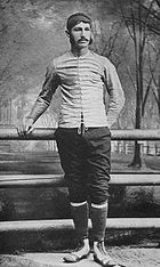
Walter Camp

Encyclopedia
Walter Chauncey Camp was an American football
player, coach, and sports writer known as the "Father of American Football". With John Heisman
, Amos Alonzo Stagg
, Pop Warner
, Fielding H. Yost, and George Halas
, Camp was one of the most accomplished persons in the early history of American football
. He played college football
at Yale College
from 1876 to 1882. Camp served as the head football coach at Yale from 1888 to 1892 before moving to Stanford University
, where he coached in December 1892 and in 1894 and 1895. Camp's Yale teams
of 1888, 1891, and 1892 have been recognized as national champions. Camp was inducted into the College Football Hall of Fame
as a coach in 1951.
, the son of Leverett Lee and Ellen Sophia (Cornwell) Camp. He attended Hopkins Grammar School
in New Haven
, entered Yale College
in 1876, and graduated in 1880. At Yale he was a member of Delta Kappa Epsilon
fraternity and Skull and Bones
. He attended Yale Medical School, where his studies were interrupted first by an outbreak of typhoid fever
and then by work for the Manhattan Watch Company. He worked for the New Haven Clock Company beginning in 1883, working his way up to chairman of the board of directors.
On June 30, 1888, Camp married Alice Graham Sumner, sister of William Graham Sumner
. They had two children: Walter Camp, Jr. (born 1891) who attended Yale as well and was elected as a member of Scroll and Key
in 1912, and Janet Camp Troxell (born 1897).
In 2011, reviewing Camp's role in the founding of the sport and of the NCAA, Taylor Branch
also credited Camp with cutting the number of players on a football team from 15 to 11 and adding measuring lines to the field. However, Branch noted that the revelation in a contemporaneous McClure
s magazine story of "Camp's $100,000 slush fund", along with concern about the violence of the growing sport (25 college players killed during the 1905 football season), helped lead to President Theodore Roosevelt
's intervention in the sport. The NCAA emerged out of the national talks but worked to Yale's disadvantage relative to rival (and Roosevelt's) Harvard, according to Branch.
By the age of 33, twelve years after graduating from Yale, Walter Camp had already become known as the "Father of American Football". In a column in the popular magazine Harper's Weekly
, sports columnist Caspar Whitney
had applied the nickname; the sobriquet was appropriate because, by 1892, Camp had almost single-handedly fashioned the game of modern American football.
during World War I
, he devised a program to help servicemen become more physically fit.
Both the Army
and the Navy
used Camp's methods.
The names of the exercises in the original Daily Dozen, as the whole set became known, were hands, grind, crawl, wave, hips, grate, curl, weave, head, grasp, crouch, and wing. As the name indicates, there were twelve exercises, and they could be completed in about eight minutes. A prolific writer, Camp wrote a book explaining the exercises and extolling their benefits. During the 1920s, a number of newspapers and magazines used the term "Daily Dozen" to refer to exercise in general.
Starting in 1921 with the Musical Health Builder record
sets, Camp began offering morning setting-up exercises to a wider market. In 1922, the initiative reached the new medium of radio
.
American football
American football is a sport played between two teams of eleven with the objective of scoring points by advancing the ball into the opposing team's end zone. Known in the United States simply as football, it may also be referred to informally as gridiron football. The ball can be advanced by...
player, coach, and sports writer known as the "Father of American Football". With John Heisman
John Heisman
John William Heisman was an American player and coach of football, basketball, and baseball. He served as the head football coach at Oberlin College , Buchtel College, now known as the University of Akron , Auburn University , Clemson University , Georgia Tech , the...
, Amos Alonzo Stagg
Amos Alonzo Stagg
Amos Alonzo Stagg was an American athlete and pioneering college coach in multiple sports, primarily American football...
, Pop Warner
Glenn Scobey Warner
Glenn Scobey Warner , most commonly known as Pop Warner, was an American football player and coach...
, Fielding H. Yost, and George Halas
George Halas
George Stanley Halas, Sr. , nicknamed "Papa Bear" and "Mr. Everything", was a player, coach, owner and pioneer in professional American football. He was the iconic longtime leader of the NFL's Chicago Bears...
, Camp was one of the most accomplished persons in the early history of American football
History of American football
American football can be traced to early versions of rugby football and association football. Both games have their origin in varieties of football played in Britain in the mid-19th century, in which a football is kicked at a goal and/or run over a line....
. He played college football
College football
College football refers to American football played by teams of student athletes fielded by American universities, colleges, and military academies, or Canadian football played by teams of student athletes fielded by Canadian universities...
at Yale College
Yale University
Yale University is a private, Ivy League university located in New Haven, Connecticut, United States. Founded in 1701 in the Colony of Connecticut, the university is the third-oldest institution of higher education in the United States...
from 1876 to 1882. Camp served as the head football coach at Yale from 1888 to 1892 before moving to Stanford University
Stanford University
The Leland Stanford Junior University, commonly referred to as Stanford University or Stanford, is a private research university on an campus located near Palo Alto, California. It is situated in the northwestern Santa Clara Valley on the San Francisco Peninsula, approximately northwest of San...
, where he coached in December 1892 and in 1894 and 1895. Camp's Yale teams
Yale Bulldogs football
The Yale Bulldogs football program represents Yale University in college football at the NCAA Division I Football Championship Subdivision . Yale's football program is one of the oldest in the world, having begun competing in the sport in 1872...
of 1888, 1891, and 1892 have been recognized as national champions. Camp was inducted into the College Football Hall of Fame
College Football Hall of Fame
The College Football Hall of Fame is a hall of fame and museum devoted to college football. Located in South Bend, Indiana, it is connected to a convention center and situated in the city's renovated downtown district, two miles south of the University of Notre Dame campus. It is slated to move...
as a coach in 1951.
Life
Camp was born in the city of New Britain, ConnecticutNew Britain, Connecticut
New Britain is a city in Hartford County, Connecticut, United States. It is located approximately 9 miles southwest of Hartford. According to 2006 Census Bureau estimates, the population of the city is 71,254....
, the son of Leverett Lee and Ellen Sophia (Cornwell) Camp. He attended Hopkins Grammar School
Hopkins School
The Hopkins School is a private, college-preparatory, coeducational day school, located in New Haven, Connecticut....
in New Haven
New Haven, Connecticut
New Haven is the second-largest city in Connecticut and the sixth-largest in New England. According to the 2010 Census, New Haven's population increased by 5.0% between 2000 and 2010, a rate higher than that of the State of Connecticut, and higher than that of the state's five largest cities, and...
, entered Yale College
Yale University
Yale University is a private, Ivy League university located in New Haven, Connecticut, United States. Founded in 1701 in the Colony of Connecticut, the university is the third-oldest institution of higher education in the United States...
in 1876, and graduated in 1880. At Yale he was a member of Delta Kappa Epsilon
Delta Kappa Epsilon
Delta Kappa Epsilon is a fraternity founded at Yale College in 1844 by 15 men of the sophomore class who had not been invited to join the two existing societies...
fraternity and Skull and Bones
Skull and Bones
Skull and Bones is an undergraduate senior or secret society at Yale University, New Haven, Connecticut. It is a traditional peer society to Scroll and Key and Wolf's Head, as the three senior class 'landed societies' at Yale....
. He attended Yale Medical School, where his studies were interrupted first by an outbreak of typhoid fever
Typhoid fever
Typhoid fever, also known as Typhoid, is a common worldwide bacterial disease, transmitted by the ingestion of food or water contaminated with the feces of an infected person, which contain the bacterium Salmonella enterica, serovar Typhi...
and then by work for the Manhattan Watch Company. He worked for the New Haven Clock Company beginning in 1883, working his way up to chairman of the board of directors.
On June 30, 1888, Camp married Alice Graham Sumner, sister of William Graham Sumner
William Graham Sumner
William Graham Sumner was an American academic and "held the first professorship in sociology" at Yale College. For many years he had a reputation as one of the most influential teachers there. He was a polymath with numerous books and essays on American history, economic history, political...
. They had two children: Walter Camp, Jr. (born 1891) who attended Yale as well and was elected as a member of Scroll and Key
Scroll and Key
The Scroll and Key Society is a secret society, founded in 1842 at Yale University, in New Haven, Connecticut. It is the wealthiest and second oldest Yale secret society...
in 1912, and Janet Camp Troxell (born 1897).
Rules committee
Camp was on the various collegiate football rules committees that developed the American game from his time as a player at Yale until his death. He is credited with innovations such as the snap-back from center, the system of downs, and the points system, as well as the introduction of the now-standard offensive arrangement of players (a seven-man offensive line and a four-man backfield consisting of a quarterback, two halfbacks, and a fullback). Camp was also responsible for introducing the "safety", the awarding of two points to the defensive side for tackling a ball carrier in his own end zone followed by a free kick by the offense from its own 20-yard line (to change possession). This is significant, as rugby union has no point value award for this action, but instead awards a scrum to the attacking side five meters from the goal line and Rugby League awards the defense by receiving a drop out on the goal line by the team caught inside their goal area.In 2011, reviewing Camp's role in the founding of the sport and of the NCAA, Taylor Branch
Taylor Branch
Taylor Branch is an American author and historian best known for his award-winning trilogy of books chronicling the life of Martin Luther King, Jr. and some of the history of the American civil rights movement...
also credited Camp with cutting the number of players on a football team from 15 to 11 and adding measuring lines to the field. However, Branch noted that the revelation in a contemporaneous McClure
McClure
McClure may refer to:* McClure * McClure's Magazine, a popular United States illustrated monthly magazine at the turn of the 20th century* McClure , an impact crater on the MoonIn geography:* McClure, British Columbia, Canada...
s magazine story of "Camp's $100,000 slush fund", along with concern about the violence of the growing sport (25 college players killed during the 1905 football season), helped lead to President Theodore Roosevelt
Theodore Roosevelt
Theodore "Teddy" Roosevelt was the 26th President of the United States . He is noted for his exuberant personality, range of interests and achievements, and his leadership of the Progressive Movement, as well as his "cowboy" persona and robust masculinity...
's intervention in the sport. The NCAA emerged out of the national talks but worked to Yale's disadvantage relative to rival (and Roosevelt's) Harvard, according to Branch.
Writing
Despite having a full-time job at the New Haven Clock Company (A Camp Family Business) and being an unpaid yet very involved adviser to the Yale football team, Camp wrote articles and books on gridiron and also on sports in general. By the time of his death, he had written nearly 30 books and more than 250 magazine articles. His articles appeared in national periodicals such as Harper's Weekly, Collier's, Outing, Outlook, and The Independent, and in juvenile magazines such as St. Nicholas, Youth's Companion, and Boys' Magazine. His stories also appeared in major daily newspapers throughout the United States. He also selected an annual "All-American" team. According to his biographer, Richard P. Borkowski, "Camp was instrumental through writing and lecturing in attaching an almost mythical atmosphere of manliness and heroism to the game not previously known in American team sports."By the age of 33, twelve years after graduating from Yale, Walter Camp had already become known as the "Father of American Football". In a column in the popular magazine Harper's Weekly
Harper's Weekly
Harper's Weekly was an American political magazine based in New York City. Published by Harper & Brothers from 1857 until 1916, it featured foreign and domestic news, fiction, essays on many subjects, and humor...
, sports columnist Caspar Whitney
Caspar Whitney
Caspar William Whitney was an American author, editor, explorer, and war correspondent. He originated the concept of the All-American team in college football in 1889 when he worked for Harper's Magazine....
had applied the nickname; the sobriquet was appropriate because, by 1892, Camp had almost single-handedly fashioned the game of modern American football.
The Daily Dozen exercise regimen
Camp was a proponent of exercise, and not just for the athletes he coached. While working as an adviser to the United States militaryUnited States armed forces
The United States Armed Forces are the military forces of the United States. They consist of the Army, Navy, Marine Corps, Air Force, and Coast Guard.The United States has a strong tradition of civilian control of the military...
during World War I
World War I
World War I , which was predominantly called the World War or the Great War from its occurrence until 1939, and the First World War or World War I thereafter, was a major war centred in Europe that began on 28 July 1914 and lasted until 11 November 1918...
, he devised a program to help servicemen become more physically fit.
Walter Camp has just developed for the Naval Commission on Training Camp Activities a "short hand" system of setting up exercises that seems to fill the bill; a system designed to give a man a running jump start for the serious work of the day. It is called the "daily dozen set-up," meaning thereby twelve very simple exercises.
Both the Army
United States Army
The United States Army is the main branch of the United States Armed Forces responsible for land-based military operations. It is the largest and oldest established branch of the U.S. military, and is one of seven U.S. uniformed services...
and the Navy
United States Navy
The United States Navy is the naval warfare service branch of the United States Armed Forces and one of the seven uniformed services of the United States. The U.S. Navy is the largest in the world; its battle fleet tonnage is greater than that of the next 13 largest navies combined. The U.S...
used Camp's methods.
The names of the exercises in the original Daily Dozen, as the whole set became known, were hands, grind, crawl, wave, hips, grate, curl, weave, head, grasp, crouch, and wing. As the name indicates, there were twelve exercises, and they could be completed in about eight minutes. A prolific writer, Camp wrote a book explaining the exercises and extolling their benefits. During the 1920s, a number of newspapers and magazines used the term "Daily Dozen" to refer to exercise in general.
Starting in 1921 with the Musical Health Builder record
Gramophone record
A gramophone record, commonly known as a phonograph record , vinyl record , or colloquially, a record, is an analog sound storage medium consisting of a flat disc with an inscribed, modulated spiral groove...
sets, Camp began offering morning setting-up exercises to a wider market. In 1922, the initiative reached the new medium of radio
Radio
Radio is the transmission of signals through free space by modulation of electromagnetic waves with frequencies below those of visible light. Electromagnetic radiation travels by means of oscillating electromagnetic fields that pass through the air and the vacuum of space...
.
Head coaching record