

Economy of England

Encyclopedia
The Economy of England is the largest economy of the four countries of the United Kingdom
, and the sixth largest in the world if the countries of the United Kingdom
were compared with other countries.
England is a highly industrialised country. It is an important producer of textiles and chemical products. Although automobiles, locomotives, and aircraft are among England's other important industrial products, a significant proportion of the country's income comes from the City
.
Since the 1990s, the financial services sector has played an increasingly significant role in the English economy and the City of London
is one of the world's largest financial centres. Banks, insurance companies, commodity and futures exchange
s are heavily concentrated in the City.
The service sector of the economy as a whole is now the largest in England, with manufacturing and primary industries in decline. The only major secondary industry that is growing is the construction industry, fuelled by economic growth provided mainly by the growing services, administrative and financial sector.
The British pound sterling
is the official currency of England and the central bank of the United Kingdom, the Bank of England
, is located in London.
s and railways began to be built, in the late 18th century and early 19th century.
England became the world's first industrialised nation, with the industrial revolution
taking place in the late 18th century. This was also the age of British overseas expansion, where England relied upon colonies (such as India
, America
, Canada, or Australia) to bring in resources such as cotton and tobacco. English factories then processed goods and sold them on in both the quickly growing domestic market or abroad. Cities grew and large industrial centres were established, especially in the Midlands
and North England.
Heavy industries, such as coal mining, steel production and shipbuilding
, declined in England during the second half of the 20th century and were replaced by service industries and hi-tech industries, such as the computer
and pharmaceutical industries.
, and efficient by European standards, producing about 60% of food needs with only 2% of the labour force. It contributes around 2% of GDP. Around two thirds of production is devoted to livestock, and one third to arable
crops. Agriculture is heavily subsidised by the European Union's Common Agricultural Policy
and it is not known how large a sector it would be if the market was unregulated.
The main crops that are grown are wheat, barley
, oat
s, potatoes, sugar beet
s
England is one of the world's leading fishing nations. Its fleets bring home fish of every kind, ranging from sole
to herring
. Kingston upon Hull
, Grimsby
, Fleetwood
, Great Yarmouth
, and Lowestoft
are among the coastal towns that have large fishing industries.
is London's major financial district, and one of the world's leading financial centres. The city is where the London Stock Exchange
, as well as many other exchanges, are based.
Service industries, particularly banking, insurance, and business services, account by far for the largest proportion of GDP and employ around 80% of the working population.
Leeds
is the UK's second largest financial centre, with over 30 national and international banks based in the city. Over 124,000 people are employed in banking and financial services in Leeds, and over in the wider Leeds City Region
.
Manchester
is the largest financial and professional services sector outside of London and is the mid tier private equity capital of Europe.
continues to decline in importance. In the 1960s and 70s manufacturing was a significant part of England's economic output. However, a lot of the heavy manufacturing industry was government-run and had failed to respond to world markets. State industries were sold off and over the 20th century many closed as they were unable to compete; a situation largely reflected in other Western industrialised countries. However, manufacturing still accounts for some 26% of the UK's GDP. England remains a key player in the aerospace
, defence
, pharmaceutical and chemical
industries, and British companies worldwide continue to have a role in the sector through foreign investment.
Two of the 10 economically strongest areas in the European Union are in England. Inner London
is number 1 with a €71 338 GDP per capita (303% above EU average); Berkshire
, Buckinghamshire & Oxfordshire
is number 7 with a €40 937 GDP per capita (174% above EU average).
Although being in South West England, which is the 4th strongest region in England, Cornwall
and the Isles of Scilly
(combined into a NUTS:3 region for statistical purposes) is the weakest area in England, with a GDP per capita of €18 645 per capita, or 79% of the EU average of €21 503.
Countries of the United Kingdom
Countries of the United Kingdom is a term used to describe England, Northern Ireland, Scotland and Wales. These four countries together form the sovereign state of the United Kingdom of Great Britain and Northern Ireland, which is also described as a country. The alternative terms, constituent...
, and the sixth largest in the world if the countries of the United Kingdom
Countries of the United Kingdom
Countries of the United Kingdom is a term used to describe England, Northern Ireland, Scotland and Wales. These four countries together form the sovereign state of the United Kingdom of Great Britain and Northern Ireland, which is also described as a country. The alternative terms, constituent...
were compared with other countries.
England is a highly industrialised country. It is an important producer of textiles and chemical products. Although automobiles, locomotives, and aircraft are among England's other important industrial products, a significant proportion of the country's income comes from the City
City of London
The City of London is a small area within Greater London, England. It is the historic core of London around which the modern conurbation grew and has held city status since time immemorial. The City’s boundaries have remained almost unchanged since the Middle Ages, and it is now only a tiny part of...
.
Since the 1990s, the financial services sector has played an increasingly significant role in the English economy and the City of London
City of London
The City of London is a small area within Greater London, England. It is the historic core of London around which the modern conurbation grew and has held city status since time immemorial. The City’s boundaries have remained almost unchanged since the Middle Ages, and it is now only a tiny part of...
is one of the world's largest financial centres. Banks, insurance companies, commodity and futures exchange
Futures exchange
A futures exchange or futures market is a central financial exchange where people can trade standardized futures contracts; that is, a contract to buy specific quantities of a commodity or financial instrument at a specified price with delivery set at a specified time in the future. These types of...
s are heavily concentrated in the City.
The service sector of the economy as a whole is now the largest in England, with manufacturing and primary industries in decline. The only major secondary industry that is growing is the construction industry, fuelled by economic growth provided mainly by the growing services, administrative and financial sector.
The British pound sterling
Pound sterling
The pound sterling , commonly called the pound, is the official currency of the United Kingdom, its Crown Dependencies and the British Overseas Territories of South Georgia and the South Sandwich Islands, British Antarctic Territory and Tristan da Cunha. It is subdivided into 100 pence...
is the official currency of England and the central bank of the United Kingdom, the Bank of England
Bank of England
The Bank of England is the central bank of the United Kingdom and the model on which most modern central banks have been based. Established in 1694, it is the second oldest central bank in the world...
, is located in London.
History
In medieval times (c. 11th–15th century), the wool trade was the major industry of England and the country exported wool to Europe. Many market towns and ports grew up on the industry. Poor infrastructure hampered the development of large scale industry. This changed when the canalCanal
Canals are man-made channels for water. There are two types of canal:#Waterways: navigable transportation canals used for carrying ships and boats shipping goods and conveying people, further subdivided into two kinds:...
s and railways began to be built, in the late 18th century and early 19th century.
England became the world's first industrialised nation, with the industrial revolution
Industrial Revolution
The Industrial Revolution was a period from the 18th to the 19th century where major changes in agriculture, manufacturing, mining, transportation, and technology had a profound effect on the social, economic and cultural conditions of the times...
taking place in the late 18th century. This was also the age of British overseas expansion, where England relied upon colonies (such as India
British Raj
British Raj was the British rule in the Indian subcontinent between 1858 and 1947; The term can also refer to the period of dominion...
, America
Thirteen Colonies
The Thirteen Colonies were English and later British colonies established on the Atlantic coast of North America between 1607 and 1733. They declared their independence in the American Revolution and formed the United States of America...
, Canada, or Australia) to bring in resources such as cotton and tobacco. English factories then processed goods and sold them on in both the quickly growing domestic market or abroad. Cities grew and large industrial centres were established, especially in the Midlands
English Midlands
The Midlands, or the English Midlands, is the traditional name for the area comprising central England that broadly corresponds to the early medieval Kingdom of Mercia. It borders Southern England, Northern England, East Anglia and Wales. Its largest city is Birmingham, and it was an important...
and North England.
Heavy industries, such as coal mining, steel production and shipbuilding
Shipbuilding
Shipbuilding is the construction of ships and floating vessels. It normally takes place in a specialized facility known as a shipyard. Shipbuilders, also called shipwrights, follow a specialized occupation that traces its roots to before recorded history.Shipbuilding and ship repairs, both...
, declined in England during the second half of the 20th century and were replaced by service industries and hi-tech industries, such as the computer
Computer industry
Computer industry is a collective term used to describe the whole range of businesses involved in developing computer software, designing computer hardware and computer networking infrastructures, the manufacture of computer components and the provision of information technology services.-See...
and pharmaceutical industries.
Agriculture and fishing
Agriculture is intensive, highly mechanisedMechanised agriculture
Mechanized agriculture is the process of using agricultural machinery to mechanize the work of agriculture, massively increasing farm output and farm worker productivity...
, and efficient by European standards, producing about 60% of food needs with only 2% of the labour force. It contributes around 2% of GDP. Around two thirds of production is devoted to livestock, and one third to arable
Agronomy
Agronomy is the science and technology of producing and using plants for food, fuel, feed, fiber, and reclamation. Agronomy encompasses work in the areas of plant genetics, plant physiology, meteorology, and soil science. Agronomy is the application of a combination of sciences like biology,...
crops. Agriculture is heavily subsidised by the European Union's Common Agricultural Policy
Common Agricultural Policy
The Common Agricultural Policy is a system of European Union agricultural subsidies and programmes. It represents 48% of the EU's budget, €49.8 billion in 2006 ....
and it is not known how large a sector it would be if the market was unregulated.
The main crops that are grown are wheat, barley
Barley
Barley is a major cereal grain, a member of the grass family. It serves as a major animal fodder, as a base malt for beer and certain distilled beverages, and as a component of various health foods...
, oat
Oat
The common oat is a species of cereal grain grown for its seed, which is known by the same name . While oats are suitable for human consumption as oatmeal and rolled oats, one of the most common uses is as livestock feed...
s, potatoes, sugar beet
Sugar beet
Sugar beet, a cultivated plant of Beta vulgaris, is a plant whose tuber contains a high concentration of sucrose. It is grown commercially for sugar production. Sugar beets and other B...
s
England is one of the world's leading fishing nations. Its fleets bring home fish of every kind, ranging from sole
Sole (fish)
Sole is a group of flatfish belonging to several families. Generally speaking, they are members of the family Soleidae, but, outside Europe, the name sole is also applied to various other similar flatfish, especially other members of the sole suborder Soleoidei as well as members of the flounder...
to herring
Herring
Herring is an oily fish of the genus Clupea, found in the shallow, temperate waters of the North Pacific and the North Atlantic oceans, including the Baltic Sea. Three species of Clupea are recognized. The main taxa, the Atlantic herring and the Pacific herring may each be divided into subspecies...
. Kingston upon Hull
Kingston upon Hull
Kingston upon Hull , usually referred to as Hull, is a city and unitary authority area in the ceremonial county of the East Riding of Yorkshire, England. It stands on the River Hull at its junction with the Humber estuary, 25 miles inland from the North Sea. Hull has a resident population of...
, Grimsby
Grimsby
Grimsby is a seaport on the Humber Estuary in Lincolnshire, England. It has been the administrative centre of the unitary authority area of North East Lincolnshire since 1996...
, Fleetwood
Fleetwood
Fleetwood is a town within the Wyre district of Lancashire, England, lying at the northwest corner of the Fylde. It had a population of 26,840 people at the 2001 Census. It forms part of the Greater Blackpool conurbation. The town was the first planned community of the Victorian era...
, Great Yarmouth
Great Yarmouth
Great Yarmouth, often known to locals as Yarmouth, is a coastal town in Norfolk, England. It is at the mouth of the River Yare, east of Norwich.It has been a seaside resort since 1760, and is the gateway from the Norfolk Broads to the sea...
, and Lowestoft
Lowestoft
Lowestoft is a town in the English county of Suffolk. The town is on the North Sea coast and is the most easterly point of the United Kingdom. It is north-east of London, north-east of Ipswich and south-east of Norwich...
are among the coastal towns that have large fishing industries.
Finance
England's capital is London. The City of LondonCity of London
The City of London is a small area within Greater London, England. It is the historic core of London around which the modern conurbation grew and has held city status since time immemorial. The City’s boundaries have remained almost unchanged since the Middle Ages, and it is now only a tiny part of...
is London's major financial district, and one of the world's leading financial centres. The city is where the London Stock Exchange
London Stock Exchange
The London Stock Exchange is a stock exchange located in the City of London within the United Kingdom. , the Exchange had a market capitalisation of US$3.7495 trillion, making it the fourth-largest stock exchange in the world by this measurement...
, as well as many other exchanges, are based.
Service industries, particularly banking, insurance, and business services, account by far for the largest proportion of GDP and employ around 80% of the working population.
Leeds
Leeds
Leeds is a city and metropolitan borough in West Yorkshire, England. In 2001 Leeds' main urban subdivision had a population of 443,247, while the entire city has a population of 798,800 , making it the 30th-most populous city in the European Union.Leeds is the cultural, financial and commercial...
is the UK's second largest financial centre, with over 30 national and international banks based in the city. Over 124,000 people are employed in banking and financial services in Leeds, and over in the wider Leeds City Region
Leeds City Region
The Leeds City Region is the area whose economic development is supported by the Leeds City Region Partnership, a sub-regional economic development partnership...
.
Manchester
Manchester
Manchester is a city and metropolitan borough in Greater Manchester, England. According to the Office for National Statistics, the 2010 mid-year population estimate for Manchester was 498,800. Manchester lies within one of the UK's largest metropolitan areas, the metropolitan county of Greater...
is the largest financial and professional services sector outside of London and is the mid tier private equity capital of Europe.
Manufacturing
ManufacturingManufacturing
Manufacturing is the use of machines, tools and labor to produce goods for use or sale. The term may refer to a range of human activity, from handicraft to high tech, but is most commonly applied to industrial production, in which raw materials are transformed into finished goods on a large scale...
continues to decline in importance. In the 1960s and 70s manufacturing was a significant part of England's economic output. However, a lot of the heavy manufacturing industry was government-run and had failed to respond to world markets. State industries were sold off and over the 20th century many closed as they were unable to compete; a situation largely reflected in other Western industrialised countries. However, manufacturing still accounts for some 26% of the UK's GDP. England remains a key player in the aerospace
Aerospace
Aerospace comprises the atmosphere of Earth and surrounding space. Typically the term is used to refer to the industry that researches, designs, manufactures, operates, and maintains vehicles moving through air and space...
, defence
Defense industry
The defense industry, also called the military industry, comprises government and commercial industry involved in research, development, production, and service of military materiel, equipment and facilities...
, pharmaceutical and chemical
Chemical industry
The chemical industry comprises the companies that produce industrial chemicals. Central to the modern world economy, it converts raw materials into more than 70,000 different products.-Products:...
industries, and British companies worldwide continue to have a role in the sector through foreign investment.
Tourism
Tourism accounts for £96 billion of GDP (8.6% of the economy) as of 2009. It employs over 2 million people – around 4% of the working population. The largest centre for tourism is London, which attracts millions of international tourists every year.Regional variation
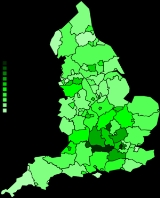
The strength of the English economy varies from region to region. GDP, and GDP per capita is highest in London. The following table shows the GDP (2004) per capita of England as a whole and each of the nine regions.| Rank | Place | GDP per capita in Euros |
|---|---|---|
| England | 26 904 | |
| 1. | London | 44 401 |
| 2. | South East South East England South East England is one of the nine official regions of England, designated in 1994 and adopted for statistical purposes in 1999. It consists of Berkshire, Buckinghamshire, East Sussex, Hampshire, Isle of Wight, Kent, Oxfordshire, Surrey and West Sussex... |
31 300 |
| 3. | East of England East of England The East of England is one of the nine official regions of England. It was created in 1994 and was adopted for statistics from 1999. It includes the ceremonial counties of Essex, Hertfordshire, Bedfordshire, Cambridgeshire, Norfolk and Suffolk. Essex has the highest population in the region.Its... |
27 778 |
| 4. | South West South West England South West England is one of the regions of England defined by the Government of the United Kingdom for statistical and other purposes. It is the largest such region in area, covering and comprising Bristol, Gloucestershire, Somerset, Dorset, Wiltshire, Devon, Cornwall and the Isles of Scilly. ... |
27 348 |
| 5. | East Midlands East Midlands The East Midlands is one of the regions of England, consisting of most of the eastern half of the traditional region of the Midlands. It encompasses the combined area of Nottinghamshire, Derbyshire, Leicestershire, Rutland, Northamptonshire and most of Lincolnshire... |
26 683 |
| 6. | West Midlands West Midlands (region) The West Midlands is an official region of England, covering the western half of the area traditionally known as the Midlands. It contains the second most populous British city, Birmingham, and the larger West Midlands conurbation, which includes the city of Wolverhampton and large towns of Dudley,... |
25 931 |
| 7. | North West North West England North West England, informally known as The North West, is one of the nine official regions of England.North West England had a 2006 estimated population of 6,853,201 the third most populated region after London and the South East... |
25 396 |
| 8. | Yorkshire and the Humber Yorkshire and the Humber Yorkshire and the Humber is one of the nine regions of England and formally one of the government office regions. It covers most of the historic county of Yorkshire, along with the part of northern Lincolnshire that was, from 1974 to 1996, within the former shire county of Humberside. The... |
25 300 |
| 9. | North East North East England North East England is one of the nine official regions of England. It covers Northumberland, County Durham, Tyne and Wear, and Teesside . The only cities in the region are Durham, Newcastle upon Tyne and Sunderland... |
22 886 |
Two of the 10 economically strongest areas in the European Union are in England. Inner London
Inner London
Inner London is the name for the group of London boroughs which form the interior part of Greater London and are surrounded by Outer London. The area was first officially defined in 1965 and for purposes such as statistics, the definition has changed over time. The terms Inner London and Central...
is number 1 with a €71 338 GDP per capita (303% above EU average); Berkshire
Berkshire
Berkshire is a historic county in the South of England. It is also often referred to as the Royal County of Berkshire because of the presence of the royal residence of Windsor Castle in the county; this usage, which dates to the 19th century at least, was recognised by the Queen in 1957, and...
, Buckinghamshire & Oxfordshire
Oxfordshire
Oxfordshire is a county in the South East region of England, bordering on Warwickshire and Northamptonshire , Buckinghamshire , Berkshire , Wiltshire and Gloucestershire ....
is number 7 with a €40 937 GDP per capita (174% above EU average).
Although being in South West England, which is the 4th strongest region in England, Cornwall
Cornwall
Cornwall is a unitary authority and ceremonial county of England, within the United Kingdom. It is bordered to the north and west by the Celtic Sea, to the south by the English Channel, and to the east by the county of Devon, over the River Tamar. Cornwall has a population of , and covers an area of...
and the Isles of Scilly
Isles of Scilly
The Isles of Scilly form an archipelago off the southwestern tip of the Cornish peninsula of Great Britain. The islands have had a unitary authority council since 1890, and are separate from the Cornwall unitary authority, but some services are combined with Cornwall and the islands are still part...
(combined into a NUTS:3 region for statistical purposes) is the weakest area in England, with a GDP per capita of €18 645 per capita, or 79% of the EU average of €21 503.
See also
- Economy of Northern IrelandEconomy of Northern IrelandThe economy of Northern Ireland is the smallest of the four countries in the United Kingdom. Northern Ireland has traditionally had an industrial economy, most notably in shipbuilding, rope manufacture and textiles, but most heavy industry has since been replaced by services...
- Economy of ScotlandEconomy of ScotlandThe economy of Scotland is closely linked with the rest of the United Kingdom and the wider European Economic Area. Scotland has the second largest GVA per capita of countries in the United Kingdom after England, though it is still lower than the average of the United Kingdom as a whole...
- Economy of WalesEconomy of WalesThe Economy of Wales. In 2010, according to ONS provisional data, headline gross value added in Wales was £44,517m, making the Welsh economy the tenth largest of the UK's twelve regions ahead of only Northern Ireland and the North East of England...
- Economy of the United KingdomEconomy of the United KingdomThe economy of the United Kingdom is the sixth-largest national economy in the world measured by nominal GDP and seventh-largest measured by purchasing power parity , and the third-largest in Europe measured by nominal GDP and second-largest measured by PPP...
- Economy of EuropeEconomy of EuropeThe economy of Europe comprises more than 731 million people in 48 different states. Like other continents, the wealth of Europe's states varies, although the poorest are well above the poorest states of other continents in terms of GDP and living standards. The difference in wealth across...
- List of country subdivisions by GDP over USD 100 billions