


Dinghy sailing

Encyclopedia
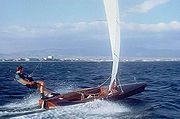
Sailing
Sailing is the propulsion of a vehicle and the control of its movement with large foils called sails. By changing the rigging, rudder, and sometimes the keel or centre board, a sailor manages the force of the wind on the sails in order to move the boat relative to its surrounding medium and...
small boats by using five essential
Five essentials
The five essentials of sailing describes the five key things that a dinghy sailor uses to sail the boat as efficiently as possible. The five essentials are:*Boat balance - which side the sailor sits on and how far out to make sure the boat sails level....
controls:
- the sailSailA sail is any type of surface intended to move a vessel, vehicle or rotor by being placed in a wind—in essence a propulsion wing. Sails are used in sailing.-History of sails:...
s - the foilsHydrofoilA hydrofoil is a foil which operates in water. They are similar in appearance and purpose to airfoils.Hydrofoils can be artificial, such as the rudder or keel on a boat, the diving planes on a submarine, a surfboard fin, or occur naturally, as with fish fins, the flippers of aquatic mammals, the...
(i.e. the daggerboardDaggerboardA daggerboard is a retractable centreboard used by various sailing craft. While other types of centreboard may pivot to retract, a daggerboard slides in a casing. The shape of the daggerboard converts the forward motion into a windward lift, countering the leeward push of the...
or centreboardCentreboardA centreboard or centerboard is a retractable keel which pivots out of a slot in the hull of a sailboat, known as a centreboard trunk or centerboard case...
and rudderRudderA rudder is a device used to steer a ship, boat, submarine, hovercraft, aircraft or other conveyance that moves through a medium . On an aircraft the rudder is used primarily to counter adverse yaw and p-factor and is not the primary control used to turn the airplane...
and sometimes lifting foils as found on the Moth). - the trim (forward/rear angle of the boat in the water)
- side to side balance of the dinghy by movement of the crewCrewA crew is a body or a class of people who work at a common activity, generally in a structured or hierarchical organization. A location in which a crew works is called a crewyard or a workyard...
, particularly in windy weather ("move fast or swim"). - the choice of route (in terms of existing and anticipated wind shifts, possible obstacles, other water traffic, currents, tides etc.).
When racing
Dinghy racing
Dinghy racing is the competitive sport of sailing dinghies. Dinghy racing has affected aspects of the modern dinghy, including hull design, sail materials and sailplan, and techniques such as planing and trapezing.-Organisation of dinghy racing:...
, the above skills need to be refined and additional skills and techniques learned, such as the application of the "racing rules of sailing
Racing Rules of Sailing
The Racing Rules of Sailing govern the conduct of yacht racing, windsurfing, kitesurfing, model boat racing, dinghy racing and virtually any other form of racing around a course with more than one vessel while powered by the wind...
", boat handling skills when starting and when rounding marks, and knowledge of tactics and strategy. Racing tactics include sailing so as to minimise the effect of other competitor's sails on your speed, or to influence their movements to your advantage.
Those shared challenges, and the variability of the weather and sea can make dinghy sailing and racing a fascinating and rewarding recreational sport: physically, mentally, and in terms of personal relationships with other crew member(s), competitors, and organizers. The RYA
Rya
A rya is a traditional Scandinavian wool rug with a long pile of about 1 to 3 inches. They were made using a form of the Ghiordes knot to make the double-sided pile fabric. Though rya means "rug" in English, the original meaning in Sweden of rya was a bed cover with a knotted pile...
, regulating authority for sail training in the UK and Europe, states that "With a reliance on nature and the elements, sailing ... is about adventure, exploration, teamwork and fun."
Early beginnings
There has always been a need for small tender boats for transporting goods and personnel to and from anchored sailing ships. Together with other smaller work craft such as fishing and light cargo, small inshore craft have always been in evidence. Charles II of EnglandCharles II of England
Charles II was monarch of the three kingdoms of England, Scotland, and Ireland.Charles II's father, King Charles I, was executed at Whitehall on 30 January 1649, at the climax of the English Civil War...
had a private sailing boat presented to him when he returned from exile to England in the 17th century, and he sailed for recreation and competition.
In 1887 Thomas Middleton, A Dublin Solicitor considered that yacht racing was becoming an excessively expensive activity, with boats becoming eclipsed by better designs each year. He proposed the 'One design' principle. He wanted yacht racing to be an exercise of skill with all boats being built to the same design. He called the boat 'The Water Wag'. The Water Wag Club still prospers in Dun Laoghaire harbour, with racing each Wednesday evening during the Summer season.
Towards the end of the 19th century people began to use these small boats for sport and recreational sailing, utilising the opportunities for leisure afforded by the industrial revolution
Industrial Revolution
The Industrial Revolution was a period from the 18th to the 19th century where major changes in agriculture, manufacturing, mining, transportation, and technology had a profound effect on the social, economic and cultural conditions of the times...
. Larger privately used sailing boats had developed separately, and have resulted in the yacht
Yacht
A yacht is a recreational boat or ship. The term originated from the Dutch Jacht meaning "hunt". It was originally defined as a light fast sailing vessel used by the Dutch navy to pursue pirates and other transgressors around and into the shallow waters of the Low Countries...
s of today. There has been some crossover, in that the sloop
Sloop
A sloop is a sail boat with a fore-and-aft rig and a single mast farther forward than the mast of a cutter....
sail plan was adopted as standard and most convenient by early dinghy designers.
Planing and trapezing

Uffa Fox
Uffa Fox CBE was an English boat designer and sailing enthusiast.-Life:Uffa Fox was born on the Isle of Wight and was raised in East Cowes. He lived for a while in Puckaster on the Isle of Wight.-Work:...
(1898–1972), an English boat designer and sailing enthusiast. He developed and contributed to many dinghy classes which are still with us nearly a century later: the Albacore
Albacore (dinghy)
The Albacore is a 4.57 m two-sailed planing dinghy developed in 1954 from an Uffa Fox design. Hulls may be made of either wood or fibreglass....
, International 14
International 14
The International 14 is 14-foot double-handed racing dinghy. The class originated in England in the early part of the 20th century. It is sailed and raced in many countries around the world and was one of the very first true international racing dinghy classes recognised by International Sailing...
, National 12, the Firefly
Firefly (dinghy)
The Firefly is a two-sail, wooden or GRP sailing dinghy with no spinnaker, designed by Uffa Fox in 1938. Although designed as a double hander, it was selected as the single handed class for the 1948 Olympics but was subsequently replaced by the Finn class. The class then became popular as a double...
, Flying Fifteen and the Scorpion
Scorpion (dinghy)
The Scorpion is a class of small sailing dinghy. The Scorpion is a lightweight, high performance, two person racing dinghy. Its adjustable rig enables sailing in all weathers to crews of all weights, ages and experiences. The Scorpion was originally designed for launch and recovery through Cornish...
.
He also introduced the major advance of hull shapes which can plane
Planing (sailing)
Planing is the mode of operation for a waterborne craft in which its weight is predominantly supported by hydrodynamic lift, rather than hydrostatic lift .-History:...
, and which can therefore reach beyond the usual speed limits for small sailing boats. In effect, a boat which is planing is skimming along the surface, rising up on its own bow wave. This results in less friction because of reduced waterline
Waterline
The term "waterline" generally refers to the line where the hull of a ship meets the water surface. It is also the name of a special marking, also known as the national Load Line or Plimsoll Line, to be positioned amidships, that indicates the draft of the ship and the legal limit to which a ship...
length, reduced displacement (the amount of water needing to be pushed aside by the boat), and reduced 'wetted area
Wetted area
In sailboating, the wetted area is the area of the hull which is immersed in water.In aircraft, the wetted area is the area which is in contact with the external airflow...
'. The power given by the sails has to overcome less resistance, and therefore speed increases dramatically.
In 1928 Uffa Fox introduced planing to the English dinghy racing world in his International 14 boat, the Avenger. He gained 52 first places, two second places and three third places out of 57 race starts that year. Note: Graham Anderson in his 1999 book Fast Light Boats, a Century of Kiwi Innovation argues that planing centreboard sailing boats were introduced into New Zealand in the early 20th century - well before Uffa Fox popularised the concept.
Another advance in dinghy sailing was introduced in the 1930s, when the technique of trapezing
Trapeze (sailing)
In sailing, the trapeze refers to a wire that comes from a point high on the mast, usually where the shrouds are fixed, to a hook on the crew member's harness at approximately waist level...
was introduced. This involves using the crew to provide more leverage to keep the sails vertical, by hanging outside the boat on a harness and rope attached to the 'hounds' or upper mast
Mast (sailing)
The mast of a sailing vessel is a tall, vertical, or near vertical, spar, or arrangement of spars, which supports the sails. Large ships have several masts, with the size and configuration depending on the style of ship...
. As a result the boat is easier to keep upright, and the sails can deliver maximum power most of the time.
Trapezing during a race first appeared in 1934, on the Thames A Class Rater
Thames A Class Rater (scow)
The Thames A Class Rater is both a historic and modern specialist sailing craft designed for the particular conditions at Thames Sailing Club, on the River Thames at Surbiton in England...
Vagabond sailed by Peter Scott
Peter Scott
Sir Peter Markham Scott, CH, CBE, DSC and Bar, MID, FRS, FZS, was a British ornithologist, conservationist, painter, naval officer and sportsman....
(son of the famous Scott of the Antarctic
Robert Falcon Scott
Captain Robert Falcon Scott, CVO was a Royal Navy officer and explorer who led two expeditions to the Antarctic regions: the Discovery Expedition, 1901–04, and the ill-fated Terra Nova Expedition, 1910–13...
), and John Winter. The owner of the boat, Beecher Moore
Beecher Moore
Beecher Moore, was a highly influential figure in the development of dinghy sailing in the United Kingdom after the Second World War...
, of Thames Sailing Club had worked on developing the technique, in discussion with Uffa Fox. Vagabond was spectacularly successful in that race, winning by four minutes.
The innovative technique was immediately banned, and received little development until it was reintroduced on the Osprey and Fiveohfive Class (505
505 (dinghy)
The International 505 is a one-design high-performance two-person monohull planing centerboard dinghy, with spinnaker, utilizing a trapeze for the crew...
) in 1954 by John Westell and the Flying Dutchman
Flying Dutchman (dinghy)
thumbthumbThe Flying Dutchman is a 20-foot one-design high-performance two-person monohull racing dinghy. Developed in the early 1950s, its large sail area per unit weight allow it to plane easily when sailing upwind. The boat utilizes a trapeze harness for the crew and hiking straps for the...
class in the early 1960s.
Post WWII developments
During the Second World War plywood had become a major building material for aircraft. After the war, plywood was adapted for building sailing dinghies. Two primary methods of construction were adopted: Stitch and glueStitch and glue
Stitch and glue is a simple boat building method which uses plywood, epoxy glue, and "stitches" and eliminates the need for stems and chines. Plywood panels are cut to detailed profiles and stitched together to form an accurate hull shape, without the need for forms or special tools...
and timber framed construction. Jack Holt
Jack Holt (dinghy designer)
Jack Holt, OBE was a prolific designer of sailing dinghies. His pioneering designs of dingies using plywood did much to popularise the sport of sailing in the period immediately following World War II....
designed many dinghies to be built by home handymen using these construction techniques. The Mirror Dinghy was predominantly built using stitch and glue, while the Heron
Heron (dinghy)
The Heron Dinghy is a dinghy designed by Jack Holt of the United Kingdom as the Yachting World Cartopper . The Heron dinghy was designed to be built by a home handyman out of marine ply over a timber frame, but can now also be constructed from marine ply using a stitch and glue technique or from...
is an example of a boat built using plywood on a timber frame.
Modern developments
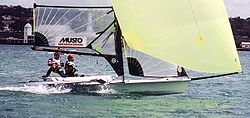
Rigging
Rigging is the apparatus through which the force of the wind is used to propel sailboats and sailing ships forward. This includes masts, yards, sails, and cordage.-Terms and classifications:...
such as Gennaker
Gennaker
A gennaker is a sail that was developed around 1990. Used when sailing downwind, it is a cross between a genoa and a spinnaker. It is asymmetric like a genoa, but the gennaker is not attached to the forestay like a jib or genoa. The gennaker is rigged like a spinnaker but the tack is fastened to...
s instead of more complex Spinnaker
Spinnaker
A spinnaker is a special type of sail that is designed specifically for sailing off the wind from a reaching course to a downwind, i.e. with the wind 90°–180° off the bow. The spinnaker fills with wind and balloons out in front of the boat when it is deployed, called flying. It is constructed of...
s. These advances are more economical in time and money, and have greatly extended the appeal of dinghy sailing.
Increasingly sailing is a young person's sport, and the number of participants is mushrooming. In many dinghy clubs in the UK
United Kingdom
The United Kingdom of Great Britain and Northern IrelandIn the United Kingdom and Dependencies, other languages have been officially recognised as legitimate autochthonous languages under the European Charter for Regional or Minority Languages...
the adult members are sometimes outnumbered by junior members, and the balance of activities can change from mainly racing to increasingly providing training courses.
Sailing is also becoming more accessible to people with disabilities, partly through new boat designs, and generally through recognition of everybody's right to participate in all areas of life. (See the Sailability website)
In Britain
United Kingdom
The United Kingdom of Great Britain and Northern IrelandIn the United Kingdom and Dependencies, other languages have been officially recognised as legitimate autochthonous languages under the European Charter for Regional or Minority Languages...
dinghy sailing has also been considerably advanced by the RYA
Rya
A rya is a traditional Scandinavian wool rug with a long pile of about 1 to 3 inches. They were made using a form of the Ghiordes knot to make the double-sided pile fabric. Though rya means "rug" in English, the original meaning in Sweden of rya was a bed cover with a knotted pile...
, the regulatory authority which regulates racing and which provides modular and accredited training courses for leisure and competitive sailing. A basic sailing course can be completed in several days, and participants can be sure that the training is competent and delivered in a safe setting. Similar organisations exist worldwide in most other countries to administer and promote both leisure and competitive sailing.
Types of dinghies
Some dinghies come into more than one category, either because boundaries overlap or because different categories are measuring different things; e.g. both "one design" boats and boats of much freer design can be found in each of the main categories below.Dinghy designs are often referred to as "classes"; these classes are usually categorised as one design, open, or restricted. A more formal term for open is "Development Class". One design dinghies are supposed to be identical, though in reality this is not always the case. Only the most restrictive one design classes will restrict individual fittings. Then there becomes a sliding scale of allowable modification or design differences; restricted classes would typically allow the movement of fittings or even parts of the boat around, but are unlikely to allow major changes to hull shape or sails. Truly open development classes are also almost unknown, the famous line about the 18ft skiff "the boat shall be 18ft long and the race starts at 2 o'clock" is a myth but open classes will usually allow pretty radical changes within usually some kind of box rule which specifies depth, length, width of hull height of mast and sometimes a minimum weight and sail area.
Classes which are not development classes are usually referred to as "One design". The idea is that One Designs provide a fair and level playing field for even competition, where as Development Classes drive boat speed and technology forwards. The first one design was the Water Wag designed by Thomas Middleton, which first sailed in Dublin Bay
Dublin Bay
Dublin Bay is a C-shaped inlet of the Irish Sea on the east coast of Ireland. The bay is about 10 kilometres wide along its north-south base, and 7 km in length to its apex at the centre of the city of Dublin; stretching from Howth Head in the north to Dalkey Point in the south...
in 1887. The class is still sailed today, well over a hundred years later.
Skiff
Skiff
The term skiff is used for a number of essentially unrelated styles of small boat. The word is related to ship and has a complicated etymology: "skiff" comes from the Middle English skif, which derives from the Old French esquif, which in turn derives from the Old Italian schifo, which is itself of...
s are the fastest and arguably most difficult type of dinghy to sail. A skiff has a flat narrow hull with a disproportionately large sailplan, usually consisting of an asymmetric spinnaker, blade jib and fully battened main. Sailors manage the rig with the use of racks (wings) and trapeze. Examples are the 49er
49er (dinghy)
The 49er is a double handed twin trapeze skiff type sailing dinghy. The two crew work on different roles with the helm making many tactical decisions, as well as steering, and the crew doing most of the sail control. The design, by Julian Bethwaite, the son of Frank Bethwaite , is revolutionary...
, an Olympic boat, 18 Footers (see below) and the advanced International 14
International 14
The International 14 is 14-foot double-handed racing dinghy. The class originated in England in the early part of the 20th century. It is sailed and raced in many countries around the world and was one of the very first true international racing dinghy classes recognised by International Sailing...
.
High Performance dinghies are fast and powerful dinghies designed for racing around an Olympic triangle
Olympic triangle
The Olympic triangle is a sailing course used in racing dinghies, particularly at major regattas like State, National and World Titles and was used at the Olympics...
(Olympic Racing Course). Examples of such dinghies are the International Flying Dutchman
Flying Dutchman (dinghy)
thumbthumbThe Flying Dutchman is a 20-foot one-design high-performance two-person monohull racing dinghy. Developed in the early 1950s, its large sail area per unit weight allow it to plane easily when sailing upwind. The boat utilizes a trapeze harness for the crew and hiking straps for the...
, the International 505
505 (dinghy)
The International 505 is a one-design high-performance two-person monohull planing centerboard dinghy, with spinnaker, utilizing a trapeze for the crew...
, the Jet 14
Jet 14
The Jet 14 sailboat is a One-Design racing dinghy. The fleets are organized by the Jet 14 Class Association, which is broken into four divisions based upon geographical locations of the fleets. District I is in New Jersey, District II is in Ohio, District III is in Maryland, and District IV is in...
, the Fireball
Fireball (dinghy)
Originally designed by Peter Milne in 1962, the Fireball is a one-design high-performance sailing dinghy. The Fireball is sailed by a crew of two, and sports a single trapeze, symmetric spinnaker and chined hull. The class is strictly controlled, but has adapted to advances in building techniques...
, the Osprey, the Javelin
Javelin dinghy
The Javelin can refer to several different class of boats. The boats are significantly different and only have the same name by coincidence.-Javelin :...
and the International 470
470 (dinghy)
The 470 is a double-handed monohull planing dinghy with a centreboard, Bermuda rig, and centre sheeting. The name is the overall length of the boat in centimetres . The hull is fibreglass with integral buoyancy tanks. The 470 is equipped with spinnaker and trapeze, making teamwork necessary to...
. They can all plane easily, even upwind and they use trapeze and a symmetric spinnaker. Not all are two handed boats: the International Contender
Contender (dinghy)
The International Contender is a single-handed high performance sailing dinghy, designed by Bob Miller, latterly known as Ben Lexcen, in 1967 as a possible successor to the Finn dinghy for Olympic competition....
and the RS600
RS600 (dinghy)
The RS600 is a sailing dinghy designed by Clive Everest and Nick Peters and supplied by RS Sailing. It is a single hander with trapeze and racks. It has a Portsmouth Yardstick of 920.-Performance and design:...
are high performance single handed boats equipped with a trapeze, but not a spinnaker, and demonstrate a comparable performance. Skiff
Skiff
The term skiff is used for a number of essentially unrelated styles of small boat. The word is related to ship and has a complicated etymology: "skiff" comes from the Middle English skif, which derives from the Old French esquif, which in turn derives from the Old Italian schifo, which is itself of...
s are usually classed as High performance dinghies.
Racing dinghies are designed for racing, but not all have necessarily the same calibre of performance as the above. However in many cases they can still offer equally close competition, at the very highest standards, which for many racing helmsmen and crews is the most important consideration. They cover a wide range, and many are descended from Uffa Fox's seminal International 14. People often "travel" with their dinghies to international races in famous sailing spots such as Lake Garda in Italy. The Snipe
Snipe (dinghy)
The Snipe is a foot, 2 person, one design racing dinghy. Designed by William Crosby in 1931, it has evolved into a modern, tactical racing dinghy with fleets around the world. The Snipe is simple, making it easy to sail and trailer. The boat is recognized by the International Sailing Federation as...
International Class
International Class
The designation International Class may be granted by the International Sailing Federation to classes of sail boat that offer a high standard of international competitive sailing and satisfy a number of criteria regarding the number of boats of that class, their international distribution, and the...
still stands as one of the strongest classes, after reaching the status of world's largest fleet of dinghies in July 1936. Other examples include the GP14
GP14 (dinghy)
The GP14 is a popular sailing dinghy, with over 14,000 built.The class is active in the UK, Ireland, Australia, South Africa, Sri Lanka and parts of north-eastern USA, and the GP 14 can be used for both racing and cruising. The boat is relatively heavy, but stable, and the weight and the...
, Enterprise
Enterprise (dinghy)
The Enterprise is a two-man sloop-rigged hiking sailing dinghy with distinctive blue sails. Despite being one of the older classes of dinghies, it remains popular in the United Kingdom and about a dozen other countries, and is used for both cruising and racing. It has a combination of size, weight,...
, Solo
Solo (dinghy)
The National Solo class is a racing dinghy designed by Jack Holt in 1956. The Solo is sailed in the United Kingdom, Holland and Australia.Originally designed in wood, competitive boats are now widely available in Fibre Reinforced Plastic or composite construction as well as wood.2006 was the 50th...
, Graduate
Graduate (dinghy)
The Graduate is a 12.5-foot sailing dinghy. Rules for the class allow for customization the boat with rigs of various sophistication.- References:...
, Firefly
Firefly (dinghy)
The Firefly is a two-sail, wooden or GRP sailing dinghy with no spinnaker, designed by Uffa Fox in 1938. Although designed as a double hander, it was selected as the single handed class for the 1948 Olympics but was subsequently replaced by the Finn class. The class then became popular as a double...
, Lark
Lark (dinghy)
The Lark is a two-person, non-trapeze sailing dinghy, designed in 1966 by Michael Jackson . All Larks are made of glass-reinforced plastic . The Lark is a one-design class which leads to very close racing.The boat is very popular in the UK with a new builder signed up in 2010...
.
Cruising dinghies are designed for leisure and family sailing and are usually more stable than high performance dinghies. This is provided by a 'chined' (less rounded) hull, greater displacement, and proportionally smaller sail area. Some are specifically designed for longer passage-making, and/or for camping aboard. Examples of these include the Wayfarer
Wayfarer (dinghy)
The Wayfarer is a wooden or fibreglass hulled Bermuda rigged sailing dinghy, often used for short sailing trips as a 'day boat'. The boat is 15 feet 10 inches long, and broad and deep enough for three adults to comfortably sail for several hours. Longer trips are undertaken by enthusiasts, notably...
, arguably the GP14
GP14 (dinghy)
The GP14 is a popular sailing dinghy, with over 14,000 built.The class is active in the UK, Ireland, Australia, South Africa, Sri Lanka and parts of north-eastern USA, and the GP 14 can be used for both racing and cruising. The boat is relatively heavy, but stable, and the weight and the...
, the Tideway, the Laser Stratos
Laser Stratos
The Laser Stratos is an all-round cruising and racing boat built by Laser Performance, the same company as the famous Laser Standard dinghy. It is built from fibre-glass and foam sandwich. The Laser Stratos comes in two forms, one with a keel and one with a centreboard . The centreboard version is...
, the Drascombe
Drascombe
The word Drascombe is a trademark that was first registered by who applied it to a series of sailing boats which he designed and built in the period 1965-79 and sold in the United Kingdom ....
series of dinghies, the CL 16
CL 16
The CL 16 is a British designed 16' sailboat first built in the 1950s. It is essentially the same design as the Wayfarer dinghy, with the addition of a double-hull. It continues to be produced by a Canadian company near Fort Erie, on Lake Ontario.The CL 16 is an open cockpit boat that is extremely...
and the Laser 16, plus many designs of Iain Oughtread and John Welsford. Sailing these boats can still give much excitement.
Cruiser-Racer dinghies successfully combine elements of both the immediately previous two groups, offering good racing performance and also being very viable cruising boats. Arguably the only two world-class cruiser-racer dinghies, in terms of both the extensive availability of top class racing and their suitability for serious cruising, are the Wayfarer
Wayfarer (dinghy)
The Wayfarer is a wooden or fibreglass hulled Bermuda rigged sailing dinghy, often used for short sailing trips as a 'day boat'. The boat is 15 feet 10 inches long, and broad and deep enough for three adults to comfortably sail for several hours. Longer trips are undertaken by enthusiasts, notably...
and the GP14
GP14 (dinghy)
The GP14 is a popular sailing dinghy, with over 14,000 built.The class is active in the UK, Ireland, Australia, South Africa, Sri Lanka and parts of north-eastern USA, and the GP 14 can be used for both racing and cruising. The boat is relatively heavy, but stable, and the weight and the...
; of these the Wayfarer has the edge for cruising, once on the water, in part because she is the larger boat, while the GP14 has the edge for racing. However the Mirror and her larger sisters, and the Heron
Heron (dinghy)
The Heron Dinghy is a dinghy designed by Jack Holt of the United Kingdom as the Yachting World Cartopper . The Heron dinghy was designed to be built by a home handyman out of marine ply over a timber frame, but can now also be constructed from marine ply using a stitch and glue technique or from...
, can also be regarded as coming into this category.
Classic dinghies are typically used as yacht tenders or shore boats, and emphasize beauty and versatility over sailing performance. Although many are still made entirely from wood, the majority of the most popular classic sailing dinghies combine a fiberglass hull with enough finely finished teak or mahogany to represent the "best of two worlds" approach. Examples of classic sailing dinghies are Minto
Minto Sailing Dinghy
The Minto Sailing Dinghy is a sailing dinghy first produced commercially in the early 1960 and still in production.-Initial version:The Minto Sailing Dinghy began its life as a skiff for a 24 foot sloop built by Hugh Rodd at Canoe Cove on Vancouver Island...
, Fatty Knees
Fatty Knees (dinghy)
The Fatty Knees fibreglass sailing dinghies were designed by Lyle Hess . Produced in 7’ , 8’ and 9’ long models. The 8’ model has a 4’ beam. Primarily designed as a yacht tender with good rowing and towing characteristics, the boat can be sailed, with enough width in the beam to provide...
, Trinka, Bauer, Whitehall and Gig Harbor.
Safety dinghies were designed to be used as yacht tenders with the added function of proactive self-rescue boat that can be sailed to safety. These boats are also used as recreational sailboats. Some of them can be fitted out with exposure canopies, sea anchors, and other survival gear.
Catamaran
Catamaran
A catamaran is a type of multihulled boat or ship consisting of two hulls, or vakas, joined by some structure, the most basic being a frame, formed of akas...
s are fast twin hulled boats that fall under the definition of dinghy, unlike dinghies catamarans have high aspect ratio rigs with fully battened mainsails and a rotating mast, this allows the rig to be highly aerodynamic and gives a catamaran with two slim hulls its great speed advantage over traditional monohulls. Dinghy-sized catamarans are sometimes referred to as "Beach Catamarans".
The International 14
International 14
The International 14 is 14-foot double-handed racing dinghy. The class originated in England in the early part of the 20th century. It is sailed and raced in many countries around the world and was one of the very first true international racing dinghy classes recognised by International Sailing...
remains a popular racing class, having acquired racks (for trapezing crews) and a gennaker since its original design. The Laser Standard
Laser (dinghy)
The International Laser Class sailboat, also called Laser Standard and the Laser One is a popular one-design class of small sailing dinghy. According the Laser Class Rules the boat may be sailed by either one or two people, though it is rarely sailed by two. The design, by Bruce Kirby, emphasizes...
, Laser Radial
Laser Radial
The Laser Radial is a popular one-design class of small sailing dinghy, originally built by Laser Performance. It is a singlehanded boat, meaning that it is sailed by one person. The Laser Radial is a variant of the Laser Standard, with shorter mast and reduced sail area, allowing light sailors to...
and Laser 4.7
Laser 4.7
The Laser 4.7 is a one-design dinghy class in the Laser series and is a one-design class of sailboat. All Lasers are built to the same specifications. The Laser is 4.06 m long, with a waterline length of 3.81 m . The hull weight is 59 kg...
are the variants of the Laser dinghy, a single-hander whose combination of simplicity, portability and performance has done much to advance dinghy racing and training. More modern dinghies like the Musto Skiff, Splash
Splash (dinghy)
The Splash Dinghy is 3.5m in length and all boats are identical, thus, as is typical in One-Design classes, the sailor's ability rather than equipment is emphasised fleet racing. The boats employ an un-stayed mono rig with a sail area of 5.5 m2, which makes the class easy to handle by sailors...
, RS600
RS600 (dinghy)
The RS600 is a sailing dinghy designed by Clive Everest and Nick Peters and supplied by RS Sailing. It is a single hander with trapeze and racks. It has a Portsmouth Yardstick of 920.-Performance and design:...
and RS Vareo
RS Vareo
The RS Vareo is a modern, single handed sailing dinghy widely raced throughout the UK at both club and national level. It is a unique dinghy manufactured by RS Sailing. The RS Vareo is a hiking singlehander with an asymmetric spinnaker....
have also increased dinghy sailing participation around the UK. Two popular dinghies used in high school
High school
High school is a term used in parts of the English speaking world to describe institutions which provide all or part of secondary education. The term is often incorporated into the name of such institutions....
and college racing are the 420
420 (dinghy)
The International 420 Class Dinghy is a double-handed monohull planing dinghy with centreboard, bermuda rig and centre sheeting. The name describes the overall length of the boat in centimetres . The hull is fibreglass with internal buoyancy tanks. The 420 is equipped with spinnaker and optional...
and Flying Junior
Flying Junior
thumb|Coen Gulcher helming one of the first Flying Juniors The International Flying Junior or FJ is a sailing dinghy which was originally designed in 1955 in the Netherlands by renowned boat designer Van Essen and Olympic sailor Conrad Gülcher. The FJ was built to serve as a training boat for the...
.
Sports Boats: These classes are larger off-shore racing dinghies which shade off into classes of yachts with fixed keels. Usually they have several crew members as well as the helm. Melges 24
Melges 24
The Melges 24 is a one-design class of sailboat commonly used for racing. The boat is notable for its ability to plane over the water downwind in modest winds, and for its combination of a simple design that is highly tunable....
and Laser SB3 are current examples of this type.
Development classes: Most dinghy classes have a fairly fixed layout of sails and hull design, and changes are very infrequent. However, some classes can compete and sail with less rigid definitions and measurements. This encourages experiment which often leads to innovation in techniques and construction. Examples are the International 14, National 12, the 18ft Skiff
18ft Skiff
The 18ft Skiff is considered the fastest class of sailing skiffs. The class has a long history beginning with races on Sydney Harbour, Australia in 1892. The boat has changed significantly since the early days, bringing in new technology as it became available. Because of the need of strength,...
, the Puddle Duck Racer
Puddle Duck Racer
A Puddle Duck Racer or PD Racer is an 8 foot long, 4 foot wide, 16 inch high, spec series, racing sailboat or day sailer. It is a one design hull shape with wide options in other areas. Billed as "the easiest sailboat in the world to build", the scow hull is a simple box, usually built of...
and the Moth (dinghy)
Moth (dinghy)
The Moth Class is the name for a small development class sailing dinghy. There are three "species" of moths currently in existence: the International Moth, a fast sailing hydrofoil dinghy with liberal restrictions; the Classic Moth, a traditional dinghy with tighter restrictions; and the British...
. The International Moth is worth noting because of its use of lifting foils on the rudder and daggerboard. These generate enough lift to push the hull above the water, significantly reducing friction and allowing speeds in excess of 25 knots (49 km/h).
Learning to sail
Many people learn to sail at accredited sailing schools, or through their local sailing club. Many of these schools teach certificated syllabuses which first of all teach the beginner how to sail in manageable chunks, and then after the first couple of lessons they usually begin teaching more advanced skills or moving onto more powerful rigs.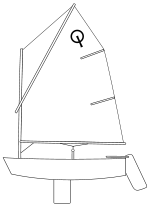
Optimist (dinghy)
The Optimist is a small, single-handed sailing dinghy intended for use by children up to the age of 15. Nowadays boats are usually made of fiber reinforced plastic, although wooden boats are still built....
, Topper
Topper (dinghy)
The Topper is an 11 foot sailing dinghy designed by Ian Proctor. The Topper is a one-design boat sailed mostly in the British Isles. It was recognised as an International class by the International Sailing Federation...
and the Laser Funboat and Picos. The Wayfarer was the standard teaching boats for Adult schemes, however many centres have moved onto more modern 'Centre-Main' boats such as the Laser Stratos
Laser Stratos
The Laser Stratos is an all-round cruising and racing boat built by Laser Performance, the same company as the famous Laser Standard dinghy. It is built from fibre-glass and foam sandwich. The Laser Stratos comes in two forms, one with a keel and one with a centreboard . The centreboard version is...
and Topaz Omega. In Australia the main boats children learn in are Sabot
Sabot
A sabot is a device used in a firearm or cannon to fire a projectile, such as a bullet, that is smaller than the bore diameter, or which must be held in a precise position. The term is also applied to a battery stub case, a device used similarly to make a small electrical battery usable in a...
, Manly Junior
Manly Junior
The Manly Junior is a junior racing dinghy class popular in Sydney Australia. It was designed in 1959 for younger sailors and the length was originally decided so that the boat could be stored vertically downstairs inside Manly Yacht Club...
, Heron
Heron (dinghy)
The Heron Dinghy is a dinghy designed by Jack Holt of the United Kingdom as the Yachting World Cartopper . The Heron dinghy was designed to be built by a home handyman out of marine ply over a timber frame, but can now also be constructed from marine ply using a stitch and glue technique or from...
Flying Eleven
Flying Eleven (dinghy)
The Flying Eleven is an Australian boat designed as a high performance racing skiff suitable for 12 to 18 year olds. High performance sailing is fast becoming the goal of a great many dinghy sailors with the appearance of 49ers as an Olympic class...
with the Optimist
Optimist (dinghy)
The Optimist is a small, single-handed sailing dinghy intended for use by children up to the age of 15. Nowadays boats are usually made of fiber reinforced plastic, although wooden boats are still built....
becoming more popular. Adults often learn in Spirals
Spiral (dinghy)
The Spiral is a type or class of sailing dinghy.It is similar to a Laser , but smaller and easier to manoeuvre on land and in the water, and suited to a skipper of smaller body weight and less athleticism than is a Laser.-External links:...
or Lasers
Laser (dinghy)
The International Laser Class sailboat, also called Laser Standard and the Laser One is a popular one-design class of small sailing dinghy. According the Laser Class Rules the boat may be sailed by either one or two people, though it is rarely sailed by two. The design, by Bruce Kirby, emphasizes...
or by crewing in NS14
NS14
The NS14 is an Australian restricted development class of sailing dinghy. Measuring 14 feet in length, the class was designed the 1960 and introduced at the Northbridge sailing club in Sydney, Australia, with control of the class transferred to the NS14 Association of New South Wales in 1965...
s or Tasars
In the UK, the Royal Yachting Association
Royal Yachting Association
The Royal Yachting Association is the national governing body for certain watersports in the United Kingdom. Activities it covers include:* Sailing* Windsurfing* Motor cruising* Sportsboats* Personal watercraft* Powerboat racing...
is the governing body of all dinghy sailing qualifications offering youth Stage 1 through 4 certificates, and Adult Level 1 and 2 certificates. More and more boat hire companies ask to see certificates before they will allow you to hire out a boat. In Australia Yachting Australia fulfils a similar role.
On yachts in Australia a Competent Crew course is usually the first formal learn to sail course.
Dinghy racing
Racing is one of the most popular forms of dinghy sailing, and it contributes to the development of sailing skills as well as to improvements in dinghy and sail construction and design. Sometimes the Olympic triangleOlympic triangle
The Olympic triangle is a sailing course used in racing dinghies, particularly at major regattas like State, National and World Titles and was used at the Olympics...
is used as a course for dinghy races where space permits, particularly for events where there ought be little local advantage such as State and National titles and for classes which are mainly displacement sailing such as the Heron (dinghy)
Heron (dinghy)
The Heron Dinghy is a dinghy designed by Jack Holt of the United Kingdom as the Yachting World Cartopper . The Heron dinghy was designed to be built by a home handyman out of marine ply over a timber frame, but can now also be constructed from marine ply using a stitch and glue technique or from...
.
External references
- Puddle Duck Racer
- Dick Harrington, "Dinghy Cruising in a Wayfarer"
- Classic Boat Class Notes
- RYA website
- General information about dinghy sailing
- News, Opinion and Controversy from the Racing world of Sailing
- Hostellers Sailing Club: "All About Dinghy Cruising"
- Dinghy Cruising Association
- "Dinghy Cruising With Phillips"