

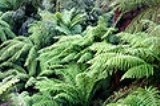
Dicksonia antarctica

Encyclopedia
Australia
Australia , officially the Commonwealth of Australia, is a country in the Southern Hemisphere comprising the mainland of the Australian continent, the island of Tasmania, and numerous smaller islands in the Indian and Pacific Oceans. It is the world's sixth-largest country by total area...
, namely south-east Queensland
Queensland
Queensland is a state of Australia, occupying the north-eastern section of the mainland continent. It is bordered by the Northern Territory, South Australia and New South Wales to the west, south-west and south respectively. To the east, Queensland is bordered by the Coral Sea and Pacific Ocean...
, coastal New South Wales
New South Wales
New South Wales is a state of :Australia, located in the east of the country. It is bordered by Queensland, Victoria and South Australia to the north, south and west respectively. To the east, the state is bordered by the Tasman Sea, which forms part of the Pacific Ocean. New South Wales...
and Victoria
Victoria (Australia)
Victoria is the second most populous state in Australia. Geographically the smallest mainland state, Victoria is bordered by New South Wales, South Australia, and Tasmania on Boundary Islet to the north, west and south respectively....
and Tasmania
Tasmania
Tasmania is an Australian island and state. It is south of the continent, separated by Bass Strait. The state includes the island of Tasmania—the 26th largest island in the world—and the surrounding islands. The state has a population of 507,626 , of whom almost half reside in the greater Hobart...
.
Anatomy and biology
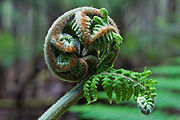
These ferns can grow to 15 m in height, but more typically grow to about 4.5-5 m, and consist of an erect rhizomeRhizome
In botany and dendrology, a rhizome is a characteristically horizontal stem of a plant that is usually found underground, often sending out roots and shoots from its nodes...
forming a trunk. They are very hairy at the base of the stipe
Stipe (botany)
In botany, a stipe is a stalk that supports some other structure. The precise meaning is different depending on which taxonomic group is being described....
(trunk). The large, dark green, roughly-textured frond
Frond
The term frond refers to a large, divided leaf. In both common usage and botanical nomenclature, the leaves of ferns are referred to as fronds and some botanists restrict the term to this group...
s spread in a canopy of 2-6 m in diameter. The shapes of the stems vary as some grow curved and there are multi-headed ones. The fronds are borne in flushes, with fertile and sterile fronds often in alternating layers.
The "trunk" of this fern is merely the decaying remains of earlier growth of the plant and forms a medium through which the roots grow. The trunk is usually solitary, without runners, but may produce offsets. They can be cut down and, if they are kept moist, the top portions can be replanted and will form new root
Root
In vascular plants, the root is the organ of a plant that typically lies below the surface of the soil. This is not always the case, however, since a root can also be aerial or aerating . Furthermore, a stem normally occurring below ground is not exceptional either...
s. The stump, however, will not regenerate since it is dead organic matter. In nature, the fibrous trunks are hosts for a range of epiphytic
Epiphyte
An epiphyte is a plant that grows upon another plant non-parasitically or sometimes upon some other object , derives its moisture and nutrients from the air and rain and sometimes from debris accumulating around it, and is found in the temperate zone and in the...
plants including other ferns and moss
Moss
Mosses are small, soft plants that are typically 1–10 cm tall, though some species are much larger. They commonly grow close together in clumps or mats in damp or shady locations. They do not have flowers or seeds, and their simple leaves cover the thin wiry stems...
es.
The fern grows at 3.5 to 5 cm per year and produces spore
Spore
In biology, a spore is a reproductive structure that is adapted for dispersal and surviving for extended periods of time in unfavorable conditions. Spores form part of the life cycles of many bacteria, plants, algae, fungi and some protozoa. According to scientist Dr...
s at the age of about 20 years.
Reproduction
Reproduction by this species is primarily from spores, but it can also be grown from plantlets occurring around the base of the rhizome.In cultivation, it can also be grown as a "cutting", a method not to be encouraged unless the tree-fern is doomed to die in its present position. This involves sawing the trunk through, usually at ground level, and removing the fronds; the top part will form roots and regrow, but the base will die.
Habitat
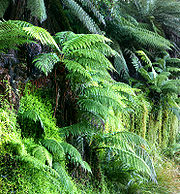
The fern grows on damp, sheltered woodland slopes and moist gullies, and they occasionally occur at high altitudes in cloud forests. Dicksonia antarctica is the most abundant tree fern in South Eastern Australia.The plant can grow in acid, neutral and alkaline soil
Soil
Soil is a natural body consisting of layers of mineral constituents of variable thicknesses, which differ from the parent materials in their morphological, physical, chemical, and mineralogical characteristics...
s. It can grow in semi-shade. It strongly resents drought or dryness at the roots, but does best in moist soil.
Cultivation
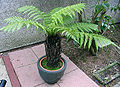
Ornamental plant
Ornamental plants are plants that are grown for decorative purposes in gardens and landscape design projects, as house plants, for cut flowers and specimen display...
, it is hardy to about –5 C, succeeding outdoors in the milder areas of Britain
Great Britain
Great Britain or Britain is an island situated to the northwest of Continental Europe. It is the ninth largest island in the world, and the largest European island, as well as the largest of the British Isles...
where it thrives and often self-sows in Cornish
Cornwall
Cornwall is a unitary authority and ceremonial county of England, within the United Kingdom. It is bordered to the north and west by the Celtic Sea, to the south by the English Channel, and to the east by the county of Devon, over the River Tamar. Cornwall has a population of , and covers an area of...
gardens.
It is best to leave old fronds on the plant in order to protect the trunk from cold and desiccation
Desiccation
Desiccation is the state of extreme dryness, or the process of extreme drying. A desiccant is a hygroscopic substance that induces or sustains such a state in its local vicinity in a moderately sealed container.-Science:...
. Winter protection of the trunk is recommended during prolonged or severe cold weather.
They grow best in areas of rainfall of over 1,000 mm per year but in lower rainfall areas do well in moist gullies. They are tolerant of fire and re-shoot readily after re-location. This plant can provide habitat for epiphytes and also provides shelter for more delicate fern species to flourish underneath.
Plant in organic soils and heavily and regularly mulched and water. Dicksonia antarctica generally requires a minimum rainfall of 500 mm (20 inches) per year. In dry climates, a drip irrigation or spray system applied overhead is the most effective method of watering.
Harvesting
Large Dicksonia antarctica available for sale come from old growth Tasmanian forests, and may be hundreds of years old. The logging practices by the company GunnsGunns
Gunns Limited is a major forestry enterprise located in Tasmania, Australia. Founded in 1875 by brothers John and Thomas Gunn, it is one of Australia's oldest companies. It has over 900 square kilometres of plantations, mainly eucalyptus trees. It is Tasmania’s largest private land-owner...
, who effectively have a state-monopoly on logging and make these plants available, have been criticized by green groups for several decades. The trunks are also available legally from local suppliers who licence collection of minor species from Forestry Tasmania
Forestry Tasmania
Forestry Tasmania is a Tasmanian state government-owned corporation. It runs the state-owned forestry for tourism and logging including the Tahune Airwalk and Upper Florentine Valley.-Controversy:...
, the State Government GBE who manage forestry.
Edibility
Pith
Pith, or medulla, is a tissue in the stems of vascular plants. Pith is composed of soft, spongy parenchyma cells, which store and transport nutrients throughout the plant. In eudicots, pith is located in the center of the stem. In monocots, it extends also into flowering stems and roots...
of the plant being eaten either cooked or raw. It is a good source of starch
Starch
Starch or amylum is a carbohydrate consisting of a large number of glucose units joined together by glycosidic bonds. This polysaccharide is produced by all green plants as an energy store...
.