

Veterinarian

Encyclopedia
A veterinary physician, colloquially called a vet, shortened from veterinarian (American English
) or veterinary surgeon (British English
), is a professional who treats disease, disorder and injury in animals.
In many countries, the local nomenclature for a vet is a regulated and protected term, meaning that members of the public without the prerequisite qualifications and/or registration are not able to use the title. In many cases, the activities that may be undertaken by a veterinarian (such as animal treatment or surgery) are restricted only to those professionals who are registered as vet. For instance, in the United Kingdom, as in other jurisdictions, animal treatment may only be performed by registered vets (with a few designated exceptions, such as paraveterinary workers
), and it is illegal for any person who is not registered to call themselves a vet or perform any treatment.
Most vets work in clinical settings, treating animals directly. These vets may be involved in a general practice, treating animals of all types; may be specialised in a specific group of animals such as companion animals
, livestock
, zoo animals
or horse
s; or may specialise in a narrow medical discipline such as surgery
, dermatology
or internal medicine
.
As with healthcare professionals, vets face ethical decisions about the care of their patients. Current debates within the profession include the ethics of purely cosmetic procedures on animals, such as declawing
of cats, docking of tails, cropping of ears
and debarking on dogs.
in 1646.
The term veterinarian is used in North America and other countries using predominantly American English
, whereas in the United Kingdom, and countries which are formerly part of the British Empire
or are part of the Commonwealth of Nations
tend to use the term veterinary surgeon.
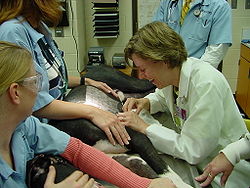 Vets are primarily required to treat disease, disorder or injury in animals, which includes diagnosis, treatment and aftercare. The scope of practice, speciality and experience of the individual vets will dictate exactly what interventions they perform, but most will perform surgery (of differing complexity).
Unlike in adult human medicine, vets must rely on clinical signs, as animals are unable to vocalise symptom
s as a human would (and in that respect is similar to medicine on human children). In some cases, owners may be able to provide a medical history
and the vet can combine this information along with observations, and the results of pertinent diagnostic tests such as x-ray
s, CT scans, blood test
s, urinalysis
or other diagnostics.
As with human medicine, much veterinary work is concerned with prophylactic treatment, in order to prevent problems occurring in the future. Common interventions include vaccination
against common animal illnesses, such as distemper
or rabies
. This may also involve being involved in owner education so as to avoid future medical or behavioural issues.
Unlike in most human medicine, vets will often consider the appropriateness of euthanasia ("putting to sleep")
if a condition is likely to leave the animal in pain or with a poor quality of life.
Small animal vets typically work in veterinary clinics or veterinary hospitals, or both. Large animal vets often spend more time travelling to see their patients at the primary facilities which house them, such as zoos or farms.
Other employers include charities treating animals, colleges of veterinary medicine, research laboratories, animal food companies, and pharmaceutical companies. In many countries, the government may also be a major employer of vets, such as the United States Department of Agriculture
or the State Veterinary Service
in the United Kingdom. State and local governments also employ veterinarians.
Veterinary specialities are accredited in North America by the AVMA through the American Board of Veterinary Specialties, in Europe by the European Board of Veterinary Specialisation and in Australasia by the Australasian Veterinary Boards Council. While some vets may have areas of interest outside of recognized specialities, they are not legally specialists.
Specialities can cover from general topics such as anaesthesiology and dentistry
to organ system focus such as cardiology
or dermatology
. A full list can be seen at veterinary specialties
The average income for private practice in the United States rose from $105,510 in 2005 to $115,447 in 2007. These increased values exceed those of public practice including uniformed services and government.
in veterinary medicine
, and in most cases must be registered with the relevant governing body for their jurisdiction.
(BVS, BVSc, BVetMed or BVMS), and in Ireland graduates receive a Medicina Veterinaria Baccalaureate (MVB).
The award of a bachelor's degree was previously commonplace in the United States, but the degree name and academic standards were upgraded to match the 'doctor' title used by graduates.
Comparatively few universities having veterinary schools that offer degrees which are accredited to qualify the graduates as registered vets. In the United States, only 28 universities offer a degree meeting American Veterinary Medical Association
(AVMA) standards, in Canada, only 5 veterinary schools offer a vet qualifying course and in the United Kingdom only 7 universities offer a suitable degree.
Due to this scarcity of places for veterinary degrees, admission to veterinary school is highly competitive and requires extensive preparation. The likelihood of acceptance is not in favour of the applicant. In the United States in 2007, approximately 5,750 applicants competed for the 2,650 seats in the 28 accredited veterinary school
s, with an acceptance rate of 46%.
With high levels of competition, many schools may place heavy emphasis and consideration on a candidate's veterinary and animal experience. Formal experience is a particular advantage to the applicant, often consisting of work with veterinarians or scientists in clinics, agribusiness, research, or some area of health science. Less formal experience is also helpful for the applicant to have, and this includes working with animals on a farm or ranch or at a stable or animal shelter and basic overall animal exposure.
In the United States, approximately 80% of admitted students are female. In the early history of veterinary medicine of the USA, most veterinarians were males. However, in the 1990s this ratio reached parity, and now it has been reversed.
Dependent on where the vet practices (or wishes to practice), they may have to complete an examination or test in order to complete this registration. For instance, in the United States, a prospective vet must receive a passing grade on a national board examination, the North America Veterinary Licensing Exam. This exam must be completed over the course of eight hours, and consists of 360 multiple-choice questions, covering all aspects of veterinary medicine, as well as visual material designed to test diagnostic skills.
The last two year curriculum of the two fields are similar only in their clinical emphasis. A veterinary student must be well prepared to be fully functional animal physician on the day of graduation - competent in surgery and medicine at the same time, and willing to practice on as many as 5 or more common animal species. Most veterinarians are trained to perform orthopaedic surgery, gynaecological and obstetrical surgeries, intestinal surgeries, minor urologic surgery, oral surgeries, and even minor cardio-thoracic surgeries. The accumulation of skills in the last two years of veterinary school encompasses what many human doctors acquire after 3 or 5 years of post-doctoral residency. In fact, it is impossible for a human doctor to independently perform ALL the surgical procedures a veterinarian is trained to do in one residency alone. The graduating veterinarian must be able to pass medical board examination and be prepare to enter clinical practice on the day of graduation, while most medical doctors for human in the USA complete 3 to 5 years of post-doctoral residency before practising medicine independently, usually in a very narrow and focused speciality.
and epidemiology
. Research veterinarians were the first to isolate oncovirus
es, Salmonella
species, Brucella
species, and various other pathogen
ic agents. Veterinarians were in the forefront in the effort to suppress malaria
and yellow fever
in the United States. Veterinarians identified the botulism
disease-causing agent, produced an anticoagulant
used to treat human heart disease
, and developed surgical
techniques for human
s, such as hip-joint replacement
, limb
and organ
transplant
s.
's All Creatures Great and Small, made into a BBC series.
Doctor Dolittle
is a series of children's books, one of which was turned into a 1967 movie
. The movie was remade in 1998
with Eddie Murphy
as Dr. Dolittle.
US-based cable network Animal Planet
, with animal-based programming, frequently features veterinarians. Two notable shows are Emergency Vets
and E-Vet Interns
, set at Alameda East Veterinary Hospital
in Denver, Colorado
.
The song Grandma Got Run Over by a Reindeer
, performed by the husband and wife duo "Elmo & Patsy", is a song performed by a veterinarian, Elmo Shropshire
, DVM.
Fictional character
veterinarians in TV series include Steve Parker
in Neighbours
; Jim Hansen in Providence
, and Vincent Ventresca
in the horror film
Larva
The Garfield comic has a vet named Liz.
: "Its only the ready availability of modern veterinary medicine that has permitted some conditions…to become widespread.” Before one criticizes the veterinary profession on these issues, one needs to understand the make up of the veterinary profession. Veterinarians are as diverse as the general population. Some veterinarians work for and represent the animal industry, some are involved in research using animal as models for human diseases, and some are actively working in protest against the animal industry and facilities that use animals for research. All veterinarians strive to work to improve animal welfare. However, not all veterinarians are all in agreement on all issues concerning animal research, animal husbandry, and animal rights.
American English
American English is a set of dialects of the English language used mostly in the United States. Approximately two-thirds of the world's native speakers of English live in the United States....
) or veterinary surgeon (British English
British English
British English, or English , is the broad term used to distinguish the forms of the English language used in the United Kingdom from forms used elsewhere...
), is a professional who treats disease, disorder and injury in animals.
In many countries, the local nomenclature for a vet is a regulated and protected term, meaning that members of the public without the prerequisite qualifications and/or registration are not able to use the title. In many cases, the activities that may be undertaken by a veterinarian (such as animal treatment or surgery) are restricted only to those professionals who are registered as vet. For instance, in the United Kingdom, as in other jurisdictions, animal treatment may only be performed by registered vets (with a few designated exceptions, such as paraveterinary workers
Paraveterinary workers
Paraveterinary workers are those people who assist a veterinarian in the performance of their duties. The job role varies throughout the world, and common titles include veterinary nurse, veterinary technician, veterinary assistant and veterinary technologist, and variants with the prefix of...
), and it is illegal for any person who is not registered to call themselves a vet or perform any treatment.
Most vets work in clinical settings, treating animals directly. These vets may be involved in a general practice, treating animals of all types; may be specialised in a specific group of animals such as companion animals
Pet
A pet is a household animal kept for companionship and a person's enjoyment, as opposed to wild animals or to livestock, laboratory animals, working animals or sport animals, which are kept for economic or productive reasons. The most popular pets are noted for their loyal or playful...
, livestock
Livestock
Livestock refers to one or more domesticated animals raised in an agricultural setting to produce commodities such as food, fiber and labor. The term "livestock" as used in this article does not include poultry or farmed fish; however the inclusion of these, especially poultry, within the meaning...
, zoo animals
Zoological medicine
Zoological medicine refers to the subspecialty of veterinary medicine that addresses the care of captive zoo animals, free ranging wildlife species, aquatic animals, birds, reptiles and amphibians, and non-domestic companion animals...
or horse
Horse
The horse is one of two extant subspecies of Equus ferus, or the wild horse. It is a single-hooved mammal belonging to the taxonomic family Equidae. The horse has evolved over the past 45 to 55 million years from a small multi-toed creature into the large, single-toed animal of today...
s; or may specialise in a narrow medical discipline such as surgery
Veterinary surgery
Veterinary surgery is surgery performed on animals by veterinarians. Advanced surgical procedures such as joint replacement , fracture repair, ACL treatment, oncologic surgery, herniated disc treatment, complicated gastrointestinal or urogenital procedures, kidney transplant, skin grafts,...
, dermatology
Dermatology
Dermatology is the branch of medicine dealing with the skin and its diseases, a unique specialty with both medical and surgical aspects. A dermatologist takes care of diseases, in the widest sense, and some cosmetic problems of the skin, scalp, hair, and nails....
or internal medicine
Internal medicine
Internal medicine is the medical specialty dealing with the prevention, diagnosis, and treatment of adult diseases. Physicians specializing in internal medicine are called internists. They are especially skilled in the management of patients who have undifferentiated or multi-system disease processes...
.
As with healthcare professionals, vets face ethical decisions about the care of their patients. Current debates within the profession include the ethics of purely cosmetic procedures on animals, such as declawing
Onychectomy
Onychectomy, popularly known as declawing, is an operation to surgically remove an animal's claws by means of amputating all or part of the distal phalanx, or end bones, of the animal's toes. It is performed most often on household cats, though occasionally on other animals such as circus lions or...
of cats, docking of tails, cropping of ears
Cropping (animal)
Cropping is the removal of part or all of the pinnae or auricles, the external visible flap of the ear, of an animal. Most commonly performed on dogs, it is an ancient practice that was once done for perceived health, practical or cosmetic reasons...
and debarking on dogs.
Etymology and nomenclature
The word veterinary comes from the Latin veterinae meaning "working animals". "Veterinarian" was first used in print by Thomas BrowneThomas Browne
Sir Thomas Browne was an English author of varied works which reveal his wide learning in diverse fields including medicine, religion, science and the esoteric....
in 1646.
The term veterinarian is used in North America and other countries using predominantly American English
American English
American English is a set of dialects of the English language used mostly in the United States. Approximately two-thirds of the world's native speakers of English live in the United States....
, whereas in the United Kingdom, and countries which are formerly part of the British Empire
British Empire
The British Empire comprised the dominions, colonies, protectorates, mandates and other territories ruled or administered by the United Kingdom. It originated with the overseas colonies and trading posts established by England in the late 16th and early 17th centuries. At its height, it was the...
or are part of the Commonwealth of Nations
Commonwealth of Nations
The Commonwealth of Nations, normally referred to as the Commonwealth and formerly known as the British Commonwealth, is an intergovernmental organisation of fifty-four independent member states...
tend to use the term veterinary surgeon.
Roles and responsibilities
Unlike in adult human medicine, vets must rely on clinical signs, as animals are unable to vocalise symptom
Symptom
A symptom is a departure from normal function or feeling which is noticed by a patient, indicating the presence of disease or abnormality...
s as a human would (and in that respect is similar to medicine on human children). In some cases, owners may be able to provide a medical history
Medical history
The medical history or anamnesis of a patient is information gained by a physician by asking specific questions, either of the patient or of other people who know the person and can give suitable information , with the aim of obtaining information useful in formulating a diagnosis and providing...
and the vet can combine this information along with observations, and the results of pertinent diagnostic tests such as x-ray
X-ray
X-radiation is a form of electromagnetic radiation. X-rays have a wavelength in the range of 0.01 to 10 nanometers, corresponding to frequencies in the range 30 petahertz to 30 exahertz and energies in the range 120 eV to 120 keV. They are shorter in wavelength than UV rays and longer than gamma...
s, CT scans, blood test
Blood test
A blood test is a laboratory analysis performed on a blood sample that is usually extracted from a vein in the arm using a needle, or via fingerprick....
s, urinalysis
Urinalysis
A urinalysis , also known as Routine and Microscopy , is an array of tests performed on urine, and one of the most common methods of medical diagnosis...
or other diagnostics.
As with human medicine, much veterinary work is concerned with prophylactic treatment, in order to prevent problems occurring in the future. Common interventions include vaccination
Vaccination
Vaccination is the administration of antigenic material to stimulate the immune system of an individual to develop adaptive immunity to a disease. Vaccines can prevent or ameliorate the effects of infection by many pathogens...
against common animal illnesses, such as distemper
Distemper
Distemper may refer to:*A viral infection**Canine distemper, a disease of dogs**Feline distemper, a disease of cats**Phocine distemper, a disease of seals*A bacterial infection**Equine distemper, or Strangles, a bacterial infection of the horse...
or rabies
Rabies
Rabies is a viral disease that causes acute encephalitis in warm-blooded animals. It is zoonotic , most commonly by a bite from an infected animal. For a human, rabies is almost invariably fatal if post-exposure prophylaxis is not administered prior to the onset of severe symptoms...
. This may also involve being involved in owner education so as to avoid future medical or behavioural issues.
Unlike in most human medicine, vets will often consider the appropriateness of euthanasia ("putting to sleep")
Animal euthanasia
Animal euthanasia is the act of putting to death painlessly or allowing to die, as by withholding extreme medical measures, an animal suffering from an incurable, especially a painful, disease or condition. Euthanasia methods are designed to cause minimal pain and distress...
if a condition is likely to leave the animal in pain or with a poor quality of life.
Employment
The majority of vets are employed in private practice treating animals (75% of vets in the United States, according to the American Veterinary Medical Association).Small animal vets typically work in veterinary clinics or veterinary hospitals, or both. Large animal vets often spend more time travelling to see their patients at the primary facilities which house them, such as zoos or farms.
Other employers include charities treating animals, colleges of veterinary medicine, research laboratories, animal food companies, and pharmaceutical companies. In many countries, the government may also be a major employer of vets, such as the United States Department of Agriculture
United States Department of Agriculture
The United States Department of Agriculture is the United States federal executive department responsible for developing and executing U.S. federal government policy on farming, agriculture, and food...
or the State Veterinary Service
State Veterinary Service
The State Veterinary Service was an executive agency of the UK government department the . It was the government's delivery agent responsible for animal health and welfare in England, Scotland and Wales....
in the United Kingdom. State and local governments also employ veterinarians.
Focus of practice
Vets and their practices may be specialised in certain areas of veterinary medicine. Areas of focus include:- Exotic animal veterinarianExotic animal veterinarianAn exotic animal veterinarian is a veterinarian who has a special interest in the medical treatment of exotic animals. These veterinarians may obtain additional training and certification in areas related to exotic animal medicine....
- Generally considered to include reptileReptileReptiles are members of a class of air-breathing, ectothermic vertebrates which are characterized by laying shelled eggs , and having skin covered in scales and/or scutes. They are tetrapods, either having four limbs or being descended from four-limbed ancestors...
s, exotic birds such as parrotParrotParrots, also known as psittacines , are birds of the roughly 372 species in 86 genera that make up the order Psittaciformes, found in most tropical and subtropical regions. The order is subdivided into three families: the Psittacidae , the Cacatuidae and the Strigopidae...
s and cockatooCockatooA cockatoo is any of the 21 species belonging to the bird family Cacatuidae. Along with the Psittacidae and the Strigopidae , they make up the parrot order Psittaciformes . Placement of the cockatoos as a separate family is fairly undisputed, although many aspects of the other living lineages of...
s, and small mammalMammalMammals are members of a class of air-breathing vertebrate animals characterised by the possession of endothermy, hair, three middle ear bones, and mammary glands functional in mothers with young...
s such as ferretFerretThe ferret is a domesticated mammal of the type Mustela putorius furo. Ferrets are sexually dimorphic predators with males being substantially larger than females. They typically have brown, black, white, or mixed fur...
s, rabbitRabbitRabbits are small mammals in the family Leporidae of the order Lagomorpha, found in several parts of the world...
s, chinchillaChinchillaChinchillas are crepuscular rodents, slightly larger and more robust than ground squirrels, and are native to the Andes mountains in South America. Along with their relatives, viscachas, they make up the family Chinchillidae....
s, and deguDeguThe degu is a small caviomorph rodent that is endemic to central Chile.It is sometimes referred to as the brush-tailed rat, and is also called the common degu, to distinguish it from the other members of the genus Octodon. Other members are also called degus, but they are distinguished by...
s. - Conservation medicineConservation medicineConservation medicine is an emerging, interdisciplinary field that studies the relationship between human and animal health, and environmental conditions. Also known as ecological medicine, environmental medicine, or medical geology....
- The study of the relationship between animal and human health and environmental conditions. - Small animal practice - Usually dogDogThe domestic dog is a domesticated form of the gray wolf, a member of the Canidae family of the order Carnivora. The term is used for both feral and pet varieties. The dog may have been the first animal to be domesticated, and has been the most widely kept working, hunting, and companion animal in...
s, catCatThe cat , also known as the domestic cat or housecat to distinguish it from other felids and felines, is a small, usually furry, domesticated, carnivorous mammal that is valued by humans for its companionship and for its ability to hunt vermin and household pests...
s, and other companion animals/household pets such as hamsterHamsterHamsters are rodents belonging to the subfamily Cricetinae. The subfamily contains about 25 species, classified in six or seven genera....
s and gerbilGerbilA gerbil is a small mammal of the order Rodentia. Once known simply as "desert rats", the gerbil subfamily includes about 110 species of African, Indian, and Asian rodents, including sand rats and jirds, all of which are adapted to arid habitats...
s. Some practices are canine-only or feline-only practices. - Laboratory animal practice - Some veterinarians work in a universityUniversityA university is an institution of higher education and research, which grants academic degrees in a variety of subjects. A university is an organisation that provides both undergraduate education and postgraduate education...
or industrial laboratory and are responsible for the care and treatment of laboratory animals of any species (often involving bovines, porcine species, felines, canines, rodentRodentRodentia is an order of mammals also known as rodents, characterised by two continuously growing incisors in the upper and lower jaws which must be kept short by gnawing....
s, and even exotic animals). Their responsibility is not only for the health and well being of the animals, but also for enforcing humane and ethical treatment of the animals in the facility. - Large animal practice - Usually referring to veterinarians that work with, variously, livestockLivestockLivestock refers to one or more domesticated animals raised in an agricultural setting to produce commodities such as food, fiber and labor. The term "livestock" as used in this article does not include poultry or farmed fish; however the inclusion of these, especially poultry, within the meaning...
and other large farm animals, as well as equine speciesEquus (genus)Equus is a genus of animals in the family Equidae that includes horses, donkeys, and zebras. Within Equidae, Equus is the only extant genus. Like Equidae more broadly, Equus has numerous extinct species known only from fossils. This article deals primarily with the extant species.The term equine...
and large reptiles. - Equine medicine - Some veterinarians are specialists in equine medicine. Horses are different in anatomyAnatomyAnatomy is a branch of biology and medicine that is the consideration of the structure of living things. It is a general term that includes human anatomy, animal anatomy , and plant anatomy...
, physiologyPhysiologyPhysiology is the science of the function of living systems. This includes how organisms, organ systems, organs, cells, and bio-molecules carry out the chemical or physical functions that exist in a living system. The highest honor awarded in physiology is the Nobel Prize in Physiology or...
, pathologyPathologyPathology is the precise study and diagnosis of disease. The word pathology is from Ancient Greek , pathos, "feeling, suffering"; and , -logia, "the study of". Pathologization, to pathologize, refers to the process of defining a condition or behavior as pathological, e.g. pathological gambling....
, pharmacologyPharmacologyPharmacology is the branch of medicine and biology concerned with the study of drug action. More specifically, it is the study of the interactions that occur between a living organism and chemicals that affect normal or abnormal biochemical function...
, and husbandryAnimal husbandryAnimal husbandry is the agricultural practice of breeding and raising livestock.- History :Animal husbandry has been practiced for thousands of years, since the first domestication of animals....
to other domestic species. Specialization in equine veterinary practice is something that is normally developed after qualification, even if students do have some interest before graduation. - Food animal medicine - Some veterinarians deal exclusively or primary with animals raised for food (such as meatMeatMeat is animal flesh that is used as food. Most often, this means the skeletal muscle and associated fat and other tissues, but it may also describe other edible tissues such as organs and offal...
, milkMilkMilk is a white liquid produced by the mammary glands of mammals. It is the primary source of nutrition for young mammals before they are able to digest other types of food. Early-lactation milk contains colostrum, which carries the mother's antibodies to the baby and can reduce the risk of many...
, and eggsEgg (food)Eggs are laid by females of many different species, including birds, reptiles, amphibians, and fish, and have probably been eaten by mankind for millennia. Bird and reptile eggs consist of a protective eggshell, albumen , and vitellus , contained within various thin membranes...
). Livestock practitioners may deal with ovineDomestic sheepSheep are quadrupedal, ruminant mammals typically kept as livestock. Like all ruminants, sheep are members of the order Artiodactyla, the even-toed ungulates. Although the name "sheep" applies to many species in the genus Ovis, in everyday usage it almost always refers to Ovis aries...
(sheep), bovineBovinaeThe biological subfamily Bovinae includes a diverse group of 10 genera of medium to large sized ungulates, including domestic cattle, the bison, African buffalo, the water buffalo, the yak, and the four-horned and spiral-horned antelopes...
(cattleCattleCattle are the most common type of large domesticated ungulates. They are a prominent modern member of the subfamily Bovinae, are the most widespread species of the genus Bos, and are most commonly classified collectively as Bos primigenius...
) and porcineSuidaeSuidae is the biological family to which pigs belong. In addition to numerous fossil species, up to sixteen extant species are currently recognized, classified into between four and eight genera...
(swinePigA pig is any of the animals in the genus Sus, within the Suidae family of even-toed ungulates. Pigs include the domestic pig, its ancestor the wild boar, and several other wild relatives...
) species; such veterinarians deal with management of herdHerdHerd refers to a social grouping of certain animals of the same species, either wild or domestic, and also to the form of collective animal behavior associated with this or as a verb, to herd, to its control by another species such as humans or dogs.The term herd is generally applied to mammals,...
s, nutritionNutritionNutrition is the provision, to cells and organisms, of the materials necessary to support life. Many common health problems can be prevented or alleviated with a healthy diet....
, reproduction, and minor field surgery. DairyDairyA dairy is a business enterprise established for the harvesting of animal milk—mostly from cows or goats, but also from buffalo, sheep, horses or camels —for human consumption. A dairy is typically located on a dedicated dairy farm or section of a multi-purpose farm that is concerned...
medicine practice focuses on dairy animals. PoultryPoultryPoultry are domesticated birds kept by humans for the purpose of producing eggs, meat, and/or feathers. These most typically are members of the superorder Galloanserae , especially the order Galliformes and the family Anatidae , commonly known as "waterfowl"...
medicine practice focuses on the health of flocks of poultry; the field often involves extensive training in pathology, epidemiology, and nutrition of birdBirdBirds are feathered, winged, bipedal, endothermic , egg-laying, vertebrate animals. Around 10,000 living species and 188 families makes them the most speciose class of tetrapod vertebrates. They inhabit ecosystems across the globe, from the Arctic to the Antarctic. Extant birds range in size from...
s. The veterinarian treats the flock and not the individual animals. - Food safetyFood safetyFood safety is a scientific discipline describing handling, preparation, and storage of food in ways that prevent foodborne illness. This includes a number of routines that should be followed to avoid potentially severe health hazards....
practice - Veterinarians are employed by both the food industryFood industryThe food production is a complex, global collective of diverse businesses that together supply much of the food energy consumed by the world population...
and government agenciesGovernment agencyA government or state agency is a permanent or semi-permanent organization in the machinery of government that is responsible for the oversight and administration of specific functions, such as an intelligence agency. There is a notable variety of agency types...
to advise on and monitor the handling, preparation, and storage of food in ways that prevent foodborne illnessFoodborne illnessFoodborne illness is any illness resulting from the consumption of contaminated food, pathogenic bacteria, viruses, or parasites that contaminate food, as well as chemical or natural toxins such as poisonous mushrooms.-Causes:Foodborne illness usually arises from improper handling, preparation, or...
. - Wildlife medicineZoological medicineZoological medicine refers to the subspecialty of veterinary medicine that addresses the care of captive zoo animals, free ranging wildlife species, aquatic animals, birds, reptiles and amphibians, and non-domestic companion animals...
- A relatively recent branch of veterinary medicine, focusing on wildlifeWildlifeWildlife includes all non-domesticated plants, animals and other organisms. Domesticating wild plant and animal species for human benefit has occurred many times all over the planet, and has a major impact on the environment, both positive and negative....
. Wildlife medicine veterinarians may work with zoologistsZoologyZoology |zoölogy]]), is the branch of biology that relates to the animal kingdom, including the structure, embryology, evolution, classification, habits, and distribution of all animals, both living and extinct...
and conservation medicine practitioners and may also be called out to treat marine species such as sea otterSea OtterThe sea otter is a marine mammal native to the coasts of the northern and eastern North Pacific Ocean. Adult sea otters typically weigh between 14 and 45 kg , making them the heaviest members of the weasel family, but among the smallest marine mammals...
s, dolphinDolphinDolphins are marine mammals that are closely related to whales and porpoises. There are almost forty species of dolphin in 17 genera. They vary in size from and , up to and . They are found worldwide, mostly in the shallower seas of the continental shelves, and are carnivores, mostly eating...
s, or whaleWhaleWhale is the common name for various marine mammals of the order Cetacea. The term whale sometimes refers to all cetaceans, but more often it excludes dolphins and porpoises, which belong to suborder Odontoceti . This suborder also includes the sperm whale, killer whale, pilot whale, and beluga...
s after a natural disaster or oil spillOil spillAn oil spill is the release of a liquid petroleum hydrocarbon into the environment, especially marine areas, due to human activity, and is a form of pollution. The term is mostly used to describe marine oil spills, where oil is released into the ocean or coastal waters...
.
Veterinary specialities
Veterinary specialists are in the minority compared to general practice vets, and tend to be based at points of referral, such as veterinary schools or larger animal hospitals. Unlike human medicine, veterinary specialities often combine both the surgical and medical aspects of a biological system.Veterinary specialities are accredited in North America by the AVMA through the American Board of Veterinary Specialties, in Europe by the European Board of Veterinary Specialisation and in Australasia by the Australasian Veterinary Boards Council. While some vets may have areas of interest outside of recognized specialities, they are not legally specialists.
Specialities can cover from general topics such as anaesthesiology and dentistry
Dentistry
Dentistry is the branch of medicine that is involved in the study, diagnosis, prevention, and treatment of diseases, disorders and conditions of the oral cavity, maxillofacial area and the adjacent and associated structures and their impact on the human body. Dentistry is widely considered...
to organ system focus such as cardiology
Cardiology
Cardiology is a medical specialty dealing with disorders of the heart . The field includes diagnosis and treatment of congenital heart defects, coronary artery disease, heart failure, valvular heart disease and electrophysiology...
or dermatology
Dermatology
Dermatology is the branch of medicine dealing with the skin and its diseases, a unique specialty with both medical and surgical aspects. A dermatologist takes care of diseases, in the widest sense, and some cosmetic problems of the skin, scalp, hair, and nails....
. A full list can be seen at veterinary specialties
Veterinary specialties
A veterinary specialist is a veterinarian who specializes in a clinical field of veterinary medicine."A veterinary specialist, as recognized by the AVMA, is a graduate veterinarian who has successfully completed the process of board certification in an AVMA-recognized veterinary specialty...
Salary
The mean salary for new graduates in the United States during 2010 was including nearly 50% going on to advanced study programs. Those not continuing their studies made US$67,359 at first., whereas vets in the United Kingdom earned slightly less with new graduate wages at an average of £25,000.The average income for private practice in the United States rose from $105,510 in 2005 to $115,447 in 2007. These increased values exceed those of public practice including uniformed services and government.
Education and regulation
In order to practice, vets must complete both an appropriate degreeAcademic degree
An academic degree is a position and title within a college or university that is usually awarded in recognition of the recipient having either satisfactorily completed a prescribed course of study or having conducted a scholarly endeavour deemed worthy of his or her admission to the degree...
in veterinary medicine
Veterinary medicine
Veterinary Medicine is the branch of science that deals with the prevention, diagnosis and treatment of disease, disorder and injury in non-human animals...
, and in most cases must be registered with the relevant governing body for their jurisdiction.
Veterinary science degrees
Degrees in veterinary medicine culminate in the award of a veterinary science degree, although the title varies by region. For instance, in North America, graduates will receive a Doctor of Veterinary Medicine (DVM or VMD) whereas in the United Kingdom or India they would be awarded a Bachelor's degree in Veterinary Science, Surgery or MedicineBachelor of Veterinary Science
The Bachelor of Veterinary Science or "Bachelor of Veterinary Medicine" is a bachelor's degree for studies in veterinary science in the United Kingdom and some other countries. In the US, these degrees are equivalent to DVM/VMD degrees...
(BVS, BVSc, BVetMed or BVMS), and in Ireland graduates receive a Medicina Veterinaria Baccalaureate (MVB).
The award of a bachelor's degree was previously commonplace in the United States, but the degree name and academic standards were upgraded to match the 'doctor' title used by graduates.
Comparatively few universities having veterinary schools that offer degrees which are accredited to qualify the graduates as registered vets. In the United States, only 28 universities offer a degree meeting American Veterinary Medical Association
American Veterinary Medical Association
The American Veterinary Medical Association , founded in 1863, is a not-for-profit association representing more than 81,500 U.S. veterinarians working in private and corporate practice, government, industry, academia, and uniformed services....
(AVMA) standards, in Canada, only 5 veterinary schools offer a vet qualifying course and in the United Kingdom only 7 universities offer a suitable degree.
Due to this scarcity of places for veterinary degrees, admission to veterinary school is highly competitive and requires extensive preparation. The likelihood of acceptance is not in favour of the applicant. In the United States in 2007, approximately 5,750 applicants competed for the 2,650 seats in the 28 accredited veterinary school
Veterinary school
A veterinary school is a tertiary educational institution, or part of such an institution, which is involved in the education of veterinarians. To become a veterinarian one must first complete a veterinary degree A veterinary school should not be confused with a department of animal science...
s, with an acceptance rate of 46%.
With high levels of competition, many schools may place heavy emphasis and consideration on a candidate's veterinary and animal experience. Formal experience is a particular advantage to the applicant, often consisting of work with veterinarians or scientists in clinics, agribusiness, research, or some area of health science. Less formal experience is also helpful for the applicant to have, and this includes working with animals on a farm or ranch or at a stable or animal shelter and basic overall animal exposure.
In the United States, approximately 80% of admitted students are female. In the early history of veterinary medicine of the USA, most veterinarians were males. However, in the 1990s this ratio reached parity, and now it has been reversed.
Registration and licensing
Following academic education, most countries require a vet to be registered with the relevant governing body, and to maintain this licence to practice.Dependent on where the vet practices (or wishes to practice), they may have to complete an examination or test in order to complete this registration. For instance, in the United States, a prospective vet must receive a passing grade on a national board examination, the North America Veterinary Licensing Exam. This exam must be completed over the course of eight hours, and consists of 360 multiple-choice questions, covering all aspects of veterinary medicine, as well as visual material designed to test diagnostic skills.
Postgraduate study
The percentage electing to undertake further study following registration in the United States has increased from 36.8% to 39.9% in 2008. About 25% of those or about 9% of graduates were accepted into traditional academic internships. (2008 -696 graduates accepted a position in advanced study, 89.2% (621) accepted an internship (private practice, 74.5%; academic, 25.3%; and other internship, 0.2%). An additional 6.0% (42) accepted a residency). Approximately 9% of veterinarians eventually board certify in one of 20 specialties.Curriculum comparison with human medicine
The first two year curriculum in both veterinary and human medical schools are very similar in the course names, but very different in the content. First two year curriculum usually include Biochemistry, Physiology, Histology, Anatomy, Pharmacology, Microbiology, Epidemiology, Pathology and Hematology. Some veterinary school uses the same biochemistry, histology, and microbiology books as human medicine students; however, the course content is greatly supplemented to include the varied animal diseases and species specific differences. Many veterinarians were trained in pharmacology using the same text books as human physicians. As the specialty of veterinary pharmacology develop, more schools are using pharmacology textbooks written specifically for veterinarians. Veterinary Physiology is more complex, as intestinal physiology of animals is complex (Rumen Physiology), different renal physiology (especially in the Equine Species, Fish, Reptiles and Poultry), and of course, different pulmonary physiology (Avian vs. Fish vs. Mammals). Histology is essentially the same for most organs, with the additional differences in the tissues of ruminant intestinal tract and pilo-sebaceous differences in birds, reptiles, and fish. Anatomy is exceedingly complex with the anatomy of the dog most focused upon; ruminant anatomy, with particular focus on intestinal surgical approaches; and equine anatomy, with focuses on musculoskeletal anatomy of the limbs, and intestinal surgical anatomy. Microbiology and particularly, virology, of animals share the same foundation as human microbiology, however, with grossly different disease manifestation and presentations. Epidemiology is focused on herd health and prevention of herd borne diseases, and foreign animal diseases. Pathology, like microbilogy and histology, is very diverse and encompasses many species and organ systems. Most veterinary school have courses in small animal and also large animal nutrition, often taken as electives in the clinical years or as part of the core first two year curriculum.The last two year curriculum of the two fields are similar only in their clinical emphasis. A veterinary student must be well prepared to be fully functional animal physician on the day of graduation - competent in surgery and medicine at the same time, and willing to practice on as many as 5 or more common animal species. Most veterinarians are trained to perform orthopaedic surgery, gynaecological and obstetrical surgeries, intestinal surgeries, minor urologic surgery, oral surgeries, and even minor cardio-thoracic surgeries. The accumulation of skills in the last two years of veterinary school encompasses what many human doctors acquire after 3 or 5 years of post-doctoral residency. In fact, it is impossible for a human doctor to independently perform ALL the surgical procedures a veterinarian is trained to do in one residency alone. The graduating veterinarian must be able to pass medical board examination and be prepare to enter clinical practice on the day of graduation, while most medical doctors for human in the USA complete 3 to 5 years of post-doctoral residency before practising medicine independently, usually in a very narrow and focused speciality.
Impact on human medicine
Some veterinarians pursue post-graduate training and enter research careers and have contributed to advances in many human and veterinary medical fields, including pharmacologyPharmacology
Pharmacology is the branch of medicine and biology concerned with the study of drug action. More specifically, it is the study of the interactions that occur between a living organism and chemicals that affect normal or abnormal biochemical function...
and epidemiology
Epidemiology
Epidemiology is the study of health-event, health-characteristic, or health-determinant patterns in a population. It is the cornerstone method of public health research, and helps inform policy decisions and evidence-based medicine by identifying risk factors for disease and targets for preventive...
. Research veterinarians were the first to isolate oncovirus
Oncovirus
An oncovirus is a virus that can cause cancer. This term originated from studies of acutely-transforming retroviruses in the 1950–60s, often called oncornaviruses to denote their RNA virus origin. It now refers to any virus with a DNA or RNA genome causing cancer and is synonymous with "tumor...
es, Salmonella
Salmonella
Salmonella is a genus of rod-shaped, Gram-negative, non-spore-forming, predominantly motile enterobacteria with diameters around 0.7 to 1.5 µm, lengths from 2 to 5 µm, and flagella which grade in all directions . They are chemoorganotrophs, obtaining their energy from oxidation and reduction...
species, Brucella
Brucella
Brucella is a genus of Gram-negative bacteria. They are small , non-motile, non-encapsulated coccobacilli, which function as facultative intracellular parasites....
species, and various other pathogen
Pathogen
A pathogen gignomai "I give birth to") or infectious agent — colloquially, a germ — is a microbe or microorganism such as a virus, bacterium, prion, or fungus that causes disease in its animal or plant host...
ic agents. Veterinarians were in the forefront in the effort to suppress malaria
Malaria
Malaria is a mosquito-borne infectious disease of humans and other animals caused by eukaryotic protists of the genus Plasmodium. The disease results from the multiplication of Plasmodium parasites within red blood cells, causing symptoms that typically include fever and headache, in severe cases...
and yellow fever
Yellow fever
Yellow fever is an acute viral hemorrhagic disease. The virus is a 40 to 50 nm enveloped RNA virus with positive sense of the Flaviviridae family....
in the United States. Veterinarians identified the botulism
Botulism
Botulism also known as botulinus intoxication is a rare but serious paralytic illness caused by botulinum toxin which is metabolic waste produced under anaerobic conditions by the bacterium Clostridium botulinum, and affecting a wide range of mammals, birds and fish...
disease-causing agent, produced an anticoagulant
Anticoagulant
An anticoagulant is a substance that prevents coagulation of blood. A group of pharmaceuticals called anticoagulants can be used in vivo as a medication for thrombotic disorders. Some anticoagulants are used in medical equipment, such as test tubes, blood transfusion bags, and renal dialysis...
used to treat human heart disease
Heart disease
Heart disease, cardiac disease or cardiopathy is an umbrella term for a variety of diseases affecting the heart. , it is the leading cause of death in the United States, England, Canada and Wales, accounting for 25.4% of the total deaths in the United States.-Types:-Coronary heart disease:Coronary...
, and developed surgical
Surgery
Surgery is an ancient medical specialty that uses operative manual and instrumental techniques on a patient to investigate and/or treat a pathological condition such as disease or injury, or to help improve bodily function or appearance.An act of performing surgery may be called a surgical...
techniques for human
Human
Humans are the only living species in the Homo genus...
s, such as hip-joint replacement
Hip replacement
Hip replacement is a surgical procedure in which the hip joint is replaced by a prosthetic implant. Hip replacement surgery can be performed as a total replacement or a hemi replacement. Such joint replacement orthopaedic surgery generally is conducted to relieve arthritis pain or fix severe...
, limb
Limb (anatomy)
A limb is a jointed, or prehensile , appendage of the human or other animal body....
and organ
Organ (anatomy)
In biology, an organ is a collection of tissues joined in structural unit to serve a common function. Usually there is a main tissue and sporadic tissues . The main tissue is the one that is unique for the specific organ. For example, main tissue in the heart is the myocardium, while sporadic are...
transplant
Organ transplant
Organ transplantation is the moving of an organ from one body to another or from a donor site on the patient's own body, for the purpose of replacing the recipient's damaged or absent organ. The emerging field of regenerative medicine is allowing scientists and engineers to create organs to be...
s.
In popular culture
Well-known depictions of a veterinarian at work are in James HerriotJames Herriot
James Herriot was the pen name of James Alfred Wight, OBE, FRCVS also known as Alf Wight , an English veterinary surgeon and writer, who used his many years of experiences as a veterinarian to write a series of books of stories about animals and their owners...
's All Creatures Great and Small, made into a BBC series.
Doctor Dolittle
Doctor Dolittle
Doctor John Dolittle is the central character of a series of children's books by Hugh Lofting starting with the 1920 The Story of Doctor Dolittle. He is a doctor who shuns human patients in favour of animals, with whom he can speak in their own languages...
is a series of children's books, one of which was turned into a 1967 movie
Doctor Dolittle (film)
Doctor Dolittle is a 1967 American musical film directed by Richard Fleischer and starring Rex Harrison, Samantha Eggar, Anthony Newley and Richard Attenborough. It's adapted by Leslie Bricusse from the novel series by Hugh Lofting, primarily The Voyages of Doctor Dolittle, The Story of Doctor...
. The movie was remade in 1998
Dr. Dolittle (film)
Dr. Dolittle is a 1998 American family comedy film starring Eddie Murphy as a doctor who discovers that he has the ability to talk to animals...
with Eddie Murphy
Eddie Murphy
Edward Regan "Eddie" Murphy is an American stand-up comedian, actor, writer, singer, director, and musician....
as Dr. Dolittle.
US-based cable network Animal Planet
Animal Planet
Animal Planet is an American cable tv specialty channel that launched on October 1, 1996. It is distributed by Discovery Communications. A high-definition simulcast of the channel launched on September 1, 2007.-History:...
, with animal-based programming, frequently features veterinarians. Two notable shows are Emergency Vets
Emergency Vets
Emergency Vets is a reality television series that airs on the U.S. cable network Animal Planet. First aired in 1998, it depicts the working and outside lives of the veterinarians at Alameda East Veterinary Hospital in Denver, Colorado, USA, plus the animals that they treat...
and E-Vet Interns
E-Vet Interns
E-Vet Interns is a reality television series about veterinary interns working at Alameda East Veterinary Hospital in Denver, Colorado. It is a spinoff of Emergency Vets, a series about the lives of veterinarians at Alameda East that aired from 1998 to 2002 on the U.S. cable network Animal Planet...
, set at Alameda East Veterinary Hospital
Alameda East Veterinary Hospital
Alameda East Veterinary Hospital is one of the world's leading veterinary hospitals. It is equipped with state-of-the-art technology and is considered one of the best intern places a future vet can study in the United States. It is located in Denver, Colorado, in the United States of...
in Denver, Colorado
Denver, Colorado
The City and County of Denver is the capital and the most populous city of the U.S. state of Colorado. Denver is a consolidated city-county, located in the South Platte River Valley on the western edge of the High Plains just east of the Front Range of the Rocky Mountains...
.
The song Grandma Got Run Over by a Reindeer
Grandma Got Run Over by a Reindeer
"Grandma Got Run Over by a Reindeer" is a novelty Christmas song, which led to the creation of an animated movie with the same title.Written by Randy Brooks, the song was originally performed by the husband and wife duo of Elmo and Patsy Trigg Shropshire in 1979...
, performed by the husband and wife duo "Elmo & Patsy", is a song performed by a veterinarian, Elmo Shropshire
Elmo Shropshire
Elmo Shropshire, D.V.M. , better known as Dr. Elmo, is a singer of comedy songs, most notably "Grandma Got Run Over by a Reindeer." He originally recorded the song in 1979 with his then-wife Patsy. He re-recorded it solo in 1992 for the album Dr. Elmo's Twisted Christmas and again in 2000 for the...
, DVM.
Fictional character
Fictional character
A character is the representation of a person in a narrative work of art . Derived from the ancient Greek word kharaktêr , the earliest use in English, in this sense, dates from the Restoration, although it became widely used after its appearance in Tom Jones in 1749. From this, the sense of...
veterinarians in TV series include Steve Parker
Steve Parker
Steven "Steve" Parker is a fictional character from the Australian Network Ten soap opera Neighbours, played by Steve Bastoni. In 2007, Neighbours decided to return to focusing more on family dynamics and the characters of Steve and his family were created and introduced to help boost falling...
in Neighbours
Neighbours
Neighbours is an Australian television soap opera first broadcast on the Seven Network on 18 March 1985. It was created by TV executive Reg Watson, who proposed the idea of making a show that focused on realistic stories and portrayed adults and teenagers who talk openly and solve their problems...
; Jim Hansen in Providence
Providence (TV series)
Providence is an American drama series that aired on NBC starring Melina Kanakaredes. The show ran for five seasons from January 8, 1999 until December 20, 2002.-Synopsis:The show revolves around Dr...
, and Vincent Ventresca
Vincent Ventresca
Vincent Paul Gerard Ventresca is an American actor, best known for playing Darien Fawkes on SCI FI's The Invisible Man .-Early years:...
in the horror film
Horror film
Horror films seek to elicit a negative emotional reaction from viewers by playing on the audience's most primal fears. They often feature scenes that startle the viewer through the means of macabre and the supernatural, thus frequently overlapping with the fantasy and science fiction genres...
Larva
Larva (film)
Larva is a 2005 Science Fiction-Horror film, directed by Tim Cox, written from Kenneth M. Badish, Boaz Davidson, David Goodin, Kevin Moore, J. Paul V. Robert and T.M. Van Ostrand...
The Garfield comic has a vet named Liz.
Veterinary Malpractice
Most states in the US allow for malpractice lawsuit in case of death or injury to an animal from professional negligence. Usually the penalty is not greater than the value of the animal. For that reason, malpractice insurance for veterinarians usually is well under $500 a year, compared to an average of over $15000 a year for a human doctor. Some states allow for punitive penalty, loss of companionship, and suffering into the award, likely increasing the cost of veterinary malpractice insurance and the cost of veterinary care. Most veterinarian carry much higher cost business, worker's compensation, and facility insurance to protect their client and worker's from injury inflicted by animals.Criticisms
Concerns about the role of veterinary surgeons in helping health threats survive and spread have been raised by several commentators, particularly with respect to pedigree dogs. Koharik Arman (2007) reached the following conclusion for example: "Veterinarians also bear some responsibility for the welfare situation of purebred dogs. In fact, the veterinary profession has facilitated the evolution of purebred dogs. ‘Breeds’ that would not normally be sustainable are propagated by the compliance of veterinarians to breeder wishes.” A finding that was echoed by Sir Patrick Bateson in his Independent Review of Dog Breeding following the broadcast of the BBC documentary Pedigree Dogs ExposedPedigree Dogs Exposed
Pedigree Dogs Exposed was a BBC One investigative documentary, produced by Jemima Harrison, which looked into health and welfare issues facing pedigree dogs in the United Kingdom....
: "Its only the ready availability of modern veterinary medicine that has permitted some conditions…to become widespread.” Before one criticizes the veterinary profession on these issues, one needs to understand the make up of the veterinary profession. Veterinarians are as diverse as the general population. Some veterinarians work for and represent the animal industry, some are involved in research using animal as models for human diseases, and some are actively working in protest against the animal industry and facilities that use animals for research. All veterinarians strive to work to improve animal welfare. However, not all veterinarians are all in agreement on all issues concerning animal research, animal husbandry, and animal rights.
Further reading
- Freyberger, P. (2009). Vetting: The Making of a Veterinarian. PJF Publishing.
- Gutkind, LLee GutkindLee Gutkind is an American writer.Gurkind is the founder of the literary magazine Creative Nonfiction and the author or editor of over a dozen books. He started the first ever MFA program in creative nonfiction at the University of Pittsburgh in Pittsburgh...
. (1998). The Veterinarian's Touch: Profiles of Life Among the Animals. Holt Paperbacks. - Herriot, J. (2004). All Creatures Great and Small. St. Martin's Griffin.