

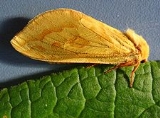
Ghost Moth

Encyclopedia
The Ghost Moth also known as the Ghost Swift, is a moth
of the family Hepialidae
. It is common throughout Europe
except for the far south-east. This species is now considered the only species in the genus Hepialus which previously included several other species now reclassified into other genera.
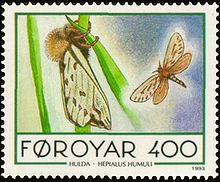
The male has a wingspan
of about 44 mm and both forewings and hindwings are pure white (although in H. h. thulensis, found in Shetland and the Faroe Islands
, there are buff-coloured individuals). The female is larger (wingspan about 48 mm) and has yellowish-buff forewings with darker linear markings and brown hindwings. The adults fly from June to August and are attracted to light. The species overwinters as a larva
.
The Ghost Moth gets its name from the display flight of the male, which hovers, sometimes slowly rising and falling, over open ground to attract females. In a suitable location several males may display together in a lek.
The larva is whitish and maggot
-like and feeds underground on the root
s of a variety of wild and cultivated plants (see list below). The species can be an economically significant pest in forest nurseries
.
The term ghost moth is sometimes used as a general term for all Hepialids.
Moth
A moth is an insect closely related to the butterfly, both being of the order Lepidoptera. Moths form the majority of this order; there are thought to be 150,000 to 250,000 different species of moth , with thousands of species yet to be described...
of the family Hepialidae
Hepialidae
The Hepialidae is a family of insects in the lepidopteran order. Moths of this family are often referred to as swift moths or ghost moths.-Taxonomy and systematics:...
. It is common throughout Europe
Europe
Europe is, by convention, one of the world's seven continents. Comprising the westernmost peninsula of Eurasia, Europe is generally 'divided' from Asia to its east by the watershed divides of the Ural and Caucasus Mountains, the Ural River, the Caspian and Black Seas, and the waterways connecting...
except for the far south-east. This species is now considered the only species in the genus Hepialus which previously included several other species now reclassified into other genera.
The male has a wingspan
Wingspan
The wingspan of an airplane or a bird, is the distance from one wingtip to the other wingtip. For example, the Boeing 777 has a wingspan of about ; and a Wandering Albatross caught in 1965 had a wingspan of , the official record for a living bird.The term wingspan, more technically extent, is...
of about 44 mm and both forewings and hindwings are pure white (although in H. h. thulensis, found in Shetland and the Faroe Islands
Faroe Islands
The Faroe Islands are an island group situated between the Norwegian Sea and the North Atlantic Ocean, approximately halfway between Scotland and Iceland. The Faroe Islands are a self-governing territory within the Kingdom of Denmark, along with Denmark proper and Greenland...
, there are buff-coloured individuals). The female is larger (wingspan about 48 mm) and has yellowish-buff forewings with darker linear markings and brown hindwings. The adults fly from June to August and are attracted to light. The species overwinters as a larva
Larva
A larva is a distinct juvenile form many animals undergo before metamorphosis into adults. Animals with indirect development such as insects, amphibians, or cnidarians typically have a larval phase of their life cycle...
.
The Ghost Moth gets its name from the display flight of the male, which hovers, sometimes slowly rising and falling, over open ground to attract females. In a suitable location several males may display together in a lek.
The larva is whitish and maggot
Maggot
In everyday speech the word maggot means the larva of a fly ; it is applied in particular to the larvae of Brachyceran flies, such as houseflies, cheese flies, and blowflies, rather than larvae of the Nematocera, such as mosquitoes and Crane flies...
-like and feeds underground on the root
Root
In vascular plants, the root is the organ of a plant that typically lies below the surface of the soil. This is not always the case, however, since a root can also be aerial or aerating . Furthermore, a stem normally occurring below ground is not exceptional either...
s of a variety of wild and cultivated plants (see list below). The species can be an economically significant pest in forest nurseries
Nursery (horticulture)
A nursery is a place where plants are propagated and grown to usable size. They include retail nurseries which sell to the general public, wholesale nurseries which sell only to businesses such as other nurseries and to commercial gardeners, and private nurseries which supply the needs of...
.
The term ghost moth is sometimes used as a general term for all Hepialids.
Subspecies
- Hepialus humuli humuli
- Hepialus humuli thulensis Newman, 1865 (Great Britain, Faroe Islands)
Recorded food plants
- Arctium - BurdockBurdockBurdock is any of a group of biennial thistles in the genus Arctium, family Asteraceae. Native to the Old World, several species have been widely introduced worldwide....
- AsparagusAsparagus (genus)Asparagus is a genus in the plant family Asparagaceae, subfamily Asparagoideae. It comprises up to 300 species. Most are evergreen long-lived perennial plants growing from the understory as lianas, bushes or climbing plants. The best-known species is the edible Asparagus officinalis, commonly...
- Beta - BeetBeetThe beet is a plant in the Chenopodiaceae family which is now included in Amaranthaceae family. It is best known in its numerous cultivated varieties, the most well known of which is the purple root vegetable known as the beetroot or garden beet...
- BrassicaBrassicaBrassica is a genus of plants in the mustard family . The members of the genus may be collectively known either as cabbages, or as mustards...
- CannabisCannabis sativaCannabis sativa is an annual herbaceous plant in the Cannabaceae family. Humans have cultivated this herb throughout recorded history as a source of industrial fibre, seed oil, food, recreation, spiritual enlightenment and medicine...
- ChrysanthemumChrysanthemumChrysanthemums, often called mums or chrysanths, are of the genus constituting approximately 30 species of perennial flowering plants in the family Asteraceae which is native to Asia and northeastern Europe.-Etymology:...
- DahliaDahliaDahlia is a genus of bushy, tuberous, perennial plants native to Mexico, Central America, and Colombia. There are at least 36 species of dahlia, some like D. imperialis up to 10 metres tall. Dahlia hybrids are commonly grown as garden plants...
- Daucus - CarrotCarrotThe carrot is a root vegetable, usually orange in colour, though purple, red, white, and yellow varieties exist. It has a crisp texture when fresh...
- Fagus - BeechBeechBeech is a genus of ten species of deciduous trees in the family Fagaceae, native to temperate Europe, Asia and North America.-Habit:...
- Fragaria - StrawberryStrawberryFragaria is a genus of flowering plants in the rose family, Rosaceae, commonly known as strawberries for their edible fruits. Although it is commonly thought that strawberries get their name from straw being used as a mulch in cultivating the plants, the etymology of the word is uncertain. There...
- Helianthus - Jerusalem artichokeJerusalem artichokeThe Jerusalem artichoke , also called the sunroot, sunchoke, earth apple or topinambour, is a species of sunflower native to eastern North America, and found from Eastern Canada and Maine west to North Dakota, and south to northern Florida and Texas...
- Humulus - HopHop (plant)Humulus, Hop, is a small genus of flowering plants native to temperate regions of the Northern Hemisphere. The female flowers of H. lupulus are known as hops, and are used as a culinary flavoring and stabilizer, especially in the brewing of beer...
- LactucaLactucaLactuca, commonly known as lettuce, is a genus of flowering plants in the daisy family Asteraceae. The genus includes about 100 species, distributed worldwide, but mainly in temperate Eurasia....
- Lettuce - Pastinaca - ParsnipParsnipThe parsnip is a root vegetable related to the carrot. Parsnips resemble carrots, but are paler than most carrots and have a sweeter taste, especially when cooked. The buttery, slightly spicy, sweet flavor of cooked mature parsnips is reminiscent of butterscotch, honey, and subtle cardamom...
- PhaseolusPhaseolusPhaseolus is a genus in the family Fabaceae of about fifty plant species, all native to the Americas.At least four of the species have been domesticated since pre-Columbian times for their beans. Most prominent among these is the common bean, P...
- Bean - PisumPisumPisum is a genus of the family Fabaceae, native to southwest Asia and northeast Africa. It contains one to five species, depending on taxonomic interpretation; the International Legume Database accepts three species, one with two subspecies :...
- Pea - PoaceaePoaceaeThe Poaceae is a large and nearly ubiquitous family of flowering plants. Members of this family are commonly called grasses, although the term "grass" is also applied to plants that are not in the Poaceae lineage, including the rushes and sedges...
- Grasses - Quercus - OakOakAn oak is a tree or shrub in the genus Quercus , of which about 600 species exist. "Oak" may also appear in the names of species in related genera, notably Lithocarpus...
- RumexRumexThe docks and sorrels, genus Rumex L., are a genus of about 200 species of annual, biennial and perennial herbs in the buckwheat family Polygonaceae....
- Dock/Sorrel - Solanum - PotatoPotatoThe potato is a starchy, tuberous crop from the perennial Solanum tuberosum of the Solanaceae family . The word potato may refer to the plant itself as well as the edible tuber. In the region of the Andes, there are some other closely related cultivated potato species...
- Urtica - NettleNettleNettles constitute between 24 and 39 species of flowering plants of the genus Urtica in the family Urticaceae, with a cosmopolitan though mainly temperate distribution. They are mostly herbaceous perennial plants, but some are annual and a few are shrubby...
- FungiFungusA fungus is a member of a large group of eukaryotic organisms that includes microorganisms such as yeasts and molds , as well as the more familiar mushrooms. These organisms are classified as a kingdom, Fungi, which is separate from plants, animals, and bacteria...
Species previously included in the genus Hepialus
Species previously placed in the genus Hepialus include:- Hepialus behrensii (Stretch, 1872) now Phymatopus behrensii
- Hepialus californicus Boisduval, 1868, now Phymatopus californicus
- Hepialus gracilis Grote, 1864, now Korscheltellus gracilis
- Hepialus hecta (Linnaeus, 1758), now Phymatopus hecta
- Hepialus hectoides Boisduval, 1868, now Phymatopus hectoides
- Hepialus lupulinus (Linnaeus, 1758), now Korscheltellus lupulina
- Hepialus montanus (Stretch, 1872) now Phymatopus behrensii
- Hepialus mustelinus Packard, 1864
- Hepialus sequoiolus, now Phymatopus californicus sequoiolus
- Hepialus virescens (Doubleday), now Aenetus virescens