

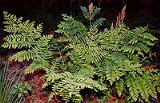
Osmundaceae

Encyclopedia
The Osmundaceae
(Royal Fern Family) is a family of four genera and 15-25 species. It is the only fern
family of the order Osmundales; an order in the class Pteridopsida (Polypodiopsida) or in some classifications the only order in the class Osmundopsida. This is an ancient (known from the Upper Permian
) and fairly isolated group that is often known as the "flowering ferns" because of the striking aspect of the ripe sporangia in Osmunda and Osmundastrum. In these genera the sporangia are borne naked on non-laminar pinnules, while Todea and Leptopteris bear sporangia naked on laminar pinnules. Ferns in this family are larger than most other ferns.
Ferns of this family form heavy rootstocks with thick mats of wiry roots. Many species form short trunks; in the case of the genus Todea
, they are sometimes considered as tree ferns because of the trunk, although it is relatively short.
The leaf
tissue ranges from very coarse, almost leathery in the case of the Cinnamon fern
(Osmundastrum cinnamomeum), to delicate and translucent, as in the case of the genus Leptopteris
.
Recent research on this family has significantly changed our understanding of the relationships of its species. The most striking finding is that O. cinnamomeum, despite its apparent similarity to Osmunda claytoniana, is actually the most anciently-derived species of the family, and so is a sister clade to the clade that comprises Osmunda, Todea, and Leptopteris (Jud et al. 2008), (Metzgar et al. 2008).
Osmundaceae
The Osmundaceae is a family of four genera and 15-25 species. It is the only fern family of the order Osmundales; an order in the class Pteridopsida or in some classifications the only order in the class Osmundopsida...
(Royal Fern Family) is a family of four genera and 15-25 species. It is the only fern
Fern
A fern is any one of a group of about 12,000 species of plants belonging to the botanical group known as Pteridophyta. Unlike mosses, they have xylem and phloem . They have stems, leaves, and roots like other vascular plants...
family of the order Osmundales; an order in the class Pteridopsida (Polypodiopsida) or in some classifications the only order in the class Osmundopsida. This is an ancient (known from the Upper Permian
Permian
The PermianThe term "Permian" was introduced into geology in 1841 by Sir Sir R. I. Murchison, president of the Geological Society of London, who identified typical strata in extensive Russian explorations undertaken with Edouard de Verneuil; Murchison asserted in 1841 that he named his "Permian...
) and fairly isolated group that is often known as the "flowering ferns" because of the striking aspect of the ripe sporangia in Osmunda and Osmundastrum. In these genera the sporangia are borne naked on non-laminar pinnules, while Todea and Leptopteris bear sporangia naked on laminar pinnules. Ferns in this family are larger than most other ferns.
Ferns of this family form heavy rootstocks with thick mats of wiry roots. Many species form short trunks; in the case of the genus Todea
Todea
The fern genus Todea is known from only two living species. Todea barbara L., known as the king fern, is native to South Africa, New Zealand, and Australia while Todea papuana H. is known only from Papua New Guinea...
, they are sometimes considered as tree ferns because of the trunk, although it is relatively short.
The leaf
Leaf
A leaf is an organ of a vascular plant, as defined in botanical terms, and in particular in plant morphology. Foliage is a mass noun that refers to leaves as a feature of plants....
tissue ranges from very coarse, almost leathery in the case of the Cinnamon fern
Cinnamon fern
Osmundastrum cinnamomeum, the Cinnamon Fern, is a species of eusporangiate fern in the family Osmundaceae. It is native to the Americas and eastern Asia, growing in swamps, bogs and moist woodlands....
(Osmundastrum cinnamomeum), to delicate and translucent, as in the case of the genus Leptopteris
Leptopteris
The fern genus Leptopteris is a small group of plants found growing in the Pacific Islands, New Guinea and Australia. They are similar to ferns in the related genus Todea.Species include:* L. alpina* L. fraseri - Crepe Fern, Australia...
.
Recent research on this family has significantly changed our understanding of the relationships of its species. The most striking finding is that O. cinnamomeum, despite its apparent similarity to Osmunda claytoniana, is actually the most anciently-derived species of the family, and so is a sister clade to the clade that comprises Osmunda, Todea, and Leptopteris (Jud et al. 2008), (Metzgar et al. 2008).