

Craniata

Encyclopedia
Craniata is a proposed clade
of chordate animal
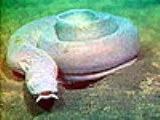
s that contains the Myxini (hagfish), Petromyzontida (including lamprey
s), and Gnathostomata
(jawed vertebrates) as living representatives. As the name suggests, Craniata are animals with a (hard bone
or cartilage
) skull
in Chordata.
(lancelets), but including Myxini, which have cartilaginous skulls and tooth-like structures composed of keratin
. Craniata also includes all lampreys and armored jawless fishes
, armoured fish
, spiny sharks
, sharks, skates, and rays
, bony fish
, amphibian
s, reptile
s, bird
s and mammal
s. The craniate head consists of a brain
, sense organs including eye
s, and a skull.
In addition to distinct crania (sing. cranium), craniates possess many derived characteristics which have allowed for more complexity to follow. Molecular-genetic
analysis of craniates reveals that, compared to less complex animals, they developed duplicate sets of many gene
families that are involved in cell signaling
, transcription
, and morphogenesis
(see homeobox
).
In general, craniates are much more active than tunicates and lancelets and as a result have greater metabolic demands, as well as several anatomical adaptations. Aquatic craniates have gill slits which are connected to muscles and nerves which pump water through the slits (as opposed to lancelets, whose pharyngeal slit
s are used only for suspension feeding), engaging in both feeding and gas exchange. Muscles line the alimentary canal, moving
food through the canal, allowing higher craniates like mammals to develop more complex digestive systems for optimal food processing. Craniates have cardiovascular systems which include a heart with two or more chambers, red blood cells, and O2 transporting hemoglobin
, as well as kidney
s.
, possibly representing a transitional form between 'worms' and fishes. Dumeril (1806) grouped hagfishes and lampreys in the taxon 'Cyclostomi', characterized by horny teeth borne on a tongue-like apparatus, a large notochord as adults, and pouch-shaped gills (Marspibranchii). Cyclostomes were regarded as either degenerate cartilaginous fishes or primitive vertebrates. Cope (1889) coined the name 'Agnatha' (jawless) for a group that included the cyclostomes and a number of fossil groups in which jaws could not be observed. Vertebrates were subsequently divided into two major sister-groups; Agnatha and Gnathostomata (jawed vertebrates). Stensiö (1927) suggested that the two groups of living agnathans (i.e., cyclostomes) arose independently from different groups of fossil agnathans. Løvtrup (1977) argued that lampreys are more closely related to gnathostomes based on a number of uniquely derived characters, including: arcualia (serially arranged paired cartilages above the notochord), extrinsic eyeball muscles, radial muscles in the fins, a closely set atrium and ventricle of the heart, nervous regulation of the heart (by the vagus nerve), a typhlosole (spirally coiled valve of the intestinal wall), true lymphocytes, a differentiated anterior lobe of the pituitary gland (adenohypophysis), three inner ear maculae (patches of acceleration sensitive 'hair cells' used in balance) organized into two or three vertical semicircular canals, neuromast organs (composed of vibration sensitive hair cells) in the laterosensory canals, an electroreceptive lateral line (with voltage sensitive hair cells) and electrosensory lateral line nerves, and a cerebellum (i.e., the multi-layered roof of the hindbrain with unique structure [characteristic neural architecture including direct inputs from the lateral line and large output Purkinje cells) and function [integrating sensory perception and coordinating motor control]). In other words, the 'cyclostome' characteristics (e.g., horny teeth, "tongue", gill pouches) are either instances of convergent evolution for feeding and gill ventilation in animals with an eel-like body shape, or represent primitive craniate characteristics subsequently lost or modified in gnathostomes. Janvier (1978) proposed to use the names 'Vertebrata' and 'Craniata' as two distinct and nested taxa.
data, concluding that Myxini is more closely related to Hyperoartia
than to Gnathostomata - i.e., that modern jawless fishes form a clade called Cyclostomata
. The argument is that if Craniata is indeed monophyletic, Vertebrata would return to its old content (Gnathostomata
+ Cyclostomata
) and the name Craniata, being superfluous, would become a junior synonym.
The new evidence removes support for the hypothesis for the evolutionary sequence by which (from among lancelet
-like cordates) first the hard cranium arose as it is exhibited by the hagfish, then the backbone as exhibited by the lampreys, and then finally the hinged jaw that is now ubiquitous. In 2010, Philippe Janvier
stated:
Clade
A clade is a group consisting of a species and all its descendants. In the terms of biological systematics, a clade is a single "branch" on the "tree of life". The idea that such a "natural group" of organisms should be grouped together and given a taxonomic name is central to biological...
of chordate animal
Animal
Animals are a major group of multicellular, eukaryotic organisms of the kingdom Animalia or Metazoa. Their body plan eventually becomes fixed as they develop, although some undergo a process of metamorphosis later on in their life. Most animals are motile, meaning they can move spontaneously and...
s that contains the Myxini (hagfish), Petromyzontida (including lamprey
Lamprey
Lampreys are a family of jawless fish, whose adults are characterized by a toothed, funnel-like sucking mouth. Translated from an admixture of Latin and Greek, lamprey means stone lickers...
s), and Gnathostomata
Gnathostomata
Gnathostomata is the group of vertebrates with jaws. The term derives from Greek γνάθος "jaw" + στόμα "mouth". Gnathostome diversity comprises roughly 60,000 species, which accounts for 99% of all living vertebrates...
(jawed vertebrates) as living representatives. As the name suggests, Craniata are animals with a (hard bone
Bone
Bones are rigid organs that constitute part of the endoskeleton of vertebrates. They support, and protect the various organs of the body, produce red and white blood cells and store minerals. Bone tissue is a type of dense connective tissue...
or cartilage
Cartilage
Cartilage is a flexible connective tissue found in many areas in the bodies of humans and other animals, including the joints between bones, the rib cage, the ear, the nose, the elbow, the knee, the ankle, the bronchial tubes and the intervertebral discs...
) skull
Skull
The skull is a bony structure in the head of many animals that supports the structures of the face and forms a cavity for the brain.The skull is composed of two parts: the cranium and the mandible. A skull without a mandible is only a cranium. Animals that have skulls are called craniates...
in Chordata.
Characteristics
In the simplest sense craniates are chordates with heads, thus excluding members of chordate subphyla Urochordata (tunicates) and CephalochordataCephalochordata
Cephalochordata is a chordate subphylum defined by the presence of a notochord that persists throughout life. It is represented in the modern oceans by the lancelets...
(lancelets), but including Myxini, which have cartilaginous skulls and tooth-like structures composed of keratin
Keratin
Keratin refers to a family of fibrous structural proteins. Keratin is the key of structural material making up the outer layer of human skin. It is also the key structural component of hair and nails...
. Craniata also includes all lampreys and armored jawless fishes
Cephalaspidomorphi
Cephalaspidomorphs are a group of jawless fishes named for the cephalaspids, a group of osteostracans. Most biologists regard this taxon as extinct, but the name is sometimes used in the classification of lampreys because lampreys were once thought to be related to cephalaspids...
, armoured fish
Placodermi
Placodermi is a class of armoured prehistoric fish, known from fossils, which lived from the late Silurian to the end of the Devonian Period. Their head and thorax were covered by articulated armoured plates and the rest of the body was scaled or naked, depending on the species. Placoderms were...
, spiny sharks
Acanthodii
Acanthodii is a class of extinct fishes, sharing features with both bony fish and cartilaginous fish. In form they resembled sharks, but their epidermis was covered with tiny rhomboid platelets like the scales of holosteans...
, sharks, skates, and rays
Chondrichthyes
Chondrichthyes or cartilaginous fishes are jawed fish with paired fins, paired nares, scales, two-chambered hearts, and skeletons made of cartilage rather than bone...
, bony fish
Osteichthyes
Osteichthyes , also called bony fish, are a taxonomic group of fish that have bony, as opposed to cartilaginous, skeletons. The vast majority of fish are osteichthyes, which is an extremely diverse and abundant group consisting of over 29,000 species...
, amphibian
Amphibian
Amphibians , are a class of vertebrate animals including animals such as toads, frogs, caecilians, and salamanders. They are characterized as non-amniote ectothermic tetrapods...
s, reptile
Reptile
Reptiles are members of a class of air-breathing, ectothermic vertebrates which are characterized by laying shelled eggs , and having skin covered in scales and/or scutes. They are tetrapods, either having four limbs or being descended from four-limbed ancestors...
s, bird
Bird
Birds are feathered, winged, bipedal, endothermic , egg-laying, vertebrate animals. Around 10,000 living species and 188 families makes them the most speciose class of tetrapod vertebrates. They inhabit ecosystems across the globe, from the Arctic to the Antarctic. Extant birds range in size from...
s and mammal
Mammal
Mammals are members of a class of air-breathing vertebrate animals characterised by the possession of endothermy, hair, three middle ear bones, and mammary glands functional in mothers with young...
s. The craniate head consists of a brain
Brain
The brain is the center of the nervous system in all vertebrate and most invertebrate animals—only a few primitive invertebrates such as sponges, jellyfish, sea squirts and starfishes do not have one. It is located in the head, usually close to primary sensory apparatus such as vision, hearing,...
, sense organs including eye
Eye
Eyes are organs that detect light and convert it into electro-chemical impulses in neurons. The simplest photoreceptors in conscious vision connect light to movement...
s, and a skull.
In addition to distinct crania (sing. cranium), craniates possess many derived characteristics which have allowed for more complexity to follow. Molecular-genetic
Molecular biology
Molecular biology is the branch of biology that deals with the molecular basis of biological activity. This field overlaps with other areas of biology and chemistry, particularly genetics and biochemistry...
analysis of craniates reveals that, compared to less complex animals, they developed duplicate sets of many gene
Gene
A gene is a molecular unit of heredity of a living organism. It is a name given to some stretches of DNA and RNA that code for a type of protein or for an RNA chain that has a function in the organism. Living beings depend on genes, as they specify all proteins and functional RNA chains...
families that are involved in cell signaling
Cell signaling
Cell signaling is part of a complex system of communication that governs basic cellular activities and coordinates cell actions. The ability of cells to perceive and correctly respond to their microenvironment is the basis of development, tissue repair, and immunity as well as normal tissue...
, transcription
Transcription (genetics)
Transcription is the process of creating a complementary RNA copy of a sequence of DNA. Both RNA and DNA are nucleic acids, which use base pairs of nucleotides as a complementary language that can be converted back and forth from DNA to RNA by the action of the correct enzymes...
, and morphogenesis
Morphogenesis
Morphogenesis , is the biological process that causes an organism to develop its shape...
(see homeobox
Homeobox
A homeobox is a DNA sequence found within genes that are involved in the regulation of patterns of anatomical development in animals, fungi and plants.- Discovery :...
).
In general, craniates are much more active than tunicates and lancelets and as a result have greater metabolic demands, as well as several anatomical adaptations. Aquatic craniates have gill slits which are connected to muscles and nerves which pump water through the slits (as opposed to lancelets, whose pharyngeal slit
Pharyngeal slit
Pharyngeal slits are filter-feeding organs found in non-vertebrate chordates and hemichordates living in aquatic environments. These repeated segments are controlled by similar developmental mechanisms. Some hemichordate species can have as many as 200 gill slits...
s are used only for suspension feeding), engaging in both feeding and gas exchange. Muscles line the alimentary canal, moving
Peristalsis
Peristalsis is a radially symmetrical contraction and relaxation of muscles which propagates in a wave down the muscular tube, in an anterograde fashion. In humans, peristalsis is found in the contraction of smooth muscles to propel contents through the digestive tract. Earthworms use a similar...
food through the canal, allowing higher craniates like mammals to develop more complex digestive systems for optimal food processing. Craniates have cardiovascular systems which include a heart with two or more chambers, red blood cells, and O2 transporting hemoglobin
Hemoglobin
Hemoglobin is the iron-containing oxygen-transport metalloprotein in the red blood cells of all vertebrates, with the exception of the fish family Channichthyidae, as well as the tissues of some invertebrates...
, as well as kidney
Kidney
The kidneys, organs with several functions, serve essential regulatory roles in most animals, including vertebrates and some invertebrates. They are essential in the urinary system and also serve homeostatic functions such as the regulation of electrolytes, maintenance of acid–base balance, and...
s.
Systematics and taxonomy
Linnaeus (1758) used the terms 'Craniata' and 'Vertebrata' interchangeably to include lampreys, jawed fishes, and terrestrial vertebrates (tetrapods). Hagfishes were classified as VermesVermes
Vermes is an obsolete taxon used by Carolus Linnaeus and Jean-Baptiste Lamarck for all non-arthropod invertebrate animals. In Linnaeus system the group had the rank of class, occupying the 6th slot of his animal systematics...
, possibly representing a transitional form between 'worms' and fishes. Dumeril (1806) grouped hagfishes and lampreys in the taxon 'Cyclostomi', characterized by horny teeth borne on a tongue-like apparatus, a large notochord as adults, and pouch-shaped gills (Marspibranchii). Cyclostomes were regarded as either degenerate cartilaginous fishes or primitive vertebrates. Cope (1889) coined the name 'Agnatha' (jawless) for a group that included the cyclostomes and a number of fossil groups in which jaws could not be observed. Vertebrates were subsequently divided into two major sister-groups; Agnatha and Gnathostomata (jawed vertebrates). Stensiö (1927) suggested that the two groups of living agnathans (i.e., cyclostomes) arose independently from different groups of fossil agnathans. Løvtrup (1977) argued that lampreys are more closely related to gnathostomes based on a number of uniquely derived characters, including: arcualia (serially arranged paired cartilages above the notochord), extrinsic eyeball muscles, radial muscles in the fins, a closely set atrium and ventricle of the heart, nervous regulation of the heart (by the vagus nerve), a typhlosole (spirally coiled valve of the intestinal wall), true lymphocytes, a differentiated anterior lobe of the pituitary gland (adenohypophysis), three inner ear maculae (patches of acceleration sensitive 'hair cells' used in balance) organized into two or three vertical semicircular canals, neuromast organs (composed of vibration sensitive hair cells) in the laterosensory canals, an electroreceptive lateral line (with voltage sensitive hair cells) and electrosensory lateral line nerves, and a cerebellum (i.e., the multi-layered roof of the hindbrain with unique structure [characteristic neural architecture including direct inputs from the lateral line and large output Purkinje cells) and function [integrating sensory perception and coordinating motor control]). In other words, the 'cyclostome' characteristics (e.g., horny teeth, "tongue", gill pouches) are either instances of convergent evolution for feeding and gill ventilation in animals with an eel-like body shape, or represent primitive craniate characteristics subsequently lost or modified in gnathostomes. Janvier (1978) proposed to use the names 'Vertebrata' and 'Craniata' as two distinct and nested taxa.
Validity
The validity of the taxon "Craniata" was recently examined by Delarbre et al. (2002) using mtDNA sequenceDNA sequence
The sequence or primary structure of a nucleic acid is the composition of atoms that make up the nucleic acid and the chemical bonds that bond those atoms. Because nucleic acids, such as DNA and RNA, are unbranched polymers, this specification is equivalent to specifying the sequence of...
data, concluding that Myxini is more closely related to Hyperoartia
Hyperoartia
Hyperoartia or Petromyzontida is a group of jawless fish that includes the modern lampreys and their fossil relatives, the jawless fish of the class Anaspida. Examples of hyperoartians from early in their fossil record are Endeiolepis and Euphanerops, fishes with hypocercal tails that lived during...
than to Gnathostomata - i.e., that modern jawless fishes form a clade called Cyclostomata
Cyclostomata
Cyclostomata is a group of chordates that comprises the living jawless fishes: the lampreys and hagfishes. Both groups have round mouths that lack jaws but have retractable horny teeth...
. The argument is that if Craniata is indeed monophyletic, Vertebrata would return to its old content (Gnathostomata
Gnathostomata
Gnathostomata is the group of vertebrates with jaws. The term derives from Greek γνάθος "jaw" + στόμα "mouth". Gnathostome diversity comprises roughly 60,000 species, which accounts for 99% of all living vertebrates...
+ Cyclostomata
Cyclostomata
Cyclostomata is a group of chordates that comprises the living jawless fishes: the lampreys and hagfishes. Both groups have round mouths that lack jaws but have retractable horny teeth...
) and the name Craniata, being superfluous, would become a junior synonym.
The new evidence removes support for the hypothesis for the evolutionary sequence by which (from among lancelet
Lancelet
The lancelets , also known as amphioxus, are the modern representatives of the subphylum Cephalochordata, formerly thought to be the sister group of the craniates. They are usually found buried in sand in shallow parts of temperate or tropical seas. In Asia, they are harvested commercially as food...
-like cordates) first the hard cranium arose as it is exhibited by the hagfish, then the backbone as exhibited by the lampreys, and then finally the hinged jaw that is now ubiquitous. In 2010, Philippe Janvier
Philippe Janvier
Philippe Janvier is a French paleontologist, specialising in Palaeozoic vertebrates, who currently works at the Museum National de l’Histoire Naturelle in Paris. He has written several books and scientific papers on Palaeozoic vertebrates and contributed to the Tree of Life phylogeny project...
stated: