

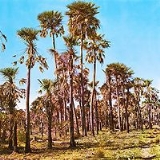
Copernicia alba

Encyclopedia
Copernicia alba is a South America
n species of palm tree, which is found in the humid part of the Gran Chaco
ecoregion in Bolivia
, Paraguay
, Colombia
, Brazil
(in the states of Mato Grosso
and Mato Grosso do Sul
) and Argentina
(especially the province
of Formosa
, and less abundantly towards drier areas). They often, but not always, form dense single-species woodlands. Its common name
in Spanish
show the various colours (and technical qualities) that its wood and/or bark
takes according to its environment: palma blanca, palma negra, palma colorada ("white", "black" and "red" palm, respectively). In Guaraní
it is called caranday, "water palm". Its English trade name is wax palm or caranday wax palm (it belongs to the same genus
as the Carnauba wax palm).
Ancient peoples in South America
used wax palm for making candles by scraping away wax on the leaves.
C. alba can reach 25 m in height and 40 cm in girth. The trunk is cylindrical, rarely bifurcated, and has a grayish bark with a smooth surface in adult specimens. The leaves are persistent, grouped at the apex of the trunk, and measuring between 40 and 70 cm. The inflorescence is almost 2 m long; the flowers are hermaphroditic, about 4 mm long, with a tubular yellowish green corolla, and arranged in a spiral pattern. Each flower has three ovaries, of which only one develops into a globular fruit, a dark pulpous berry that contains a light-brown, 12 mm long ovoid seed.
Young specimens have a lightweight semi-hard wood, which becomes hard and heavier in grown-up individuals, reaching a relative density
of up to 0.92. This wood finds its main use in telephone and electrical line poles.
In Paraguay
Copernicia Alba / Karanda’y is currently studied for its suitability as a Biodiesel
oil crop.
South America
South America is a continent situated in the Western Hemisphere, mostly in the Southern Hemisphere, with a relatively small portion in the Northern Hemisphere. The continent is also considered a subcontinent of the Americas. It is bordered on the west by the Pacific Ocean and on the north and east...
n species of palm tree, which is found in the humid part of the Gran Chaco
Gran Chaco
The Gran Chaco is a sparsely populated, hot and semi-arid lowland region of the Río de la Plata basin, divided among eastern Bolivia, Paraguay, northern Argentina and a portion of the Brazilian states of Mato Grosso and Mato Grosso do Sul, where it is connected with the Pantanal region...
ecoregion in Bolivia
Bolivia
Bolivia officially known as Plurinational State of Bolivia , is a landlocked country in central South America. It is the poorest country in South America...
, Paraguay
Paraguay
Paraguay , officially the Republic of Paraguay , is a landlocked country in South America. It is bordered by Argentina to the south and southwest, Brazil to the east and northeast, and Bolivia to the northwest. Paraguay lies on both banks of the Paraguay River, which runs through the center of the...
, Colombia
Colombia
Colombia, officially the Republic of Colombia , is a unitary constitutional republic comprising thirty-two departments. The country is located in northwestern South America, bordered to the east by Venezuela and Brazil; to the south by Ecuador and Peru; to the north by the Caribbean Sea; to the...
, Brazil
Brazil
Brazil , officially the Federative Republic of Brazil , is the largest country in South America. It is the world's fifth largest country, both by geographical area and by population with over 192 million people...
(in the states of Mato Grosso
Mato Grosso
Mato Grosso is one of the states of Brazil, the third largest in area, located in the western part of the country.Neighboring states are Rondônia, Amazonas, Pará, Tocantins, Goiás and Mato Grosso do Sul. It also borders Bolivia to the southwest...
and Mato Grosso do Sul
Mato Grosso do Sul
Mato Grosso do Sul is one of the states of Brazil.Neighboring Brazilian states are Mato Grosso, Goiás, Minas Gerais, São Paulo and Paraná. It also borders the countries of Paraguay and Bolivia to the west. The economy of the state is largely based on agriculture and cattle-raising...
) and Argentina
Argentina
Argentina , officially the Argentine Republic , is the second largest country in South America by land area, after Brazil. It is constituted as a federation of 23 provinces and an autonomous city, Buenos Aires...
(especially the province
Provinces of Argentina
Argentina is subdivided into twenty-three provinces and one autonomous city...
of Formosa
Formosa Province
Formosa Province is in northeastern Argentina, part of the Gran Chaco Region. Its northeast end touches Asunción, Paraguay, and borders the provinces of Chaco and Salta to its south and west, respectively...
, and less abundantly towards drier areas). They often, but not always, form dense single-species woodlands. Its common name
Common name
A common name of a taxon or organism is a name in general use within a community; it is often contrasted with the scientific name for the same organism...
in Spanish
Spanish language
Spanish , also known as Castilian , is a Romance language in the Ibero-Romance group that evolved from several languages and dialects in central-northern Iberia around the 9th century and gradually spread with the expansion of the Kingdom of Castile into central and southern Iberia during the...
show the various colours (and technical qualities) that its wood and/or bark
Bark
Bark is the outermost layers of stems and roots of woody plants. Plants with bark include trees, woody vines and shrubs. Bark refers to all the tissues outside of the vascular cambium and is a nontechnical term. It overlays the wood and consists of the inner bark and the outer bark. The inner...
takes according to its environment: palma blanca, palma negra, palma colorada ("white", "black" and "red" palm, respectively). In Guaraní
Guaraní language
Guaraní, specifically the primary variety known as Paraguayan Guaraní , is an indigenous language of South America that belongs to the Tupí–Guaraní subfamily of the Tupian languages. It is one of the official languages of Paraguay , where it is spoken by the majority of the population, and half of...
it is called caranday, "water palm". Its English trade name is wax palm or caranday wax palm (it belongs to the same genus
Genus
In biology, a genus is a low-level taxonomic rank used in the biological classification of living and fossil organisms, which is an example of definition by genus and differentia...
as the Carnauba wax palm).
Ancient peoples in South America
South America
South America is a continent situated in the Western Hemisphere, mostly in the Southern Hemisphere, with a relatively small portion in the Northern Hemisphere. The continent is also considered a subcontinent of the Americas. It is bordered on the west by the Pacific Ocean and on the north and east...
used wax palm for making candles by scraping away wax on the leaves.
C. alba can reach 25 m in height and 40 cm in girth. The trunk is cylindrical, rarely bifurcated, and has a grayish bark with a smooth surface in adult specimens. The leaves are persistent, grouped at the apex of the trunk, and measuring between 40 and 70 cm. The inflorescence is almost 2 m long; the flowers are hermaphroditic, about 4 mm long, with a tubular yellowish green corolla, and arranged in a spiral pattern. Each flower has three ovaries, of which only one develops into a globular fruit, a dark pulpous berry that contains a light-brown, 12 mm long ovoid seed.
Young specimens have a lightweight semi-hard wood, which becomes hard and heavier in grown-up individuals, reaching a relative density
Relative density
Relative density, or specific gravity, is the ratio of the density of a substance to the density of a given reference material. Specific gravity usually means relative density with respect to water...
of up to 0.92. This wood finds its main use in telephone and electrical line poles.
In Paraguay
Paraguay
Paraguay , officially the Republic of Paraguay , is a landlocked country in South America. It is bordered by Argentina to the south and southwest, Brazil to the east and northeast, and Bolivia to the northwest. Paraguay lies on both banks of the Paraguay River, which runs through the center of the...
Copernicia Alba / Karanda’y is currently studied for its suitability as a Biodiesel
Biodiesel
Biodiesel refers to a vegetable oil- or animal fat-based diesel fuel consisting of long-chain alkyl esters. Biodiesel is typically made by chemically reacting lipids with an alcohol....
oil crop.