
All Topics  
Relative density


   Email Print
   Bookmark   Link


Relative density


Relative density, sometimes called specific density, is the ratio
Ratio

A ratio is an expression which compares quantities relative to each other. The most common examples involve two quantities, but in theory any number of quantities can be compared....
 of the density
Density

The density of a material is defined as its mass per unit volume. The symbol of density is ....
 of a substance to the density of a given reference material. If a substance's relative density is less than one then it is less dense than the reference; if greater than one then it is denser than the reference. If the relative density is exactly one then the densities are equal; that is, equal volumes of the two substances have the same mass.

Relative density is a generalisation of, or in some usages synonymous with, specific gravity
Specific gravity

Specific gravity is defined as the ratio of the density of a given solid or liquid substance to the density of water at a specific temperature and pressure, typically at 4?C and , making it a dimensionless quantity ....
 (which specifically means relative density with respect to water), with the former term often preferred in modern scientific usage.

In symbols,

where RD is relative density, is the density of the substance being measured, and is the density of the reference.


Discussion
Ask a question about 'Relative density'
Start a new discussion about 'Relative density'
Answer questions from other users
Full Discussion Forum


Recent Posts


Encyclopedia


Relative density, sometimes called specific density, is the ratio
Ratio

A ratio is an expression which compares quantities relative to each other. The most common examples involve two quantities, but in theory any number of quantities can be compared....
 of the density
Density

The density of a material is defined as its mass per unit volume. The symbol of density is ....
 of a substance to the density of a given reference material. If a substance's relative density is less than one then it is less dense than the reference; if greater than one then it is denser than the reference. If the relative density is exactly one then the densities are equal; that is, equal volumes of the two substances have the same mass.

Relative density is a generalisation of, or in some usages synonymous with, specific gravity
Specific gravity

Specific gravity is defined as the ratio of the density of a given solid or liquid substance to the density of water at a specific temperature and pressure, typically at 4?C and , making it a dimensionless quantity ....
 (which specifically means relative density with respect to water), with the former term often preferred in modern scientific usage.

In symbols,

where RD is relative density, is the density of the substance being measured, and is the density of the reference. (By convention ?, the Greek letter rho
Rho (letter)

Rho is the 17th letter of the Greek alphabet. In the system of Greek numerals it has a value of 100. It is derived from Proto-Canaanite alphabet R? "head" ....
, denotes density.)

The reference material can be indicated using subscripts:

which means "the relative density of substance with respect to reference". If the reference is not explicitly stated then it is normally assumed to be water
Water

Water is a common chemical substance that is essential for the survival of all known forms of life. In typical usage, water refers only to its liquid form or States of matter, but the substance also has a solid state, ice, and a gaseous state, water vapor or steam....
 at 4 °C
Celsius

Celsius is a temperature scale that is named after the Swedish astronomer Anders Celsius , who developed a similar temperature scale two years before his death....
 (or, more precisely, 3.98 °C
Celsius

Celsius is a temperature scale that is named after the Swedish astronomer Anders Celsius , who developed a similar temperature scale two years before his death....
, which is the temperature at which water reaches its maximum density). In SI
International System of Units

The International System of Units is the modern form of the metric system and is generally a system devised around the convenience of the number ten....
 units, the density of water is (approximately) 1000 kg
Kilogram

The kilogram or kilogrammeThe spelling kilogram is used by the International Committee for Weights and Measures and the U.S....
/
Cubic metre

The cubic metre is the SI derived unit of volume. It is the volume of a cube with edges one metre in length. An alternative name, which allowed a different usage with SI prefix, was the st?re....
 or 1 g
Gram

The gram , ; symbol g, is a Physical unit of mass.Originally defined as "the absolute weight of a volume of pure water equal to the cube of the hundredth part of a metre, and at the temperature of melting ice" , a gram is now defined as one one-thousandth of the SI base unit, the kilogram, or Scientific notation kg, which itself is...
/cm³
Cubic centimetre

A cubic centimetre or cubic centimeter is a commonly used unit of volume extending the derived International System of Units-unit cubic metre and corresponds to the volume of a cube measuring 1?1?1 cm....
, which makes relative density calculations particularly convenient: the density of the object only needs to be divided by 1000 or 1, depending on the units.

The relative density of gases is often measured with respect to dry air
AIR

Air is the part of Earth's atmosphere that humans breath and as such Air .Air may also refer to:...
 at a temperature of 20 degrees Celsius and a pressure of 101.325 kPa absolute, which has a density of 1.205 kg/m3.

Relative density with respect to air can be obtained by

Where is the molar mass
Molar mass

Molar mass, symbol M, is the mass of one mole of a substance . It is a physical property which is characteristic of each pure substance. The base SI unit for mass is the kilogram but, for both practical and historical reasons, molar masses are almost always quoted in grams per mole , especially in chemistry....
.

Examples


Taking the relative density with respect to ethanol
Ethanol

Ethanol, also called ethyl alcohol, pure alcohol, grain alcohol, or drinking alcohol, is a volatility , flammable, colorless liquid....
, the relative densities of ethanol, water and iron
Iron

Iron is a chemical element with the symbol Fe and atomic number 26. Iron is a Group 8 element and period 4 element. Iron is lustrous and silvery in color....
 are as follows:

  • Ethanol: 1.0 (by definition)
  • Water: 1.2 (i.e. water is 1.2 times as dense as ethanol)
  • Iron: 10.0 (i.e. iron is 10.0 times as dense as ethanol)


Taking the relative density relative to water, the numbers are 0.78, 1.0, and 7.9 respectively. With respect to iron, the numbers are 0.1, 0.12, and 1.0 respectively

Dimensions


Since it is a ratio of two quantities of the same type, relative density is dimensionless (it has no units). Although relative density does not depend on the unit system being used, the two densities must as necessary be converted to the same units (e.g., kg
Kilogram

The kilogram or kilogrammeThe spelling kilogram is used by the International Committee for Weights and Measures and the U.S....
/
Cubic metre

The cubic metre is the SI derived unit of volume. It is the volume of a cube with edges one metre in length. An alternative name, which allowed a different usage with SI prefix, was the st?re....
 or g
Gram

The gram , ; symbol g, is a Physical unit of mass.Originally defined as "the absolute weight of a volume of pure water equal to the cube of the hundredth part of a metre, and at the temperature of melting ice" , a gram is now defined as one one-thousandth of the SI base unit, the kilogram, or Scientific notation kg, which itself is...
/cm³
Cubic centimetre

A cubic centimetre or cubic centimeter is a commonly used unit of volume extending the derived International System of Units-unit cubic metre and corresponds to the volume of a cube measuring 1?1?1 cm....
) before calculating the numerical value of the ratio.

For example, suppose an object has a density of 4 g/cm3. To calculate its relative density with respect to water, which has a density of 1 g/cm3, we divide the former by the latter:

If the densities are instead measured in kg/m3 then the calculation becomes

which gives exactly the same answer.

Relative density can also be calculated as the ratio of gravitational densities rather than "ordinary" mass-based densities. Defining gravitational density as ρg, where ρ is ordinary density and g is the local gravitational constant
Earth's gravity

Earth's gravity, denoted by g, refers to the acceleration that the Earth exerts on objects on or near its surface. Its strength is usually quoted in terms of falling bodies , which in International System of Units is measured in m/s? ....
, it is seen that the gravitational constant simply cancels out when the ratio is computed.

Temperature dependence

See Density
Density

The density of a material is defined as its mass per unit volume. The symbol of density is ....
 for a table of the measured densities of water at various temperatures.


Changes in temperature affect the densities of different materials differently, and thus alter their relative densities. For precision work the temperatures of the two materials may be explicitly stated; for example:
relative density: or specific gravity:
where the superscript indicates the temperature at which the density of the material is measured, and the subscript indicates the temperature of the reference substance to which it is compared.

Uses

Relative density can help quantify the buoyancy
Buoyancy

In physics, buoyancy is the upward force that keeps things afloat. The net upward buoyancy force is equal to the magnitude of the weight of fluid displaced by the body....
 of a substance in a fluid
Fluid

A fluid is defined as a substance that continually deforms under an applied shear stress. All liquids and all gases are fluids. Fluids are a subset of the Phase and include liquids, gas, Plasma physics and, to some extent, plasticity ....
, or determine the density of an unknown substance from the known density of another.

Relative density is often used by geologists
Geology

Geology is the science and study of the solid and liquid matter that constitute the Earth. The field of geology encompasses the study of the composition, structural geology, physical properties, dynamics, and History of the Earth of Earth materials, and the processes by which they are formed, moved, and changed....
 and mineralogists
Mineralogy

Mineralogy is an Earth Science focused around the chemistry, crystal structure, and physical properties of minerals. Specific studies within mineralogy include the processes of mineral origin and formation, classification of minerals, their geographical distribution, as well as their utilization....
 to help determine the mineral
Mineral

A mineral is a naturally occurring solid formed through Geology processes that has a characteristic chemical composition, a highly ordered atomic structure, and specific physical properties....
 content of a rock or other sample. Gemologists
Gemology

Gemology or gemmology is the science, art and profession of identifying and evaluating gemstones. It is considered a geoscience and a branch of mineralogy....
 use it as an aid in the identification of gemstone
Gemstone

A gemstone or gem, also called a precious or semi-precious stone, is a piece of attractive mineral, which — when cut and polished — is used to make jewellery or other adornments....
s. Water is preferred as the reference because measurements are then easy to carry out in the field (see below for examples of measurement methods).

The relative density of liquids has numerous practical uses, as described under hydrometer
Hydrometer

A hydrometer is an instrument used to measure the specific gravity of liquids; that is, the ratio of the density of the liquid to the density of water....
.

Relative density may be a more intelligible quantity than density itself, especially to the layman. For example, the density of iridium
Iridium

Iridium is the chemical element with atomic number 77, and is represented by the symbol Ir. A very hard, brittle, silvery-white transition metal of the platinum group, iridium is the second densest element and is the most corrosion-resistant metal, even at temperatures as high as 2000 ?C....
 may be stated as 22650 kg/m³, but this is not a number that can easily be grasped unless one is already familiar with the numerical densities of various materials. However, if iridium it is said to be nearly twice as dense as lead
Lead

Lead is a main-group Chemical element with symbol Pb and atomic number 82. Lead is a soft, malleable poor metal, also considered to be one of the heavy metal ....
, or over 22 times as dense as water, then it is easy to understand how heavy iridium really is.

Measurement


Relative density can be calculated directly by measuring the density of a sample and dividing it by the (known) density of the reference substance. The density of the sample is simply its mass divided by its volume. Although mass is easy to measure, the volume of an irregularly shaped sample can be more difficult to ascertain. One method is to put the sample in a water-filled graduated cylinder
Graduated cylinder

A graduated cylinder is a piece of laboratory equipment used to accurately measure out volumes of objects for use in labs. They are generally more accurate and precise for this purpose than flasks and beakers....
 and read off how much water it displaces. Alternatively the container can be filled to the brim, the sample immersed, and the volume of overflow measured. The surface tension
Surface tension

Surface tension is an attractive property of the surface of a liquid. It is what causes the surface portion of liquid to be attracted to another surface, such as that of another portion of liquid ....
 of the water may keep a significant amount of water from overflowing, which is especially problematic for small samples. For this reason it is desirable to use a water container with as small a mouth as possible.

The fact that relative density is a unitless ratio often simplifies calculations. For example, suppose a certain rock sample deflects a spring by 3 inches, and a sample of the reference substance deflects the spring by 5 inches. Furthermore, the rock sample causes the water in a certain graduated cylinder
Graduated cylinder

A graduated cylinder is a piece of laboratory equipment used to accurately measure out volumes of objects for use in labs. They are generally more accurate and precise for this purpose than flasks and beakers....
 rise by 20 mm, and the reference substance causes it to rise by 34 mm. The relative density between these two objects can easily be determined without having to figure out several constants that would be needed to determine the density directly (such as the spring constant or the cross sectional area of the cylinder).

For each substance, the density, ρ, is given by

When these densities are divided, references to the spring constant, gravity and cross-sectional area simply cancel, leaving

Relative density is more easily and perhaps more accurately measured without measuring volume. Using a spring scale, the sample is weighed first in air and then in water. Relative density (with respect to water) can then be calculated using the following formula:

where
Wair is the weight of the sample in air (measured in pounds-force
Pound-force

The pound-force or simply pound is a Units of measurement of force....
, newton
Newton

The newton is the International System of Units SI derived unit of force, named after Isaac Newton in recognition of his work on classical mechanics....
s, or some other unit of force)
Wwater is the weight of the sample in water (measured in the same units).


This technique cannot easily be used to measure relative densities less than one, because the sample will then float. Wwater becomes a negative quantity, representing the force needed to keep the sample underwater.

Another practical method uses three measurements. The sample is weighed dry. Then a container filled to the brim with water is weighed, and weighed again with the sample immersed, after the displaced water has overflowed and been removed. Subtracting the last reading from the sum of the first two readings gives the weight of the displaced water. The relative density result is the dry sample weight divided by that of the displaced water. This method works with scales that can't easily accommodate a suspended sample, and also allows for measurement of samples that are less dense than water.

Relative density and hydrometers

The relative density of a liquid can be measured using a hydrometer
Hydrometer

A hydrometer is an instrument used to measure the specific gravity of liquids; that is, the ratio of the density of the liquid to the density of water....
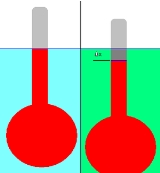
. This consists of a bulb attached to a stalk of constant cross-sectional area, as shown in the diagram to the right.

First the hydrometer is floated in the reference liquid (shown in light blue), and the displacement
Displacement

Displacement may refer to:...
 (the level of the liquid on the stalk) is marked (blue line). The reference could be any liquid, but in practice it is usually water.

The hydrometer is then floated in a liquid of unknown density (shown in green). The change in displacement, Δx, is noted. In the example depicted, the hydrometer has dropped slightly in the green liquid; hence its density is lower than that of the reference liquid. It is, of course, necessary that the hydrometer floats in both liquids.

The application of simple physical principles allows the relative density of the unknown liquid to be calculated from the change in displacement. (In practice the stalk of the hydrometer is pre-marked with graduations to facilitate this measurement.)

In the explanation that follows,

ρref is the known density (mass
Mass

In physical science, mass refers to the degree of acceleration a body acquires when subject to a force: bodies with greater mass are accelerated less by the same force....
 per unit volume
Volume

The volume of any solid, liquid, plasma, vacuum or theoretical object is how much three-dimensional space it occupies, often quantified numerically....
) of the reference liquid (typically water).
ρnew is the unknown density of the new (green) liquid.
RDnew/ref is the relative density of the new liquid with respect to the reference.
V is the volume of reference liquid displaced, i.e. the red volume in the diagram.
m is the mass of the entire hydrometer.
g is the local gravitational constant
Earth's gravity

Earth's gravity, denoted by g, refers to the acceleration that the Earth exerts on objects on or near its surface. Its strength is usually quoted in terms of falling bodies , which in International System of Units is measured in m/s? ....
.
Δx is the change in displacement. In accordance with the way in which hydrometers are usually graduated, Δx is here taken to be negative if the displacement line rises on the stalk of the hydrometer, and positive if it falls. In the example depicted, Δx is negative.
A is the cross sectional area of the shaft.


Since the floating hydrometer is in static equilibrium, the downward gravitational force acting upon it must exactly balance the upward buoyancy force. The gravitational force acting on the hydrometer is simply its weight, mg. From the Archimedes
Archimedes

Archimedes of Syracuse was a Greek mathematics, physicist, engineer, inventor, and astronomer. Although few details of his life are known, he is regarded as one of the leading scientists in classical antiquity....
 buoyancy
Buoyancy

In physics, buoyancy is the upward force that keeps things afloat. The net upward buoyancy force is equal to the magnitude of the weight of fluid displaced by the body....
 principle, the buoyancy force acting on the hydrometer is equal to the weight of liquid displaced. This weight is equal to the mass of liquid displaced multiplied by g, which in the case of the reference liquid is ρrefVg. Setting these equal, we have

or just

 (1)


Exactly the same equation applies when the hydrometer is floating in the liquid being measured, except that the new volume is V − AΔx (see note above about the sign of Δx). Thus,

 (2)


Combining (1) and (2) yields

 (3)


But from (1) we have V = m/ρref. Substituting into (3) gives

 (4)


This equation allows the relative density to be calculated from the change in displacement, the known density of the reference liquid, and the known properties of the hydrometer. If & Delta;x is small then, as a first-order approximation
Orders of approximation

Orders of approximation have been used not only in science, engineering, and other quantitative disciplines to make approximations with various degrees of precision but also more generally, and more loosely, to indicate relative precision outside these disciplines in the form of "first level", "second level" and so on, "approximations"....
 of the geometric series
Geometric series

In mathematics, a geometric series is a series with a constant ratio between successive term . For example, the seriesis geometric, because each term is equal to half of the previous term....
 equation (4) can be written as:

This shows that, for small Δx, changes in displacement are approximately proportional to changes in relative density.

See also

  • Buoyancy
    Buoyancy

    In physics, buoyancy is the upward force that keeps things afloat. The net upward buoyancy force is equal to the magnitude of the weight of fluid displaced by the body....
  • Gravity (beer)
    Gravity (beer)

    Gravity, in the Context of brewing alcoholic beverages, refers to the specific gravity of a beverage. It is an indirect measurement of the amount of sugar, and thus ethanol, present in a given alcoholic beverage....


External links