

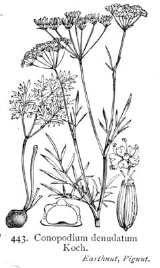
Conopodium majus

Encyclopedia
Conopodium majus is a small perennial
herb
, whose underground part resembles a chestnut
and is sometimes eaten as a wild or cultivated root vegetable
.
The plant has many English names (many of them shared with Bunium bulbocastanum, a related plant with similar appearance and uses) variously including kippernut, cipernut, arnut, jarnut, hawknut, earth chestnut, groundnut, and earthnut. From its popularity with pig
s come the names pignut, hognut, and more indirectly Saint Anthony's nut, for Anthony the Great
or Anthony of Padua
, both patron saint
s of swineherd
s. (See groundnut, earthnut, and hognut for other plants which share these names.)
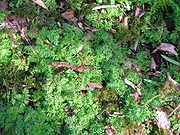 The plant is common through much of Europe
and parts of North Africa
. It grows in woods and fields, and is an indicator
of long-established grassland
.
It has a smooth, slender, curving stem, up to 1 m high, much-divided leaves
, and small, white flower
s in many-rayed terminal compound umbel
s.
The rounded "nut" (inconsistently described by authorities as a tuber
, corm
, or root
) is similar to a chestnut in its brown colour and its size (up to 25 mm in diameter), and its sweet, aromatic flavour has been compared to that of the chestnut, hazelnut
, sweet potato
, and Brazil nut
. Palatable and nutritious, its eating qualities are widely praised, and it is popular among wild food
foragers, but it remains a minor crop, due in part to its low yields and difficulty of harvest.
Government and virtues: They are something hot and dry in quality, under the dominion of Venus; they provoke lust exceedingly, and stir up those sports she is mistress of; the seed is excellent good to provoke urine; and so also is the root, but it does not perform it so forcibly as the seed doth. The root being dried and beaten into powder, and the powder being made into an electuary, is a singular remedy for spitting and pissing of blood, as the former chesnut was for coughs."
Taken from Nicholas Culpeper
's Complete Herbal
-Caliban
, The Tempest
by William Shakespeare
Perennial plant
A perennial plant or simply perennial is a plant that lives for more than two years. The term is often used to differentiate a plant from shorter lived annuals and biennials. The term is sometimes misused by commercial gardeners or horticulturalists to describe only herbaceous perennials...
herb
Herb
Except in botanical usage, an herb is "any plant with leaves, seeds, or flowers used for flavoring, food, medicine, or perfume" or "a part of such a plant as used in cooking"...
, whose underground part resembles a chestnut
Chestnut
Chestnut , some species called chinkapin or chinquapin, is a genus of eight or nine species of deciduous trees and shrubs in the beech family Fagaceae, native to temperate regions of the Northern Hemisphere. The name also refers to the edible nuts they produce.-Species:The chestnut belongs to the...
and is sometimes eaten as a wild or cultivated root vegetable
Root vegetable
Root vegetables are plant roots used as vegetables. Here "root" means any underground part of a plant.Root vegetables are generally storage organs, enlarged to store energy in the form of carbohydrates. They differ in the concentration and the balance between sugars, starches, and other types of...
.
The plant has many English names (many of them shared with Bunium bulbocastanum, a related plant with similar appearance and uses) variously including kippernut, cipernut, arnut, jarnut, hawknut, earth chestnut, groundnut, and earthnut. From its popularity with pig
Pig
A pig is any of the animals in the genus Sus, within the Suidae family of even-toed ungulates. Pigs include the domestic pig, its ancestor the wild boar, and several other wild relatives...
s come the names pignut, hognut, and more indirectly Saint Anthony's nut, for Anthony the Great
Anthony the Great
Anthony the Great or Antony the Great , , also known as Saint Anthony, Anthony the Abbot, Anthony of Egypt, Anthony of the Desert, Anthony the Anchorite, Abba Antonius , and Father of All Monks, was a Christian saint from Egypt, a prominent leader among the Desert Fathers...
or Anthony of Padua
Anthony of Padua
Anthony of Padua or Anthony of Lisbon, O.F.M., was a Portuguese Catholic priest and friar of the Franciscan Order. Though he died in Padua, Italy, he was born to a wealthy family in Lisbon, Portugal, which is where he was raised...
, both patron saint
Patron saint
A patron saint is a saint who is regarded as the intercessor and advocate in heaven of a nation, place, craft, activity, class, clan, family, or person...
s of swineherd
Swineherd
A swineherd is a person who looks after pigs. The term has fallen out of popular use in favour of pig farmer.-Swineherds in literature:* Hans Christian Andersen wrote a Fairy tale called, "The Swineherd"....
s. (See groundnut, earthnut, and hognut for other plants which share these names.)
Europe
Europe is, by convention, one of the world's seven continents. Comprising the westernmost peninsula of Eurasia, Europe is generally 'divided' from Asia to its east by the watershed divides of the Ural and Caucasus Mountains, the Ural River, the Caspian and Black Seas, and the waterways connecting...
and parts of North Africa
North Africa
North Africa or Northern Africa is the northernmost region of the African continent, linked by the Sahara to Sub-Saharan Africa. Geopolitically, the United Nations definition of Northern Africa includes eight countries or territories; Algeria, Egypt, Libya, Morocco, South Sudan, Sudan, Tunisia, and...
. It grows in woods and fields, and is an indicator
Indicator plant
- Definition :Since a plant species or plant community acts as a measure of environmental conditions, it is referred to as biological indicators/bioindicators/phytoindicators...
of long-established grassland
Grassland
Grasslands are areas where the vegetation is dominated by grasses and other herbaceous plants . However, sedge and rush families can also be found. Grasslands occur naturally on all continents except Antarctica...
.
It has a smooth, slender, curving stem, up to 1 m high, much-divided leaves
Leaf
A leaf is an organ of a vascular plant, as defined in botanical terms, and in particular in plant morphology. Foliage is a mass noun that refers to leaves as a feature of plants....
, and small, white flower
Flower
A flower, sometimes known as a bloom or blossom, is the reproductive structure found in flowering plants . The biological function of a flower is to effect reproduction, usually by providing a mechanism for the union of sperm with eggs...
s in many-rayed terminal compound umbel
Umbel
An umbel is an inflorescence which consists of a number of short flower stalks which are equal in length and spread from a common point, somewhat like umbrella ribs....
s.
The rounded "nut" (inconsistently described by authorities as a tuber
Tuber
Tubers are various types of modified plant structures that are enlarged to store nutrients. They are used by plants to survive the winter or dry months and provide energy and nutrients for regrowth during the next growing season and they are a means of asexual reproduction...
, corm
Corm
A corm is a short, vertical, swollen underground plant stem that serves as a storage organ used by some plants to survive winter or other adverse conditions such as summer drought and heat ....
, or root
Root
In vascular plants, the root is the organ of a plant that typically lies below the surface of the soil. This is not always the case, however, since a root can also be aerial or aerating . Furthermore, a stem normally occurring below ground is not exceptional either...
) is similar to a chestnut in its brown colour and its size (up to 25 mm in diameter), and its sweet, aromatic flavour has been compared to that of the chestnut, hazelnut
Hazelnut
A hazelnut is the nut of the hazel and is also known as a cob nut or filbert nut according to species. A cob is roughly spherical to oval, about 15–25 mm long and 10–15 mm in diameter, with an outer fibrous husk surrounding a smooth shell. A filbert is more elongated, being about twice...
, sweet potato
Sweet potato
The sweet potato is a dicotyledonous plant that belongs to the family Convolvulaceae. Its large, starchy, sweet-tasting, tuberous roots are an important root vegetable. The young leaves and shoots are sometimes eaten as greens. Of the approximately 50 genera and more than 1,000 species of...
, and Brazil nut
Brazil Nut
The Brazil nut is a South American tree in the family Lecythidaceae, and also the name of the tree's commercially harvested edible seed.- Order :...
. Palatable and nutritious, its eating qualities are widely praised, and it is popular among wild food
Wild Food
Wild Food is a documentary television series hosted by Ray Mears. The series airs on the BBC in United Kingdom, it is also shown on Discovery Channel in the United States, Canada, India, Italy, Brazil, New Zealand, Australia, Norway, Sweden, The Netherlands and Russia. The show was first broadcast...
foragers, but it remains a minor crop, due in part to its low yields and difficulty of harvest.
Culpepper on pignuts
"A description of them were needless, for every child knows them.Government and virtues: They are something hot and dry in quality, under the dominion of Venus; they provoke lust exceedingly, and stir up those sports she is mistress of; the seed is excellent good to provoke urine; and so also is the root, but it does not perform it so forcibly as the seed doth. The root being dried and beaten into powder, and the powder being made into an electuary, is a singular remedy for spitting and pissing of blood, as the former chesnut was for coughs."
Taken from Nicholas Culpeper
Nicholas Culpeper
Nicholas Culpeper was an English botanist, herbalist, physician, and astrologer. His published books include The English Physician and the Complete Herbal , which contain a rich store of pharmaceutical and herbal knowledge, and Astrological Judgement of Diseases from the Decumbiture of the Sick ,...
's Complete Herbal
Shakespeare on pignuts
"I prithee, let me bring thee where crabs grow; and I with my long nails will dig thee pignuts"-Caliban
Caliban (character)
Caliban is one of the primary antagonists in William Shakespeare's play The Tempest.- Character :Caliban is forced into servitude on an island ruled by Prospero. While he is referred to as a calvaluna or mooncalf, a freckled monster, he is the only human inhabitant of the island that is otherwise...
, The Tempest
The Tempest
The Tempest is a play by William Shakespeare, believed to have been written in 1610–11, and thought by many critics to be the last play that Shakespeare wrote alone. It is set on a remote island, where Prospero, the exiled Duke of Milan, plots to restore his daughter Miranda to her rightful place,...
by William Shakespeare
William Shakespeare
William Shakespeare was an English poet and playwright, widely regarded as the greatest writer in the English language and the world's pre-eminent dramatist. He is often called England's national poet and the "Bard of Avon"...