

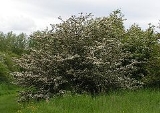
Common Hawthorn

Encyclopedia
Crataegus monogyna, known as common hawthorn or single-seeded hawthorn, is a species of hawthorn
native to Europe
, northwest Africa
and western Asia
. It has been introduced in many other parts of the world where it is an invasive weed. Other common names include may, mayblossom, maythorn, quickthorn, whitethorn, motherdie, and haw. This species is one of several that have been referred to as Crataegus oxyacantha
, a name that has been rejected by the botanical community as too ambiguous.
or small tree
5–14 m tall, with a dense crown. The bark
is dull brown with vertical orange cracks. The younger stems bear sharp thorns, 1 to 1.5 cm long. The leaves
are 2–4 cm long, obovate and deeply lobed, sometimes almost to the midrib, with the lobes spreading at a wide angle. The upper surface is dark green above and paler underneath.
The hermaphrodite
flower
s are produced in late spring (May to early June in its native area) in corymbs of 5-25 together; each flower is about 1 cm diameter, and has five white petals, numerous red stamens, and a single style; they are moderately fragrant. They are pollinated by midge
s and later in the year bear numerous haws. The haw is a small, oval dark red fruit
about 1 cm long, berry
-like, but structurally a pome
containing a single seed
. Haws are important for wildlife
in winter, particularly thrushes
and waxwing
s; these birds eat the haws and disperse the seed
s in their droppings.
It is distinguished from the related but less widespread Midland Hawthorn
(C. laevigata) by its more upright growth, the leaves being deeply lobed, with spreading lobes, and in the flowers having just one style, not two or three. However they are inter-fertile and hybrids occur frequently; they are only entirely distinct in their more typical forms.
, which is of considerable interest for treating cardiac insufficiency by evidence-based medicine
. The plant parts used medicinally are usually sprigs with both leaves and flowers, or alternatively the fruit. Several species of Crataegus have both traditional and modern medicinal uses.
It is a good source of antioxidant
phytochemicals,especially extracts of hawthorn leaves with flowers.
use. Its spines and close branching habit render it effectively stock and human proof with some basic maintenance. The traditional practice of hedge laying
is most commonly practiced with this species. It is a good fire wood which burns with a good heat and little smoke.
Numerous hybrids exist, some of which are used as garden
shrubs. The most widely used hybrid is C. × media
(C. monogyna × C. laevigata) , of which several cultivar
s are known, including the very popular 'Paul's Scarlet' with dark pink double flowers. Other garden shrubs that have sometimes been suggested as possible hybrids involving the Common Hawthorn, include the Various-leaved Hawthorn of the Caucasus
, which is only very occasionally found in parks and gardens.
, jams, and syrup
s, used to make wine, or to add flavour to brandy, rather than eaten fresh. Botanically they are pomes, but they look similar to berries
. A haw is small and oblong
, similar in size and shape to a small olive or grape, and red when ripe
. Haws develop in groups of 2-3 along smaller branches. They are pulpy and delicate in taste. In this species (C. monogyna) they have only one seed, but in other species of hawthorn there may be up to 5 seeds.
Petals are also edible, as are the leaves, which if picked in spring when still young are tender enough to be used in salads.
http://pagesperso-orange.fr/affo/FicheFF/FF_Aubepine.htm. The tree has a height of 9 m, and a girth of 2.65 m (2009). The inscription on the plaque beneath reads: "This hawthorn is without doubt the oldest tree of France. Its origin goes back to St Julien
(3rd century)", but such claims are impossible to verify.
A famous specimen in England, the Glastonbury Thorn
, was noteworthy because it flowered twice in a year, once in the late spring which is normal, but also once after the harshness of midwinter has passed. The original specimen at Glastonbury Abbey, now long dead, has been propagated as the cultivar 'Biflora'.
The oldest known living specimen in East Anglia
, and possibly in the United Kingdom, is known as "The Hethel Old Thorn", and is located in the churchyard in the small village of Hethel
, south of Norwich
, in Norfolk
. It is reputed to be more than 700 years old, having been planted in the 13th century.
Crataegus
Crataegus , commonly called hawthorn or thornapple, is a large genus of shrubs and trees in the rose family, Rosaceae, native to temperate regions of the Northern Hemisphere in Europe, Asia and North America. The name hawthorn was originally applied to the species native to northern Europe,...
native to Europe
Europe
Europe is, by convention, one of the world's seven continents. Comprising the westernmost peninsula of Eurasia, Europe is generally 'divided' from Asia to its east by the watershed divides of the Ural and Caucasus Mountains, the Ural River, the Caspian and Black Seas, and the waterways connecting...
, northwest Africa
Africa
Africa is the world's second largest and second most populous continent, after Asia. At about 30.2 million km² including adjacent islands, it covers 6% of the Earth's total surface area and 20.4% of the total land area...
and western Asia
Asia
Asia is the world's largest and most populous continent, located primarily in the eastern and northern hemispheres. It covers 8.7% of the Earth's total surface area and with approximately 3.879 billion people, it hosts 60% of the world's current human population...
. It has been introduced in many other parts of the world where it is an invasive weed. Other common names include may, mayblossom, maythorn, quickthorn, whitethorn, motherdie, and haw. This species is one of several that have been referred to as Crataegus oxyacantha
Crataegus oxyacantha
The name Crataegus oxyacantha L. has been rejected as being of uncertain application, but is sometimes still used.-Taxonomy:Linnaeus introduced the name Crataegus oxyacantha for a species of Northern European Hawthorn and the name gradually became used for several similar species which were assumed...
, a name that has been rejected by the botanical community as too ambiguous.
Description
The Common Hawthorn is a shrubShrub
A shrub or bush is distinguished from a tree by its multiple stems and shorter height, usually under 5–6 m tall. A large number of plants may become either shrubs or trees, depending on the growing conditions they experience...
or small tree
Tree
A tree is a perennial woody plant. It is most often defined as a woody plant that has many secondary branches supported clear of the ground on a single main stem or trunk with clear apical dominance. A minimum height specification at maturity is cited by some authors, varying from 3 m to...
5–14 m tall, with a dense crown. The bark
Bark
Bark is the outermost layers of stems and roots of woody plants. Plants with bark include trees, woody vines and shrubs. Bark refers to all the tissues outside of the vascular cambium and is a nontechnical term. It overlays the wood and consists of the inner bark and the outer bark. The inner...
is dull brown with vertical orange cracks. The younger stems bear sharp thorns, 1 to 1.5 cm long. The leaves
Leaf
A leaf is an organ of a vascular plant, as defined in botanical terms, and in particular in plant morphology. Foliage is a mass noun that refers to leaves as a feature of plants....
are 2–4 cm long, obovate and deeply lobed, sometimes almost to the midrib, with the lobes spreading at a wide angle. The upper surface is dark green above and paler underneath.
The hermaphrodite
Plant sexuality
Plant sexuality covers the wide variety of sexual reproduction systems found across the plant kingdom. This article describes morphological aspects of sexual reproduction of plants....
flower
Flower
A flower, sometimes known as a bloom or blossom, is the reproductive structure found in flowering plants . The biological function of a flower is to effect reproduction, usually by providing a mechanism for the union of sperm with eggs...
s are produced in late spring (May to early June in its native area) in corymbs of 5-25 together; each flower is about 1 cm diameter, and has five white petals, numerous red stamens, and a single style; they are moderately fragrant. They are pollinated by midge
Midge
A midge is a very small, two-winged flying insect. "Midge" may also refer to:-Real:* Midge Costanza , American politician* Mildred Gillars , aka "Midge", American broadcaster of Nazi propaganda during World War II...
s and later in the year bear numerous haws. The haw is a small, oval dark red fruit
Fruit
In broad terms, a fruit is a structure of a plant that contains its seeds.The term has different meanings dependent on context. In non-technical usage, such as food preparation, fruit normally means the fleshy seed-associated structures of certain plants that are sweet and edible in the raw state,...
about 1 cm long, berry
Berry
The botanical definition of a berry is a fleshy fruit produced from a single ovary. Grapes are an example. The berry is the most common type of fleshy fruit in which the entire ovary wall ripens into an edible pericarp. They may have one or more carpels with a thin covering and fleshy interiors....
-like, but structurally a pome
Pome
In botany, a pome is a type of fruit produced by flowering plants in the subfamily Maloideae of the family Rosaceae.A pome is an accessory fruit composed of one or more carpels surrounded by accessory tissue...
containing a single seed
Seed
A seed is a small embryonic plant enclosed in a covering called the seed coat, usually with some stored food. It is the product of the ripened ovule of gymnosperm and angiosperm plants which occurs after fertilization and some growth within the mother plant...
. Haws are important for wildlife
Wildlife
Wildlife includes all non-domesticated plants, animals and other organisms. Domesticating wild plant and animal species for human benefit has occurred many times all over the planet, and has a major impact on the environment, both positive and negative....
in winter, particularly thrushes
Thrush (bird)
The thrushes, family Turdidae, are a group of passerine birds that occur worldwide.-Characteristics:Thrushes are plump, soft-plumaged, small to medium-sized birds, inhabiting wooded areas, and often feed on the ground or eat small fruit. The smallest thrush may be the Forest Rock-thrush, at and...
and waxwing
Waxwing
The waxwings form the genus Bombycilla of passerine birds. According to most authorities, this is the only genus placed in the family Bombycillidae.-Description:Waxwings are characterised by soft silky plumage...
s; these birds eat the haws and disperse the seed
Seed
A seed is a small embryonic plant enclosed in a covering called the seed coat, usually with some stored food. It is the product of the ripened ovule of gymnosperm and angiosperm plants which occurs after fertilization and some growth within the mother plant...
s in their droppings.
It is distinguished from the related but less widespread Midland Hawthorn
Midland Hawthorn
Crataegus laevigata, known as the midland hawthorn, woodland hawthorn or mayflower, is a species of hawthorn native to western and central Europe, from Great Britain and Spain east to the Czech Republic and Hungary. The species name is often spelled C. levigata, but the original orthography is C...
(C. laevigata) by its more upright growth, the leaves being deeply lobed, with spreading lobes, and in the flowers having just one style, not two or three. However they are inter-fertile and hybrids occur frequently; they are only entirely distinct in their more typical forms.
Medicinal use
Crataegus monogyna is one of the most common species used as the "hawthorn" of traditional herbalismHerbalism
Herbalism is a traditional medicinal or folk medicine practice based on the use of plants and plant extracts. Herbalism is also known as botanical medicine, medical herbalism, herbal medicine, herbology, herblore, and phytotherapy...
, which is of considerable interest for treating cardiac insufficiency by evidence-based medicine
Evidence-based medicine
Evidence-based medicine or evidence-based practice aims to apply the best available evidence gained from the scientific method to clinical decision making. It seeks to assess the strength of evidence of the risks and benefits of treatments and diagnostic tests...
. The plant parts used medicinally are usually sprigs with both leaves and flowers, or alternatively the fruit. Several species of Crataegus have both traditional and modern medicinal uses.
It is a good source of antioxidant
Antioxidant
An antioxidant is a molecule capable of inhibiting the oxidation of other molecules. Oxidation is a chemical reaction that transfers electrons or hydrogen from a substance to an oxidizing agent. Oxidation reactions can produce free radicals. In turn, these radicals can start chain reactions. When...
phytochemicals,especially extracts of hawthorn leaves with flowers.
In gardening and agriculture
Common Hawthorn is extensively planted as a hedge plant, especially for agriculturalAgriculture
Agriculture is the cultivation of animals, plants, fungi and other life forms for food, fiber, and other products used to sustain life. Agriculture was the key implement in the rise of sedentary human civilization, whereby farming of domesticated species created food surpluses that nurtured the...
use. Its spines and close branching habit render it effectively stock and human proof with some basic maintenance. The traditional practice of hedge laying
Hedge laying
Hedge laying is a country skill, typically found in the United Kingdom and Ireland, which, through the creation and maintenance of hedges, achieves the following:* the formation of livestock-proof barriers;...
is most commonly practiced with this species. It is a good fire wood which burns with a good heat and little smoke.
Numerous hybrids exist, some of which are used as garden
Garden
A garden is a planned space, usually outdoors, set aside for the display, cultivation, and enjoyment of plants and other forms of nature. The garden can incorporate both natural and man-made materials. The most common form today is known as a residential garden, but the term garden has...
shrubs. The most widely used hybrid is C. × media
Crataegus × media
Crataegus × media, is a hybrid between two species in the genus Crataegus , C. monogyna and C. laevigata, both in series Crataegus...
(C. monogyna × C. laevigata) , of which several cultivar
Cultivar
A cultivar'Cultivar has two meanings as explained under Formal definition. When used in reference to a taxon, the word does not apply to an individual plant but to all those plants sharing the unique characteristics that define the cultivar. is a plant or group of plants selected for desirable...
s are known, including the very popular 'Paul's Scarlet' with dark pink double flowers. Other garden shrubs that have sometimes been suggested as possible hybrids involving the Common Hawthorn, include the Various-leaved Hawthorn of the Caucasus
Caucasus
The Caucasus, also Caucas or Caucasia , is a geopolitical region at the border of Europe and Asia, and situated between the Black and the Caspian sea...
, which is only very occasionally found in parks and gardens.
Edible "berries", petals, and leaves
The fruit of hawthorn, called haws, are edible, but are commonly made into jelliesGelatin dessert
Gelatin desserts are desserts made with sweetened and flavored gelatin. They can be made by combining plain gelatin with other ingredients or by using a premixed blend of gelatin with additives...
, jams, and syrup
Syrup
In cooking, a syrup is a thick, viscous liquid consisting primarily of a solution of sugar in water, containing a large amount of dissolved sugars but showing little tendency to deposit crystals...
s, used to make wine, or to add flavour to brandy, rather than eaten fresh. Botanically they are pomes, but they look similar to berries
Berry
The botanical definition of a berry is a fleshy fruit produced from a single ovary. Grapes are an example. The berry is the most common type of fleshy fruit in which the entire ovary wall ripens into an edible pericarp. They may have one or more carpels with a thin covering and fleshy interiors....
. A haw is small and oblong
Rectangle
In Euclidean plane geometry, a rectangle is any quadrilateral with four right angles. The term "oblong" is occasionally used to refer to a non-square rectangle...
, similar in size and shape to a small olive or grape, and red when ripe
Ripe
Ripe may refer to:* Ripening, especially of fruit* Ripeness in viticulture, how the term "ripe" is used in viticulture and winemaking* RIPE, Réseaux IP Européens* RIPE NCC, the Regional Internet Registry for Europe* Ripeness, a term in law...
. Haws develop in groups of 2-3 along smaller branches. They are pulpy and delicate in taste. In this species (C. monogyna) they have only one seed, but in other species of hawthorn there may be up to 5 seeds.
Petals are also edible, as are the leaves, which if picked in spring when still young are tender enough to be used in salads.
Notable trees
An ancient specimen, and reputedly the oldest tree of any species in France, is to be found alongside the church at Saint Mars sur la Futaie, MayenneMayenne
Mayenne is a department in northwest France named after the Mayenne River.-History:Mayenne is one of the original 83 departments created during the French Revolution on March 4, 1790. The northern two thirds correspond to the western part of the former province of Maine...
http://pagesperso-orange.fr/affo/FicheFF/FF_Aubepine.htm. The tree has a height of 9 m, and a girth of 2.65 m (2009). The inscription on the plaque beneath reads: "This hawthorn is without doubt the oldest tree of France. Its origin goes back to St Julien
Julian of Le Mans
Saint Julian of Le Mans is a saint venerated in both the Roman Catholic and Eastern Orthodox Church, honored as the first bishop of Le Mans. His feast day is January 27...
(3rd century)", but such claims are impossible to verify.
A famous specimen in England, the Glastonbury Thorn
Glastonbury Thorn
The Glastonbury Thorn is a form of Common Hawthorn, Crataegus monogyna 'Biflora' , found in and around Glastonbury, Somerset, England. Unlike ordinary hawthorn trees, it flowers twice a year , the first time in winter and the second time in spring...
, was noteworthy because it flowered twice in a year, once in the late spring which is normal, but also once after the harshness of midwinter has passed. The original specimen at Glastonbury Abbey, now long dead, has been propagated as the cultivar 'Biflora'.
The oldest known living specimen in East Anglia
East Anglia
East Anglia is a traditional name for a region of eastern England, named after an ancient Anglo-Saxon kingdom, the Kingdom of the East Angles. The Angles took their name from their homeland Angeln, in northern Germany. East Anglia initially consisted of Norfolk and Suffolk, but upon the marriage of...
, and possibly in the United Kingdom, is known as "The Hethel Old Thorn", and is located in the churchyard in the small village of Hethel
Hethel
Hethel is a small village in Norfolk, England, near the historic market town of Wymondham, and approximately 10 miles south of the city of Norwich....
, south of Norwich
Norwich
Norwich is a city in England. It is the regional administrative centre and county town of Norfolk. During the 11th century, Norwich was the largest city in England after London, and one of the most important places in the kingdom...
, in Norfolk
Norfolk
Norfolk is a low-lying county in the East of England. It has borders with Lincolnshire to the west, Cambridgeshire to the west and southwest and Suffolk to the south. Its northern and eastern boundaries are the North Sea coast and to the north-west the county is bordered by The Wash. The county...
. It is reputed to be more than 700 years old, having been planted in the 13th century.
See also
- The hawthorn button-top gall on Hawthorn, is caused by the dipteron gall-midge Dasineura crataegiDasineura crataegiThe hawthorn button-top gall, is caused by the dipteron gall-midge Dasineura crataegi . The gall develops in the terminal shoots of Hawthorn, Crataegus monogyna and the midland hawthorn Crataegus laevigata and their hybrids.Synonyms are Perrisia crataegi and Cecidomyia crataegi, .-The physical...
. - HaweaterHaweaterHaweater is a nickname given to a person born on Manitoulin Island, Ontario. The name derives from the prevalence of hawberries among the island's vegetation...
- List of Lepidoptera that feed on hawthorns
- Folklore about hawthorns, primarily the European species C. laevigata and/or C. monogyna and hybrids between these two species.
External links
- Crataegus monogyna in Topwalks
- Hawthorn Gallery (photographs of a number of such trees, including Hethel Old Thorn)