

Hethel

Encyclopedia
Hethel is a small village in Norfolk
, England
, near the historic market town of Wymondham
, and approximately 10 miles (16 km) south of the city of Norwich
.
According to the 2001 census
, the Bracon Ash
and Hethel parish covered an area of 9.84 square kilometres and had a population of 446 people within 171 households.
The village gave its name to the former RAF Hethel
airbase, which has been the location of the Head Office and factory of Lotus Cars
since the 1960s. The Lotus Cars test track uses sections of the old RAF Hethel runway.
Hethel is noted for containing the oldest known living hawthorn
tree in East Anglia
and possibly in the United Kingdom (reputed to be more than 700 years old). Planted in the 13th century, "Hethel Old Thorn" (a specimen of Common Hawthorn, Crataegus monogyna
)http://www.wildaboutbritain.co.uk/forums/wildflowers-plants-tree-forums/5509-bowthorpe-oak.htmlhttp://www.wildlifetrust.org.uk/norfolk/nature%20reserves/map-links/hethel.htm is in the village churchyard, which is classified as the smallest reserve under the care of the British Wildlife Trusts partnership
.http://www.wildlifetrusts.org/index.php?section=home:wildfacts.
The name 'Hethel' is derived from the older name 'Het Hill'.
was an airfield used by the US during the Second World War, and later by the RAF. Located 7 miles (11.3 km) south west of Norwich
, it was constructed in 1942 for American use and assigned USAAF designation "Station 114". From 14 September 1943 though to 12 June 1945, Hethel served as headquarters for the 2nd Combat Bombardment Wing of the 2nd Bomb Division.
After the departure of the Americans, it was assigned to RAF Fighter Command
. On 25 June Polish
-manned North American Mustang RAF squadrons moved into the base. In mid-1947, Hethel became a Personnel Transit Centre but was transferred to RAF Technical Training Command
. With the downsizing of the RAF, the field was closed in 1948. For many years the base was inactive and abandoned until it was finally sold by the Air Ministry
in 1964.
For a number of years the old airbase Nissen hut
s were used to house families awaiting re-housing under the post-war building programme. Forehoe and Henstead RDC also used part of the area as a store depot. With the end of military control, Hethel became the manufacturing and testing site for Lotus Cars
. The manufacture of vehicles, originally started in the old hangars and workshops, now takes place in several modern buildings. Lotus
uses parts of the airfield perimeter track and lengths of the main runway as a testing track.

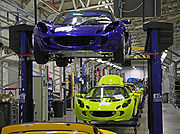 In 1966 Lotus Cars
moved into a purpose built factory on the site of the airfield and developed portions of the runways and taxiways as a test track for their cars. The factory and engineering centres cover 55 acres (222,577.3 m²) of the former base and use 2.5 miles (4 km) of runway. Much of the remaining runways have been removed and returned to agricultural use. The layout can still be seen from aerial photos.
Lotus Cars
designs and builds race and production automobiles of light weight and high handling
characteristics. Colin Chapman
, the founder of Lotus
died of a heart attack in 1982 at the age of 54, having begun life an innkeeper's son and become a multi-millionaire industrialist. The car maker built tens of thousands of successful racing and road cars and won the Formula One
World Championship
seven times. At the time of his death he was linked with the DeLorean scandal over the use of government subsidies for the production of the DeLorean DMC-12 for which Lotus had designed the chassis
.
In 1986, the company was bought by General Motors. On 27 August 1993, GM sold the company, for £30 million, to A.C.B.N. Holdings S.A. of Luxembourg
, a company controlled by Italian businessman Romano Artioli
, who also owned Bugatti Automobili SpA. In 1996, a majority share in Lotus was sold to Perusahaan Otomobil Nasional Bhd (Proton
), a Malaysian car company listed on the Kuala Lumpur Stock Exchange
.
The company also acts as an engineering
consultancy, providing engineering development—particularly of suspension
—for other car manufacturers. The company's racing arm, Team Lotus
, and the Lotus Driving Academy are also based at Hethel.
Norfolk
Norfolk is a low-lying county in the East of England. It has borders with Lincolnshire to the west, Cambridgeshire to the west and southwest and Suffolk to the south. Its northern and eastern boundaries are the North Sea coast and to the north-west the county is bordered by The Wash. The county...
, England
England
England is a country that is part of the United Kingdom. It shares land borders with Scotland to the north and Wales to the west; the Irish Sea is to the north west, the Celtic Sea to the south west, with the North Sea to the east and the English Channel to the south separating it from continental...
, near the historic market town of Wymondham
Wymondham
Wymondham is a historic market town and civil parish in the English county of Norfolk. It lies 9.5 miles to the south west of the city of Norwich, on the A11 road to Thetford and London.- Before The Great Fire :...
, and approximately 10 miles (16 km) south of the city of Norwich
Norwich
Norwich is a city in England. It is the regional administrative centre and county town of Norfolk. During the 11th century, Norwich was the largest city in England after London, and one of the most important places in the kingdom...
.
According to the 2001 census
United Kingdom Census 2001
A nationwide census, known as Census 2001, was conducted in the United Kingdom on Sunday, 29 April 2001. This was the 20th UK Census and recorded a resident population of 58,789,194....
, the Bracon Ash
Bracon Ash
Bracon Ash is a village and civil parish in the South Norfolk district of Norfolk, England.According to the 2001 United Kingdom national census, the Bracon Ash and Hethel Parish covered an area of 9.84 km2 and had a population of 446 people, spread between 171 households.The B1113 road runs...
and Hethel parish covered an area of 9.84 square kilometres and had a population of 446 people within 171 households.
The village gave its name to the former RAF Hethel
RAF Hethel
RAF Hethel is a former World War II airfield used by the US during the Second World War in Norfolk, England situated located 7 miles south west of Norwich.-USAAF use:...
airbase, which has been the location of the Head Office and factory of Lotus Cars
Lotus Cars
Lotus Cars is a British manufacturer of sports and racing cars based at the former site of RAF Hethel, a World War II airfield in Norfolk. The company designs and builds race and production automobiles of light weight and fine handling characteristics...
since the 1960s. The Lotus Cars test track uses sections of the old RAF Hethel runway.
Hethel is noted for containing the oldest known living hawthorn
Crataegus
Crataegus , commonly called hawthorn or thornapple, is a large genus of shrubs and trees in the rose family, Rosaceae, native to temperate regions of the Northern Hemisphere in Europe, Asia and North America. The name hawthorn was originally applied to the species native to northern Europe,...
tree in East Anglia
East Anglia
East Anglia is a traditional name for a region of eastern England, named after an ancient Anglo-Saxon kingdom, the Kingdom of the East Angles. The Angles took their name from their homeland Angeln, in northern Germany. East Anglia initially consisted of Norfolk and Suffolk, but upon the marriage of...
and possibly in the United Kingdom (reputed to be more than 700 years old). Planted in the 13th century, "Hethel Old Thorn" (a specimen of Common Hawthorn, Crataegus monogyna
Common Hawthorn
Crataegus monogyna, known as common hawthorn or single-seeded hawthorn, is a species of hawthorn native to Europe, northwest Africa and western Asia. It has been introduced in many other parts of the world where it is an invasive weed...
)http://www.wildaboutbritain.co.uk/forums/wildflowers-plants-tree-forums/5509-bowthorpe-oak.htmlhttp://www.wildlifetrust.org.uk/norfolk/nature%20reserves/map-links/hethel.htm is in the village churchyard, which is classified as the smallest reserve under the care of the British Wildlife Trusts partnership
The Wildlife Trusts partnership
The Wildlife Trusts is an organisation made up of 47 local Wildlife Trusts in the United Kingdom plus the Isle of Man and Alderney.The Wildlife Trusts, between them, look after around 2,300 nature reserves covering more than 90,000 hectares...
.http://www.wildlifetrusts.org/index.php?section=home:wildfacts.
The name 'Hethel' is derived from the older name 'Het Hill'.
Hethel Airfield
RAF HethelRAF Hethel
RAF Hethel is a former World War II airfield used by the US during the Second World War in Norfolk, England situated located 7 miles south west of Norwich.-USAAF use:...
was an airfield used by the US during the Second World War, and later by the RAF. Located 7 miles (11.3 km) south west of Norwich
Norwich
Norwich is a city in England. It is the regional administrative centre and county town of Norfolk. During the 11th century, Norwich was the largest city in England after London, and one of the most important places in the kingdom...
, it was constructed in 1942 for American use and assigned USAAF designation "Station 114". From 14 September 1943 though to 12 June 1945, Hethel served as headquarters for the 2nd Combat Bombardment Wing of the 2nd Bomb Division.
After the departure of the Americans, it was assigned to RAF Fighter Command
RAF Fighter Command
RAF Fighter Command was one of three functional commands of the Royal Air Force. It was formed in 1936 to allow more specialised control of fighter aircraft. It served throughout the Second World War, gaining recognition in the Battle of Britain. The Command continued until 17 November 1943, when...
. On 25 June Polish
Poland
Poland , officially the Republic of Poland , is a country in Central Europe bordered by Germany to the west; the Czech Republic and Slovakia to the south; Ukraine, Belarus and Lithuania to the east; and the Baltic Sea and Kaliningrad Oblast, a Russian exclave, to the north...
-manned North American Mustang RAF squadrons moved into the base. In mid-1947, Hethel became a Personnel Transit Centre but was transferred to RAF Technical Training Command
RAF Technical Training Command
Technical Training Command was an organization within the Royal Air Force which controlled units responsible for delivering aircraft maintenance training and other non-flying training, initially in Berkshire then in Cambridgeshire.-History:...
. With the downsizing of the RAF, the field was closed in 1948. For many years the base was inactive and abandoned until it was finally sold by the Air Ministry
Air Ministry
The Air Ministry was a department of the British Government with the responsibility of managing the affairs of the Royal Air Force, that existed from 1918 to 1964...
in 1964.
For a number of years the old airbase Nissen hut
Nissen hut
A Nissen hut is a prefabricated steel structure made from a half-cylindrical skin of corrugated steel, a variant of which was used extensively during World War II.-Description:...
s were used to house families awaiting re-housing under the post-war building programme. Forehoe and Henstead RDC also used part of the area as a store depot. With the end of military control, Hethel became the manufacturing and testing site for Lotus Cars
Lotus Cars
Lotus Cars is a British manufacturer of sports and racing cars based at the former site of RAF Hethel, a World War II airfield in Norfolk. The company designs and builds race and production automobiles of light weight and fine handling characteristics...
. The manufacture of vehicles, originally started in the old hangars and workshops, now takes place in several modern buildings. Lotus
Lotus Cars
Lotus Cars is a British manufacturer of sports and racing cars based at the former site of RAF Hethel, a World War II airfield in Norfolk. The company designs and builds race and production automobiles of light weight and fine handling characteristics...
uses parts of the airfield perimeter track and lengths of the main runway as a testing track.
Lotus Cars
Lotus Cars
Lotus Cars is a British manufacturer of sports and racing cars based at the former site of RAF Hethel, a World War II airfield in Norfolk. The company designs and builds race and production automobiles of light weight and fine handling characteristics...
moved into a purpose built factory on the site of the airfield and developed portions of the runways and taxiways as a test track for their cars. The factory and engineering centres cover 55 acres (222,577.3 m²) of the former base and use 2.5 miles (4 km) of runway. Much of the remaining runways have been removed and returned to agricultural use. The layout can still be seen from aerial photos.
Lotus Cars
Lotus Cars
Lotus Cars is a British manufacturer of sports and racing cars based at the former site of RAF Hethel, a World War II airfield in Norfolk. The company designs and builds race and production automobiles of light weight and fine handling characteristics...
designs and builds race and production automobiles of light weight and high handling
Car handling
Automobile handling and vehicle handling are descriptions of the way wheeled vehicles perform transverse to their direction of motion, particularly during cornering and swerving. It also includes their stability when moving at rest. Handling and braking are the major components of a vehicle's...
characteristics. Colin Chapman
Colin Chapman
Anthony Colin Bruce Chapman CBE was an influential British designer, inventor, and builder in the automotive industry, and founder of Lotus Cars....
, the founder of Lotus
Lotus Cars
Lotus Cars is a British manufacturer of sports and racing cars based at the former site of RAF Hethel, a World War II airfield in Norfolk. The company designs and builds race and production automobiles of light weight and fine handling characteristics...
died of a heart attack in 1982 at the age of 54, having begun life an innkeeper's son and become a multi-millionaire industrialist. The car maker built tens of thousands of successful racing and road cars and won the Formula One
Formula One
Formula One, also known as Formula 1 or F1 and referred to officially as the FIA Formula One World Championship, is the highest class of single seater auto racing sanctioned by the Fédération Internationale de l'Automobile . The "formula" designation in the name refers to a set of rules with which...
World Championship
World championship
A world championship is the top achievement for any sport or contest. The title is usually awarded by contests, ranking systems, stature, ability, etc. This determines the best nation, team, individual in the world in a particular field. Certain sports do not have a world championship, instead...
seven times. At the time of his death he was linked with the DeLorean scandal over the use of government subsidies for the production of the DeLorean DMC-12 for which Lotus had designed the chassis
Chassis
A chassis consists of an internal framework that supports a man-made object. It is analogous to an animal's skeleton. An example of a chassis is the underpart of a motor vehicle, consisting of the frame with the wheels and machinery.- Vehicles :In the case of vehicles, the term chassis means the...
.
In 1986, the company was bought by General Motors. On 27 August 1993, GM sold the company, for £30 million, to A.C.B.N. Holdings S.A. of Luxembourg
Luxembourg
Luxembourg , officially the Grand Duchy of Luxembourg , is a landlocked country in western Europe, bordered by Belgium, France, and Germany. It has two principal regions: the Oesling in the North as part of the Ardennes massif, and the Gutland in the south...
, a company controlled by Italian businessman Romano Artioli
Romano Artioli
Romano Artioli is an Italian entrepreneur and one-time owner of Bugatti and Lotus automobile makers.Artioli was born in Moglia of the Province of Mantua, and raised in Bolzano where he in the 1980s ran one of the largest Ferrari dealerships in the world, selling in northern Italy and southern...
, who also owned Bugatti Automobili SpA. In 1996, a majority share in Lotus was sold to Perusahaan Otomobil Nasional Bhd (Proton
Proton (company)
Proton is a Malaysian automobile manufacturer headquartered in Subang Jaya and Shah Alam, Selangor, Malaysia, with a manufacturing plant in Tanjung Malim, Perak. Founded in 1983, it was Malaysia's only carmaker until the establishment of its competitor and arch-rival, Perodua, in 1993...
), a Malaysian car company listed on the Kuala Lumpur Stock Exchange
Kuala Lumpur Stock Exchange
The Kuala Lumpur Stock Exchange dates back to 1930 when the Singapore Stockbrokers' Association was set up as a formal organisation dealing in securities in Malaya...
.
The company also acts as an engineering
Engineering
Engineering is the discipline, art, skill and profession of acquiring and applying scientific, mathematical, economic, social, and practical knowledge, in order to design and build structures, machines, devices, systems, materials and processes that safely realize improvements to the lives of...
consultancy, providing engineering development—particularly of suspension
Suspension (vehicle)
Suspension is the term given to the system of springs, shock absorbers and linkages that connects a vehicle to its wheels. Suspension systems serve a dual purpose — contributing to the car's roadholding/handling and braking for good active safety and driving pleasure, and keeping vehicle occupants...
—for other car manufacturers. The company's racing arm, Team Lotus
Team Lotus
Team Lotus was the motorsport sister company of English sports car manufacturer Lotus Cars. The team ran cars in many motorsport series including Formula One, Formula Two, Formula Ford, Formula Junior, IndyCar and sports car racing...
, and the Lotus Driving Academy are also based at Hethel.
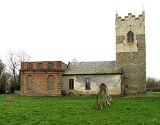
Church of All Saints
All Saints Church displays an unusual juxtaposition of styles, from its square Saxon tower to the red-brick east end which includes the 18th-century Branthwaite family chapel on the north side of the chancel. It is a Grade I listed buildinghttp://www.imagesofengland.org.uk/details/default.aspx?id=226578.External links
- Map of Hethel (east)
- Map of Hethel (west)
- Historic map of Hethel (map made in 1842)
- Photograph of Hethel Old Thorn
- Hawthown Gallery (includes an image of Hethel Old Thorn)
- Lotus Cars
- Lotus Engineering
- Lotus Driving Academy
- Classic Team Lotus