

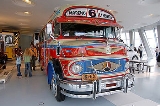
Colectivo

Encyclopedia
Colectivo is the name given in Argentina
and Paraguay
(in Uruguay
is common, too) to a type of public transportation vehicles, especially those of Argentina's capital city, Buenos Aires
. The name comes from "vehículos de transporte colectivo" (vehicles for collective transport), reflecting their origin as shared taxis.
When they first appeared in the 1920s, colectivos were small bus
es built out of smaller vehicle chassis (cars, vans, etc.) and, later, out of truck
chassis (1950–1990, by Mercedes-Benz
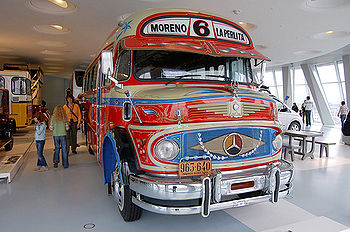
Argentina), not specifically designed for the transportation of people, and were decorated with unique hand-painted drawings (fileteado
) that gave each unit a distinct flavor.
They steadily evolved and grew larger, but kept their picturesque style until 1990, when the urban fleet was modernized with standard rear-engined bus
units.
During most of their history tickets were sold by the driver, who would drive off as soon as all passengers had boarded, selling tickets while driving.
In the 1900s Argentina was the "Granary of the World", one of the largest world food producers and exporters, and a wealthy country. The streets of prosperous Buenos Aires (with 2 million inhabitants) soon filled with cars.
Commercial relations with the United Kingdom
(mainly trade in meat and grain), also brought a myriad of investors and enterprises in the early years of the century, including Latin America
's first metro system
, car
s, train
s, tram
ways, taxi
s and public buses.
On 24 September 1928, the first taxi-bus ran through Buenos Aires. Later called "colectivo", it was based on an Argentine-manufactured longer-wheelbase Chevrolet Superior K-series Double Phaeton
called "Especial Argentino". It provided public transportation throughout Buenos Aires on pre-defined itineraries and stops, charging a low price for each passenger.
Chevrolet started manufacturing a truck chassis adaptable to passenger transport. By the 1930s the size of the colectivo had increased from five to up to a dozen seats, and the Chevrolet line had become widely used, with bodies made by local companies. This style was kept until the 1970s and 1980s, by which time the units had twenty seats plus cramped room for many standing passengers.
During its heyday, drivers deliberately challenged the "real" public buses and electric tramways, parking near them at the busiest stations and driving close to them during the day to pick up their passengers. Soon people started to prefer these colectivos, which displaced the original buses and trams.
With time the routes were formalized, and owners of colectivos joined together into lines that operated standard routes, distinguished by numbers displayed on the colectivos. Since several lines often traversed the same roads, companies began to adopt different colors to distinguish their units more clearly than by the number alone. Line 60
, a particularly well-know line with a long route, had its beginnings in this era.
 Mercedes-Benz truck and buses
After World War II
and during the 1950s Argentine industry started to develop again, but the country's public transport system was inadequate for the new era: practically no modernization had taken place since the early years, and the suburban railway system was not sufficient to meet the rising demands of the population.
Mercedes-Benz moved into the colectivo market: in 1951 the then Daimler-Benz AG set up in Argentina its first factories outside Germany
: one in the town of San Martín
, near Buenos Aires, and another in González Catán
.
Mercedes released updated local colectivo chassis, a modified L 3500 truck chassis – LO 3500, OP 3500, LO 311, LO 312, LO 911 – with a separately-manufactured body fitted later by different coach-builders. In less than a decade the output was 6,500 units a year. In 1963 Mercedes built the 10,000nd colectivo (model LO 312), and continued with other models, such as L 1112 (120 HP
), LA 1112 (all-wheel traction) and the L 1114. The Mercedes-Benz colectivos had truck powerplants, a diesel engine with power transmitted to the rear axle by a five-speed constant-mesh gearbox.
All the lines progressively adopted these units and, from 1950 to 1990, all colectivos were eventually Mercedes-Benz models.
In 1987 El Detalle, one of the bus body suppliers of Mercedes-Benz, started competing with its former chassis provider, investing in low price and modern urban buses, with cheaper Deutz
engines. That same year model El Detalle OA-101 was launched. This model was rear-engined and had pneumatic suspension, providing smoother rides and more inside space.
Mercedes-Benz responded the following year with the rear-engined OH-1314, but that was considered "the death of the Colectivo", certainly the end of an era.
In 1989 the last truck-based colectivos, on the classic Mercedes-Benz chassis LO-1114, were assembled. Production had been discontinued the previous year.
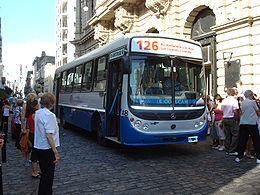
During the 1990s some companies found it cheaper to switch to single-colored units, and a flurry of mergers and foldings changed the appearance of colectivos.
Nowadays, only the three-digit numbering and some of the routes survive from the traditional "líneas", fileteado
is rarely seen, the filigranas were lost, and some of the classic big details, such as the panoramic mirrors close to the driver's head, disappeared.
After 1995 automatic ticket machines made journeys safer, since drivers did not have to sell tickets and drive at the same time.
In 2005 Mercedes-Benz units accounted for about half of the buses in the city of Buenos Aires and its surroundings, with units built in Buenos Aires
(La Favorita, Eivar, CND, CEAP, Ugarte, etc.) and in Brazil
(Marcopolo, CAIO and others). The other half were El Detalle units and others such as Scania, Volvo
, Dimex and Zanello.
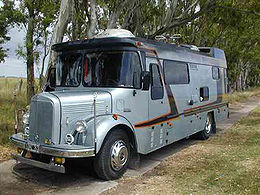
Most older units have been retired from service in Buenos Aires, as they are considered too dangerous and noisy for use in the fast-paced city. They were disposed of, or sent to smaller cities all over the country. Colectivos are usually retired only when they are too damaged to be repaired; some of them have “resuscitated” as fine motorhomes.
The colectivos were where this art found its best canvas. Long, wide mirrors placed around the driver seat often had winding drawings and motifs that usually portrayed the driver's preferences in football
, religion
and tango
.
The outside of the units was also painted with fileteado details, flower motifs, national flags
, and football team banners. It was also very common to see phrases written down in complex fonts, usually at the back. These phrases were often ingenious puns
or rhymes and became part of Argentine folklore. A simple example of a very common phrase is: Lo mejor que hizo la vieja es el pibe que maneja (loosely "The best thing my mum did was this bus-driving kid").
Before 1995 tickets were sold by the colectivero (driver) as he drove; they were colored strips of paper with a 5-digit number. Palindromic numbers
(such as 10301) were called capicúas (from Catalan
cap i cúa, "head and tail") and sometimes collected.
With low ticket prices, very frequent services, and extensive routes, with many places within 400m of a route, the colectivo is a very widely-used mode of transportation around the city. "Porteños" (Buenos Aires residents) have a love-hate relationship with the colectivo: on the one hand, they are usually very crowded in rush hour
and plagued with pickpockets
, petty thieves
, beggars
and hawker
s (itinerant salesmen). On the other hand, they are a necessity in the city, and a convenient and cheap way to get around. Most colectivos in the big cities of Argentina do not have a fixed timetable, but run at least four, and often many more, services per hour, depending on the bus line and time of day. During night-time, all colectivos en Buenos Aires
city run through their stops at least twice an hour.
Section boundaries are fixed at about 3 km from each other (less so near the city center), so that a 4-kilometer ride may sometimes require to pay the second rate.
Fares are valid for one bus ride, with no transfer facility.
Some lines operate a number of "diferencial" (premium) buses, with no need to stand and with other amenities, for example curtains, at a higher price.
Argentina
Argentina , officially the Argentine Republic , is the second largest country in South America by land area, after Brazil. It is constituted as a federation of 23 provinces and an autonomous city, Buenos Aires...
and Paraguay
Paraguay
Paraguay , officially the Republic of Paraguay , is a landlocked country in South America. It is bordered by Argentina to the south and southwest, Brazil to the east and northeast, and Bolivia to the northwest. Paraguay lies on both banks of the Paraguay River, which runs through the center of the...
(in Uruguay
Uruguay
Uruguay ,officially the Oriental Republic of Uruguay,sometimes the Eastern Republic of Uruguay; ) is a country in the southeastern part of South America. It is home to some 3.5 million people, of whom 1.8 million live in the capital Montevideo and its metropolitan area...
is common, too) to a type of public transportation vehicles, especially those of Argentina's capital city, Buenos Aires
Buenos Aires
Buenos Aires is the capital and largest city of Argentina, and the second-largest metropolitan area in South America, after São Paulo. It is located on the western shore of the estuary of the Río de la Plata, on the southeastern coast of the South American continent...
. The name comes from "vehículos de transporte colectivo" (vehicles for collective transport), reflecting their origin as shared taxis.
When they first appeared in the 1920s, colectivos were small bus
Bus
A bus is a road vehicle designed to carry passengers. Buses can have a capacity as high as 300 passengers. The most common type of bus is the single-decker bus, with larger loads carried by double-decker buses and articulated buses, and smaller loads carried by midibuses and minibuses; coaches are...
es built out of smaller vehicle chassis (cars, vans, etc.) and, later, out of truck
Truck
A truck or lorry is a motor vehicle designed to transport cargo. Trucks vary greatly in size, power, and configuration, with the smallest being mechanically similar to an automobile...
chassis (1950–1990, by Mercedes-Benz
Mercedes-Benz
Mercedes-Benz is a German manufacturer of automobiles, buses, coaches, and trucks. Mercedes-Benz is a division of its parent company, Daimler AG...
Argentina), not specifically designed for the transportation of people, and were decorated with unique hand-painted drawings (fileteado
Fileteado
Fileteado is a type of artistic drawing, with stylised lines and flowered, climbing plants typically used in Buenos Aires, Argentina.It is used to adorn all kind of beloved objects, signs, taxis, lorries and even the old Colectivos, Buenos Aires' buses....
) that gave each unit a distinct flavor.
They steadily evolved and grew larger, but kept their picturesque style until 1990, when the urban fleet was modernized with standard rear-engined bus
Bus
A bus is a road vehicle designed to carry passengers. Buses can have a capacity as high as 300 passengers. The most common type of bus is the single-decker bus, with larger loads carried by double-decker buses and articulated buses, and smaller loads carried by midibuses and minibuses; coaches are...
units.
During most of their history tickets were sold by the driver, who would drive off as soon as all passengers had boarded, selling tickets while driving.
1928–1950
Taxi-bus, Chevrolet Double Phaeton, creation of the "líneas"In the 1900s Argentina was the "Granary of the World", one of the largest world food producers and exporters, and a wealthy country. The streets of prosperous Buenos Aires (with 2 million inhabitants) soon filled with cars.
Commercial relations with the United Kingdom
United Kingdom
The United Kingdom of Great Britain and Northern IrelandIn the United Kingdom and Dependencies, other languages have been officially recognised as legitimate autochthonous languages under the European Charter for Regional or Minority Languages...
(mainly trade in meat and grain), also brought a myriad of investors and enterprises in the early years of the century, including Latin America
Latin America
Latin America is a region of the Americas where Romance languages – particularly Spanish and Portuguese, and variably French – are primarily spoken. Latin America has an area of approximately 21,069,500 km² , almost 3.9% of the Earth's surface or 14.1% of its land surface area...
's first metro system
Buenos Aires Metro
The Buenos Aires Metro , locally known as Subte is a mass-transit system that serves the city of Buenos Aires, Argentina. The first station of this network opened in 1913, the first of its kind in South America, the Southern Hemisphere and the entire Spanish-speaking world...
, car
Čar
Čar is a village in the municipality of Bujanovac, Serbia. According to the 2002 census, the town has a population of 296 people.-References:...
s, train
Train
A train is a connected series of vehicles for rail transport that move along a track to transport cargo or passengers from one place to another place. The track usually consists of two rails, but might also be a monorail or maglev guideway.Propulsion for the train is provided by a separate...
s, tram
Tram
A tram is a passenger rail vehicle which runs on tracks along public urban streets and also sometimes on separate rights of way. It may also run between cities and/or towns , and/or partially grade separated even in the cities...
ways, taxi
Taxicab
A taxicab, also taxi or cab, is a type of vehicle for hire with a driver, used by a single passenger or small group of passengers, often for a non-shared ride. A taxicab conveys passengers between locations of their choice...
s and public buses.
On 24 September 1928, the first taxi-bus ran through Buenos Aires. Later called "colectivo", it was based on an Argentine-manufactured longer-wheelbase Chevrolet Superior K-series Double Phaeton
Phaeton body
A Phaeton is a style of open car or carriage without proper weather protection for passengers. Use of this name for automobiles was limited to North America or its products....
called "Especial Argentino". It provided public transportation throughout Buenos Aires on pre-defined itineraries and stops, charging a low price for each passenger.
Chevrolet started manufacturing a truck chassis adaptable to passenger transport. By the 1930s the size of the colectivo had increased from five to up to a dozen seats, and the Chevrolet line had become widely used, with bodies made by local companies. This style was kept until the 1970s and 1980s, by which time the units had twenty seats plus cramped room for many standing passengers.
During its heyday, drivers deliberately challenged the "real" public buses and electric tramways, parking near them at the busiest stations and driving close to them during the day to pick up their passengers. Soon people started to prefer these colectivos, which displaced the original buses and trams.
With time the routes were formalized, and owners of colectivos joined together into lines that operated standard routes, distinguished by numbers displayed on the colectivos. Since several lines often traversed the same roads, companies began to adopt different colors to distinguish their units more clearly than by the number alone. Line 60
Colectivo 60
The Colectivo 60 runs from Constitución station, in the centre of the city of Buenos Aires, Argentina to the Tigre Club in the partido of Tigre...
, a particularly well-know line with a long route, had its beginnings in this era.
1950–1990
After World War II
World War II
World War II, or the Second World War , was a global conflict lasting from 1939 to 1945, involving most of the world's nations—including all of the great powers—eventually forming two opposing military alliances: the Allies and the Axis...
and during the 1950s Argentine industry started to develop again, but the country's public transport system was inadequate for the new era: practically no modernization had taken place since the early years, and the suburban railway system was not sufficient to meet the rising demands of the population.
Mercedes-Benz moved into the colectivo market: in 1951 the then Daimler-Benz AG set up in Argentina its first factories outside Germany
Germany
Germany , officially the Federal Republic of Germany , is a federal parliamentary republic in Europe. The country consists of 16 states while the capital and largest city is Berlin. Germany covers an area of 357,021 km2 and has a largely temperate seasonal climate...
: one in the town of San Martín
San Martín, Buenos Aires
Ciudad del Libertador General Don José de San Martín, more commonly known as San Martín is the head city of the General San Martín Partido in the Gran Buenos Aires metropolitan area.-Geography:...
, near Buenos Aires, and another in González Catán
González Catán
González Catán is a city located in La Matanza Partido, Buenos Aires Province, Argentina. The city is the second-largest by area in the county , and the second most-populous.It forms part of the Greater Buenos Aires urban conurbation....
.
Mercedes released updated local colectivo chassis, a modified L 3500 truck chassis – LO 3500, OP 3500, LO 311, LO 312, LO 911 – with a separately-manufactured body fitted later by different coach-builders. In less than a decade the output was 6,500 units a year. In 1963 Mercedes built the 10,000nd colectivo (model LO 312), and continued with other models, such as L 1112 (120 HP
Horsepower
Horsepower is the name of several units of measurement of power. The most common definitions equal between 735.5 and 750 watts.Horsepower was originally defined to compare the output of steam engines with the power of draft horses in continuous operation. The unit was widely adopted to measure the...
), LA 1112 (all-wheel traction) and the L 1114. The Mercedes-Benz colectivos had truck powerplants, a diesel engine with power transmitted to the rear axle by a five-speed constant-mesh gearbox.
All the lines progressively adopted these units and, from 1950 to 1990, all colectivos were eventually Mercedes-Benz models.
1990 to the present
Omnibus. Blurring of the tradition of the colectivoIn 1987 El Detalle, one of the bus body suppliers of Mercedes-Benz, started competing with its former chassis provider, investing in low price and modern urban buses, with cheaper Deutz
Deutz AG
Deutz AG is an engine manufacturer, based in Cologne, Germany.-History:The company was founded by Nikolaus Otto, inventor of the four-stroke internal combustion engine, in 1864 as N. A...
engines. That same year model El Detalle OA-101 was launched. This model was rear-engined and had pneumatic suspension, providing smoother rides and more inside space.
Mercedes-Benz responded the following year with the rear-engined OH-1314, but that was considered "the death of the Colectivo", certainly the end of an era.
In 1989 the last truck-based colectivos, on the classic Mercedes-Benz chassis LO-1114, were assembled. Production had been discontinued the previous year.
During the 1990s some companies found it cheaper to switch to single-colored units, and a flurry of mergers and foldings changed the appearance of colectivos.
Nowadays, only the three-digit numbering and some of the routes survive from the traditional "líneas", fileteado
Fileteado
Fileteado is a type of artistic drawing, with stylised lines and flowered, climbing plants typically used in Buenos Aires, Argentina.It is used to adorn all kind of beloved objects, signs, taxis, lorries and even the old Colectivos, Buenos Aires' buses....
is rarely seen, the filigranas were lost, and some of the classic big details, such as the panoramic mirrors close to the driver's head, disappeared.
After 1995 automatic ticket machines made journeys safer, since drivers did not have to sell tickets and drive at the same time.
In 2005 Mercedes-Benz units accounted for about half of the buses in the city of Buenos Aires and its surroundings, with units built in Buenos Aires
Buenos Aires
Buenos Aires is the capital and largest city of Argentina, and the second-largest metropolitan area in South America, after São Paulo. It is located on the western shore of the estuary of the Río de la Plata, on the southeastern coast of the South American continent...
(La Favorita, Eivar, CND, CEAP, Ugarte, etc.) and in Brazil
Brazil
Brazil , officially the Federative Republic of Brazil , is the largest country in South America. It is the world's fifth largest country, both by geographical area and by population with over 192 million people...
(Marcopolo, CAIO and others). The other half were El Detalle units and others such as Scania, Volvo
Volvo Buses
Volvo Buses is a subsidiary and a business area of the Swedish vehicle maker Volvo, which became an independent division in 1968. It is based in Göteborg....
, Dimex and Zanello.
Most older units have been retired from service in Buenos Aires, as they are considered too dangerous and noisy for use in the fast-paced city. They were disposed of, or sent to smaller cities all over the country. Colectivos are usually retired only when they are too damaged to be repaired; some of them have “resuscitated” as fine motorhomes.
Description of the colectivo
The Mercedes units were more sophisticated than the original taxi-bus but the body kept its artistic touches, preserving the original style of the colectivo. This style was not influenced by the social class of the districts through which the colectivos journeyed. All the units of all the "líneas" shared these characteristics until the 1990s:Multi-colored units
Decorators used many colorful combinations over the units' external body, helping identify each one of the líneas. These eventually evolved into "corporate colors": when one company ran several lines, they painted buses on all lines in the same colors. Until the 1990s the fileteado, individual to each bus, was maintained.Fileteados
Fileteado has been defined as: "art on wheels": full of colored ornaments and symmetries completed with poetic phrases, sayings and aphorisms, both humorous or roguish, emotional or philosophical".The colectivos were where this art found its best canvas. Long, wide mirrors placed around the driver seat often had winding drawings and motifs that usually portrayed the driver's preferences in football
Football (soccer)
Association football, more commonly known as football or soccer, is a sport played between two teams of eleven players with a spherical ball...
, religion
Religion
Religion is a collection of cultural systems, belief systems, and worldviews that establishes symbols that relate humanity to spirituality and, sometimes, to moral values. Many religions have narratives, symbols, traditions and sacred histories that are intended to give meaning to life or to...
and tango
Tango music
Tango is a style of ballroom dance music in 2/4 or 4/4 time that originated among European immigrant populations of Argentina and Uruguay . It is traditionally played by a sextet, known as the orquesta típica, which includes two violins, piano, double bass, and two bandoneons...
.
The outside of the units was also painted with fileteado details, flower motifs, national flags
Flag of Argentina
The national flag of Argentina is a triband, composed of three equally wide horizontal bands coloured light blue, white and light blue. There are multiple interpretations on the reasons for those colors...
, and football team banners. It was also very common to see phrases written down in complex fonts, usually at the back. These phrases were often ingenious puns
Puns
Puns may refer to:*Partido de Unión Nacional Saharaui, the Sahrawi political party* Pun, figure of speech* Phoenicians...
or rhymes and became part of Argentine folklore. A simple example of a very common phrase is: Lo mejor que hizo la vieja es el pibe que maneja (loosely "The best thing my mum did was this bus-driving kid").
Other details
The units with a larger budget had more details added around the driver's seat. These usually came in the form of lights of exotic colors or seat covers with wool and fringes or even leather. It was very common to see the gear-stick full of hanging knickknacks and the casing where the tickets and coins were stored covered with motifs.Before 1995 tickets were sold by the colectivero (driver) as he drove; they were colored strips of paper with a 5-digit number. Palindromic numbers
Palindrome
A palindrome is a word, phrase, number, or other sequence of units that can be read the same way in either direction, with general allowances for adjustments to punctuation and word dividers....
(such as 10301) were called capicúas (from Catalan
Catalan language
Catalan is a Romance language, the national and only official language of Andorra and a co-official language in the Spanish autonomous communities of Catalonia, the Balearic Islands and Valencian Community, where it is known as Valencian , as well as in the city of Alghero, on the Italian island...
cap i cúa, "head and tail") and sometimes collected.
Usage in Buenos Aires
The colectivo bus operations of Buenos Aires, Argentina, provide a widespread and frequent bus service that attracts exceptionally high ridership with virtually no public financial support beyond subsidized petrol to keep fares low.With low ticket prices, very frequent services, and extensive routes, with many places within 400m of a route, the colectivo is a very widely-used mode of transportation around the city. "Porteños" (Buenos Aires residents) have a love-hate relationship with the colectivo: on the one hand, they are usually very crowded in rush hour
Rush hour
A rush hour or peak hour is a part of the day during which traffic congestion on roads and crowding on public transport is at its highest. Normally, this happens twice a day—once in the morning and once in the evening, the times during when the most people commute...
and plagued with pickpockets
Pickpocketing
Pickpocketing is a form of larceny that involves the stealing of money or other valuables from the person of a victim without their noticing the theft at the time. It requires considerable dexterity and a knack for misdirection...
, petty thieves
Theft
In common usage, theft is the illegal taking of another person's property without that person's permission or consent. The word is also used as an informal shorthand term for some crimes against property, such as burglary, embezzlement, larceny, looting, robbery, shoplifting and fraud...
, beggars
Begging
Begging is to entreat earnestly, implore, or supplicate. It often occurs for the purpose of securing a material benefit, generally for a gift, donation or charitable donation...
and hawker
Hawker (trade)
A hawker is a vendor of merchandise that can be easily transported; the term is roughly synonymous with peddler or costermonger. In most places where the term is used, a hawker sells items or food that are native to the area...
s (itinerant salesmen). On the other hand, they are a necessity in the city, and a convenient and cheap way to get around. Most colectivos in the big cities of Argentina do not have a fixed timetable, but run at least four, and often many more, services per hour, depending on the bus line and time of day. During night-time, all colectivos en Buenos Aires
Buenos Aires
Buenos Aires is the capital and largest city of Argentina, and the second-largest metropolitan area in South America, after São Paulo. It is located on the western shore of the estuary of the Río de la Plata, on the southeastern coast of the South American continent...
city run through their stops at least twice an hour.
Fares
Most buses share a basic distance-dependent fare system. the "universal" fare in pesos was:- ARSArgentine pesoThe peso is the currency of Argentina, identified by the symbol $ preceding the amount in the same way as many countries using dollar currencies. It is subdivided into 100 centavos. Its ISO 4217 code is ARS...
1.10 (about USD 0.26) for less than 3 kilometers - ARSArgentine pesoThe peso is the currency of Argentina, identified by the symbol $ preceding the amount in the same way as many countries using dollar currencies. It is subdivided into 100 centavos. Its ISO 4217 code is ARS...
1.20 (about USD 0.28) for more than 3 kilometers and up to 6 - ARSArgentine pesoThe peso is the currency of Argentina, identified by the symbol $ preceding the amount in the same way as many countries using dollar currencies. It is subdivided into 100 centavos. Its ISO 4217 code is ARS...
1.50 (about USD 0.36) for more than 6 kilometers and up to 9 - ARSArgentine pesoThe peso is the currency of Argentina, identified by the symbol $ preceding the amount in the same way as many countries using dollar currencies. It is subdivided into 100 centavos. Its ISO 4217 code is ARS...
1.60 (about USD 0.38) for more than 9 kilometers
Section boundaries are fixed at about 3 km from each other (less so near the city center), so that a 4-kilometer ride may sometimes require to pay the second rate.
Fares are valid for one bus ride, with no transfer facility.
Some lines operate a number of "diferencial" (premium) buses, with no need to stand and with other amenities, for example curtains, at a higher price.
In popular culture
- The makers of the 19791979 in filmThe year 1979 in film involved some significant events.- Major events :* March 5 - Production begins on Star Wars Episode V: The Empire Strikes Back.* May 25 - Alien, a landmark of the science fiction genre, is released....
motion picture La fiesta de todos, after Argentina's victory in the 1978 FIFA World Cup1978 FIFA World CupThe 1978 FIFA World Cup, the 11th staging of the FIFA World Cup, was held in Argentina between 1 June and 25 June. The 1978 World Cup was won by Argentina who beat the Netherlands 3–1 after extra time in the final. This win was the first World Cup title for Argentina, who became the fifth...
were forced by the military government to film one of its key stories inside a colectivo.
- One of Argentina's best-remembered soap operaSoap operaA soap opera, sometimes called "soap" for short, is an ongoing, episodic work of dramatic fiction presented in serial format on radio or as television programming. The name soap opera stems from the original dramatic serials broadcast on radio that had soap manufacturers, such as Procter & Gamble,...
s was called Un mundo de 20 asientos ("A 20-seat world") and its main character was a colectivero (colectivo driver).
- Domestically, the colectivo is also called bondi; the word comes from the name of Rio de JaneiroRio de JaneiroRio de Janeiro , commonly referred to simply as Rio, is the capital city of the State of Rio de Janeiro, the second largest city of Brazil, and the third largest metropolitan area and agglomeration in South America, boasting approximately 6.3 million people within the city proper, making it the 6th...
's tramTramA tram is a passenger rail vehicle which runs on tracks along public urban streets and also sometimes on separate rights of way. It may also run between cities and/or towns , and/or partially grade separated even in the cities...
ways (bondes), in turn from EnglishEnglish languageEnglish is a West Germanic language that arose in the Anglo-Saxon kingdoms of England and spread into what was to become south-east Scotland under the influence of the Anglian medieval kingdom of Northumbria...
bonds, which is how the government paid for the Rio tramway system to the British company that built it.
- The term colectivo came to be used in some neighbouring countries including ParaguayParaguayParaguay , officially the Republic of Paraguay , is a landlocked country in South America. It is bordered by Argentina to the south and southwest, Brazil to the east and northeast, and Bolivia to the northwest. Paraguay lies on both banks of the Paraguay River, which runs through the center of the...
. However, the word can also be found in Central AmericaCentral AmericaCentral America is the central geographic region of the Americas. It is the southernmost, isthmian portion of the North American continent, which connects with South America on the southeast. When considered part of the unified continental model, it is considered a subcontinent...
, particularly NicaraguaNicaraguaNicaragua is the largest country in the Central American American isthmus, bordered by Honduras to the north and Costa Rica to the south. The country is situated between 11 and 14 degrees north of the Equator in the Northern Hemisphere, which places it entirely within the tropics. The Pacific Ocean...
.
See also
- Customised busesCustomised busesCustomised buses are buses that have been modified for decorative purposes. The customisation is unrelated to performing their job or work, usually as public transport buses...
- Transportation in ArgentinaTransportation in ArgentinaTransport in Argentina is mainly based on a complex network of routes, crossed by relatively inexpensive long-distance buses and by cargo trucks. The country also has a number of national and international airports. The importance of the long-distance train is minor today, though in the past it was...
- Colectivo 60Colectivo 60The Colectivo 60 runs from Constitución station, in the centre of the city of Buenos Aires, Argentina to the Tigre Club in the partido of Tigre...
- Mercedes-BenzMercedes-BenzMercedes-Benz is a German manufacturer of automobiles, buses, coaches, and trucks. Mercedes-Benz is a division of its parent company, Daimler AG...
- JeepneyJeepneyJeepneys are the most popular means of public transportation in the Philippines. They were originally made from US military jeeps left over from World War II and are known for their flamboyant decoration and crowded seating...
- a similar type of vehicle made in the PhilippinesPhilippinesThe Philippines , officially known as the Republic of the Philippines , is a country in Southeast Asia in the western Pacific Ocean. To its north across the Luzon Strait lies Taiwan. West across the South China Sea sits Vietnam...
External links
- www.busarg.com.ar History (Spanish)
- www.loscolectivos.com.ar History (Spanish)
- www.busesrosarinos.com.ar/History History (Spanish)
- www.busesrosarinos.com.ar/expo2007 Transportation Expo 2007, (Spanish) but with nice photos of vintage buses.
- www.cyberbondi.com.ar (Spanish)
- Mercedes Benz Argentina (Spanish)