


Phaeton body

Encyclopedia
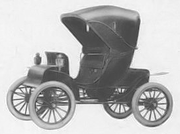
It is not a convertible. A convertible has wind-up windows in its doors and may be converted from open to fully closed. A convertible is by nature much heavier.
Side protection may be supplied to a phaeton by clipping on flexible sidescreens where there are no windows. Phaeton bodywork is by its nature much lighter than convertible bodywork or a sedan and so it is suitable if speed is important. Because the body was entirely open it was easy to add or remove an extra row of seating where space had been left in the original construction.
Origin of the term
The term phaeton had earlier referred to a light, open four-wheeled carriagePhaeton (carriage)
Phaeton is the early 19th-century term for a sporty open carriage drawn by a single horse or a pair, typically with four extravagantly large wheels, very lightly sprung, with a minimal body, fast and dangerous. It usually had no sidepieces in front of the seats...
, which again referreds to the disastrous ride of the mythical Phaëton
Phaëton
In Greek mythology, Phaëton or Phaethon was the son of Helios and the Oceanid Clymene. Alternate, less common genealogies make him a son of Clymenus by Merope, of Helios and Rhode or of Helios and Prote....
, son of Helios
Helios
Helios was the personification of the Sun in Greek mythology. Homer often calls him simply Titan or Hyperion, while Hesiod and the Homeric Hymn separate him as a son of the Titans Hyperion and Theia or Euryphaessa and brother of the goddesses Selene, the moon, and Eos, the dawn...
, who set the earth on fire while attempting to drive the chariot of the sun.
History
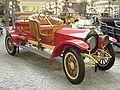
Roadster
A roadster is a two-seat open car with emphasis on sporty handling and without a fixed roof or side weather protection. Strictly speaking a roadster with wind-up windows is a convertible but as true roadsters are no longer made the distinction is now irrelevant...
, which may be due to the spyder's origin in the spider phaeton
Spider phaeton
A spider phaeton was a very high carriage of light construction, with a covered seat in front and a footman's seat behind. Of American origin, this phaeton was made for gentlemen drivers.-External links:...
. However, there were also double phaetons, with two rows of seats, triple phaetons, or even closed phaetons. Eventually, the term "phaeton" became so widely and loosely applied that almost any vehicle with two axles and a row or rows of seats across the body could be called a phaeton.
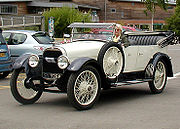
Car body style
Automobiles' body styles are highly variable. Some body styles remain in production, while others become less common or obsolete. They may or may not correlate to a car's price, size or intended market classification. The same car model might be available in multiple body styles comprising a...
where the rear seat area was extended for added leg room or for an additional row of seating. This often gave the vehicle the appearance that it was meant to be chauffeur-operated. This led to the term "phaeton" becoming similiar to, and eventually interchangeable with, the term "touring car
Touring car
A touring car, or tourer, is an open car seating five or more. Touring cars may have two or four doors. Often, the belt line is lowered in the front doors to give the car a more sportive character. They were often fitted with a folding roof and side curtains. Engines on early models were either in...
". This body type was popular up to the early years of World War II
World War II
World War II, or the Second World War , was a global conflict lasting from 1939 to 1945, involving most of the world's nations—including all of the great powers—eventually forming two opposing military alliances: the Allies and the Axis...
.
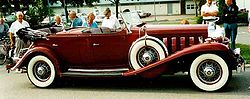
The phaeton and the touring car were ultimately supplanted by the convertible
Convertible
A convertible is a type of automobile in which the roof can retract and fold away having windows which wind-down inside the doors, converting it from an enclosed to an open-air vehicle...
, an open car which could be fully closed with windows in the doors. The Chrysler Phaeton
Chrysler Phaeton
The Chrysler Phaeton, not to be confused with the Volkswagen Phaeton, was a four-door convertible sedan concept car built by Chrysler in 1997....
concept car shows what a modern phaeton might look like.
Cars called "phaeton"
After open cars disappeared from the market, manufacturers used the term "phaeton" to describe cars that resembled the open phaeton or touring car. Buick advertized a "convertible phaeton" body style which was actually a four-door convertibleConvertible
A convertible is a type of automobile in which the roof can retract and fold away having windows which wind-down inside the doors, converting it from an enclosed to an open-air vehicle...
, as the doors had windows in them and the car could be fully closed. In 1956, Mecury marketed the four-door hardtop versions of its Montclair
Mercury Montclair
The Mercury Montclair was a full-size automobile produced by the Mercury Division of the Ford Motor Company from 1955 to 1957, the M-E-L Division of Ford Motor Company 1958 to 1959 and by the Lincoln Mercury Division of the Ford Motor Company from 1964 to 1968...
and Monterey
Mercury Monterey
The Monterey was introduced in 1950 as a high-end two-door coupe in the same vein as the Ford Crestliner, the Lincoln Lido coupe and the Lincoln Cosmopolitan Capri coupe. The reason was to offer a more luxurious coupe as the FoMoCo still not had any hard top. The Mercury line got a styling redesign...
as phaetons.
In 2004, Volkswagen
Volkswagen
Volkswagen is a German automobile manufacturer and is the original and biggest-selling marque of the Volkswagen Group, which now also owns the Audi, Bentley, Bugatti, Lamborghini, SEAT, and Škoda marques and the truck manufacturer Scania.Volkswagen means "people's car" in German, where it is...
introduced their flagship vehicle with the name Phaeton, despite the car not resembling an open car in any way.