

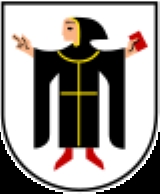
Coat of arms of Munich

Encyclopedia
| MunichFree state of Bavaria | |
|---|---|
 |
|
| Emblazoning | |
"Small Coat: The coat of arms of the city of Munich shows, on a field ---- "Large Coat: On a field argent, an open gules city gate between two gules tin towers each decorated with or and sable zig-zagging bands on the top, above which is an observing crowned and embattled or Lion; in the gate stands the monk of the small crest." |
|
| Basic data | |
| Introduction: | 13th CenturyRoyal Seal: 1304 |
| Legal basis: | Main seal: 1239City council ruling: 1957 |
| Supporting Documents: | 11 June 1865:Royal Approval 24 December 1936:Ministerial Resolution 17 December 1957:City council ruling |
| Alterations: | 1808, 1818, 1834, 1865, 1936, 1949 |
| Former munincipalities with their own coat: | Au Au (Munich) Au is a district in the south eastern plain tract of the German city of Munich in Bavaria. Au extends from the Deutsches Museum in the north and along the Isar up to Wittelsbacherbrücke in the south.... , Aubing, Feldmoching, Milbertshofen, Obermenzing, Pasing Pasing Pasing is a district in the city of Munich, Germany and part of the borough Pasing-Obermenzing.-Overview:Pasing is located west of the Munich city centre, at the north-western edge of the city's innermost traffic zone. The district is mainly residential; there is a large concentration of shops,... , Schwabing Schwabing Schwabing is a borough in the northern part of Munich, the capital of the German state of Bavaria. It is divided into the city borough 4 and the city borough 12... , Untermenzing |
The coat of arms of Munich (Münchner Wappen) depicts a young monk dressed in black holding a red book. It has existed in a similar form since the 13th century, though at certain points in its history it has not depicted the central figure of the monk at all. As the German name for Munich
Munich
Munich The city's motto is "" . Before 2006, it was "Weltstadt mit Herz" . Its native name, , is derived from the Old High German Munichen, meaning "by the monks' place". The city's name derives from the monks of the Benedictine order who founded the city; hence the monk depicted on the city's coat...
, i.e. München, means of Monks, the monk
Monk
A monk is a person who practices religious asceticism, living either alone or with any number of monks, while always maintaining some degree of physical separation from those not sharing the same purpose...
in this case is a self-explanatory symbol who represents the city of Munich. Appearing on a document of May 28, 1239, the oldest seal of Munich has a picture of a monk wearing an open hood. While all seal impressions show the monk with the book in one hand and three outstretched fingers in the other, the monk has varied slightly, appearing in profile, then later full-faced and bare-headed. By the 19th century the figure was portrayed as youthful and became known as the Münchner Kindl
Münchner Kindl
Münchner Kindl is German for "Munich child", the symbol on the coat of arms of the city Munich.-History:This symbol has been the coat-of-arms of Munich since the 13th century...
or Munich Child. The coat of arms
Coat of arms
A coat of arms is a unique heraldic design on a shield or escutcheon or on a surcoat or tabard used to cover and protect armour and to identify the wearer. Thus the term is often stated as "coat-armour", because it was anciently displayed on the front of a coat of cloth...
in its current form was created in 1957 and is still an important symbol of the Bavaria
Bavaria
Bavaria, formally the Free State of Bavaria is a state of Germany, located in the southeast of Germany. With an area of , it is the largest state by area, forming almost 20% of the total land area of Germany...
n state capital.
The Monk
As the German name for Munich, i.e. München, means "of Monks", the monkMonk
A monk is a person who practices religious asceticism, living either alone or with any number of monks, while always maintaining some degree of physical separation from those not sharing the same purpose...
in this case is a self-explanatory symbol who represents the city of Munich. The figure is portrayed wearing a golden trimmed black cowl
Cowl
This article is about the garment used by monks and nuns. For other uses, see Cowl or Cowling .The cowl is an item of clothing consisting of a long, hooded garment with wide sleeves. Originally it may have referred simply to the hooded portion of a cloak...
with a black hood and red shoes. The right hand is raised and the left carries a red book.
The open right hand of the monk is interpreted as an oath-making gesture, or a blessing gesture in Christian tradition. The red book in the left hand refers to the oath book of the city (in accordance with the gesture of the right hand), or the munincipal law book which is bounded in red and has been handed down since 1365. Another interpretation is that it is a gospel book.
When the Munich town administration developed a constitution of its council, a seal was necessary for the purposes of asserting the authenticity of town-council documents. Appearing on a document of May 28, 1239, the oldest seal of Munich has a picture of a monk wearing an open hood. While all seal impressions show the monk with the book in one hand and three outstretched fingers in the other, the monk has varied slightly, appearing in profile, then later full-faced and bare-headed. The monk as a sole heraldic figure can be found on a seal dating from the year 1304, and on flags of the city since the middle of the 14th century. Colourful representations of the town's coat of arms stem from the 15th century.
Münchner Kindl
In the course of the few centuries up until the current version of 1957, the coat of arms has undergone some distinctly visible changes. While some 15th century portrayals already show a child figure instead of the monk, the monk in representations onwards began to lose its serious disposition, with curly hair and a more youthful looking face. By the 18th century and especially the 19th century, the monk had been minimised into the Münchner KindlMünchner Kindl
Münchner Kindl is German for "Munich child", the symbol on the coat of arms of the city Munich.-History:This symbol has been the coat-of-arms of Munich since the 13th century...
, Bavarian for Munich Child, a reference to the figure first documented in 1727, although it is not clear when it appeared on the coat of arms for the first time or who coined the term. The transformation was brought about by artists such as sculptors and painters as well as copper and seal engravers, as opposed to a legal order.
In the second half of the nineteenth century, local artists also supplemented the figure with items such as radishes, pretzels, laurel wreaths and foaming beer steins. The symbol diversely appears in numerous places such as on manhole covers, beer steins and the top of the tower of the town hall. While the symbol as a man through being a monk was previously clear, its gender has become ambiguous since being designated the Kindl. One interpretation is that it is simply genderless, however in the 1920s a female inclination became apparent, and portrayals in person are to this day by young women.
History
The Munich coat of arms is verifiable from seals in 1239 and 1268. These seals show a monk in a gate, above which is in eagle, referring to the Bishop of Freising. The city belonged to him and this was probably derived from his coat of arms. From 1313, the city was in possession of the Wittelsbach Dukes and the eagle was replaced with a lion, a symbol of the old Bavarian and Palatine Wittelsbachs since the FiefdomFiefdom
A fee was the central element of feudalism and consisted of heritable lands granted under one of several varieties of feudal tenure by an overlord to a vassal who held it in fealty in return for a form of feudal allegiance and service, usually given by the...
of Duke Ludwig
Louis I, Duke of Bavaria
Duke Louis I of Bavaria was the Duke of Bavaria in 1183 and Count Palatine of the Rhine in 1214. He was a son of Otto I and his wife Agnes of Loon. Louis was married to Ludmilla, a daughter of Duke Frederick of Bohemia.-Biography:Louis extended the duchy of Bavaria and founded many cities...
in 1214.
Coat of arms after ratification by Max I. Joseph
In 1808, King Maximilian I Joseph granted the city a historicistHistoricism (art)
Historicism refers to artistic styles that draw their inspiration from copying historic styles or artisans. After neo-classicism, which could itself be considered a historicist movement, the 19th century saw a new historicist phase marked by a return to a more ancient classicism, in particular in...
city emblem depicting a classical portal, atop which the King's crown lies. A golden lion sits in the gate's threshold with a sword in one paw and a shield with the letter "M" in the other. As an enlightened monarch
Enlightened absolutism
Enlightened absolutism is a form of absolute monarchy or despotism in which rulers were influenced by the Enlightenment. Enlightened monarchs embraced the principles of the Enlightenment, especially its emphasis upon rationality, and applied them to their territories...
, Max I. Joseph wanted the city's symbol to show its culture and at the same time dispel the stereotype of the "Mönchsbarbarei", or the barbarianism of the monks. However, the township decided against the complete elimination of the historical reference to the monk and thus in 1818 the M was replaced with the previous monk's head design.
Coat of arms after ratification by Ludwig I
In 1834, King Ludwig ILudwig I of Bavaria
Ludwig I was a German king of Bavaria from 1825 until the 1848 revolutions in the German states.-Crown prince:...
granted the city its old coat of arms again in the form of large and small crests. These embodied the small crest seal of 1304 and the large one of 1323. The 1835 coat of arms had a blue background, though this was later corrected to argent
Argent
In heraldry, argent is the tincture of silver, and belongs to the class of light tinctures, called "metals". It is very frequently depicted as white and usually considered interchangeable with it...
under Ludwig II
Ludwig II of Bavaria
Ludwig II was King of Bavaria from 1864 until shortly before his death. He is sometimes called the Swan King and der Märchenkönig, the Fairy tale King...
in 1865. The background was rarely changed. One example of its occurrence, however, was when or
Or (heraldry)
In heraldry, Or is the tincture of gold and, together with argent , belongs to the class of light tinctures called "metals". In engravings and line drawings, it may be represented using a field of evenly spaced dots...
was used in the 16th century instead.
Coat of arms in the Third Reich
From 1936 to 1945, the lion was once again replaced by an eagle, only this time the one of the Nazi party, the Reichsadler. Deemed the Hauptstadt der Bewegung (Capital of the Movement), Munich was a significant place in terms of the Nazi ideologyNazism
Nazism, the common short form name of National Socialism was the ideology and practice of the Nazi Party and of Nazi Germany...
. The city was home to the NSDAP headquarters, the Beer Hall Putsch
Beer Hall Putsch
The Beer Hall Putsch was a failed attempt at revolution that occurred between the evening of 8 November and the early afternoon of 9 November 1923, when Nazi Party leader Adolf Hitler, Generalquartiermeister Erich Ludendorff, and other heads of the Kampfbund unsuccessfully tried to seize power...
and also saw the establishment of Dachau, the first Nazi concentration camp. Post-war designs were not pursued until 1949.
New coat of arms
Both a small and large coat of arms existed from 1949 until 1957 based on representations of them prior to 1936. In 1957 both the large and small city coat of arms were newly arranged by the designerDesigner
A designer is a person who designs. More formally, a designer is an agent that "specifies the structural properties of a design object". In practice, anyone who creates tangible or intangible objects, such as consumer products, processes, laws, games and graphics, is referred to as a...
Eduard Ege. At the same time, the city council set the resolution on the December 17, 1957 that the large one was no longer for official use but only for particular representative purposes.
The official version uses the colour of skin, which is non-standard for blazon
Blazon
In heraldry and heraldic vexillology, a blazon is a formal description of a coat of arms, flag or similar emblem, from which the reader can reconstruct the appropriate image...
ing. The coat also does not follow the Rule of tincture
Rule of tincture
The first rule of heraldic design is the rule of tincture: metal should not be put on metal, nor colour on colour . This means that Or and argent may not be placed on each other; nor may any of the colours be placed on another colour...
, since colours are not set apart from each other. Today this is not considered important, as the original purpose of heraldry is identification, e.g. for purposes of easy distinction on medieval battlefields over long distances.