

Coaching Stock of Ireland

Encyclopedia
A wide variety of hauled coaches have been used on the railways of Ireland. This page lists all those since 1945.
(CIÉ) inherited from its constituents a motley collection of coaching stock from various manufacturers, in equally variegated conditions of repair. Although many were over 40 years old they had to remain in service until a programme of replacement could be found.
CIÉ, which controlled the Republic's railways between 1945 and 1986, and its subsidiary, Iarnród Éireann
(IÉ) from 1986, have made great use of hauled coaches, though in recent years IÉ has turned increasingly to multiple unit
s to replace old locomotives and coaches. IÉ and NIR
jointly own the current stock used on the Enterprise service between Dublin and Belfast
, with IÉ nominally owning the odd-numbered vehicles and NIR the even-numbered ones, though all share a common Enterprise livery.
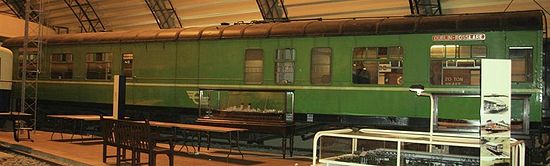
 The Laminate stock comprised a variety of designs, built to two distinct profiles. The carriages built in the early 1950s had a narrower, more vertical profile with a small tumblehome similar to that used by Edgar Bredin of the Great Southern Railways
for its steel panelled coaches. The carriages built from the end of the 1950s had a wider profile with a more pronounced tumblehome.
The earlier coaches included the last compartment stock built for CIÉ. Typically there were 7 compartments per carriage with each having seating for 6 passengers. Seats were aligned to windows and so passengers could enjoy an unobstructed view out of the train from all seats.
Some of which were later converted to steam heating vans to allow the four-wheel and six-wheel heating vans to be withdrawn in the late 1970s and early 1980s. All of CIÉ's restaurant cars prior to the Mark 2 stock were of the vertical profile design. [A brake standard design was adapted as a driving trailer for use with CIÉ's AEC railcar stock][This needs confirmation].
There were three varieties of the later wide body profile coaches:
-a composite (all later converted to brake standards)
-a standard open design with two lavatories at one end
-a standard open design with a single lavatory at each end
The "Laminate" stock was a long distance design but the carriages were extensively used on Dublin and Cork suburban services in the 1970s and 1980s despite their unsuitable layout and limited door openings. Following the Buttevant crash
in 1980, the "Laminate" and Park Royal stock was restricted to a 70 mph top speed and later banned from certain routes.
After the electrification of the Howth-Bray route in 1984 and the introduction of Mark 3 stock, the "Laminate" stock was progressively withdrawn. Some have been preserved at various locations around Ireland:
-Downpatrick & County Down Railway
has Buffet Car 2419 and Brake Standard 1918TL (orig.2163) .
-Kiltamagh Museum has Standard Open 1460 and Composite 2148 http://www.museumsofmayo.com/kiltimagh.htm
-The Railway Preservation Society of Ireland
in Dublin has Standard 1463, Bar Car 2421 and Brake 3rd 1916http://www.rpsi-online.org/carriages/#carriages. The RPSI also owns Buffet Car 2422TL, which is on display at the Ulster Folk and Transport Museum
.
-Sligo Folk Park in Riverstown
has Standard Open 1468 http://www.sligofolkpark.com/http://www.ovestirlanda.com/sligo/gallery5.htm
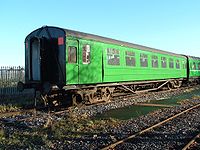 In 1955 Inchicore Works commenced the construction of 50 coaches from parts supplied by the Park Royal
Works in London. These coaches made full use of the Irish loading gauge, being 61 feet 6 inches long and 10 feet 2 inches wide, reducing by 8 inches at their ends. Because of their aluminium and steel construction, they weighed only 26 tons tare
(Suburban) and approx. 27¼ tons tare
(Main Line). Unusually, these coaches had inward opening doors, similar to the American "Pullman"
design, but this proved unpopular and somewhat confusing to the passengers and so were rebuilt conventionally. The suburban coach seated 82, while the main line coach, fitted with lavatories, seated 70 passengers. These coaches rode on Commonwealth bogies, the first in Ireland to be so fitted. Barred from certain routes during the early 1990s, because of their construction, they were withdrawn following the delivery of the first Japanese 2600 Class
DMUs
in 1994.
There are several preserved examples;
-The RPSI has two, two Open 3rds, Nos.1383 and 1419. No.1383 is fitted with a shop, whilst No.1419 has been modified so as to be wheelchair compatible.http://www.steamtrainsireland.com/carriages/dublin_vintage.html
-No.1944 has been partially restored at the Downpatrick & Co. Down Railway http://www.downrail.co.uk/carriages.htm
-Two at the Clonakilty Model Village http://www.modelvillage.ie/front360.htm
Livery
When built, these coaches received the standard CIÉ "ivy - leaf" green livery. In the early 1960s, they were re-painted in the new black / tan / white colour scheme (See: Cravens stock / livery)
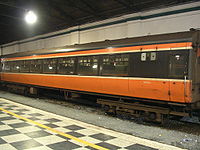
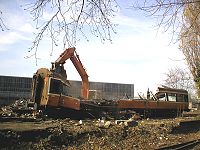 In Spring 1961 CIÉ sought tenders for the supply of 40 new Standard Class coaches, 10 to be delivered complete, the rest "part-finished" for assembly in Inchicore with technical assistance from the suppliers. The £500,000 contract was awarded to Cravens
of Sheffield. It was reported that these new vehicles "would set a pattern for future construction of CIE carriage stock." The first of the Sheffield-built coaches was unloaded at the North Wall, Dublin
on 3 May 1963 and taken to Inchicore for acceptance.
These coaches were built with light alloy bodies on steel underframes on Type B4 bogies.
Each saloon had 64 seats, arranged in eight bays of four around a table, either side of a central gangway, with two toilets situated in the vestibule
at one end. The interior was finished in laminated plastics, creating a light and airy feel. They were fitted with a public address
system, double-glazed
windows and central fluorescent lighting along their length, the first coaches in Ireland to be so treated. Heating was by steam, supplied from a Steam Heating Van.
They were 62 ft 8 in long, 9 ft 6 in wide, 12 ft 7.5 in high, weighed 28 tons and 14 cwt. and were numbered 1504 to 1513. The 30 incomplete coaches were numbered 1514-1543, and although the total order was for 70, only 15 more (numbered 1544-1558) were built to a total of 55.
During early 1963, Inchicore commenced construction of two new First Class coaches in a style similar to, but not connected with, the Craven contract. These coaches were built with an open plan format, double-glazing and air conditioning
. Numbered 1145 and 1146, they were the only post-war all-first class coaches to be added to the stock, their immediate predecessor, 1144, was built in 1935.
On 2 April 1964 the new coaches were demonstrated to the press and entered service on 10 April, working the 18.30 Dublin to Cork train. They were common on high capacity specials, with 14 vehicle trains (12 "Cravens" + 2 Gen Vans) not being atypical, with a capacity of 768 passengers.
Prior to their displacement on these services by railcars, right into the 2000s the Cravens could be found on outer suburban workings, such as those from Dublin to Arklow
and Longford
. They could also be found on rural services such as those on the Rosslare-Waterford-Limerick route
and the Mallow to Tralee line.
Throughout 2006 a phased withdrawal of the Craven stock took place. Their final regular duties were "Fridays Only" workings from Dublin Heuston to Cork, Galway, Limerick and Tralee and their return. They were also occasionally used for rugby union
and football
match specials and other one-off services.
The final set in scheduled service was withdrawn on December 11, 2006 after working the 05:15 Athlone - Dublin Heuston service.
The last operation in IÉ ownership was carriage No.1510 on an RPSI steam special on December 17.
Craven Carriage Numbers 1505, 1506, 1508, 1514, 1522, 1523, 1529, 1532, 1539,and 1541 have been preserved in regular use by the Railway Preservation Society of Ireland (RPSI), along with two BR mk1 generator vans, Nos.3173 and 3185 .
A "Dutch" type generator van, no.3158 that would have operated with the Cravens stock, has also been preserved by the RPSI, and now runs with their Whitehead based mk2 set as No.462.
Livery
The Sheffield built coaches were outshopped and delivered in the new CIÉ livery of tan below the waist, black on the central panel at window level, roof and ends, with a broad (6"/150 mm) white band between the upper window and roof. Large, white, class numerals were applied to the doors. The two Inchicore First Class coaches were similarly treated. Later on a thin white band of approx. 1" / 25 mm was applied to the waistband, separating the tan and black sections.
Following the re-branding to Irish Rail in 1988, two white 3 inch (75 mm) vinyl strips were added, separating the black from the tan above and below it. Two reflective Fluorescent Red 3M
Scotchcal 12 inch square panels were applied at each body end.
In preservation the Cravens coaches are being outshopped in a new RPSI livery of blue with white numerals and yellow lining, complete with two RPSI crests on the side of each carriage.
for 72 new coaches based on the British Rail Mark IId design
. These were built at the Litchurch Lane workshops
in Derby. With air conditioning as a principal feature they became known as “AC Stock” and ran on type B4 bogies, with vacuum brakes.
The order consisted of 6 First Class coaches (5101 to 5106), 9 Composites (5151–5159), 36 Standard Class (5201–5236), 11 Restaurant / Buffet / Standard Class (5401–5411) and 11 Generator Vans (5601–5611). Internal fit-out was done in Inchicore, and was quite different from the original BR design, using bench seating rather than individual seats and made extensive use of wood veneer panelling.
Their electrical system also differed from the BR and NIR versions. The Generator Van contained two engine / generator sets, each supplying 220 / 380 Volts 50 Hz AC to two separate "busses
" in the train. The air conditioning loads were divided in half, each half fed from each "buss". In the case of failure of one generator set, the other set automatically supplies both "busses". Air conditioning output power would then be halved, but all other loads including Cooking, Lighting and Battery Charging continue to be supplied. This has remained the model for the electrical power supply on all subsequent IE coaches.
To accommodate changes in traffic, five of the Composites, 5153-5156 and 5158 were re-classed as "Standards", while one of the Restaurant / Buffet / Standards, 5408, was converted for use as the Presidential Coach.
The remaining MK 2 carriages were gradually phased out during 2007 and 2008, with the last remaining set operating its final service, the 05:05 Athlone
- Heuston, on March 31, 2008. Two of these vehicles (Nos. 5106 and 5203) have been preserved by the RPSI and were moved to their Whitehead
base in the first quarter of 2008. They will be renumbered 303 and 304 respectively, and be repainted in RPSI dark green livery.http://www.steamtrainsireland.com/carriages/belfast_steel.html In addition, the Presidential coach No. 5408 remains stored at Inchicore, still owned by Irish Rail. This vehicle is earmarked for preservation by the RPSI.
In addition to the vacuum-braked mk2d fleet, a second fleet of mk2 coaches was used by Irish Rail. These were second hand air-braked mk2 coaches acquired in the early 1990s. They were numbered in the 41XX series for standards, or 44XX series for catering vehicles. These coaches were withdrawn around 2003 following the deployment of 2900 class railcar sets into service. Some of these vehicles have been preserved. 4106 can be found at Kilmeaden station on the Waterford and Suir Valley Railway.
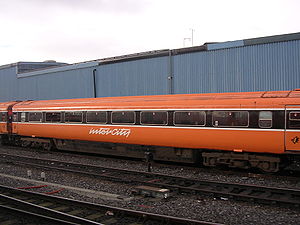
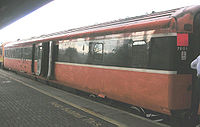

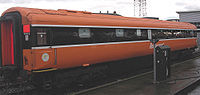 Introduced on the CIÉ system in 1986 the last set was withdrawn on Monday 28 September 2009. The decision to purchase a new fleet of modern Intercity coaches based on the British Rail Mark 3 design
was made because of several accidents
involving the older style, wooden framed, coaches. They were already a well-proven design used for BR’s High Speed Trains (HST
)
The first 44 Open Standards and all of the Buffets and Generator Vans were built at BREL’s
Litchurch Lane workshops in Derby. The remainder was built under licence in Inchicore
between 1980 and 1989. The coaches run on 5 ft 3 in gauge versions of British Rail’s BT22 Air Suspension bogie, and are air-braked.
The Irish Mark 3 coaches are similar, but not identical, to their British counterparts. They have a different electrical system (220/380V, 50 Hz) and were the first Mark 3s to be fitted with automatic swing-plug doors. There are also some different internal layouts more specifically suited to Irish traffic.
The Mark 3 fleet, as of 2005, comprised 123 standard coaches. Thirty coaches were built for push-pull
operation on the suburban rail service including 5 built to Control Car
s, numbered 6101 to 6105. Originally use in conjunction with the 121 Class
locomotives they are now used with 201 Class
locomotives. There are a number of differences between the Irish push-pull Mk3s and the standard Mk3s. An underfloor generator, mounted in the Control Car, provides electrical power to the coaches; unlike on the standard Mk3s, which use a special generator van. This single generator is not as powerful as the two used in the Mk3 generator vans and is the main reason the sets are limited to 6 cars. Irish Mk3 push-pull based rolling stock does not have air conditioning and have opening windows instead. There is also a 70-mph speed restriction imposed on the train due to the fact that at least one of the converted Control Cars is fitted with LHB
bogies from an 8100 Class DART
.
In 2004 a 1979 vintage BR Mark 3 TRFK coach was converted by Interfleet
into a modern Snack Car for use on a Push-pull set. This set was usually used on the Waterford route.
The Mark 3A "Cu Na Mara" set, now withdrawn, operated exclusively on the Dublin to Galway route, and was originally the BREL
International Train, a showcase project designed to secure overseas orders. The set travelled to a German rail exhibition in 1988, but returned without any new orders and languished for some years before being sold on through Vic Berry
. CIE converted the many different interior layouts to their own standard design, fitted their own Mk 3 type powered door and re-bogied with ABB bogies. Although also re-wired for Push-Pull operation the fact that the "10th coach" wasn't converted to a DVT
prevented the set from ever running with this configuration.
This set marked the end of coach building in Inchicore.
The plug door design found on the CIE Mark 3 coaches was later used on the British Rail Class 442
long distance commuter train.
IÉ recently announced plans to sell off the Mk 3 fleet.
All remaining Mk 3 sets were withdrawn from service on September 21, 2009, the final service being a 13:45 Dublin-Cork relief train. However, one set was brought back for a charity event for enthusiasts on April 24, 2010. This tour also formed the 12:40 Limerick - Ennis service train, making this the last passenger service operated by a Mk 3 set.
There are 2 Mk 3 sets stored at Dundalk and it is reported that their bodies are in such a bad state that they can not be brought to Dublin to be scraped so it looks like they will be scrapped on the disused sidings beside the station.
All 5 of the Mark 3 control cars and some of the passenger coaches that are in good condition will be retained in the event that Enterprise introduce a more frequent service between Belfast and Dublin. The push pull dedicated Cafe/Bar is also planned to be kept.
The Mark 3's had a max. speed of 100MPH and could run at this speed on the Cork Mainline if a 201 Class was hauling them.
On 12 December 2009, locomotive 144 brought an ex-Mk 3 Generator van (7608) from Dublin to York Road Depot, Belfast. Then again on 22 December 2009, locomotive 8209 brought another ex-Mk 3 Generator van (7613) from Dublin to York Road. It is expected that NIR will receive 4 ex-Mk 3 Generator vans in total. They have been planned to be painted in Enterprise colours and wired with push/pull to run with the Enterprise sets to replace the HEP supplied by the locomotive.
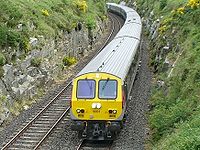 Following the introduction of the new Class 201
locomotives, the jointly operated " Enterprise" service between Dublin and Belfast was upgraded in September 1997 with new coaching stock from French train makers De Dietrich Ferroviaire
(now Alstom DDF). The interiors of the new stock were based on that of the rolling stock used by Eurostar
The coaches are divided into two classes: Standard, with 2 + 2 seating and “First Plus”, with 2 + 1 seating, individual reading lamps and power adjustable seating with "in seat" audio. All coaches are air conditioned, have powered internal and external doors, tinted windows with adjustable blinds, a single wheelchair accessible toilet with baby changing facilities, LED
route maps and scrolling LED information displays.
Electrical power for train HVAC, battery charging and cooking is supplied from the locomotive's Head End Power system as the sets do not include a Generator Van.
Although originally ordered as four sets of seven cars, each of the three in-service sets comprise 8 cars:
Each carriage is 23.43 m (76 ft 10.4 in) long, 3.787 m (12 ft 5 in) in height and 2.814 m (9 ft 2.8 in) wide.
The odd numbered coaches are owned by IÉ
and the even numbered by NIR
The Trains have a max. speed of 100MPH but are limited to 90MPH.
On 12th and 22 December 2009, NIR received the first two, 7608 and 7613, of four Mk3 Generator vans from IE for repainting in Enterprise livery. They will eventually replace the HEP power system. The other two Generator vans are due to arrive early 2010.
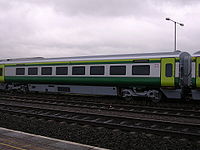 67 Mark 4 coaches were delivered in 2006 from CAF
Although the name "Mk 4" has entered common usage, these trains have no connection to the BR Mk 4
.
Though capable of 200 km/h (125 mph) operation, this higher speed would require both track & signal system upgrade and the provision of a faster locomotive than the currently used 201 class
. A possibility being considered is the replacement of the existing 201 with two power cars, one of which would be converted from the existing Generator Control Car.
Seating capacity is 423 (8-car set) and the train is fully accessible to mobility-impaired customers.
Capable of 10-car operation, each in-service set currently comprises 8 cars:
As of January 2007, seven sets are operated on the Dublin-Cork route's clockface timetable
, replacing Mark 3 pull-only carriages. On some off-peak services smaller Class 22000 sets are used since the larger sets are expensive to operate.
Main features
Mark 4 DVT
 . A lighter shade with a pale green waist was introduced in 1955 for the Park Royals. At the end of 1955 unpainted aluminium coaches were introduced with large red 1s and 2s to indicate class and small red running nos. From 1958 all carriages were repainted standard green.
In 1961, with the introduction of the "Cravens Stock", a radical new livery was introduced consisting of black upper panels, roof and body ends, deep orange (golden brown / tan) lower panels with a 6-inch white band between the windows and the roof.
In February 1987, CIÉ's railway operations were transferred to a wholly owned subsidiary, Irish Rail and the 6-inch white band was replaced by two 3-inch white bands, on each side of the black portion. The words “InterCity” in large white lettering was added on the lower orange-brown section accompanied by the "IR" logo. Craven coaches and ex-BR Mk 1 generator vans were not re-branded. These continued in CIÉ black and golden brown but the white lining was changed to the narrower style on their next works visit.
In the early 1990s, the golden brown was replaced by a brighter orange (RAL
2011) and the stylised IE icon replaced the IR track logo. The new logo did not accompany the Intercity lettering , but was put on all MK2 and MK3 coach doors.
Because of the shared nature of the service the Enterprise has its own unique livery consisting of Dark Grey (NCS
8502-Y), Light Grey (NCS 5502-Y), Dark Green (NCS 9005-G20Y), Bronze strip & Enterprise logos (3M), and either Purple (NCS 5040-R40B) for Standard Class or Dark Red (NCS 4060-R10B) for First Plus.
In 2006, a new livery reminiscent of the original green has been introduced on the CAF Mark 4s. Consisting of Fern Green (NCS 4550-G), Grey (RAL 7000), Yellow (RAL 1021), Black (RAL 9005), Green (NCS 7020- B70G), Yellow Green (NCS 1070 G60Y) & Metallic Silver (761). A new logo has also been introduced to match.
 Although the majority of passenger services in Northern Ireland have been worked by diesel multiple unit
s since the mid-1950s, a number of hauled coaches have been required under the tenure of both the Ulster Transport Authority
(1948–1966) and Northern Ireland Railways
(since 1967). NIR operates a single rake of coaches to supplement the DMU fleet. The total of ten were all built as Mark 2
s for British Rail
, and were purchased by NIR in three batches:
From 1998, NIR prefixed their numbers with “8” so as to be part of the Translink number series, which incorporates their road vehicles The table below lists the hauled passenger coaches that were in use until June 2009 plus the never used DBSO (This excludes the "De Dietrich" stock jointly owned with IÉ for operating Enterprise services between Belfast
and Dublin:
Republic of Ireland
When formed in 1945, Córas Iompair ÉireannCóras Iompair Éireann
Córas Iompair Éireann , or CIÉ, is a statutory corporation of the Irish state, answerable to the Irish Government and responsible for most public transport in the Republic of Ireland and, jointly with its Northern Ireland counterpart, the Northern Ireland Transport Holding Company, between the...
(CIÉ) inherited from its constituents a motley collection of coaching stock from various manufacturers, in equally variegated conditions of repair. Although many were over 40 years old they had to remain in service until a programme of replacement could be found.
CIÉ, which controlled the Republic's railways between 1945 and 1986, and its subsidiary, Iarnród Éireann
Iarnród Éireann
Iarnród Éireann is the national railway system operator of Ireland. Established on 2 February 1987, it is a subsidiary of Córas Iompair Éireann . It operates all internal intercity, commuter and freight railway services in the Republic of Ireland, and, jointly with Northern Ireland Railways, the...
(IÉ) from 1986, have made great use of hauled coaches, though in recent years IÉ has turned increasingly to multiple unit
Multiple unit
The term multiple unit or MU is used to describe a self-propelled carriages capable of coupling with other units of the same or similar type and still being controlled from one driving cab. The term is commonly used to denote passenger trainsets consisting of more than one carriage...
s to replace old locomotives and coaches. IÉ and NIR
Northern Ireland Railways
NI Railways, also known as Northern Ireland Railways and for a brief period of time, Ulster Transport Railways , is the railway operator in Northern Ireland...
jointly own the current stock used on the Enterprise service between Dublin and Belfast
Belfast
Belfast is the capital of and largest city in Northern Ireland. By population, it is the 14th biggest city in the United Kingdom and second biggest on the island of Ireland . It is the seat of the devolved government and legislative Northern Ireland Assembly...
, with IÉ nominally owning the odd-numbered vehicles and NIR the even-numbered ones, though all share a common Enterprise livery.
"Laminate" stock (now withdrawn)
Great Southern Railways
The Great Southern Railways Company was an Irish company that from 1925 until 1945 owned and operated all railways that lay wholly within the Irish Free State .-Formation:...
for its steel panelled coaches. The carriages built from the end of the 1950s had a wider profile with a more pronounced tumblehome.
The earlier coaches included the last compartment stock built for CIÉ. Typically there were 7 compartments per carriage with each having seating for 6 passengers. Seats were aligned to windows and so passengers could enjoy an unobstructed view out of the train from all seats.
Some of which were later converted to steam heating vans to allow the four-wheel and six-wheel heating vans to be withdrawn in the late 1970s and early 1980s. All of CIÉ's restaurant cars prior to the Mark 2 stock were of the vertical profile design. [A brake standard design was adapted as a driving trailer for use with CIÉ's AEC railcar stock][This needs confirmation].
There were three varieties of the later wide body profile coaches:
-a composite (all later converted to brake standards)
-a standard open design with two lavatories at one end
-a standard open design with a single lavatory at each end
The "Laminate" stock was a long distance design but the carriages were extensively used on Dublin and Cork suburban services in the 1970s and 1980s despite their unsuitable layout and limited door openings. Following the Buttevant crash
Buttevant Rail Disaster
Buttevant Rail Disaster was a train crash that occurred 137 miles from Heuston Station on the Dublin to Cork mainline at Buttevant Railway Station, County Cork in the Republic of Ireland on 1 August 1980. At 12:45 the 10:30am Dublin to Cork express train entered Buttevant station carrying some...
in 1980, the "Laminate" and Park Royal stock was restricted to a 70 mph top speed and later banned from certain routes.
After the electrification of the Howth-Bray route in 1984 and the introduction of Mark 3 stock, the "Laminate" stock was progressively withdrawn. Some have been preserved at various locations around Ireland:
-Downpatrick & County Down Railway
Downpatrick & County Down Railway
The Downpatrick & County Down Railway is a heritage railway in County Down, Northern Ireland. The project is based at Downpatrick, on part of the former route of the Belfast & County Down Railway....
has Buffet Car 2419 and Brake Standard 1918TL (orig.2163) .
-Kiltamagh Museum has Standard Open 1460 and Composite 2148 http://www.museumsofmayo.com/kiltimagh.htm
-The Railway Preservation Society of Ireland
Railway Preservation Society of Ireland
The Railway Preservation Society of Ireland is an Irish railway preservation group operating in both the Republic of Ireland and Northern Ireland. It was founded in 1964. The Society has its headquarters at Whitehead, County Antrim, Northern Ireland and a base at Mullingar, County Westmeath...
in Dublin has Standard 1463, Bar Car 2421 and Brake 3rd 1916http://www.rpsi-online.org/carriages/#carriages. The RPSI also owns Buffet Car 2422TL, which is on display at the Ulster Folk and Transport Museum
Ulster Folk and Transport Museum
The Ulster Folk and Transport Museum is situated in Cultra, Northern Ireland, about east of the city of Belfast. It comprises two separate museums, the Folk Museum and the Transport Museum...
.
-Sligo Folk Park in Riverstown
Riverstown
Riverstown, historically called Ballyederdaowen , is a village in County Sligo, Ireland. It is located at a bridging point of the River Unshin , about 19 km south of Sligo town and 4 km east of the N4....
has Standard Open 1468 http://www.sligofolkpark.com/http://www.ovestirlanda.com/sligo/gallery5.htm
"Park Royal" stock (now withdrawn)
Park Royal
Park Royal is an area in northwest London, UK. It is the largest industrial and business park in London, occupying about , and is promoted commercially by the Park Royal Partnership...
Works in London. These coaches made full use of the Irish loading gauge, being 61 feet 6 inches long and 10 feet 2 inches wide, reducing by 8 inches at their ends. Because of their aluminium and steel construction, they weighed only 26 tons tare
Tare
Tare may refer to:* Tare , a leg and groin protector used in a number of Japanese martial arts* Tare, a colloquial name for the Common Vetch and some other species of vetches...
(Suburban) and approx. 27¼ tons tare
Tare
Tare may refer to:* Tare , a leg and groin protector used in a number of Japanese martial arts* Tare, a colloquial name for the Common Vetch and some other species of vetches...
(Main Line). Unusually, these coaches had inward opening doors, similar to the American "Pullman"
Pullman Company
The Pullman Palace Car Company, founded by George Pullman, manufactured railroad cars in the mid-to-late 19th century through the early decades of the 20th century, during the boom of railroads in the United States. Pullman developed the sleeping car which carried his name into the 1980s...
design, but this proved unpopular and somewhat confusing to the passengers and so were rebuilt conventionally. The suburban coach seated 82, while the main line coach, fitted with lavatories, seated 70 passengers. These coaches rode on Commonwealth bogies, the first in Ireland to be so fitted. Barred from certain routes during the early 1990s, because of their construction, they were withdrawn following the delivery of the first Japanese 2600 Class
IE 2600 Class
The 2600 Class is a type of Diesel Multiple Unit operated on the Irish railway network by Iarnród Éireann, used mainly for short-haul Commuter services. At present the entire class is based in Cork, and is used on local services to Mallow, Midleton, Cobh and on token services to Tralee...
DMUs
Diesel multiple unit
A diesel multiple unit or DMU is a multiple unit train consisting of multiple carriages powered by one or more on-board diesel engines. They may also be referred to as a railcar or railmotor, depending on country.-Design:...
in 1994.
There are several preserved examples;
-The RPSI has two, two Open 3rds, Nos.1383 and 1419. No.1383 is fitted with a shop, whilst No.1419 has been modified so as to be wheelchair compatible.http://www.steamtrainsireland.com/carriages/dublin_vintage.html
-No.1944 has been partially restored at the Downpatrick & Co. Down Railway http://www.downrail.co.uk/carriages.htm
-Two at the Clonakilty Model Village http://www.modelvillage.ie/front360.htm
Livery
When built, these coaches received the standard CIÉ "ivy - leaf" green livery. In the early 1960s, they were re-painted in the new black / tan / white colour scheme (See: Cravens stock / livery)
Cravens Stock (now withdrawn)
Cravens
Cravens Railway Carriage and Wagon Company Limited was a railway rolling stock builder in the Darnall district of Sheffield, England. Cravens built many diagrams of coaching stock for the Pre-grouping Railway companies of Great Britain, the Grouped companies and for British Railways itself. They...
of Sheffield. It was reported that these new vehicles "would set a pattern for future construction of CIE carriage stock." The first of the Sheffield-built coaches was unloaded at the North Wall, Dublin
North Wall (Dublin)
North Wall is an inner city area on the Northside of Dublin.Dominated by a combination of older housing, dockland activities and new development, from apartments and offices to hotels and the planned multi-purpose Point Village, North Wall lies downstream of the city centre....
on 3 May 1963 and taken to Inchicore for acceptance.
These coaches were built with light alloy bodies on steel underframes on Type B4 bogies.
Each saloon had 64 seats, arranged in eight bays of four around a table, either side of a central gangway, with two toilets situated in the vestibule
Vestibule (architecture)
A vestibule is a lobby, entrance hall, or passage between the entrance and the interior of a building.The same term can apply to structures in modern or ancient roman architecture. In modern architecture vestibule typically refers to a small room or hall between an entrance and the interior of...
at one end. The interior was finished in laminated plastics, creating a light and airy feel. They were fitted with a public address
Public address
A public address system is an electronic amplification system with a mixer, amplifier and loudspeakers, used to reinforce a sound source, e.g., a person giving a speech, a DJ playing prerecorded music, and distributing the sound throughout a venue or building.Simple PA systems are often used in...
system, double-glazed
Insulated glazing
Insulated glazing also known as double glazing are double or triple glass window panes separated by an air or other gas filled space to reduce heat transfer across a part of the building envelope....
windows and central fluorescent lighting along their length, the first coaches in Ireland to be so treated. Heating was by steam, supplied from a Steam Heating Van.
They were 62 ft 8 in long, 9 ft 6 in wide, 12 ft 7.5 in high, weighed 28 tons and 14 cwt. and were numbered 1504 to 1513. The 30 incomplete coaches were numbered 1514-1543, and although the total order was for 70, only 15 more (numbered 1544-1558) were built to a total of 55.
During early 1963, Inchicore commenced construction of two new First Class coaches in a style similar to, but not connected with, the Craven contract. These coaches were built with an open plan format, double-glazing and air conditioning
HVAC
HVAC refers to technology of indoor or automotive environmental comfort. HVAC system design is a major subdiscipline of mechanical engineering, based on the principles of thermodynamics, fluid mechanics, and heat transfer...
. Numbered 1145 and 1146, they were the only post-war all-first class coaches to be added to the stock, their immediate predecessor, 1144, was built in 1935.
On 2 April 1964 the new coaches were demonstrated to the press and entered service on 10 April, working the 18.30 Dublin to Cork train. They were common on high capacity specials, with 14 vehicle trains (12 "Cravens" + 2 Gen Vans) not being atypical, with a capacity of 768 passengers.
Prior to their displacement on these services by railcars, right into the 2000s the Cravens could be found on outer suburban workings, such as those from Dublin to Arklow
Arklow
Arklow , also known as Inbhear Dé from the Avonmore river's older name Abhainn Dé, is a historic town located in County Wicklow on the east coast of Ireland. Founded by the Vikings in the ninth century, Arklow was the site of one of the bloodiest battles of the 1798 rebellion...
and Longford
Longford
Longford is the county town of County Longford in Ireland. It has a population of 7,622 according to the 2006 census. Approximately one third of the county's population resides in the town. Longford town is also the biggest town in the county...
. They could also be found on rural services such as those on the Rosslare-Waterford-Limerick route
Limerick-Rosslare railway line
The Limerick–Waterford railway line is the only true non-radial route still open in Ireland that is not a branch line. The route was commenced in 1848 by the Waterford and Limerick Railway and finished in 1854 – one of the oldest routes in Ireland, and the first approved by the British...
and the Mallow to Tralee line.
Throughout 2006 a phased withdrawal of the Craven stock took place. Their final regular duties were "Fridays Only" workings from Dublin Heuston to Cork, Galway, Limerick and Tralee and their return. They were also occasionally used for rugby union
Rugby union
Rugby union, often simply referred to as rugby, is a full contact team sport which originated in England in the early 19th century. One of the two codes of rugby football, it is based on running with the ball in hand...
and football
Gaelic football
Gaelic football , commonly referred to as "football" or "Gaelic", or "Gah" is a form of football played mainly in Ireland...
match specials and other one-off services.
The final set in scheduled service was withdrawn on December 11, 2006 after working the 05:15 Athlone - Dublin Heuston service.
The last operation in IÉ ownership was carriage No.1510 on an RPSI steam special on December 17.
Craven Carriage Numbers 1505, 1506, 1508, 1514, 1522, 1523, 1529, 1532, 1539,and 1541 have been preserved in regular use by the Railway Preservation Society of Ireland (RPSI), along with two BR mk1 generator vans, Nos.3173 and 3185 .
A "Dutch" type generator van, no.3158 that would have operated with the Cravens stock, has also been preserved by the RPSI, and now runs with their Whitehead based mk2 set as No.462.
Livery
The Sheffield built coaches were outshopped and delivered in the new CIÉ livery of tan below the waist, black on the central panel at window level, roof and ends, with a broad (6"/150 mm) white band between the upper window and roof. Large, white, class numerals were applied to the doors. The two Inchicore First Class coaches were similarly treated. Later on a thin white band of approx. 1" / 25 mm was applied to the waistband, separating the tan and black sections.
Following the re-branding to Irish Rail in 1988, two white 3 inch (75 mm) vinyl strips were added, separating the black from the tan above and below it. Two reflective Fluorescent Red 3M
3M
3M Company , formerly known as the Minnesota Mining and Manufacturing Company, is an American multinational conglomerate corporation based in Maplewood, Minnesota, United States....
Scotchcal 12 inch square panels were applied at each body end.
In preservation the Cravens coaches are being outshopped in a new RPSI livery of blue with white numerals and yellow lining, complete with two RPSI crests on the side of each carriage.
Mark 2 (now withdrawn)
In 1972 CIÉ placed an order with BRELBREL
British Rail Engineering Limited , was the railway systems engineering division of British Rail, until the design and building of trains in the UK was privatised in 1993. On 31 October 1969, the company was incorporated as British Rail Engineering Limited.-Main products:The vast majority of BREL's...
for 72 new coaches based on the British Rail Mark IId design
British Rail Mark 2
The Mark 2 family of railway carriages were British Rail's second design of carriages. They were built by British Rail workshops between 1964 and 1975...
. These were built at the Litchurch Lane workshops
Derby Carriage and Wagon Works
Derby Carriage and Wagon Works was built by the Midland Railway in Derby, England. The plant has been through many changes of ownership and is currently owned by Bombardier Transportation, a subsidiary of Bombardier Inc. of Canada. As of 2011 it is the only remaining passenger rolling stock...
in Derby. With air conditioning as a principal feature they became known as “AC Stock” and ran on type B4 bogies, with vacuum brakes.
The order consisted of 6 First Class coaches (5101 to 5106), 9 Composites (5151–5159), 36 Standard Class (5201–5236), 11 Restaurant / Buffet / Standard Class (5401–5411) and 11 Generator Vans (5601–5611). Internal fit-out was done in Inchicore, and was quite different from the original BR design, using bench seating rather than individual seats and made extensive use of wood veneer panelling.
Their electrical system also differed from the BR and NIR versions. The Generator Van contained two engine / generator sets, each supplying 220 / 380 Volts 50 Hz AC to two separate "busses
Electrical bus
Electric bus is a bus powered by electric energy. "Electric bus" can also refer to:* Bus , used for connecting components of a computer or communication between computers* Busbars, thick conductors acting as nodes in electrical substations...
" in the train. The air conditioning loads were divided in half, each half fed from each "buss". In the case of failure of one generator set, the other set automatically supplies both "busses". Air conditioning output power would then be halved, but all other loads including Cooking, Lighting and Battery Charging continue to be supplied. This has remained the model for the electrical power supply on all subsequent IE coaches.
To accommodate changes in traffic, five of the Composites, 5153-5156 and 5158 were re-classed as "Standards", while one of the Restaurant / Buffet / Standards, 5408, was converted for use as the Presidential Coach.
The remaining MK 2 carriages were gradually phased out during 2007 and 2008, with the last remaining set operating its final service, the 05:05 Athlone
Athlone railway station
Athlone railway station serves the town of Athlone in County Roscommon and County Westmeath. The station is at the junction between the railway lines between Dublin-Galway and Dublin-Westport. There was a railway line to Mullingar but it is now disused...
- Heuston, on March 31, 2008. Two of these vehicles (Nos. 5106 and 5203) have been preserved by the RPSI and were moved to their Whitehead
Whitehead, County Antrim
Whitehead is a small seaside town on the east coast of County Antrim, Northern Ireland, lying almost midway between the towns of Carrickfergus and Larne. It lies within the civil parishes of Island Magee and Templecorran, the barony of Belfast Lower, and is part of Carrickfergus Borough Council...
base in the first quarter of 2008. They will be renumbered 303 and 304 respectively, and be repainted in RPSI dark green livery.http://www.steamtrainsireland.com/carriages/belfast_steel.html In addition, the Presidential coach No. 5408 remains stored at Inchicore, still owned by Irish Rail. This vehicle is earmarked for preservation by the RPSI.
In addition to the vacuum-braked mk2d fleet, a second fleet of mk2 coaches was used by Irish Rail. These were second hand air-braked mk2 coaches acquired in the early 1990s. They were numbered in the 41XX series for standards, or 44XX series for catering vehicles. These coaches were withdrawn around 2003 following the deployment of 2900 class railcar sets into service. Some of these vehicles have been preserved. 4106 can be found at Kilmeaden station on the Waterford and Suir Valley Railway.
Mark 3 (now withdrawn)
British Rail Mark 3
British Rail's third design of standard carriage was designated 'Mark 3' , and was developed primarily for the InterCity 125 High Speed Train...
was made because of several accidents
Buttevant Rail Disaster
Buttevant Rail Disaster was a train crash that occurred 137 miles from Heuston Station on the Dublin to Cork mainline at Buttevant Railway Station, County Cork in the Republic of Ireland on 1 August 1980. At 12:45 the 10:30am Dublin to Cork express train entered Buttevant station carrying some...
involving the older style, wooden framed, coaches. They were already a well-proven design used for BR’s High Speed Trains (HST
High Speed Train
There are three types of trains in Britain that have been traditionally viewed as high speed trains:* Advanced Passenger Train - Tilting trains which never entered into regular revenue-earning service....
)
The first 44 Open Standards and all of the Buffets and Generator Vans were built at BREL’s
BREL
British Rail Engineering Limited , was the railway systems engineering division of British Rail, until the design and building of trains in the UK was privatised in 1993. On 31 October 1969, the company was incorporated as British Rail Engineering Limited.-Main products:The vast majority of BREL's...
Litchurch Lane workshops in Derby. The remainder was built under licence in Inchicore
Inchicore
-Location and access:Located five kilometres due west of the city centre, Inchicore lies south of the River Liffey, west of Kilmainham, north of Drimnagh and east of Ballyfermot. The majority of Inchicore is in the Dublin 8 postal district...
between 1980 and 1989. The coaches run on 5 ft 3 in gauge versions of British Rail’s BT22 Air Suspension bogie, and are air-braked.
The Irish Mark 3 coaches are similar, but not identical, to their British counterparts. They have a different electrical system (220/380V, 50 Hz) and were the first Mark 3s to be fitted with automatic swing-plug doors. There are also some different internal layouts more specifically suited to Irish traffic.
The Mark 3 fleet, as of 2005, comprised 123 standard coaches. Thirty coaches were built for push-pull
Push-pull train
Push–pull is a mode of operation for locomotive-hauled trains allowing them to be driven from either end.A push–pull train has a locomotive at one end of the train, connected via some form of remote control, such as multiple-unit train control, to a vehicle equipped with a control cab at the other...
operation on the suburban rail service including 5 built to Control Car
Control car (rail)
A control car is a generic term for a non-powered railroad vehicle that can control operation of a train from the end opposite to the position of the locomotive...
s, numbered 6101 to 6105. Originally use in conjunction with the 121 Class
CIE 121 Class
The Córas Iompair Éireann 121 class is a railway locomotive which was manufactured by General Motors Electro-Motive Division. These locomotives were in regular service on the Irish railway network until 2002, with the last two remaining in service until 2008....
locomotives they are now used with 201 Class
IE 201 Class
The Iarnród Éireann 201 Class locomotives are the newest and most powerful diesel locomotives operating in Ireland, and were built between 1994 and 1995 by General Motors. They are model type JT42HCW, fitted with an EMD 12-710G3B engine of 3200 hp, weigh 112 tonnes and have a maximum speed of...
locomotives. There are a number of differences between the Irish push-pull Mk3s and the standard Mk3s. An underfloor generator, mounted in the Control Car, provides electrical power to the coaches; unlike on the standard Mk3s, which use a special generator van. This single generator is not as powerful as the two used in the Mk3 generator vans and is the main reason the sets are limited to 6 cars. Irish Mk3 push-pull based rolling stock does not have air conditioning and have opening windows instead. There is also a 70-mph speed restriction imposed on the train due to the fact that at least one of the converted Control Cars is fitted with LHB
Alstom
Alstom is a large multinational conglomerate which holds interests in the power generation and transport markets. According to the company website, in the years 2010-2011 Alstom had annual sales of over €20.9 billion, and employed more than 85,000 people in 70 countries. Alstom's headquarters are...
bogies from an 8100 Class DART
CIE 8100 Class
The CIÉ 8100 class were the first electrical multiple units used on the Dublin Area Rapid Transit system. Built by GEC and LHB in 1983/84, they are two-car units, and were the only units used on the DART before the arrival of the 8200 Class. 40 two car sets were delivered, numbered 8101/8301 to...
.
In 2004 a 1979 vintage BR Mark 3 TRFK coach was converted by Interfleet
Interfleet
- Summary :Part of the SNC-Lavalin Group, Interfleet Technology is an international rail technology consultancy group. Founded in 1994, Interfleet Technology provides railway systems consultancy services....
into a modern Snack Car for use on a Push-pull set. This set was usually used on the Waterford route.
The Mark 3A "Cu Na Mara" set, now withdrawn, operated exclusively on the Dublin to Galway route, and was originally the BREL
BREL
British Rail Engineering Limited , was the railway systems engineering division of British Rail, until the design and building of trains in the UK was privatised in 1993. On 31 October 1969, the company was incorporated as British Rail Engineering Limited.-Main products:The vast majority of BREL's...
International Train, a showcase project designed to secure overseas orders. The set travelled to a German rail exhibition in 1988, but returned without any new orders and languished for some years before being sold on through Vic Berry
Vic Berry
Vic Berry's Scrapyard was a large, railway scrapyard situated in the former Great Central / British Railways Goods Yard and Engine Shed area of south central Leicester...
. CIE converted the many different interior layouts to their own standard design, fitted their own Mk 3 type powered door and re-bogied with ABB bogies. Although also re-wired for Push-Pull operation the fact that the "10th coach" wasn't converted to a DVT
Driving Van Trailer
A Driving Van Trailer is a purpose-built railway vehicle that allows the driver to operate a locomotive at the opposite end of a train. Trains operating with a DVT therefore do not require the locomotive to be moved around to the other end of the train at terminal stations...
prevented the set from ever running with this configuration.
This set marked the end of coach building in Inchicore.
The plug door design found on the CIE Mark 3 coaches was later used on the British Rail Class 442
British Rail Class 442
The British Rail Class 442 Wessex Electric electrical multiple units were introduced in 1988 on the South Western Main Line from London Waterloo to Southampton Central, Bournemouth, Poole and Weymouth. Twenty-four of these 5-car units were built in 1988/89 by BREL at its Derby works...
long distance commuter train.
IÉ recently announced plans to sell off the Mk 3 fleet.
All remaining Mk 3 sets were withdrawn from service on September 21, 2009, the final service being a 13:45 Dublin-Cork relief train. However, one set was brought back for a charity event for enthusiasts on April 24, 2010. This tour also formed the 12:40 Limerick - Ennis service train, making this the last passenger service operated by a Mk 3 set.
There are 2 Mk 3 sets stored at Dundalk and it is reported that their bodies are in such a bad state that they can not be brought to Dublin to be scraped so it looks like they will be scrapped on the disused sidings beside the station.
All 5 of the Mark 3 control cars and some of the passenger coaches that are in good condition will be retained in the event that Enterprise introduce a more frequent service between Belfast and Dublin. The push pull dedicated Cafe/Bar is also planned to be kept.
The Mark 3's had a max. speed of 100MPH and could run at this speed on the Cork Mainline if a 201 Class was hauling them.
On 12 December 2009, locomotive 144 brought an ex-Mk 3 Generator van (7608) from Dublin to York Road Depot, Belfast. Then again on 22 December 2009, locomotive 8209 brought another ex-Mk 3 Generator van (7613) from Dublin to York Road. It is expected that NIR will receive 4 ex-Mk 3 Generator vans in total. They have been planned to be painted in Enterprise colours and wired with push/pull to run with the Enterprise sets to replace the HEP supplied by the locomotive.
De Dietrich Stock (in use)
IE 201 Class
The Iarnród Éireann 201 Class locomotives are the newest and most powerful diesel locomotives operating in Ireland, and were built between 1994 and 1995 by General Motors. They are model type JT42HCW, fitted with an EMD 12-710G3B engine of 3200 hp, weigh 112 tonnes and have a maximum speed of...
locomotives, the jointly operated " Enterprise" service between Dublin and Belfast was upgraded in September 1997 with new coaching stock from French train makers De Dietrich Ferroviaire
De Dietrich Ferroviaire
De Dietrich Ferroviaire is a French manufacturer of railway rolling stock based in Reichshoffen, France. It was formed as a division of the De Dietrich group, which has a ....
(now Alstom DDF). The interiors of the new stock were based on that of the rolling stock used by Eurostar
Eurostar
Eurostar is a high-speed railway service connecting London with Paris and Brussels. All its trains traverse the Channel Tunnel between England and France, owned and operated separately by Eurotunnel....
The coaches are divided into two classes: Standard, with 2 + 2 seating and “First Plus”, with 2 + 1 seating, individual reading lamps and power adjustable seating with "in seat" audio. All coaches are air conditioned, have powered internal and external doors, tinted windows with adjustable blinds, a single wheelchair accessible toilet with baby changing facilities, LED
Light-emitting diode
A light-emitting diode is a semiconductor light source. LEDs are used as indicator lamps in many devices and are increasingly used for other lighting...
route maps and scrolling LED information displays.
Electrical power for train HVAC, battery charging and cooking is supplied from the locomotive's Head End Power system as the sets do not include a Generator Van.
Although originally ordered as four sets of seven cars, each of the three in-service sets comprise 8 cars:
- One DVTControl car (rail)A control car is a generic term for a non-powered railroad vehicle that can control operation of a train from the end opposite to the position of the locomotive...
(No’s 9001 to 9004), with Driving Cab, luggage area, 29 "First Plus" seats & wheelchair space, weight 42 tonnes (46.5 tons) - One "First Plus" (No’s 9101 to 9104) with 47 seats, weight 38 tonnes (42 tons)
- One Café / Buffet, (No’s 9401 to 9404), weight 40 tonnes (44.5 tons)
- One Standard (No’s 9213 to 9216) with 68 seats & wheelchair space, weight 38 tonnes (42 tons)
- Four Standard (No’s 9201 to 9212) with 71 seats, weight 38 tonnes (84,000 lbs)
Each carriage is 23.43 m (76 ft 10.4 in) long, 3.787 m (12 ft 5 in) in height and 2.814 m (9 ft 2.8 in) wide.
The odd numbered coaches are owned by IÉ
Iarnród Éireann
Iarnród Éireann is the national railway system operator of Ireland. Established on 2 February 1987, it is a subsidiary of Córas Iompair Éireann . It operates all internal intercity, commuter and freight railway services in the Republic of Ireland, and, jointly with Northern Ireland Railways, the...
and the even numbered by NIR
Northern Ireland Railways
NI Railways, also known as Northern Ireland Railways and for a brief period of time, Ulster Transport Railways , is the railway operator in Northern Ireland...
The Trains have a max. speed of 100MPH but are limited to 90MPH.
On 12th and 22 December 2009, NIR received the first two, 7608 and 7613, of four Mk3 Generator vans from IE for repainting in Enterprise livery. They will eventually replace the HEP power system. The other two Generator vans are due to arrive early 2010.
Mark 4 (in use)
Construcciones y Auxiliar de Ferrocarriles
Construcciones y Auxiliar de Ferrocarriles is a rail equipment manufacturer based in Beasain in the Basque Country, Spain. Equipment manufactured by CAF includes light rail vehicles, rapid transit trains, railroad cars and locomotives, as well as variable gauge axles that can be fitted on any...
Although the name "Mk 4" has entered common usage, these trains have no connection to the BR Mk 4
British Rail Mark 4
British Rail's fourth design of passenger carriages was designated Mark 4, designed for use in InterCity 225 sets on the newly-electrified East Coast Main Line between London, Leeds, and Edinburgh.-History and construction:...
.
Though capable of 200 km/h (125 mph) operation, this higher speed would require both track & signal system upgrade and the provision of a faster locomotive than the currently used 201 class
IE 201 Class
The Iarnród Éireann 201 Class locomotives are the newest and most powerful diesel locomotives operating in Ireland, and were built between 1994 and 1995 by General Motors. They are model type JT42HCW, fitted with an EMD 12-710G3B engine of 3200 hp, weigh 112 tonnes and have a maximum speed of...
. A possibility being considered is the replacement of the existing 201 with two power cars, one of which would be converted from the existing Generator Control Car.
Seating capacity is 423 (8-car set) and the train is fully accessible to mobility-impaired customers.
Capable of 10-car operation, each in-service set currently comprises 8 cars:
- Generator Control Car - GC (or DVTControl car (rail)A control car is a generic term for a non-powered railroad vehicle that can control operation of a train from the end opposite to the position of the locomotive...
) (no seating) - One First Class - FC (44 seats + 1 wheelchair)
- One Catering Car - CC (28 seats)
- Four Standard Class - SC (69 seats + 1 wheelchair)
- One Standard End - SCE, with retractable buffers & drop-head buckeye coupling at locomotive end.
- Length between couplers - 23.66 m (77 ft 7.5 in)
- Height - 3.85 m (12 ft 7.5 in)
- Width - 2.85 m (9 ft 4 in)
As of January 2007, seven sets are operated on the Dublin-Cork route's clockface timetable
Clock-face scheduling
A clock-face schedule is a timetable, where public means of transport run in consistent intervals. The number of departures per time is the frequency of the service...
, replacing Mark 3 pull-only carriages. On some off-peak services smaller Class 22000 sets are used since the larger sets are expensive to operate.
Main features
- Merak HVACHVACHVAC refers to technology of indoor or automotive environmental comfort. HVAC system design is a major subdiscipline of mechanical engineering, based on the principles of thermodynamics, fluid mechanics, and heat transfer...
http://www.merak-sa.com/implantacion.htm - Power operated passenger doors
- Fire resistance to BS 6553:1999 Cat 1B
- Public addressPublic addressA public address system is an electronic amplification system with a mixer, amplifier and loudspeakers, used to reinforce a sound source, e.g., a person giving a speech, a DJ playing prerecorded music, and distributing the sound throughout a venue or building.Simple PA systems are often used in...
(PA) including automated announcements in Irish and English - Closed-circuit televisionClosed-circuit televisionClosed-circuit television is the use of video cameras to transmit a signal to a specific place, on a limited set of monitors....
(CCTV) recording, including a forward-facing camera in the DVT - LEDLight-emitting diodeA light-emitting diode is a semiconductor light source. LEDs are used as indicator lamps in many devices and are increasingly used for other lighting...
Exterior & Interior Destination signs - Seat Reservation system with reserved seating LED displays above each passenger seat. System is updated via Wireless LANWireless LANA wireless local area network links two or more devices using some wireless distribution method , and usually providing a connection through an access point to the wider internet. This gives users the mobility to move around within a local coverage area and still be connected to the network...
(W-LAN) - LED Route Maps
- In-seat audio in First Class
- Power operated seating in First Class
- Suspension:
- Primary coil springs & secondary air bags
- Sanding on leading axle of GC & trailing axle of SCE cars
- Scharfenberg couplerhttp://www.voith-turbo.com/scharfenberg-schaku-principle-coupler-lock-working-principle.htm between cars, drop-head buckeye couplers http://www.wsr.org.uk/couplings.htm each end
- Wheelchair area & accessible toilets to UK Rail Vehicle Accessibility RegulationsRail Vehicle Accessibility RegulationsThe Rail Vehicle Accessibility Regulations 2010 is a Statutory Instrument in the United Kingdom. It aims to set standards designed to improve accessibility for disabled people on light rail passenger vehicles.It came into force on 6th April 2010...
Mark 4 DVT
- Air-conditioned driver's cab
- Fault Diagnostic system, displayed on driver's monitor
- Luggage Compartment
- Fire Suppression System
- Generator engine compartment protected by FM200 extinguisher
- Fuel tank protected by AFFF extinguisher
- Generators:
- Twin MAN 2846 LE 202 (320 kW) / Letag http://www.letag.com/English/Start.htm (330kVA) engine / generator sets, assembled by GESAN http://www.gesan.com
- Length between couplers - 23.81 m (78 ft)
Carriages
Carriages were originally dark (malachite) green, pale (apple) green broad stripe above and below windows and the flying snail emblem. A lighter shade with a pale green waist was introduced in 1955 for the Park Royals. At the end of 1955 unpainted aluminium coaches were introduced with large red 1s and 2s to indicate class and small red running nos. From 1958 all carriages were repainted standard green.In 1961, with the introduction of the "Cravens Stock", a radical new livery was introduced consisting of black upper panels, roof and body ends, deep orange (golden brown / tan) lower panels with a 6-inch white band between the windows and the roof.
In February 1987, CIÉ's railway operations were transferred to a wholly owned subsidiary, Irish Rail and the 6-inch white band was replaced by two 3-inch white bands, on each side of the black portion. The words “InterCity”
In the early 1990s, the golden brown was replaced by a brighter orange (RAL
RAL (color space system)
RAL is a color matching system used in Europe. In colloquial speech RAL refers to the RAL CLASSIC system, mainly used for varnish and powder coating.- RAL CLASSIC:...
2011) and the stylised IE icon replaced the IR track logo. The new logo did not accompany the Intercity lettering
Because of the shared nature of the service the Enterprise has its own unique livery consisting of Dark Grey (NCS
Natural Color System
The Natural Color System is a proprietary perceptual color model published by the Scandinavian Colour Institute of Stockholm, Sweden. It is based on the color opponency description of color vision, first proposed by German physiologist Ewald Hering...
8502-Y), Light Grey (NCS 5502-Y), Dark Green (NCS 9005-G20Y), Bronze strip & Enterprise logos (3M), and either Purple (NCS 5040-R40B) for Standard Class or Dark Red (NCS 4060-R10B) for First Plus.
In 2006, a new livery reminiscent of the original green has been introduced on the CAF Mark 4s. Consisting of Fern Green (NCS 4550-G), Grey (RAL 7000), Yellow (RAL 1021), Black (RAL 9005), Green (NCS 7020- B70G), Yellow Green (NCS 1070 G60Y) & Metallic Silver (761). A new logo has also been introduced to match.
Northern Ireland
Diesel multiple unit
A diesel multiple unit or DMU is a multiple unit train consisting of multiple carriages powered by one or more on-board diesel engines. They may also be referred to as a railcar or railmotor, depending on country.-Design:...
s since the mid-1950s, a number of hauled coaches have been required under the tenure of both the Ulster Transport Authority
Ulster Transport Authority
The Ulster Transport Authority ran rail and bus transport in Northern Ireland from 1948 until 1966.-Formation and consolidation:The UTA was formed by the Transport Act 1948, which merged the Northern Ireland Road Transport Board and the Belfast and County Down Railway...
(1948–1966) and Northern Ireland Railways
Northern Ireland Railways
NI Railways, also known as Northern Ireland Railways and for a brief period of time, Ulster Transport Railways , is the railway operator in Northern Ireland...
(since 1967). NIR operates a single rake of coaches to supplement the DMU fleet. The total of ten were all built as Mark 2
British Rail Mark 2
The Mark 2 family of railway carriages were British Rail's second design of carriages. They were built by British Rail workshops between 1964 and 1975...
s for British Rail
British Rail
British Railways , which from 1965 traded as British Rail, was the operator of most of the rail transport in Great Britain between 1948 and 1997. It was formed from the nationalisation of the "Big Four" British railway companies and lasted until the gradual privatisation of British Rail, in stages...
, and were purchased by NIR in three batches:
- Generator Van - the set has a single generator van converted from a Mark 2 BFKFirst CorridorThe First Corridor type of railway coach was one of the standard mid-20th century designs; coded 'FK' by the LNER and BR, and 'CL' by the LMS. The layout of the coach was a number of compartments, all of which were first class, linked by a side corridor....
that was purchased and converted in 1981. - Passenger coaches - the main part of the set is formed from eight Class 488British Rail Class 488The British Rail Class 488 are unpowered trailer sets, converted from Mark 2F coaches for the Gatwick Express service from London Victoria railway station to Gatwick Airport....
unpowered trailers previously operated on the Gatwick ExpressGatwick ExpressGatwick Express is the name given to the frequent rail shuttle service between Victoria station in London and Gatwick Airport in South East England, operated by the Southern franchise...
, which were purchased in 2001. - Driving trailer - a DBSODriving Brake Standard OpenA Driving Brake Standard Open or DBSO is a type of railway carriage, converted to operate as a control car. Fourteen such vehicles, numbered 9701 to 9714, were converted from Mk. 2F Brake Standard Open carriages. Modifications included adding a driving cab and TDM equipment to allow a locomotive...
was purchased in 2006 for use with the train to allow a greater degree of flexibility in its use. This was finally delivered in the summer of 2009.
From 1998, NIR prefixed their numbers with “8” so as to be part of the Translink number series, which incorporates their road vehicles The table below lists the hauled passenger coaches that were in use until June 2009 plus the never used DBSO (This excludes the "De Dietrich" stock jointly owned with IÉ for operating Enterprise services between Belfast
Belfast
Belfast is the capital of and largest city in Northern Ireland. By population, it is the 14th biggest city in the United Kingdom and second biggest on the island of Ireland . It is the seat of the devolved government and legislative Northern Ireland Assembly...
and Dublin:
| NIR Number | Introduced | BR Number(s) | Built | Type |
|---|---|---|---|---|
| 911 / 8911 | 1981 | 14104 | 1969 Derby | Generator Van (ex-Mark 2B British Rail Mark 2 The Mark 2 family of railway carriages were British Rail's second design of carriages. They were built by British Rail workshops between 1964 and 1975... BFK) |
| 8941 | 2001 | 6089 / 72634 | 1974 Derby | TSO (ex-BR Class 488 British Rail Class 488 The British Rail Class 488 are unpowered trailer sets, converted from Mark 2F coaches for the Gatwick Express service from London Victoria railway station to Gatwick Airport.... unit 488318) |
| 8942 | 2001 | 6098 / 72637 | 1974 Derby | TSO (ex-BR Class 488 British Rail Class 488 The British Rail Class 488 are unpowered trailer sets, converted from Mark 2F coaches for the Gatwick Express service from London Victoria railway station to Gatwick Airport.... unit 488318) |
| 8943 | 2001 | 6082 / 72605 | 1974 Derby | TSO (ex-BR Class 488 British Rail Class 488 The British Rail Class 488 are unpowered trailer sets, converted from Mark 2F coaches for the Gatwick Express service from London Victoria railway station to Gatwick Airport.... unit 488305) |
| 8944 | 2001 | 6080 / 72609 | 1974 Derby | TSO (ex-BR Class 488 British Rail Class 488 The British Rail Class 488 are unpowered trailer sets, converted from Mark 2F coaches for the Gatwick Express service from London Victoria railway station to Gatwick Airport.... unit 488305) |
| 8945 | 2001 | 6017 / 72626 | 1974 Derby | TSO (ex-BR Class 488 British Rail Class 488 The British Rail Class 488 are unpowered trailer sets, converted from Mark 2F coaches for the Gatwick Express service from London Victoria railway station to Gatwick Airport.... unit 488314) |
| 8946 | 2001 | 5974 / 72627 | 1974 Derby | TSO (ex-BR Class 488 British Rail Class 488 The British Rail Class 488 are unpowered trailer sets, converted from Mark 2F coaches for the Gatwick Express service from London Victoria railway station to Gatwick Airport.... unit 488314) |
| 8947 | 2001 | 6078 / 72646 | 1974 Derby | TSO (ex-BR Class 488 British Rail Class 488 The British Rail Class 488 are unpowered trailer sets, converted from Mark 2F coaches for the Gatwick Express service from London Victoria railway station to Gatwick Airport.... unit 488319) |
| 8948 | 2001 | 6081 / 72647 | 1974 Derby | TSO (ex-BR Class 488 British Rail Class 488 The British Rail Class 488 are unpowered trailer sets, converted from Mark 2F coaches for the Gatwick Express service from London Victoria railway station to Gatwick Airport.... unit 488319) |
| 8918 | (2009) | 9534 / 9712 | 1974 Derby Rebuilt 1985 Glasgow |
DBSO Driving Brake Standard Open A Driving Brake Standard Open or DBSO is a type of railway carriage, converted to operate as a control car. Fourteen such vehicles, numbered 9701 to 9714, were converted from Mk. 2F Brake Standard Open carriages. Modifications included adding a driving cab and TDM equipment to allow a locomotive... (ex-Mark 2F British Rail Mark 2 The Mark 2 family of railway carriages were British Rail's second design of carriages. They were built by British Rail workshops between 1964 and 1975... BSO) |
See also
- Steam Locomotives of IrelandSteam locomotives of IrelandA wide variety of steam locomotives have been used on Ireland's railways. This page lists all those that have been used in the Republic of Ireland and Northern Ireland...
- Diesel Locomotives of IrelandDiesel locomotives of IrelandAlthough prototype diesel locomotives ran in Britain before World War II, the railways of both the Republic and Northern Ireland changed over much more rapidly from steam to diesel traction, in the 1950s than those in Britain, due to the island's limited coal reserves and ageing steam locomotive...
- Multiple Units of IrelandMultiple Units of IrelandA wide variety of diesel and electric multiple units have been used on Ireland's railways. This page lists all those that have been used. Except with the NIR 3000 class the numbers given by each class in the lists below are those allocated to the coaches that make up the units in that class,...
- Freight Stock of Ireland
External links
- Irish Railway Technology and Information -reporting on all aspects of irish railways
- Irish Rail Fleet Information page
- Train Testing - Information on the BREL International coaches sold to C.I.É
- Video of "International" set
- The Railway Heritage Register Carriage Survey Project (includes details on preserved Irish coaches)