

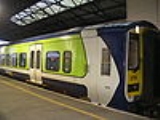
Multiple Units of Ireland

Encyclopedia
A wide variety of diesel and electric multiple unit
s have been used on Ireland's railways. This page lists all those that have been used. Except with the NIR 3000 class the numbers given by each class in the lists below are those allocated to the coaches that make up the units in that class, otherwise unit numbers are not used in Ireland.
 Córas Iompair Éireann
(CIE), which controlled the Republic's railways between 1945 and 1986, mainly used locomotives and hauled stock for its passenger trains. What diesel multiple unit cars it did have were numbered in the 25xx series. Since 1987, Iarnród Éireann
(IE) has been increasing the use of this type of train, in order to replace older locomotives and carriages. The only electrified railway network in Ireland is the Dublin Area Rapid Transit
(DART) system. Its fleet of electric multiple units is numbered in the 8xxx series.
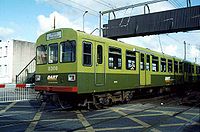
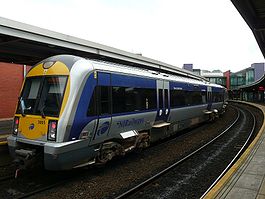 The majority of passenger services in Northern Ireland have been operated by diesel multiple units since the mid-1950s (the major exception being the locomotive-hauled Enterprise service between Belfast
and Dublin), under the tenure of both the Ulster Transport Authority
(1948–1966) and Northern Ireland Railways
(since 1967). From 2001, all items of rolling stock in use on NIR had 8000 added to their number so as to be part of the Translink number series, which incorporates their road vehicles. The new 3000 Class stock are the first multiple units to be numbered from new in the Translink series. NIR will purchase an additional 20 new trains for entry into service in 2011.
straddled the border between the Republic and Northern Ireland, and so was not incorporated in either the CIE or UTA. However, mounting losses saw the network purchased jointly by the Irish and British governments on 1 September 1953. It was run as a joint board, independent of the CIE and UTA, until 30 September 1958 when it was dissolved and the remaining stock split equally between the two railways.
Multiple unit
The term multiple unit or MU is used to describe a self-propelled carriages capable of coupling with other units of the same or similar type and still being controlled from one driving cab. The term is commonly used to denote passenger trainsets consisting of more than one carriage...
s have been used on Ireland's railways. This page lists all those that have been used. Except with the NIR 3000 class the numbers given by each class in the lists below are those allocated to the coaches that make up the units in that class, otherwise unit numbers are not used in Ireland.
Ireland
Córas Iompair Éireann
Córas Iompair Éireann , or CIÉ, is a statutory corporation of the Irish state, answerable to the Irish Government and responsible for most public transport in the Republic of Ireland and, jointly with its Northern Ireland counterpart, the Northern Ireland Transport Holding Company, between the...
(CIE), which controlled the Republic's railways between 1945 and 1986, mainly used locomotives and hauled stock for its passenger trains. What diesel multiple unit cars it did have were numbered in the 25xx series. Since 1987, Iarnród Éireann
Iarnród Éireann
Iarnród Éireann is the national railway system operator of Ireland. Established on 2 February 1987, it is a subsidiary of Córas Iompair Éireann . It operates all internal intercity, commuter and freight railway services in the Republic of Ireland, and, jointly with Northern Ireland Railways, the...
(IE) has been increasing the use of this type of train, in order to replace older locomotives and carriages. The only electrified railway network in Ireland is the Dublin Area Rapid Transit
Dublin Area Rapid Transit
The Dublin Area Rapid Transit is part of the suburban railway network in Ireland, running mainly along the coastline of Dublin Bay on the Trans-Dublin route, from Greystones in County Wicklow, through Dublin to Howth and Malahide in County Dublin.Trains are powered via a 1500V DC overhead catenary...
(DART) system. Its fleet of electric multiple units is numbered in the 8xxx series.
Diesel Multiple Units
| Class | Manufacturer | In Service | Withdrawn | Image |
|---|---|---|---|---|
| 2600 Class (I) CIÉ 2600 Class The Córas Iompair Éireann 2600 Class were Associated Equipment Company –engined diesel multiple units that operated intercity and suburban services on the CIÉ system between 1951 and 1975... |
AEC | 1951-1986 | 1986 | , |
| 80 Class | BREL BREL British Rail Engineering Limited , was the railway systems engineering division of British Rail, until the design and building of trains in the UK was privatised in 1993. On 31 October 1969, the company was incorporated as British Rail Engineering Limited.-Main products:The vast majority of BREL's... |
1987-1990 | 1990 | |
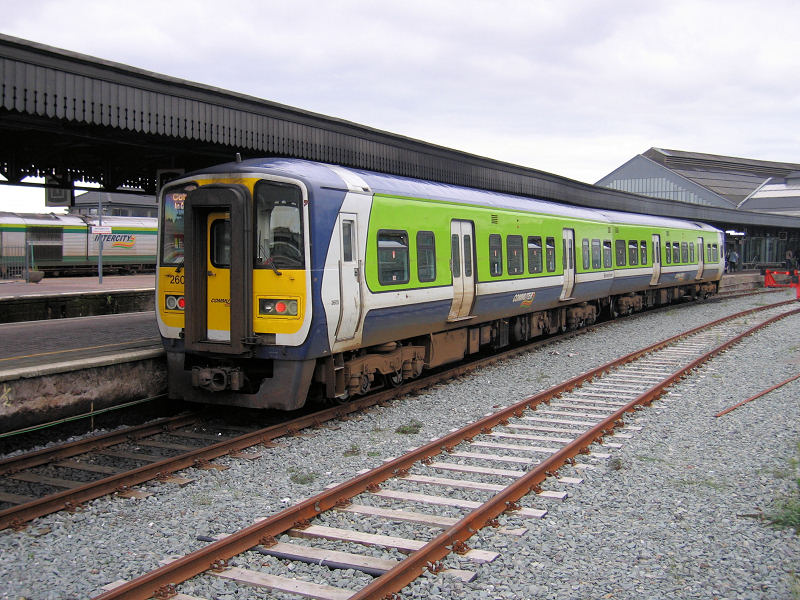
| 2600 Class (II) IE 2600 Class The 2600 Class is a type of Diesel Multiple Unit operated on the Irish railway network by Iarnród Éireann, used mainly for short-haul Commuter services. At present the entire class is based in Cork, and is used on local services to Mallow, Midleton, Cobh and on token services to Tralee... |
Tokyu Car Tokyu Car Corporation is a manufacturer of heavy rail cars in Japan. The company is based in Kanazawa Ward, Yokohama, Japan, and a member of Tokyu Group. Tokyu Car manufactures rail vehicles not only for Tokyu Corporation but for other Japanese operators, including various Japan Railways Group companies and... |
1993- | http://www.railfaneurope.net/pix/ie/dmu/2600/IE2605_Cork.jpg | |
| 2700 Class | GEC Alstom Alstom Alstom is a large multinational conglomerate which holds interests in the power generation and transport markets. According to the company website, in the years 2010-2011 Alstom had annual sales of over €20.9 billion, and employed more than 85,000 people in 70 countries. Alstom's headquarters are... |
1998- | ||
| 2750 Class | GEC Alstom Alstom Alstom is a large multinational conglomerate which holds interests in the power generation and transport markets. According to the company website, in the years 2010-2011 Alstom had annual sales of over €20.9 billion, and employed more than 85,000 people in 70 countries. Alstom's headquarters are... |
1998- | |
|
| 2800 Class IE 2800 Class The 2800 Class is a type of Diesel Multiple Unit operated on the Irish railway network by Iarnród Éireann, used mainly for short-haul Commuter services.-Description:... |
Tokyu Car Tokyu Car Corporation is a manufacturer of heavy rail cars in Japan. The company is based in Kanazawa Ward, Yokohama, Japan, and a member of Tokyu Group. Tokyu Car manufactures rail vehicles not only for Tokyu Corporation but for other Japanese operators, including various Japan Railways Group companies and... |
2000- | 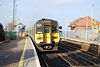 |
|
| 2900 Class IE 2900 Class The 29000 Class is a type of four-car Diesel Multiple Unit operated by Iarnród Éireann. The units were built in Spain by CAF in two batches between 2002 and 2005.-Description:... |
CAF Construcciones y Auxiliar de Ferrocarriles Construcciones y Auxiliar de Ferrocarriles is a rail equipment manufacturer based in Beasain in the Basque Country, Spain. Equipment manufactured by CAF includes light rail vehicles, rapid transit trains, railroad cars and locomotives, as well as variable gauge axles that can be fitted on any... |
2002- | ||
| 22000 Class IE 22000 Class The 22000 Class "InterCity Railcar" is a Diesel multiple unit type in service with Iarnród Éireann in Ireland.In a new departure for Iarnród Éireann they will be the first railcars to have been built specifically to serve on InterCity routes and are capable of up to 100 mph .-History:In 2005,... |
Rotem Rotem Hyundai Rotem is a South Korean company manufacturing rolling stock, defense products and plant equipment. It is part of the Hyundai Motor Group... |
2007- | 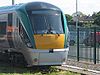 |
Electric Multiple Units
| Class | Manufacturer | In Service | Withdrawn | Image |
|---|---|---|---|---|
| 8100 Class CIE 8100 Class The CIÉ 8100 class were the first electrical multiple units used on the Dublin Area Rapid Transit system. Built by GEC and LHB in 1983/84, they are two-car units, and were the only units used on the DART before the arrival of the 8200 Class. 40 two car sets were delivered, numbered 8101/8301 to... |
Linke-Hofmann-Busch Alstom Alstom is a large multinational conglomerate which holds interests in the power generation and transport markets. According to the company website, in the years 2010-2011 Alstom had annual sales of over €20.9 billion, and employed more than 85,000 people in 70 countries. Alstom's headquarters are... |
1983- | |
|
| 8200 Class IE 8200 Class The Iarnród Éireann 8200 Class electrical multiple units were built for the Dublin Area Rapid Transit . The units are two-car sets, of which there are five. They are numbered in the sequence 8201+8401, etc... The units first entered service in 2000... |
Alstom Alstom Alstom is a large multinational conglomerate which holds interests in the power generation and transport markets. According to the company website, in the years 2010-2011 Alstom had annual sales of over €20.9 billion, and employed more than 85,000 people in 70 countries. Alstom's headquarters are... |
2000- |  |
|
| 8500 Class | Tokyu Car Corporation Tokyu Car Corporation is a manufacturer of heavy rail cars in Japan. The company is based in Kanazawa Ward, Yokohama, Japan, and a member of Tokyu Group. Tokyu Car manufactures rail vehicles not only for Tokyu Corporation but for other Japanese operators, including various Japan Railways Group companies and... |
2001- |  |
|
| 8510 Class | Tokyu Car Corporation Tokyu Car Corporation is a manufacturer of heavy rail cars in Japan. The company is based in Kanazawa Ward, Yokohama, Japan, and a member of Tokyu Group. Tokyu Car manufactures rail vehicles not only for Tokyu Corporation but for other Japanese operators, including various Japan Railways Group companies and... |
2003- | 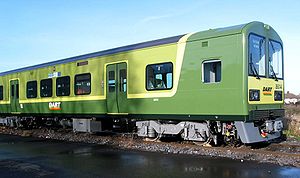 |
|
| 8520 Class | Tokyu Car Corporation Tokyu Car Corporation is a manufacturer of heavy rail cars in Japan. The company is based in Kanazawa Ward, Yokohama, Japan, and a member of Tokyu Group. Tokyu Car manufactures rail vehicles not only for Tokyu Corporation but for other Japanese operators, including various Japan Railways Group companies and... |
2004- | 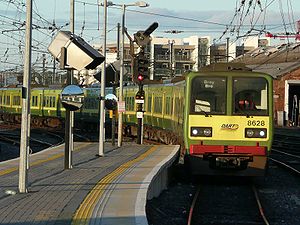 |
Northern Ireland
Belfast
Belfast is the capital of and largest city in Northern Ireland. By population, it is the 14th biggest city in the United Kingdom and second biggest on the island of Ireland . It is the seat of the devolved government and legislative Northern Ireland Assembly...
and Dublin), under the tenure of both the Ulster Transport Authority
Ulster Transport Authority
The Ulster Transport Authority ran rail and bus transport in Northern Ireland from 1948 until 1966.-Formation and consolidation:The UTA was formed by the Transport Act 1948, which merged the Northern Ireland Road Transport Board and the Belfast and County Down Railway...
(1948–1966) and Northern Ireland Railways
Northern Ireland Railways
NI Railways, also known as Northern Ireland Railways and for a brief period of time, Ulster Transport Railways , is the railway operator in Northern Ireland...
(since 1967). From 2001, all items of rolling stock in use on NIR had 8000 added to their number so as to be part of the Translink number series, which incorporates their road vehicles. The new 3000 Class stock are the first multiple units to be numbered from new in the Translink series. NIR will purchase an additional 20 new trains for entry into service in 2011.
| Class | Manufacturer | Number Built | In Service | Withdrawn | Image |
|---|---|---|---|---|---|
| AEC Class UTA AEC Following the end of World War II, most railways throughout the world were looking to either update their fleet of steam locomotives with new and more economical designs or look towards alternatives, which for many meant a programme of dieselisation. The main considerations were the rising cost of... |
UTA Works Ulster Transport Authority The Ulster Transport Authority ran rail and bus transport in Northern Ireland from 1948 until 1966.-Formation and consolidation:The UTA was formed by the Transport Act 1948, which merged the Northern Ireland Road Transport Board and the Belfast and County Down Railway... |
1951 1958 |
1968 1972 |
||
| MED Class UTA MED The Ulster Transport Authority Multi-Engined Diesel was an early diesel powered railcar, used in Northern Ireland. The 12-mile Belfast-Bangor railway line had a well used passenger service and, being devoid of goods traffic, was chosen as the testing ground for the diesel railcar era... |
UTA Works Ulster Transport Authority The Ulster Transport Authority ran rail and bus transport in Northern Ireland from 1948 until 1966.-Formation and consolidation:The UTA was formed by the Transport Act 1948, which merged the Northern Ireland Road Transport Board and the Belfast and County Down Railway... |
14 x 3-car sets | 1952 | 1978 | |
| MPD Class UTA MPD The Ulster Transport Authority Multi-Purpose Diesel was a diesel powered railcar, used in Northern Ireland. It was developed by the Ulster Transport Authority as a progression of the earlier Multi-engined Diesel... |
UTA Works Ulster Transport Authority The Ulster Transport Authority ran rail and bus transport in Northern Ireland from 1948 until 1966.-Formation and consolidation:The UTA was formed by the Transport Act 1948, which merged the Northern Ireland Road Transport Board and the Belfast and County Down Railway... |
2 x 5-car sets 10 x 3 car sets |
1958 | 1981 | |
| 70 Class UTA 70 Class UTA 70 class was a diesel multiple unit train built for service on Northern Ireland Railways. The MED’s and MPD’s, which made use of readily available power and transmission units, were cheap to operate but noisier and not as comfortable as locomotive-hauled rolling stock, a fact which made them... |
UTA Works Ulster Transport Authority The Ulster Transport Authority ran rail and bus transport in Northern Ireland from 1948 until 1966.-Formation and consolidation:The UTA was formed by the Transport Act 1948, which merged the Northern Ireland Road Transport Board and the Belfast and County Down Railway... |
8 x 3-car sets | 1966 | 1986 | |
| 80 Class NIR 80 Class The Class 80 is a type of diesel electric multiple unit in service with Northern Ireland Railways.-History:By the early 1970s the MEDs and units inherited from the GNR had been in service for 20 years, and the MPDs for 10 years. To replace these increasingly life-expired units, Northern Ireland... |
BREL BREL British Rail Engineering Limited , was the railway systems engineering division of British Rail, until the design and building of trains in the UK was privatised in 1993. On 31 October 1969, the company was incorporated as British Rail Engineering Limited.-Main products:The vast majority of BREL's... |
22 x 2/3-car sets | 1974 | 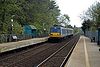 |
|
| RB3 British Rail Railbuses British Rail produced a variety of Railbuses as a means both of building new rolling stock cheaply, and to provide services on lightly used lines economically.-Terminology:... |
BREL BREL British Rail Engineering Limited , was the railway systems engineering division of British Rail, until the design and building of trains in the UK was privatised in 1993. On 31 October 1969, the company was incorporated as British Rail Engineering Limited.-Main products:The vast majority of BREL's... /Leyland |
1 x single car | 1983 | 1989 | |
| 450 Class NIR 450 Class The Class 450 is a type of diesel multiple unit used by Northern Ireland Railways.-History:In the mid 1980s, Northern Ireland Railways was in the process of upgrading its rolling stock. Having already purchased three new locomotives, it then proceeded to purchase replacements for its Class 70... |
BREL BREL British Rail Engineering Limited , was the railway systems engineering division of British Rail, until the design and building of trains in the UK was privatised in 1993. On 31 October 1969, the company was incorporated as British Rail Engineering Limited.-Main products:The vast majority of BREL's... |
9 x 3-car sets | 1985 | 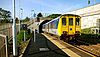 |
|
| 3000 Class NIR 3000 Class The Class 3000 is a class of diesel multiple unit in service with Northern Ireland Railways.-History:At the beginning of the 21st century, the majority of rail services in Northern Ireland continued to be operated using Class 80 DEMUs, which had been in service since the mid 1970s, and were... |
CAF Construcciones y Auxiliar de Ferrocarriles Construcciones y Auxiliar de Ferrocarriles is a rail equipment manufacturer based in Beasain in the Basque Country, Spain. Equipment manufactured by CAF includes light rail vehicles, rapid transit trains, railroad cars and locomotives, as well as variable gauge axles that can be fitted on any... |
23 x 3-car sets | 2005 | 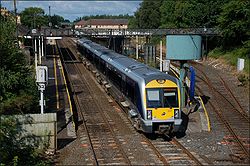 |
|
| 4000 Class | CAF Construcciones y Auxiliar de Ferrocarriles Construcciones y Auxiliar de Ferrocarriles is a rail equipment manufacturer based in Beasain in the Basque Country, Spain. Equipment manufactured by CAF includes light rail vehicles, rapid transit trains, railroad cars and locomotives, as well as variable gauge axles that can be fitted on any... |
20 x 3/4-car sets | 2011 | http://www.ribblevalleyrail.co.uk/Irish%20D/N%2030.jpg |

Great Northern Railway (Ireland)
The Great Northern Railway (Ireland)Great Northern Railway (Ireland)
The Great Northern Railway was an Irish gauge railway company in Ireland.The Great Northern was formed in 1876 by a merger of the Irish North Western Railway , Northern Railway of Ireland, and Ulster Railway. The Ulster Railway was the GNRI's oldest constituent, having opened between Belfast and...
straddled the border between the Republic and Northern Ireland, and so was not incorporated in either the CIE or UTA. However, mounting losses saw the network purchased jointly by the Irish and British governments on 1 September 1953. It was run as a joint board, independent of the CIE and UTA, until 30 September 1958 when it was dissolved and the remaining stock split equally between the two railways.
- AEC ClassGNRI AEC ClassAfter 1945, both CIE and the GNR found themselves in a poor financial position as a result of the deprivations of World War II and increased competition from road traffic. They looked to diesel power as a way to streamline costs and bring them back into profitability...
- BUT Class
See also
- Steam Locomotives of IrelandSteam locomotives of IrelandA wide variety of steam locomotives have been used on Ireland's railways. This page lists all those that have been used in the Republic of Ireland and Northern Ireland...
- Diesel Locomotives of IrelandDiesel locomotives of IrelandAlthough prototype diesel locomotives ran in Britain before World War II, the railways of both the Republic and Northern Ireland changed over much more rapidly from steam to diesel traction, in the 1950s than those in Britain, due to the island's limited coal reserves and ageing steam locomotive...
- Coaching Stock of IrelandCoaching Stock of IrelandA wide variety of hauled coaches have been used on the railways of Ireland. This page lists all those since 1945.-Republic of Ireland:When formed in 1945, Córas Iompair Éireann inherited from its constituents a motley collection of coaching stock from various manufacturers, in equally variegated...
- Freight Stock of Ireland