

Citroën BX

Encyclopedia
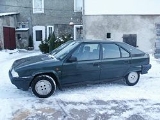
The Citroën BX is a large family car
that was produced by the French manufacturer Citroën
from 1982 to 1994. In total, 2,315,739 BXs were built during its 12-year history. The hatchback
was discontinued in 1993 with the arrival of the Xantia
, but the estate
continued for another year.
on 2 October 1982 under the Eiffel Tower
. The BX was designed to replace the successful small family car Citroën GS/A
with a larger vehicle. The French advertising campaign used the slogan "J'aime, j'aime, j'aime" showing the car accompanied by music written specially by Julien Clerc
.
The angular Marcello Gandini
-designed hatchback
was strongly inspired by the British 1977 Reliant FW11
concept and the 1979 Volvo Tundra
concept car (also designed by Bertone). It was one of the first cars to benefit from the merger of Peugeot and Citroën in 1976, sharing its platform with the more conventional 405
that appeared in 1987. Among the features that set the car apart from the competition was the traditional Citroën hydropneumatic self-levelling suspension
, extensive use of plastic body panels (bonnet, tailgate, bumpers), and front and rear disc brakes.
The BX dispensed of the air cooled, flat four engine which powered the GS, and replaced it with the new PSA group XY, TU and XU series of petrol engine
s in 1.4 L, 1.6 L and 1.9 L displacements (a 1.1 L engine, very unusual in a car of this size, was also available in Italy, Portugal and Greece). The 1.1 and 1.4 unit was an old Peugeot/Renault powertrain with its roots in the Peugeot 104 and Renault 14, but the 1.6 and 1.9 was all-new and later used in many Peugeots. The class leading XUD diesel engine
version was launched in 1984. The diesel and turbo diesel models were to become the most successful variants, they were especially popular as estates and became the best selling diesel car in Britain.
All petrol engines were badged as 11, 14, 16, 19 — signifying engine size (In some countries, a weaker, 80 PS version of the 1.6 L engine was badged as the BX15E instead of BX16). The 11TE model was seen by foreign motoring press as slow and uncomfortable.
The 1.1 L engine with engine code H1A was specially tuned for Italy, Greece and Portugal. It was fitted to the cars made from 1988 to 1993 and produced 40 kW (55 hp DIN) at 5800 rpm.
A year after the launch of the hatchback model, an estate
version was made available. In the late 1980s, a four-wheel drive
system and turbodiesel
engines were introduced.
All BXs are known for an exceptionally smooth ride, reasonable fuel economy and potent brakes. The perceived complexity of the suspension system meant that changing of the hydraulic oil (LHM) was often neglected, leading to otherwise avoidable repairs. Maintenance was seen as expensive because the suspension spheres (the equivalent of the spring and shock absorber on conventionally sprung cars) needed to be replaced every three to four years, however on the BX they were easy to change and a cheap consumable, which could even be re-gassed for a fraction of the cost. On MK2 models, the suspension piping was better protected against corrosion, and less prone to failure. That is why there are very few original Mark 1 BXs on the road today. Rust protection of the bodywork was much better than earlier Citroëns and also better than average.
Famous owners of the BX include Italian automobile designer Marcello Gandini
, who penned both the BX and the Lamborghini Countach
. Citroën featured Marcello Gandini in its advertising campaigns in the early 1990s.
The amount of standard and optional equipment available to BX customers was also surprisingly high for a car of its size and class. Besides the superior hydropneumatic suspension, one could also have equipment such as anti-lock brakes, air conditioning
, electric windows and mirrors, power sunroof, a remote-controlled central locking system and leather upholstery.
In 1986 the MK2 BX was launched. The interior and dashboard was redesigned to be more conventional-looking than the original, which used Citroën's idiosyncratic "satellite" switchgear, and "bathroom scale" speedometer. These were replaced with more conventional stalks for light and wipers and analogue instruments. The earlier GT models already had a "normal" speedometer and tachometer. The exterior was also slightly updated, with new more rounded bumpers, flared wheelarches to accept wider tyres, new and improved mirrors and the front indicators replaced with larger clear ones which fitted flush with the headlights.
1988 saw the launch of the BX Turbo Diesel, which was very highly praised by the motoring press. The BX diesel was already a strong seller, but the Turbo model brought new levels of refinement and performance to the diesel market, which brought an end to the common notion that diesel cars were slow and noisy. Diesel Car magazine said of the BX "We can think of no other car currently on sale in the UK that comes anywhere near approaching the BX Turbo's combination of performance, accommodation and economy".
In 1989, the BX range had further minor revisions and specification improvements made to it, including smoked rear lamp units, new wheeltrims and interior fabrics.
Winning many Towcar of the Year awards, the BX was very well renowned as a tow car (as was its larger sister, the CX), especially the diesel models, due to their power and economy combined with the self levelling suspension. The BX was the most highly acclaimed towcar worldwide.
The biggest problem of the BX was its variable build quality, compared to its competition. It dramatically improved over its life, until with the launch of its replacement the Citroën Xantia
build quality was being compared favourably with German cars.
The last BX was made in 1994, by which time its successors had already been launched. It had been partially replaced by the smaller ZX
in early 1991, but its key replacement was the slightly larger Xantia
that went on sale on March 1993.
The car was only available in left hand drive and so it was not sold in the UK.
-sourced engine, in general a Sport engine with only one twin choke carburettor. Max power is 105 PS. That same year, Citroën produced a "Digit" model, which was based on the BX GT. It featured a digital instrument cluster and an onboard computer. Citroën only produced 4,000 BX Digits in 1985.
rallying
with the BX in 1986
. The specially designed rally BX was called the BX 4TC and bore little resemblance to the standard BX. It had a very long nose because the engine (a turbocharger
fitted version of Chrysler Europe
's Simca Type 180
engine) was mounted longitudinally unlike in the regular BX. The rally version of the BX also featured the unique hydropneumatic suspension. Because of the Group B regulations, 200 street versions of the 4TC also had to be built.
The 4TC was never very successful in World Rally Championship
competition, its best result being a sixth place in the 1986 Swedish Rally
. Citroën only participated in three Group B rallies before the Group B class was banned in late 1986, following the death of Henri Toivonen
in his Lancia Delta S4
at the Tour de Corse
Rally. Citroën was understandably ashamed of the performance of its cars, and immediately recalled and scrapped as many examples as it could, making the BX 4TC road and race cars extremely rare and sought-after.
 In May 1987, a 16-valve version of the GTi was launched. This was the first French production car to be fitted with a 16-valve engine. A DOHC naturally aspirated 1.9 L engine, producing 160 bhp and 177 newton metre of torque, rocketed the BX to 100 km/h (62.1 mph) in 7.4 seconds, stopping at a top speed of 220 km/h (136.7 mph). Anti-lock brakes were fitted as standard. Its side skirts made it easily recognizable from all other BX models. In 1990, the facelift of the 16V gave the car a new lease of life. The updated car came with new fibreglass bumpers, anthracite painted wheels, smoked taillight lenses, and a redesigned rear spoiler. These cosmetic changes made the car look even more distinctive from other BXs. There were also a few subtle changes made to the car's performance, the most noticeable being harder suspension and a thicker anti-roll bar
, which improved handling. The BX 16V was found to be faster around a race-track than the "in house" competitor Peugeot 405
Mi16 in a test in the Swedish motoring magazine Teknikens Värld
.
Even in competition the 16V was successful. Jean-Luc Pallier drove a 240 bhp BX 16V, in strong competition with for example Renault 21
Turbo, Opel Kadett
GSI, BMW M3
and Ford Sierra RS Cosworth
. He was left in the start but later he passed the competitors mainly on the inside in the bends with the rear inner wheel in the air. It was possible because of the front wheel drive and the excellent handling of his 16V.
In rallying, young Swedish driver Magnus Gustafsson successfully drove a BX 16V supported by the Swedish Citroën dealers. It was tuned by Swedish firm Custom Racing to over 200 PS and had a six-speed gearbox from Peugeot Talbot Sport. The car also had a hydractive suspension unit from a Citroën XM installed. Gustafsson won a lot of smaller national events, but his best result was a second position in the 2 L category in the Swedish International Rally 1992 and a victory in South Swedish Rally (also in the 2 L category, of course). BX 16V (and also BX 8V) is still seen in rallying in Sweden in national categories.
Large family car
A large family car, also known as a D-segment car, is a European automobile classification which is larger than a small family car and smaller than an executive car. Multi-purpose vehicles based on a large family car design are often called large MPVs, while similarly-priced models from luxury car...
that was produced by the French manufacturer Citroën
Citroën
Citroën is a major French automobile manufacturer, part of the PSA Peugeot Citroën group.Founded in 1919 by French industrialist André-Gustave Citroën , Citroën was the first mass-production car company outside the USA and pioneered the modern concept of creating a sales and services network that...
from 1982 to 1994. In total, 2,315,739 BXs were built during its 12-year history. The hatchback
Hatchback
A Hatchback is a car body style incorporating a shared passenger and cargo volume, with rearmost accessibility via a rear third or fifth door, typically a top-hinged liftgate—and features such as fold-down rear seats to enable flexibility within the shared passenger/cargo volume. As a two-box...
was discontinued in 1993 with the arrival of the Xantia
Citroën Xantia
The Citroën Xantia, pronounced 'Zan-tia' is a large family car produced by the French automaker Citroën. First seen at the end of 1992, the car was produced between 1993 and 2001, with a facelift in 1998. Citroën sold over 1.2 million Xantias during its 8 years of production...
, but the estate
Station wagon
A station wagon is a body style variant of a sedan/saloon with its roof extended rearward over a shared passenger/cargo volume with access at the back via a third or fifth door , instead of a trunk lid...
continued for another year.
History
The Citroën BX was launched in ParisParis
Paris is the capital and largest city in France, situated on the river Seine, in northern France, at the heart of the Île-de-France region...
on 2 October 1982 under the Eiffel Tower
Eiffel Tower
The Eiffel Tower is a puddle iron lattice tower located on the Champ de Mars in Paris. Built in 1889, it has become both a global icon of France and one of the most recognizable structures in the world...
. The BX was designed to replace the successful small family car Citroën GS/A
Citroën GS
The Citroën GS and Citroën GSA are small family cars produced by the French automaker Citroën. The GS was voted European Car of the Year for 1971, and was probably the most technologically advanced car in its class when launched, with class leading comfort, safety and aerodynamics.-Market...
with a larger vehicle. The French advertising campaign used the slogan "J'aime, j'aime, j'aime" showing the car accompanied by music written specially by Julien Clerc
Julien Clerc
Julien Clerc, , born as Paul Alain Leclerc on 4 October 1947 in Paris, Clerc's parents divorced when he was still young. He grew up listening to classical music in his father's home, while his mother introduced him to the music of such singers as Georges Brassens and Edith Piaf...
.
The angular Marcello Gandini
Marcello Gandini
Marcello Gandini is an Italian car designer, widely known for his work with the automotive design house Gruppo Bertone, notably his design of the Lamborghini Countach. Together with Giorgetto Giugiaro and Leonardo Fioravanti, Gandini forms a noted triumvirate of Italian car designers, all born in...
-designed hatchback
Hatchback
A Hatchback is a car body style incorporating a shared passenger and cargo volume, with rearmost accessibility via a rear third or fifth door, typically a top-hinged liftgate—and features such as fold-down rear seats to enable flexibility within the shared passenger/cargo volume. As a two-box...
was strongly inspired by the British 1977 Reliant FW11
Reliant FW11
In 1977 Marcello Gandini designed the FW 11 for Anadol and Reliant, the latter naming it as the Scimitar SE 7. Four prototypes of this car were produced, two of which were sent to England with the Reliant badge, and two other examples, one of them white and the other one blue, were sent to Turkey...
concept and the 1979 Volvo Tundra
Volvo Tundra
Volvo Tundra was a concept car built and designed by Bertone in 1979. It was based on the Volvo 343. It was rejected by Volvo and a very similar design was instead sold to Citroën where it was produced as Citroën BX....
concept car (also designed by Bertone). It was one of the first cars to benefit from the merger of Peugeot and Citroën in 1976, sharing its platform with the more conventional 405
Peugeot 405
The Peugeot 405 is a large family car released by the French automaker Peugeot in July 1987 and which continues to be manufactured under licence outside France. It used TU/XU petrol and XUD diesel engines....
that appeared in 1987. Among the features that set the car apart from the competition was the traditional Citroën hydropneumatic self-levelling suspension
Self-levelling suspension
Self-levelling refers to an automobile suspension system that maintains a constant ride height of the vehicle above the road, regardless of load....
, extensive use of plastic body panels (bonnet, tailgate, bumpers), and front and rear disc brakes.
The BX dispensed of the air cooled, flat four engine which powered the GS, and replaced it with the new PSA group XY, TU and XU series of petrol engine
Four-stroke cycle
A four-stroke engine, also known as four-cycle, is an internal combustion engine in which the piston completes four separate strokes—intake, compression, power, and exhaust—during two separate revolutions of the engine's crankshaft, and one single thermodynamic cycle.There are two...
s in 1.4 L, 1.6 L and 1.9 L displacements (a 1.1 L engine, very unusual in a car of this size, was also available in Italy, Portugal and Greece). The 1.1 and 1.4 unit was an old Peugeot/Renault powertrain with its roots in the Peugeot 104 and Renault 14, but the 1.6 and 1.9 was all-new and later used in many Peugeots. The class leading XUD diesel engine
Diesel engine
A diesel engine is an internal combustion engine that uses the heat of compression to initiate ignition to burn the fuel, which is injected into the combustion chamber...
version was launched in 1984. The diesel and turbo diesel models were to become the most successful variants, they were especially popular as estates and became the best selling diesel car in Britain.
All petrol engines were badged as 11, 14, 16, 19 — signifying engine size (In some countries, a weaker, 80 PS version of the 1.6 L engine was badged as the BX15E instead of BX16). The 11TE model was seen by foreign motoring press as slow and uncomfortable.
The 1.1 L engine with engine code H1A was specially tuned for Italy, Greece and Portugal. It was fitted to the cars made from 1988 to 1993 and produced 40 kW (55 hp DIN) at 5800 rpm.
A year after the launch of the hatchback model, an estate
Station wagon
A station wagon is a body style variant of a sedan/saloon with its roof extended rearward over a shared passenger/cargo volume with access at the back via a third or fifth door , instead of a trunk lid...
version was made available. In the late 1980s, a four-wheel drive
Four-wheel drive
Four-wheel drive, 4WD, or 4×4 is a four-wheeled vehicle with a drivetrain that allows all four wheels to receive torque from the engine simultaneously...
system and turbodiesel
Turbodiesel
Turbodiesel refers to any diesel engine with a turbocharger. Turbocharging is the norm rather than the exception in modern car and truck diesel engines...
engines were introduced.
All BXs are known for an exceptionally smooth ride, reasonable fuel economy and potent brakes. The perceived complexity of the suspension system meant that changing of the hydraulic oil (LHM) was often neglected, leading to otherwise avoidable repairs. Maintenance was seen as expensive because the suspension spheres (the equivalent of the spring and shock absorber on conventionally sprung cars) needed to be replaced every three to four years, however on the BX they were easy to change and a cheap consumable, which could even be re-gassed for a fraction of the cost. On MK2 models, the suspension piping was better protected against corrosion, and less prone to failure. That is why there are very few original Mark 1 BXs on the road today. Rust protection of the bodywork was much better than earlier Citroëns and also better than average.
Famous owners of the BX include Italian automobile designer Marcello Gandini
Marcello Gandini
Marcello Gandini is an Italian car designer, widely known for his work with the automotive design house Gruppo Bertone, notably his design of the Lamborghini Countach. Together with Giorgetto Giugiaro and Leonardo Fioravanti, Gandini forms a noted triumvirate of Italian car designers, all born in...
, who penned both the BX and the Lamborghini Countach
Lamborghini Countach
The Lamborghini Countach is a mid-engined supercar that was produced by Italian automaker Lamborghini from 1974 to 1990. Its design both pioneered and popularized the wedge-shaped, sharply angled look popular in many high performance sports cars...
. Citroën featured Marcello Gandini in its advertising campaigns in the early 1990s.
The amount of standard and optional equipment available to BX customers was also surprisingly high for a car of its size and class. Besides the superior hydropneumatic suspension, one could also have equipment such as anti-lock brakes, air conditioning
Air conditioning
An air conditioner is a home appliance, system, or mechanism designed to dehumidify and extract heat from an area. The cooling is done using a simple refrigeration cycle...
, electric windows and mirrors, power sunroof, a remote-controlled central locking system and leather upholstery.
In 1986 the MK2 BX was launched. The interior and dashboard was redesigned to be more conventional-looking than the original, which used Citroën's idiosyncratic "satellite" switchgear, and "bathroom scale" speedometer. These were replaced with more conventional stalks for light and wipers and analogue instruments. The earlier GT models already had a "normal" speedometer and tachometer. The exterior was also slightly updated, with new more rounded bumpers, flared wheelarches to accept wider tyres, new and improved mirrors and the front indicators replaced with larger clear ones which fitted flush with the headlights.
1988 saw the launch of the BX Turbo Diesel, which was very highly praised by the motoring press. The BX diesel was already a strong seller, but the Turbo model brought new levels of refinement and performance to the diesel market, which brought an end to the common notion that diesel cars were slow and noisy. Diesel Car magazine said of the BX "We can think of no other car currently on sale in the UK that comes anywhere near approaching the BX Turbo's combination of performance, accommodation and economy".
In 1989, the BX range had further minor revisions and specification improvements made to it, including smoked rear lamp units, new wheeltrims and interior fabrics.
Winning many Towcar of the Year awards, the BX was very well renowned as a tow car (as was its larger sister, the CX), especially the diesel models, due to their power and economy combined with the self levelling suspension. The BX was the most highly acclaimed towcar worldwide.
The biggest problem of the BX was its variable build quality, compared to its competition. It dramatically improved over its life, until with the launch of its replacement the Citroën Xantia
Citroën Xantia
The Citroën Xantia, pronounced 'Zan-tia' is a large family car produced by the French automaker Citroën. First seen at the end of 1992, the car was produced between 1993 and 2001, with a facelift in 1998. Citroën sold over 1.2 million Xantias during its 8 years of production...
build quality was being compared favourably with German cars.
The last BX was made in 1994, by which time its successors had already been launched. It had been partially replaced by the smaller ZX
Citroën ZX
The Citroën ZX is a small family car produced by the French manufacturer Citroën between 1991 and 1998.During the 1990s, the ZX was Citroën's competitor in the class traditionally dominated in Europe by the Ford Escort and Vauxhall/Opel Astra, a market segment Citroën had moved away from when the...
in early 1991, but its key replacement was the slightly larger Xantia
Citroën Xantia
The Citroën Xantia, pronounced 'Zan-tia' is a large family car produced by the French automaker Citroën. First seen at the end of 1992, the car was produced between 1993 and 2001, with a facelift in 1998. Citroën sold over 1.2 million Xantias during its 8 years of production...
that went on sale on March 1993.
Sport
As well as the normal BX, Citroën produced the BX Sport from 1985 to 1987. During this period, Citroën produced 7,500 BX Sports; 2,500 at first, then an extra 5,000 due to its sales success. Rated at 126 bhp and equipped with dual 2-barrel carburettors, the BX Sport was the most powerful BX in production at that time. It also stood out with its unique body kit, alloy wheels used on the GTi later in the BX's life, a unique dashboard and PULLMAN interior.The car was only available in left hand drive and so it was not sold in the UK.
GT
The BX GT was launched in 1985 and featured a 1.9 L PeugeotPeugeot
Peugeot is a major French car brand, part of PSA Peugeot Citroën, the second largest carmaker based in Europe.The family business that precedes the current Peugeot company was founded in 1810, and manufactured coffee mills and bicycles. On 20 November 1858, Emile Peugeot applied for the lion...
-sourced engine, in general a Sport engine with only one twin choke carburettor. Max power is 105 PS. That same year, Citroën produced a "Digit" model, which was based on the BX GT. It featured a digital instrument cluster and an onboard computer. Citroën only produced 4,000 BX Digits in 1985.
4TC
Citroën entered Group BGroup B
Group B was a set of regulations introduced in 1982 for competition vehicles in sportscar racing and rallying regulated by the FIA. The Group B regulations fostered some of the quickest, most powerful and sophisticated rally cars ever built. However, a series of major accidents, some fatal, were...
rallying
Rallying
Rallying, also known as rally racing, is a form of auto racing that takes place on public or private roads with modified production or specially built road-legal cars...
with the BX in 1986
1986 World Rally Championship season
The 1986 World Rally Championship season was the 14th season of the Fédération Internationale de l'Automobile World Rally Championship . The season consisted of 13 rallies, including all twelve venues of the previous season as well as the addition of the Olympus Rally...
. The specially designed rally BX was called the BX 4TC and bore little resemblance to the standard BX. It had a very long nose because the engine (a turbocharger
Turbocharger
A turbocharger, or turbo , from the Greek "τύρβη" is a centrifugal compressor powered by a turbine that is driven by an engine's exhaust gases. Its benefit lies with the compressor increasing the mass of air entering the engine , thereby resulting in greater performance...
fitted version of Chrysler Europe
Chrysler Europe
Chrysler Europe was a division of the Chrysler Corporation that operated between 1967 and 1979.-Formation:In the 1960s, Chrysler sought to become a world producer of automobiles. The company had never had much success outside North America, contrasting with Ford's worldwide reach and General...
's Simca Type 180
Simca Type 180
The Type 180 is an automobile straight-4 engine produced in the 1970s. It was an OHC design.-1.6/1.8:These engines were used in the Chrysler 160/180, a car also sold under a multiplicity of other names.Applications:...
engine) was mounted longitudinally unlike in the regular BX. The rally version of the BX also featured the unique hydropneumatic suspension. Because of the Group B regulations, 200 street versions of the 4TC also had to be built.
The 4TC was never very successful in World Rally Championship
World Rally Championship
The World Rally Championship is a rallying series organised by the FIA, culminating with a champion driver and manufacturer. The driver's world championship and manufacturer's world championship are separate championships, but based on the same point system. The series currently consists of 13...
competition, its best result being a sixth place in the 1986 Swedish Rally
Swedish Rally
The Uddeholm Swedish Rally , formerly the Swedish Rally, is an automobile rally competition held in Värmland, Sweden in early February. First held in 1950, when it was called the Rally to the Midnight Sun with start and finish at separate locations, seventeen years later both start and finish...
. Citroën only participated in three Group B rallies before the Group B class was banned in late 1986, following the death of Henri Toivonen
Henri Toivonen
Henri Pauli Toivonen was a Finnish rally driver born in Jyväskylä, the home of Rally Finland. His father, Pauli Toivonen, was the 1968 European Rally Champion for Porsche and his brother, Harri Toivonen, became a professional circuit racer.Toivonen's first World Rally Championship victory came...
in his Lancia Delta S4
Lancia Delta S4
The Lancia Delta S4 is a Group B rally car that competed in the World Rally Championship in 1985 and 1986, until Group B cars were banned from competition by the FIA. The car replaced and was an evolution of the Lancia 037 Monte Carlo. The S4 took full advantage of the Group B regulations, and...
at the Tour de Corse
Tour de Corse
The Tour de Corse - Rallye de France is a rally first held in 1956 on the island of Corsica. It was part of the World Rally Championship from the inaugural 1973 season to 2008. The name "Tour de Corse" refers to the fact that in the early days it was run around the island; nowadays it only features...
Rally. Citroën was understandably ashamed of the performance of its cars, and immediately recalled and scrapped as many examples as it could, making the BX 4TC road and race cars extremely rare and sought-after.
GTi
An uprated version of the BX GT, the BX19 GTi was fitted with an 1.9 L 8-valve fuel injected engine producing 122 PS (also fitted to the 205 GTi), a spoiler and firmer suspension spheres/anti-roll bar than the standard model; it could reach 198 km/h. There was also a special export model, the BX16 GTi, using the 113 PS XU5JA engine from the Peugeot 205 GTi 1.6. Top speed was 194 km/h.16V
Sway bar
A sway bar or anti-roll bar or stabilizer bar is a part of an automobile suspension that helps reduce the roll of a vehicle that is induced by cornering or road irregularities. It connects opposite wheels together through short lever arms linked by a torsion spring...
, which improved handling. The BX 16V was found to be faster around a race-track than the "in house" competitor Peugeot 405
Peugeot 405
The Peugeot 405 is a large family car released by the French automaker Peugeot in July 1987 and which continues to be manufactured under licence outside France. It used TU/XU petrol and XUD diesel engines....
Mi16 in a test in the Swedish motoring magazine Teknikens Värld
Teknikens Värld
Teknikens värld is a leading motor magazine in Sweden, owned and published by Bonnier. The magazine primarily features automotive news, reviews and test drives of passenger cars from various segments. Books are also published under the name, e.g...
.
Even in competition the 16V was successful. Jean-Luc Pallier drove a 240 bhp BX 16V, in strong competition with for example Renault 21
Renault 21
The Renault 21 is a large family car produced by French automaker Renault between 1986 and 1994. It was also sold in North America through American Motors dealers as the Renault Medallion and the Eagle Medallion...
Turbo, Opel Kadett
Opel Kadett
The Opel Kadett is a small family car produced by the German automobile manufacturer Opel between 1937 and 1940, and then again from 1962 until 1991 , when it was replaced by the Opel Astra.-Original model :...
GSI, BMW M3
BMW M3
The BMW M3 is a high-performance version of the BMW 3 Series, developed by BMW's in-house motorsport division, BMW M. M3 models have been derived from the E30, E36, E46 and E90/E92/E93 3-series, and sold with coupé, sedan and convertible body styles...
and Ford Sierra RS Cosworth
Ford Sierra RS Cosworth
The Ford Sierra RS Cosworth was a high-performance version of the Ford Sierra. It was the result of a Ford Motorsport project with the purpose of producing an outright winner for Group A racing in Europe.- Development :...
. He was left in the start but later he passed the competitors mainly on the inside in the bends with the rear inner wheel in the air. It was possible because of the front wheel drive and the excellent handling of his 16V.
In rallying, young Swedish driver Magnus Gustafsson successfully drove a BX 16V supported by the Swedish Citroën dealers. It was tuned by Swedish firm Custom Racing to over 200 PS and had a six-speed gearbox from Peugeot Talbot Sport. The car also had a hydractive suspension unit from a Citroën XM installed. Gustafsson won a lot of smaller national events, but his best result was a second position in the 2 L category in the Swedish International Rally 1992 and a victory in South Swedish Rally (also in the 2 L category, of course). BX 16V (and also BX 8V) is still seen in rallying in Sweden in national categories.
External links
- Citroën BX 16-valve Club
- BX links Citroën World
- web based UK BX owners club
- http://www.citroencarclub.org.uk