

Lamborghini Countach

Encyclopedia
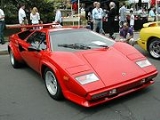
The Lamborghini Countach is a mid-engined
supercar
that was produced by Italian automaker Lamborghini
from 1974 to 1990. Its design both pioneered and popularized the wedge-shaped, sharply angled look popular in many high performance sports cars. The "cabin-forward" design concept, which pushes the passenger compartment forward in order to accommodate a larger engine, was also popularized by the Countach.
In 2004, American car magazine Sports Car International
named this car number three on the list of Top Sports Cars of the 1970s, and it was listed as number ten on their list of Top Sports Cars of the 1980s.
— generally used by men on seeing an extremely beautiful woman.
The Countach name stuck when Nuccio Bertone
first saw "Project 112" in his studio. The prototype was introduced to the world at the 1971 Geneva Motor Show. Most previous and subsequent Lamborghini car names were associated with bulls and bullfighting
.
 The Countach was styled by Marcello Gandini
of the Bertone design studio, the same designer and studio that designed the Miura
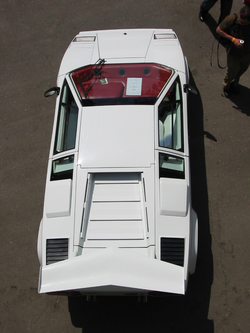
. Gandini was then a young, inexperienced designer—not very experienced in the practical, ergonomic aspects of automobile design, but at the same time unhindered by them. He produced a quite striking design. The Countach shape was wide and low (42.1 inches), but not very long (only 163 inches). Its angular and wedge-shaped body was made almost entirely of flat, trapezoid
al panels.
The doors, a Countach trademark, were scissor doors
: hinged at the front with horizontal hinges, so that the doors lifted up and tilted forwards. The main reason is the car's tubular spaceframe chassis results in very high and wide door sills. It was also partly for style, and partly because the width of the car made conventional doors impossible to use in an even slightly confined space. Care needed to be taken, though, in opening the doors with a low roof overhead. The car's poor rear visibility and wide sills led to drivers adopting a method of reversing the car for parking by opening the door, sitting on the sill, and reversing while looking over the back of the car from outside.
The pure style of the prototype was progressively enhanced or cluttered (depending on one's point of view) by the evolution of the car to improve its performance, handling, tractability, and ability to meet mandated requirements. This began with the first production model, which included several vents which were found to be necessary to cool the engine adequately. These included the iconic NACA duct
on the door and rear fender of each side of the car. The car design changes ended with a large engine vent directly behind the driver, reducing the rear view. Later additions, including fender flares, spoilers, carburetor covers, and bumpers, progressively changed the aesthetic values of the car.
The Countach's styling and visual impression caused it to become an icon of great design to almost everyone except automotive engineers. The superior performance characteristics of later Lamborghini models (such as the Diablo
, or the Murciélago
) appealed to performance car drivers and engineers, but they never had the originality or outrageousness that gave the Countach its distinction. The different impressions left by the various Lamborghini models have generated numerous debates and disagreements over what constitutes 'classic' or 'great' automotive design (elegant looks and style, vs. technical and engineering superiority).
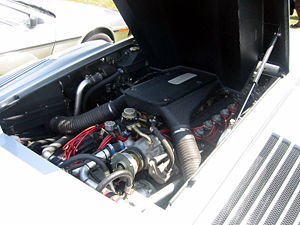 The rear wheels were driven by a traditional Lamborghini V12
engine mounted longitudinally with a mid-engined
configuration. This contrasted with the Miura, on which the centrally mounted engine had been installed transversely. For better weight distribution, the engine is pointed 'backwards'; the output shaft is at the front, and the gearbox is in front of the engine, the driveshaft running back through the engine's
sump to a differential at the rear. Although originally planned as a 5 liter powerplant, the first production cars used the Lamborghini Miura
's 4 liter engine. Later advances increased the displacement to 5 liters and then (in the "Quattrovalvole" model) 5.2 L with four valves per cylinder.
All Lamborghini Countaches were equipped with six Weber carburetors until the arrival of the 5000QV model, at which time the car became available in America, and used Bosch
K-Jetronic fuel injection
. The European models, however, continued to use the carburetors (producing more power than fuel injected cars) until the arrival of the Lamborghini Diablo
, which replaced the legendary Countach.
, as in a racing car. This is expensive to build but is immensely strong and very light (in spite of its size, the car weighs approximately 1400 kg (3,086.5 lb). The underbody tray was fiberglass.
s were added on the sides to give additional air. The experimental car was also constructed of aluminum honeycomb sheeting among other things, which was dropped for production.
The car did not survive; it was sacrificed in a crash test to gain European type approval, even though its construction method was utterly unlike production vehicles.
n in 1974. Externally, little had altered from the final form of the prototype except at the rear, where conventional lights replaced the futuristic light clusters of the prototype. The styling had become rather more aggressive than Gandini's original conception, with the required large air scoops and vents to keep the car from overheating, but the overall shape was still very sleek. The original LP400 rode on the quite narrow tires of the time, but their narrowness and the slick styling meant that this version had the lowest drag coefficient of any Countach model and possibly the highest top speed. The emblems at the rear simply read "lamborghini" and "Countach", with no engine displacement or valve arrangement markings as is found on later cars. By the end of 1977 the company had produced 158 Countach LP400s.
There are three distinct Countach LP400S Series.
Series One — The first 50 cars delivered with Campagnolo "Bravo" wheels in 1978 & 79. The very early 1978 cars had the original LP400 steering wheel. Small Stewart Warner gauges, 45mm carburettors and a lowered suspension (lowbody) setting is a trademark feature of this celebrated first series. Halfway through 1979's production, bigger gauges were employed. 50 cars were built and the last one is noted to be 1121100*
Series Two — These cars are recognized by their smooth finish dished/concave wheels, and still retain the lowbody setting. 105 cars were built and the last one is noted to be 1121310*.
Series Three — It is claimed that from chassis number 1121312 onwards, the cockpit space available was raised by 3 cm. These cars are recognized by their raised suspension setting. 82 cars were built, and the last one is noted to be 1121468*
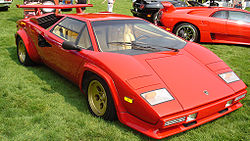 1982 saw another improvement, this time giving a bigger, more powerful 5 litre engine. The bodywork was unaltered. This version of the car is sometimes called the LP5000S, which may cause confusion with the later 5000QV (next section).
For the first time, a US specification model was produced by the factory, with styling changes to allow bumpers to meet US federal standards (large, bulky bumpers were used that, to many people, ruined the smooth lines of the car). Although this change was the most notable on the exterior, the most prominent change under the hood was the use of Bosch
K-Jetronic
fuel injection providing 420 PS, rather than the six Weber carburettors providing 455bhp used in the Euro-spec model. The 1985 US model had a base price close to $100,000. Only two optional extras were available: a $5,500 aerodynamic spoiler and a $7,500 sound system. As for other markets, 1987 and 1988 model Quattrovalvoles received straked sideskirts.
, but they improved the engine's cooling, a problem the Countach had always struggled with. It also featured 345/35R15 tires; the widest tires available on a production car at the time. The Anniversary was produced through 1990 when it was replaced by the Lamborghini Diablo
.
, a wealthy Canadian businessman and owner of the Wolf F1 Racing team
in the 1970s, purchased an LP400; however, he was not satisfied with the LP400's engine and asked Dallara, the chief engineer of Lamborghini at that time and the founder of the Italian F1 racing team Scuderia Italia in the mid 1980s, to create a special high-power version of the Countach. It was the "code NO 1120148" Walter Wolf special with the original "5" engine from the Countach prototype which produced 447 hp / 7900 rpm and reached a supposed maximum speed of 315 km/h (201.1 mph). This model also featured the upgraded wheels, Pirelli P7 tires, large fender flares, and front and rear spoilers of the LP400S model. It was painted in red, with black fender flares, and was designated "LP500S" like the standard Countach model from the 1980s, and was the stepping stone that led to this later production model. This first Walter Wolf car is currently located in Japan. Two other Wolf Countaches were produced, one painted blue, NO 1120202 (currently in Germany) and one navy blue, NO 1121210. (This machine was owned by Mr. Wolf for a long time, but was eventually sold.)
| style="background:#CCCCCC;text-align:center" | prototype
| style="background:#CCCCCC;text-align:center" | LP400
| style="background:#CCCCCC;text-align:center" | LP400S
| style="background:#CCCCCC;text-aligdcasdcascn:center" | LP500S
| style="background:#CCCCCC;text-align:center" | LP5000QV
| style="background:#CCCCCC;text-align:center" | 25 Anniversary
|-
| align="center" | 1
| align="center" | 157
| align="center" | 237
| align="center" | 321
| align="center" | 676
| align="center" | 650
|}>
Substantially more than half were built in the final five years of production, as Lamborghini's new corporate owners increased production.
| style="background:#CCCCCC;text-align:center" | Model
| style="background:#CCCCCC;text-align:center" | Capacity
| style="background:#CCCCCC;text-align:center" | Power
| style="background:#CCCCCC;text-align:center" | Torque
| style="background:#CCCCCC;text-align:center" | Compression ratio
| style="background:#CCCCCC;text-align:center" | Fuel system
|- style="text-align:center"
| Study LP500
| 4971 cc
| 328 kW 446 PS
| 448 Nm @ 5750 rpm
| 10,5:1
| Carburetor
|- style="text-align:center"
| LP400
| 3929 cc
| 276 kW (375 PS)
| 361 Nm @ 5000/min
| 10,5:1
| Carburetor
|- style="text-align:center"
| LP400S
| 3929 cc
| 261 kW (355 PS)
| 356 Nm @ 5000/min
| 10,5:1
| Carburetor
|- style="text-align:center"
| LP500S
| 4754 cc
| 276 kW (375 PS)
| 418 Nm @ 4500/min
| 9,2:1
| Carburetor
|- style="text-align:center"
| LP5000S QV
25 Anniversary
| 5167 cc
| 335 kW (455 PS)
| 500 Nm @ 5200/min
| 9,5:1
| Carburetor
|- style="text-align:center"
| Evoluzione
| 5167 cc
| 360 kW (490 PS)
|
| 9,5:1
| Carburetor
|- style="text-align:center"
| LP500 Turbo S Prototyp
| 4754 cc
| 549 kW (748 PS)
| 876 Nm @ 4500/min
|
| Carburetor with 2 turbochargers
|}>
|- style="background:#cccccc;text-align:center"
! Model > Top speed
Acceleration 0 - 100 km/h
, Canada
began producing and marketing a replica of the Countach. The form for the kit was sculpted from plaster and then a fiberglass mold was made of the form. The kits and cars Ladret Design Studio built included a tube frame chassis with an American V8 power plant. Ladret Design Studio built 141 of these replicas and the industrial clients who purchased his fiberglass forms have built several thousand over the past two decades. As of 2007 there are still several companies building kits based on Ladret's forms built in 1984. In 1993, Ladret ceased manufacturing the Countach replica and moved on to other projects.
From around 1985 until the late 1990s, several companies replicated the Countach with varying degrees of success. In 1985, Gary Thompson and Pete Jackson rented a real Countach from an up-market Manchester car-rental company and made a glass-fiber mold of it. This mold resulted in a number of UK-based manufacturers producing their own Countach replicas. A few were able to produce remarkably good replicas, including Paul Lawrenson of Prova Cars, Alan Booth of Sienna Cars, Phil Cheetham of Mirage Replicas, and Ken Cook of Brightwheel/Classic Replicas. DC Supercars now has Phil Cheetham moulds and is producing Countach replicas.
Mid-engine design
A mid-engine layout describes the placement of an automobile engine between the rear and front axles. Another term for this is mid-ship.-Benefits:The mid-engine layout is typically chosen for its relatively favorable weight distribution...
supercar
Supercar
Supercar is a term used most often to describe an expensive high end car. It has been defined specifically as "a very expensive, fast or powerful car"...
that was produced by Italian automaker Lamborghini
Lamborghini
Automobili Lamborghini S.p.A., commonly referred to as Lamborghini , is an Italian car manufacturer. The company was founded by manufacturing magnate Ferruccio Lamborghini in 1963, with the objective of producing a refined grand touring car to compete with established offerings from marques like...
from 1974 to 1990. Its design both pioneered and popularized the wedge-shaped, sharply angled look popular in many high performance sports cars. The "cabin-forward" design concept, which pushes the passenger compartment forward in order to accommodate a larger engine, was also popularized by the Countach.
In 2004, American car magazine Sports Car International
Sports Car International
Sports Car International was an automobile magazine in the United States published by Ross Periodicals Inc. that was focused on sports cars. The magazine was published from 1986 to 2008. Its business offices were located in Novato, California....
named this car number three on the list of Top Sports Cars of the 1970s, and it was listed as number ten on their list of Top Sports Cars of the 1980s.
Name
The word countach is an exclamation of astonishment in the local Piedmontese languagePiedmontese language
Piedmontese is a Romance language spoken by over 2 million people in Piedmont, northwest Italy. It is geographically and linguistically included in the Northern Italian group . It is part of the wider western group of Romance languages, including French, Occitan, and Catalan.Many European and...
— generally used by men on seeing an extremely beautiful woman.
The Countach name stuck when Nuccio Bertone
Nuccio Bertone
Giuseppe Bertone, called "Nuccio", was a famed automobile designer and constructor...
first saw "Project 112" in his studio. The prototype was introduced to the world at the 1971 Geneva Motor Show. Most previous and subsequent Lamborghini car names were associated with bulls and bullfighting
Bullfighting
Bullfighting is a traditional spectacle of Spain, Portugal, southern France and some Latin American countries , in which one or more bulls are baited in a bullring for sport and entertainment...
.
Styling
Marcello Gandini
Marcello Gandini is an Italian car designer, widely known for his work with the automotive design house Gruppo Bertone, notably his design of the Lamborghini Countach. Together with Giorgetto Giugiaro and Leonardo Fioravanti, Gandini forms a noted triumvirate of Italian car designers, all born in...
of the Bertone design studio, the same designer and studio that designed the Miura
Lamborghini Miura
The Lamborghini Miura was a sports car produced by Italian automaker Lamborghini between 1966 and 1972. The car is widely considered to have begun the trend of high performance, two-seater, mid-engined sports cars...
. Gandini was then a young, inexperienced designer—not very experienced in the practical, ergonomic aspects of automobile design, but at the same time unhindered by them. He produced a quite striking design. The Countach shape was wide and low (42.1 inches), but not very long (only 163 inches). Its angular and wedge-shaped body was made almost entirely of flat, trapezoid
Trapezoid
In Euclidean geometry, a convex quadrilateral with one pair of parallel sides is referred to as a trapezoid in American English and as a trapezium in English outside North America. A trapezoid with vertices ABCD is denoted...
al panels.
The doors, a Countach trademark, were scissor doors
Scissor doors
Scissor doors are automobile doors that rotate vertically at a fixed hinge at the front of the door, rather than outwardly as with a conventional door.- History :The first vehicle to feature scissor doors was the 1968 Alfa Romeo Carabo concept car, designed...
: hinged at the front with horizontal hinges, so that the doors lifted up and tilted forwards. The main reason is the car's tubular spaceframe chassis results in very high and wide door sills. It was also partly for style, and partly because the width of the car made conventional doors impossible to use in an even slightly confined space. Care needed to be taken, though, in opening the doors with a low roof overhead. The car's poor rear visibility and wide sills led to drivers adopting a method of reversing the car for parking by opening the door, sitting on the sill, and reversing while looking over the back of the car from outside.
The pure style of the prototype was progressively enhanced or cluttered (depending on one's point of view) by the evolution of the car to improve its performance, handling, tractability, and ability to meet mandated requirements. This began with the first production model, which included several vents which were found to be necessary to cool the engine adequately. These included the iconic NACA duct
NACA duct
A NACA duct also sometimes called a NACA scoop or NACA Inlet, is a common form of low-drag air inlet design, originally developed by the U.S. National Advisory Committee for Aeronautics , the precursor to NASA, in 1945....
on the door and rear fender of each side of the car. The car design changes ended with a large engine vent directly behind the driver, reducing the rear view. Later additions, including fender flares, spoilers, carburetor covers, and bumpers, progressively changed the aesthetic values of the car.
The Countach's styling and visual impression caused it to become an icon of great design to almost everyone except automotive engineers. The superior performance characteristics of later Lamborghini models (such as the Diablo
Lamborghini Diablo
The Lamborghini Diablo is a high-performance mid-engined sports car that was built by Italian automaker Lamborghini between 1990 and 2001. It was the first Lamborghini capable of attaining a top speed in excess of . After the end of its production run in 2001, the Diablo was replaced by the...
, or the Murciélago
Lamborghini Murciélago
The Lamborghini Murciélago is a two-door, two-seat sports car produced by Italian automaker Lamborghini between 2001 and 2010. Successor to the Diablo and flagship of the automaker's lineup, the Murciélago was introduced as a coupé in 2001. The automaker's first new design in eleven years, the car...
) appealed to performance car drivers and engineers, but they never had the originality or outrageousness that gave the Countach its distinction. The different impressions left by the various Lamborghini models have generated numerous debates and disagreements over what constitutes 'classic' or 'great' automotive design (elegant looks and style, vs. technical and engineering superiority).
Engine
Lamborghini V12
The Lamborghini V12 is a sixty degree V12 petrol engine designed by Lamborghini, and was the first internal combustion engine ever produced by the firm....
engine mounted longitudinally with a mid-engined
Mid-engine design
A mid-engine layout describes the placement of an automobile engine between the rear and front axles. Another term for this is mid-ship.-Benefits:The mid-engine layout is typically chosen for its relatively favorable weight distribution...
configuration. This contrasted with the Miura, on which the centrally mounted engine had been installed transversely. For better weight distribution, the engine is pointed 'backwards'; the output shaft is at the front, and the gearbox is in front of the engine, the driveshaft running back through the engine's
Internal combustion engine
The internal combustion engine is an engine in which the combustion of a fuel occurs with an oxidizer in a combustion chamber. In an internal combustion engine, the expansion of the high-temperature and high -pressure gases produced by combustion apply direct force to some component of the engine...
sump to a differential at the rear. Although originally planned as a 5 liter powerplant, the first production cars used the Lamborghini Miura
Lamborghini Miura
The Lamborghini Miura was a sports car produced by Italian automaker Lamborghini between 1966 and 1972. The car is widely considered to have begun the trend of high performance, two-seater, mid-engined sports cars...
's 4 liter engine. Later advances increased the displacement to 5 liters and then (in the "Quattrovalvole" model) 5.2 L with four valves per cylinder.
All Lamborghini Countaches were equipped with six Weber carburetors until the arrival of the 5000QV model, at which time the car became available in America, and used Bosch
Robert Bosch GmbH
Robert Bosch GmbH is a multinational engineering and electronics company headquartered in Gerlingen, near Stuttgart, Germany. It is the world's largest supplier of automotive components...
K-Jetronic fuel injection
Fuel injection
Fuel injection is a system for admitting fuel into an internal combustion engine. It has become the primary fuel delivery system used in automotive petrol engines, having almost completely replaced carburetors in the late 1980s....
. The European models, however, continued to use the carburetors (producing more power than fuel injected cars) until the arrival of the Lamborghini Diablo
Lamborghini Diablo
The Lamborghini Diablo is a high-performance mid-engined sports car that was built by Italian automaker Lamborghini between 1990 and 2001. It was the first Lamborghini capable of attaining a top speed in excess of . After the end of its production run in 2001, the Diablo was replaced by the...
, which replaced the legendary Countach.
Construction
The Countach used a skin of aircraft-grade aluminium over a tubular space frameSpace frame
A space frame or space structure is a truss-like, lightweight rigid structure constructed from interlocking struts in a geometric pattern. Space frames can be used to span large areas with few interior supports...
, as in a racing car. This is expensive to build but is immensely strong and very light (in spite of its size, the car weighs approximately 1400 kg (3,086.5 lb). The underbody tray was fiberglass.
Prototype LP500
A single prototype was built, the LP500 (the 500 standing for the 5 L displacement of the engine which was intended to be used). Painted bright sunflower yellow, the car was a stunner at the Geneva Motor Show in 1971. Sporting Gandini's original design concepts, the car's design needed extensive modification for production. In particular, the small air intake ducts on the car's rear shoulders proved insufficient to cool the engine, and large 'air box' scoops were added in that position. Large NACA ductNACA duct
A NACA duct also sometimes called a NACA scoop or NACA Inlet, is a common form of low-drag air inlet design, originally developed by the U.S. National Advisory Committee for Aeronautics , the precursor to NASA, in 1945....
s were added on the sides to give additional air. The experimental car was also constructed of aluminum honeycomb sheeting among other things, which was dropped for production.
The car did not survive; it was sacrificed in a crash test to gain European type approval, even though its construction method was utterly unlike production vehicles.
LP400
The Countach entered production as the LP400 with a 4.0-litre (3929 cc) 375 PS engine. The first production Countach was delivered to an AustraliaAustralia
Australia , officially the Commonwealth of Australia, is a country in the Southern Hemisphere comprising the mainland of the Australian continent, the island of Tasmania, and numerous smaller islands in the Indian and Pacific Oceans. It is the world's sixth-largest country by total area...
n in 1974. Externally, little had altered from the final form of the prototype except at the rear, where conventional lights replaced the futuristic light clusters of the prototype. The styling had become rather more aggressive than Gandini's original conception, with the required large air scoops and vents to keep the car from overheating, but the overall shape was still very sleek. The original LP400 rode on the quite narrow tires of the time, but their narrowness and the slick styling meant that this version had the lowest drag coefficient of any Countach model and possibly the highest top speed. The emblems at the rear simply read "lamborghini" and "Countach", with no engine displacement or valve arrangement markings as is found on later cars. By the end of 1977 the company had produced 158 Countach LP400s.
LP400S
In 1978, a new LP400S model was introduced. Though the engine was slightly downgraded from the LP400 model (355 PS), the most radical changes were in the exterior, where the tires were replaced with much wider Pirelli P7 units, and fiberglass wheel arch extensions were added, giving the car the fundamental look it kept until the end of its production run. An optional V-shaped spoiler was available over the rear deck, which, while improving high-speed stability, reduced the top speed by at least 10 MPH. Most owners ordered the wing. The handling of the LP400S was improved by the wider tires which made the car more stable in cornering. Aesthetically, some prefer the slick lines of the original while others prefer the more aggressive lines of the later models, beginning with the LP400S. The standard emblems ("Lamborghini" and "Countach") were kept at the rear, but an angular "S" emblem was added after the "Countach" on the right side.There are three distinct Countach LP400S Series.
Series One — The first 50 cars delivered with Campagnolo "Bravo" wheels in 1978 & 79. The very early 1978 cars had the original LP400 steering wheel. Small Stewart Warner gauges, 45mm carburettors and a lowered suspension (lowbody) setting is a trademark feature of this celebrated first series. Halfway through 1979's production, bigger gauges were employed. 50 cars were built and the last one is noted to be 1121100*
Series Two — These cars are recognized by their smooth finish dished/concave wheels, and still retain the lowbody setting. 105 cars were built and the last one is noted to be 1121310*.
Series Three — It is claimed that from chassis number 1121312 onwards, the cockpit space available was raised by 3 cm. These cars are recognized by their raised suspension setting. 82 cars were built, and the last one is noted to be 1121468*
LP500S
5000QV
In 1985 the engine was improved again, bored and stroked to 5.2 litres (5,167 cc) and given four valves per cylinder (quattrovalvole in Italian). The carburettors were moved from the sides to the top of the engine for better breathing — unfortunately this created a hump on the engine deck, reducing the already poor rear visibility to almost nothing. Some body panels were also replaced by Kevlar. In later versions of the engine, the carburettors were replaced with fuel-injection.For the first time, a US specification model was produced by the factory, with styling changes to allow bumpers to meet US federal standards (large, bulky bumpers were used that, to many people, ruined the smooth lines of the car). Although this change was the most notable on the exterior, the most prominent change under the hood was the use of Bosch
Robert Bosch GmbH
Robert Bosch GmbH is a multinational engineering and electronics company headquartered in Gerlingen, near Stuttgart, Germany. It is the world's largest supplier of automotive components...
K-Jetronic
Jetronic
Jetronic is a trade name of an fuel injection technology for automotive petrol engines, developed and marketed by Robert Bosch GmbH from the 1960s onwards. Bosch licensed the concept to many automobile manufacturers. There are several variations of the technology offering technological development...
fuel injection providing 420 PS, rather than the six Weber carburettors providing 455bhp used in the Euro-spec model. The 1985 US model had a base price close to $100,000. Only two optional extras were available: a $5,500 aerodynamic spoiler and a $7,500 sound system. As for other markets, 1987 and 1988 model Quattrovalvoles received straked sideskirts.
25th Anniversary Countach
Named to honor the company's twenty-fifth anniversary, in 1988, the 25th Anniversary Countach was mechanically very similar to the 5000QV but sported much changed styling. The rear 'air boxes' were restyled and enlarged, while the vents behind them were changed so that they ran front to back instead of side to side. In addition, a new air dam and side skirting, both with air intakes, were fitted, and the taillights were restyled to be narrower, with body-colored panels replacing the upper and lower parts of the previous large taillights. The styling changes were unpopular with many, particularly since the intakes had strakes in them that appeared to mimic those on the Ferrari TestarossaFerrari Testarossa
The Ferrari Testarossa is a 12-cylinder mid-engine sports car manufactured by Ferrari, which went into production in 1984 as the successor to the Ferrari Berlinetta Boxer...
, but they improved the engine's cooling, a problem the Countach had always struggled with. It also featured 345/35R15 tires; the widest tires available on a production car at the time. The Anniversary was produced through 1990 when it was replaced by the Lamborghini Diablo
Lamborghini Diablo
The Lamborghini Diablo is a high-performance mid-engined sports car that was built by Italian automaker Lamborghini between 1990 and 2001. It was the first Lamborghini capable of attaining a top speed in excess of . After the end of its production run in 2001, the Diablo was replaced by the...
.
Walter Wolf Countach
In 1975, Walter WolfWalter Wolf (industrialist)
Walter Wolf is a Canadian oil-drilling equipment supplier who in the early 1970s made a fortune from the North Sea oil business and decided to join the world of Formula One motor racing....
, a wealthy Canadian businessman and owner of the Wolf F1 Racing team
Walter Wolf Racing
Walter Wolf Racing was a Formula One constructor from 1977 to 1980, notable for winning the very first race the team entered.-1975-77:In 1975, the Slovenian-Austrian-Canadian businessman Walter Wolf had started to appear at many of the F1 races during the season. A year later, he bought 60% of...
in the 1970s, purchased an LP400; however, he was not satisfied with the LP400's engine and asked Dallara, the chief engineer of Lamborghini at that time and the founder of the Italian F1 racing team Scuderia Italia in the mid 1980s, to create a special high-power version of the Countach. It was the "code NO 1120148" Walter Wolf special with the original "5" engine from the Countach prototype which produced 447 hp / 7900 rpm and reached a supposed maximum speed of 315 km/h (201.1 mph). This model also featured the upgraded wheels, Pirelli P7 tires, large fender flares, and front and rear spoilers of the LP400S model. It was painted in red, with black fender flares, and was designated "LP500S" like the standard Countach model from the 1980s, and was the stepping stone that led to this later production model. This first Walter Wolf car is currently located in Japan. Two other Wolf Countaches were produced, one painted blue, NO 1120202 (currently in Germany) and one navy blue, NO 1121210. (This machine was owned by Mr. Wolf for a long time, but was eventually sold.)
Production figures
A total of 2,042 cars were built during the Countach's sixteen year lifetime:| style="background:#CCCCCC;text-align:center" | LP400
| style="background:#CCCCCC;text-align:center" | LP400S
| style="background:#CCCCCC;text-aligdcasdcascn:center" | LP500S
| style="background:#CCCCCC;text-align:center" | LP5000QV
| style="background:#CCCCCC;text-align:center" | 25 Anniversary
|-
| align="center" | 1
| align="center" | 157
| align="center" | 237
| align="center" | 321
| align="center" | 676
| align="center" | 650
|}>
Substantially more than half were built in the final five years of production, as Lamborghini's new corporate owners increased production.
Engine data
| style="background:#CCCCCC;text-align:center" | Capacity
| style="background:#CCCCCC;text-align:center" | Power
| style="background:#CCCCCC;text-align:center" | Torque
| style="background:#CCCCCC;text-align:center" | Compression ratio
| style="background:#CCCCCC;text-align:center" | Fuel system
|- style="text-align:center"
| Study LP500
| 4971 cc
| 328 kW 446 PS
| 448 Nm @ 5750 rpm
| 10,5:1
| Carburetor
Carburetor
A carburetor , carburettor, or carburetter is a device that blends air and fuel for an internal combustion engine. It is sometimes shortened to carb in North America and the United Kingdom....
|- style="text-align:center"
| LP400
| 3929 cc
| 276 kW (375 PS)
| 361 Nm @ 5000/min
| 10,5:1
| Carburetor
|- style="text-align:center"
| LP400S
| 3929 cc
| 261 kW (355 PS)
| 356 Nm @ 5000/min
| 10,5:1
| Carburetor
|- style="text-align:center"
| LP500S
| 4754 cc
| 276 kW (375 PS)
| 418 Nm @ 4500/min
| 9,2:1
| Carburetor
|- style="text-align:center"
| LP5000S QV
25 Anniversary
| 5167 cc
| 335 kW (455 PS)
| 500 Nm @ 5200/min
| 9,5:1
| Carburetor
|- style="text-align:center"
| Evoluzione
| 5167 cc
| 360 kW (490 PS)
|
| 9,5:1
| Carburetor
|- style="text-align:center"
| LP500 Turbo S Prototyp
| 4754 cc
| 549 kW (748 PS)
| 876 Nm @ 4500/min
|
| Carburetor with 2 turbochargers
|}>
Driving performance, fuel consumption, weight
! Model >
Countach replicas
In 1984, Rod Ladret of Ladret Design Studio located in AlbertaAlberta
Alberta is a province of Canada. It had an estimated population of 3.7 million in 2010 making it the most populous of Canada's three prairie provinces...
, Canada
Canada
Canada is a North American country consisting of ten provinces and three territories. Located in the northern part of the continent, it extends from the Atlantic Ocean in the east to the Pacific Ocean in the west, and northward into the Arctic Ocean...
began producing and marketing a replica of the Countach. The form for the kit was sculpted from plaster and then a fiberglass mold was made of the form. The kits and cars Ladret Design Studio built included a tube frame chassis with an American V8 power plant. Ladret Design Studio built 141 of these replicas and the industrial clients who purchased his fiberglass forms have built several thousand over the past two decades. As of 2007 there are still several companies building kits based on Ladret's forms built in 1984. In 1993, Ladret ceased manufacturing the Countach replica and moved on to other projects.
From around 1985 until the late 1990s, several companies replicated the Countach with varying degrees of success. In 1985, Gary Thompson and Pete Jackson rented a real Countach from an up-market Manchester car-rental company and made a glass-fiber mold of it. This mold resulted in a number of UK-based manufacturers producing their own Countach replicas. A few were able to produce remarkably good replicas, including Paul Lawrenson of Prova Cars, Alan Booth of Sienna Cars, Phil Cheetham of Mirage Replicas, and Ken Cook of Brightwheel/Classic Replicas. DC Supercars now has Phil Cheetham moulds and is producing Countach replicas.