

Chrysopidae

Encyclopedia
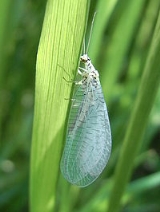
Green lacewings are insect
s in the large family
Chrysopidae of the order
Neuroptera
. There are about 85 genera
and (differing between sources) 1,300–2,000 species
in this widespread group. Members of the genera Chrysopa
and Chrysoperla
are very common in North America
and Europe
; they are very similar and many of their species have been moved from one genus to the other time and again, and in the non-scientific literature assignment to Chrysopa and Chrysoperla can rarely be relied upon. Since they are the most familiar neuropterids to many people, they are often simply called "lacewings". But actually most of the diversity of Neuroptera are properly referred to as some sort of "lacewing", so common lacewings is preferable.
en in many species. The wings are usually translucent with a slight iridescence; some have green wing veins or a cloudy brownish wing pattern. The vernacular name "stinkflies", used chiefly for Chrysopa
species but also for others (e.g. Cunctochrysa) refers to their ability to release a vile smell from paired prothoracal
glands when handled.
Adults have tympanal organ
s at the forewings' base, enabling them to hear well. Some Chrysopa show evasive behavior when they hear a bat
's ultrasound
calls: when in flight, they close their wings (making their echolocation
al signature smaller) and drop down to the ground. Green lacewings also use substrate or body vibrations as a form of communication between themselves, especially during courtship. Species which are nearly identical morphologically
may sometimes be separated more easily based on their mating signals. For example the southern European Chrysoperla mediterranea looks almost identical to its northern relative C. carnea (Common Green Lacewing), but their courtship "songs" are very different; individuals of one species will not react to the other's vibrations.
Adults are crepuscular
or nocturnal. They feed on pollen
, nectar and honeydew
supplemented with mite
s, aphids and other small arthropod
s, and some, namely Chrysopa, are mainly predatory. Others feed almost exclusively on nectar and similar substances, and have symbiotic yeast
s in their digestive tract to help break down the food into nutrient
s.
Larva
e have either a more slender "humpback
ed" shape with a prominent bulge on the thorax
, or are plumper, with long bristles jutting out from the sides. These bristles will collect debris and food remains – the empty integuments of aphid
s, most notably – that provide camouflage
from birds.
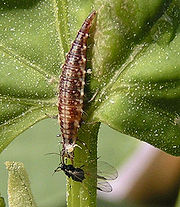 Eggs are deposited at night, singly or in small groups; one female produces some 100–200 eggs. Eggs are placed on plants, usually where aphid
s are present nearby in numbers. Each egg is hung on a slender stalk about 1 cm long, usually on the underside of a leaf. Immediately after hatching, the larvae moult
, then ascend the egg stalk to feed. They are voracious predators, attacking most insects of suitable size, especially soft-bodied ones (aphids, caterpillars and other insect larva
e, insect eggs, and at high population densities also each other). Therefore, the larvae are colloquially known as "aphid lions" (also spelled "aphidlions") or "aphid wolves", similar to the related antlion
s. Their senses are weakly developed, except that they are very sensitive to touch. Walking around in a haphazard fashion, the larvae sway their heads from one side to the other, and when they strike a potential prey object, the larva grasps it. Their maxilla
e are hollow, allowing a digestive secretion to be injected in the prey; the organs of an aphid can for example be dissolved by this in 90 seconds. Depending on environmental conditions, larvae need about 1–3 weeks to pupation which takes place in a cocoon; species from temperate
regions usually overwinter as a prepupa, though C. carnea overwinters as newly-hatched adults.
of insect and mite
pests in agriculture and gardens. They are distributed as eggs, since as noted above they are highly aggressive and cannibalistic in confined quarters; the eggs hatch in the field. Their performance is variable; thus, there is a lot of interest in further research to improve the use of green lacewings as biological pest control
. Species that have hitherto attracted wider study and are more or less readily available as captive-bred eggs to deposit out for hatching in pest-infested plant cultures are several members of Chrysoperla
as well as Mallada signatus.
Gardeners can attract these lacewings – and therefore ensure a steady supply of larvae – by using certain companion plants and tolerating beneficial weed
s. Chrysopidae are attracted mainly by Asteraceae
– e.g. calliopsis (Coreopsis), cosmos (Cosmos), sunflower
s (Helianthus) and dandelion (Taraxacum) – and Apiaceae
such as dill
(Anethum) or angelica
(Angelica).
) and brown lacewings (Hemerobiidae
) and placed in the superfamily
Hemerobioidea. But this grouping does not appear to be natural and misled most significantly by the supposed hemerobioideans' plesiomorphic larva
e. Today, the Hemerobioidea are usually considered monotypic
, containing only the brown lacewings; the green lacewings seem to be very closely related to the osmylids (Osmylidae
), which have much more advanced larvae superficially resembling those of the spongillaflies (Sisyridae
) with which the spongillaflies were thus formerly allied. Thus the superfamily Osmyloidea – also monotypic following the spongillaflies' removal from there – is the closet living relative of green lacewings; some Mesozoic
taxa have been placed in families even closer to Chrysopidae (Ascalochrysidae and Mesochrysopidae) and united with these to superfamily Chrysopoidea.
Subfamily Apochrysinae Handlirsch, 1908
Subfamily Chrysopinae
Subfamily Nothochrysinae Navas, 1910
Incertae sedis
Compared to other Neuroptera, which have an extensive, sometimes extremely abundant, fossil record, green lacewings are not known from that many fossils, and these are not generally well-studied. Their prehistoric relatives mentioned above, however, indicate that at least the basal radiation of the Chrysopoidea must have happened in the Jurassic
already, if not earlier.
Insect
Insects are a class of living creatures within the arthropods that have a chitinous exoskeleton, a three-part body , three pairs of jointed legs, compound eyes, and two antennae...
s in the large family
Family (biology)
In biological classification, family is* a taxonomic rank. Other well-known ranks are life, domain, kingdom, phylum, class, order, genus, and species, with family fitting between order and genus. As for the other well-known ranks, there is the option of an immediately lower rank, indicated by the...
Chrysopidae of the order
Order (biology)
In scientific classification used in biology, the order is# a taxonomic rank used in the classification of organisms. Other well-known ranks are life, domain, kingdom, phylum, class, family, genus, and species, with order fitting in between class and family...
Neuroptera
Neuroptera
The insect order Neuroptera, or net-winged insects, includes the lacewings, mantidflies, antlions, and their relatives. The order contains some 6,010 species...
. There are about 85 genera
Genera
Genera is a commercial operating system and development environment for Lisp machines developed by Symbolics. It is essentially a fork of an earlier operating system originating on the MIT AI Lab's Lisp machines which Symbolics had used in common with LMI and Texas Instruments...
and (differing between sources) 1,300–2,000 species
Species
In biology, a species is one of the basic units of biological classification and a taxonomic rank. A species is often defined as a group of organisms capable of interbreeding and producing fertile offspring. While in many cases this definition is adequate, more precise or differing measures are...
in this widespread group. Members of the genera Chrysopa
Chrysopa
Chrysopa is a genus of green lacewings in the insect family Chrysopidae in the order Neuroptera.Members of this genus and the genus Chrysoperla are common in much of North America, Europe and Asia. They share similar characteristics and some species have been moved from one genus to the other and...
and Chrysoperla
Chrysoperla
Chrysoperla is a genus of green lacewings in the insect family Chrysopidae in the order Neuroptera. Therein they belong to the Chrysopini, the largest tribe of subfamily Chrysopinae....
are very common in North America
North America
North America is a continent wholly within the Northern Hemisphere and almost wholly within the Western Hemisphere. It is also considered a northern subcontinent of the Americas...
and Europe
Europe
Europe is, by convention, one of the world's seven continents. Comprising the westernmost peninsula of Eurasia, Europe is generally 'divided' from Asia to its east by the watershed divides of the Ural and Caucasus Mountains, the Ural River, the Caspian and Black Seas, and the waterways connecting...
; they are very similar and many of their species have been moved from one genus to the other time and again, and in the non-scientific literature assignment to Chrysopa and Chrysoperla can rarely be relied upon. Since they are the most familiar neuropterids to many people, they are often simply called "lacewings". But actually most of the diversity of Neuroptera are properly referred to as some sort of "lacewing", so common lacewings is preferable.
Description and ecology
Green lacewings are delicate insects with a wingspan of 6 to over 65 mm, though the largest forms are tropical. They are characterized by a wide costal field in their wing venation, which includes the cross-veins. The bodies are usually bright green to greenish-brown, and the compound eyes are conspicuously goldGold
Gold is a chemical element with the symbol Au and an atomic number of 79. Gold is a dense, soft, shiny, malleable and ductile metal. Pure gold has a bright yellow color and luster traditionally considered attractive, which it maintains without oxidizing in air or water. Chemically, gold is a...
en in many species. The wings are usually translucent with a slight iridescence; some have green wing veins or a cloudy brownish wing pattern. The vernacular name "stinkflies", used chiefly for Chrysopa
Chrysopa
Chrysopa is a genus of green lacewings in the insect family Chrysopidae in the order Neuroptera.Members of this genus and the genus Chrysoperla are common in much of North America, Europe and Asia. They share similar characteristics and some species have been moved from one genus to the other and...
species but also for others (e.g. Cunctochrysa) refers to their ability to release a vile smell from paired prothoracal
Prothorax
The prothorax is the foremost of the three segments in the thorax of an insect, and bears the first pair of legs. Its principal sclerites are the pronotum , the prosternum , and the propleuron on each side. The prothorax never bears wings in extant insects, though some fossil groups possessed...
glands when handled.
Adults have tympanal organ
Tympanal organ
A tympanal organ is a hearing organ in insects, consisting of a membrane stretched across a frame backed by an air sac and associated sensory neurons...
s at the forewings' base, enabling them to hear well. Some Chrysopa show evasive behavior when they hear a bat
Bat
Bats are mammals of the order Chiroptera "hand" and pteron "wing") whose forelimbs form webbed wings, making them the only mammals naturally capable of true and sustained flight. By contrast, other mammals said to fly, such as flying squirrels, gliding possums, and colugos, glide rather than fly,...
's ultrasound
Ultrasound
Ultrasound is cyclic sound pressure with a frequency greater than the upper limit of human hearing. Ultrasound is thus not separated from "normal" sound based on differences in physical properties, only the fact that humans cannot hear it. Although this limit varies from person to person, it is...
calls: when in flight, they close their wings (making their echolocation
Animal echolocation
Echolocation, also called biosonar, is the biological sonar used by several kinds of animals.Echolocating animals emit calls out to the environment and listen to the echoes of those calls that return from various objects near them. They use these echoes to locate and identify the objects...
al signature smaller) and drop down to the ground. Green lacewings also use substrate or body vibrations as a form of communication between themselves, especially during courtship. Species which are nearly identical morphologically
Morphology (biology)
In biology, morphology is a branch of bioscience dealing with the study of the form and structure of organisms and their specific structural features....
may sometimes be separated more easily based on their mating signals. For example the southern European Chrysoperla mediterranea looks almost identical to its northern relative C. carnea (Common Green Lacewing), but their courtship "songs" are very different; individuals of one species will not react to the other's vibrations.
Adults are crepuscular
Crepuscular
Crepuscular animals are those that are active primarily during twilight, that is during dawn and dusk. The word is derived from the Latin word crepusculum, meaning "twilight." Crepuscular is, thus, in contrast with diurnal and nocturnal behavior. Crepuscular animals may also be active on a bright...
or nocturnal. They feed on pollen
Pollen
Pollen is a fine to coarse powder containing the microgametophytes of seed plants, which produce the male gametes . Pollen grains have a hard coat that protects the sperm cells during the process of their movement from the stamens to the pistil of flowering plants or from the male cone to the...
, nectar and honeydew
Honeydew (melon)
Honeydew is a cultivar group of the muskmelon, Cucumis melo Inodorus group, which includes crenshaw, casaba, Persian, winter, and other mixed melons.-Characteristics:...
supplemented with mite
Mite
Mites, along with ticks, are small arthropods belonging to the subclass Acari and the class Arachnida. The scientific discipline devoted to the study of ticks and mites is called acarology.-Diversity and systematics:...
s, aphids and other small arthropod
Arthropod
An arthropod is an invertebrate animal having an exoskeleton , a segmented body, and jointed appendages. Arthropods are members of the phylum Arthropoda , and include the insects, arachnids, crustaceans, and others...
s, and some, namely Chrysopa, are mainly predatory. Others feed almost exclusively on nectar and similar substances, and have symbiotic yeast
Yeast
Yeasts are eukaryotic micro-organisms classified in the kingdom Fungi, with 1,500 species currently described estimated to be only 1% of all fungal species. Most reproduce asexually by mitosis, and many do so by an asymmetric division process called budding...
s in their digestive tract to help break down the food into nutrient
Nutrient
A nutrient is a chemical that an organism needs to live and grow or a substance used in an organism's metabolism which must be taken in from its environment. They are used to build and repair tissues, regulate body processes and are converted to and used as energy...
s.
Larva
Larva
A larva is a distinct juvenile form many animals undergo before metamorphosis into adults. Animals with indirect development such as insects, amphibians, or cnidarians typically have a larval phase of their life cycle...
e have either a more slender "humpback
Humpback
Humpback may refer to:* Humpback whale* Humpback dolphin* Humpback salmon* Humpback bridge* Humpback, a variant of hunchback...
ed" shape with a prominent bulge on the thorax
Thorax (insect anatomy)
The thorax is the mid section of the insect body. It holds the head, legs, wings and abdomen. It is also called mesosoma in other arthropods....
, or are plumper, with long bristles jutting out from the sides. These bristles will collect debris and food remains – the empty integuments of aphid
Aphid
Aphids, also known as plant lice and in Britain and the Commonwealth as greenflies, blackflies or whiteflies, are small sap sucking insects, and members of the superfamily Aphidoidea. Aphids are among the most destructive insect pests on cultivated plants in temperate regions...
s, most notably – that provide camouflage
Camouflage
Camouflage is a method of concealment that allows an otherwise visible animal, military vehicle, or other object to remain unnoticed, by blending with its environment. Examples include a leopard's spotted coat, the battledress of a modern soldier and a leaf-mimic butterfly...
from birds.
Aphid
Aphids, also known as plant lice and in Britain and the Commonwealth as greenflies, blackflies or whiteflies, are small sap sucking insects, and members of the superfamily Aphidoidea. Aphids are among the most destructive insect pests on cultivated plants in temperate regions...
s are present nearby in numbers. Each egg is hung on a slender stalk about 1 cm long, usually on the underside of a leaf. Immediately after hatching, the larvae moult
Moult
In biology, moulting or molting , also known as sloughing, shedding, or for some species, ecdysis, is the manner in which an animal routinely casts off a part of its body , either at specific times of year, or at specific points in its life cycle.Moulting can involve the epidermis , pelage...
, then ascend the egg stalk to feed. They are voracious predators, attacking most insects of suitable size, especially soft-bodied ones (aphids, caterpillars and other insect larva
Larva
A larva is a distinct juvenile form many animals undergo before metamorphosis into adults. Animals with indirect development such as insects, amphibians, or cnidarians typically have a larval phase of their life cycle...
e, insect eggs, and at high population densities also each other). Therefore, the larvae are colloquially known as "aphid lions" (also spelled "aphidlions") or "aphid wolves", similar to the related antlion
Antlion
Antlions are a group of insects in the family Myrmeleontidae . The most well-known genus is Myrmeleo. There are about 2,000 species...
s. Their senses are weakly developed, except that they are very sensitive to touch. Walking around in a haphazard fashion, the larvae sway their heads from one side to the other, and when they strike a potential prey object, the larva grasps it. Their maxilla
Insect mouthparts
Insects exhibit a range of mouthparts, adapted to particular modes of feeding. The earliest insects had chewing mouthparts...
e are hollow, allowing a digestive secretion to be injected in the prey; the organs of an aphid can for example be dissolved by this in 90 seconds. Depending on environmental conditions, larvae need about 1–3 weeks to pupation which takes place in a cocoon; species from temperate
Temperate
In geography, temperate or tepid latitudes of the globe lie between the tropics and the polar circles. The changes in these regions between summer and winter are generally relatively moderate, rather than extreme hot or cold...
regions usually overwinter as a prepupa, though C. carnea overwinters as newly-hatched adults.
Use in biological pest control
While depending on species and environmental conditions, some green lacewings will eat only about 150 prey items in their entire life, in other cases 100 aphids will be eaten in a single week. Thus, in several countries, millions of such voracious Chrysopidae are reared for sale as biological control agentsBiological pest control
Biological control of pests in agriculture is a method of controlling pests that relies on predation, parasitism, herbivory, or other natural mechanisms...
of insect and mite
Mite
Mites, along with ticks, are small arthropods belonging to the subclass Acari and the class Arachnida. The scientific discipline devoted to the study of ticks and mites is called acarology.-Diversity and systematics:...
pests in agriculture and gardens. They are distributed as eggs, since as noted above they are highly aggressive and cannibalistic in confined quarters; the eggs hatch in the field. Their performance is variable; thus, there is a lot of interest in further research to improve the use of green lacewings as biological pest control
Biological pest control
Biological control of pests in agriculture is a method of controlling pests that relies on predation, parasitism, herbivory, or other natural mechanisms...
. Species that have hitherto attracted wider study and are more or less readily available as captive-bred eggs to deposit out for hatching in pest-infested plant cultures are several members of Chrysoperla
Chrysoperla
Chrysoperla is a genus of green lacewings in the insect family Chrysopidae in the order Neuroptera. Therein they belong to the Chrysopini, the largest tribe of subfamily Chrysopinae....
as well as Mallada signatus.
Gardeners can attract these lacewings – and therefore ensure a steady supply of larvae – by using certain companion plants and tolerating beneficial weed
Beneficial weed
|thumb|right|Clover was once included in grass seed mixes, because of its great benefits to yard healthA beneficial weed is any of various plants not generally considered domesticated, but which nonetheless has some companion plant effect, or else is edible or somehow beneficial...
s. Chrysopidae are attracted mainly by Asteraceae
Asteraceae
The Asteraceae or Compositae , is an exceedingly large and widespread family of vascular plants. The group has more than 22,750 currently accepted species, spread across 1620 genera and 12 subfamilies...
– e.g. calliopsis (Coreopsis), cosmos (Cosmos), sunflower
Sunflower
Sunflower is an annual plant native to the Americas. It possesses a large inflorescence . The sunflower got its name from its huge, fiery blooms, whose shape and image is often used to depict the sun. The sunflower has a rough, hairy stem, broad, coarsely toothed, rough leaves and circular heads...
s (Helianthus) and dandelion (Taraxacum) – and Apiaceae
Apiaceae
The Apiaceae , commonly known as carrot or parsley family, is a group of mostly aromatic plants with hollow stems. The family is large, with more than 3,700 species spread across 434 genera, it is the sixteenth largest family of flowering plants...
such as dill
Dill
Dill is a perennial herb. It is the sole species of the genus Anethum, though classified by some botanists in a related genus as Peucedanum graveolens C.B.Clarke.-Growth:...
(Anethum) or angelica
Angelica
Angelica is a genus of about 60 species of tall biennial and perennial herbs in the family Apiaceae, native to temperate and subarctic regions of the Northern Hemisphere, reaching as far North as Iceland and Lapland...
(Angelica).
Systematics and taxonomy
For long, green lacewings were considered close relatives of the pleasing lacewings (DilaridaeDilaridae
The pleasing lacewings, Dilaridae, are a family of winged insects of the order Neuroptera.They were formerly placed in the superfamily Hemerobioidea...
) and brown lacewings (Hemerobiidae
Hemerobiidae
Hemerobiidae is a family of Neuropteran insects commonly known as brown lacewings. These insects differ from the somewhat similar Chrysopidae not only by the usual colouring but by the wing venation: hemerobiids having numerous long veins lacking in chrysopids. Some of the costal cross veins are...
) and placed in the superfamily
Taxonomic rank
In biological classification, rank is the level in a taxonomic hierarchy. Examples of taxonomic ranks are species, genus, family, and class. Each rank subsumes under it a number of less general categories...
Hemerobioidea. But this grouping does not appear to be natural and misled most significantly by the supposed hemerobioideans' plesiomorphic larva
Larva
A larva is a distinct juvenile form many animals undergo before metamorphosis into adults. Animals with indirect development such as insects, amphibians, or cnidarians typically have a larval phase of their life cycle...
e. Today, the Hemerobioidea are usually considered monotypic
Monotypic
In biology, a monotypic taxon is a taxonomic group with only one biological type. The term's usage differs slightly between botany and zoology. The term monotypic has a separate use in conservation biology, monotypic habitat, regarding species habitat conversion eliminating biodiversity and...
, containing only the brown lacewings; the green lacewings seem to be very closely related to the osmylids (Osmylidae
Osmylidae
Osmylidae are a small family of winged insects of the net-winged insect order Neuroptera. The osmylids are found all over the world except in North America. A common species through most of Europe is Osmylus fulvicephalus.-Description and ecology:...
), which have much more advanced larvae superficially resembling those of the spongillaflies (Sisyridae
Sisyridae
The Sisyridae, commonly known as spongeflies or spongillaflies, is a family of winged insects of the order Neuroptera. Approximately 60 living species are known.-Description:...
) with which the spongillaflies were thus formerly allied. Thus the superfamily Osmyloidea – also monotypic following the spongillaflies' removal from there – is the closet living relative of green lacewings; some Mesozoic
Mesozoic
The Mesozoic era is an interval of geological time from about 250 million years ago to about 65 million years ago. It is often referred to as the age of reptiles because reptiles, namely dinosaurs, were the dominant terrestrial and marine vertebrates of the time...
taxa have been placed in families even closer to Chrysopidae (Ascalochrysidae and Mesochrysopidae) and united with these to superfamily Chrysopoidea.
Selected genera
The living genera of Chrysopidae are divided into one very large and two smaller subfamilies; a few genera are not robustly assigned to either of these yet:Subfamily Apochrysinae Handlirsch, 1908
- Apochrysa (including Anapochrysa, Lauraya, Nacaura, Oligochrysa, Synthochrysa)
- Domenechus
- Joguina – includes Lainius
- Loyola (including Claverina)
- Nobilinus
- Nothancyla
- Pimachrysa
Subfamily Chrysopinae
Chrysopinae
Chrysopinae is a subfamily of green lacewings in the insect family Chrysopidae in the order Neuroptera. They are the nominate taxon and largest member of the green lacewing family , containing about 60 genera....
- Almost 60 genera, see article.
Subfamily Nothochrysinae Navas, 1910
- Asthenochrysa
- Dictyochrysa
- Hypochrysa
- Kimochrysa
- Nothochrysa McLachlan, 1868
- Pamochrysa
- Triplochrysa
Incertae sedis
Incertae sedis
, is a term used to define a taxonomic group where its broader relationships are unknown or undefined. Uncertainty at specific taxonomic levels is attributed by , , and similar terms.-Examples:*The fossil plant Paradinandra suecica could not be assigned to any...
- Cladochrysa
- Maculatae
- Sinochrysa Yang, 1992 (Nothochrysinae?)
- Tibetochrysa Yang, 1988 (Chrysopinae?)
- Tolmeron
- Xanthochrysa Yang & Yang, 1991 (Chrysopinae?)
- Yunchrysopa Yang & Wang, 1994 (Chrysopinae?)
Compared to other Neuroptera, which have an extensive, sometimes extremely abundant, fossil record, green lacewings are not known from that many fossils, and these are not generally well-studied. Their prehistoric relatives mentioned above, however, indicate that at least the basal radiation of the Chrysopoidea must have happened in the Jurassic
Jurassic
The Jurassic is a geologic period and system that extends from about Mya to Mya, that is, from the end of the Triassic to the beginning of the Cretaceous. The Jurassic constitutes the middle period of the Mesozoic era, also known as the age of reptiles. The start of the period is marked by...
already, if not earlier.
Further reading
- Brooks, S. J. & Barnard. P. C. (1990): The green lacewings of the world: a generic review (Neuroptera: Chrysopidae). Bulletin of the British Museum of Natural History (Entomology) 59(2): 117–286.
- Penny, N. D.; Adams, P. A.; Stange, L. A. (1997): Species Catalog of the Neuroptera, Megaloptera, and Raphidioptera of America North of Mexico. Proceedings of the California Academy of Sciences 50(3): 39–114.
- Tauber, C. A. (2004): A systematic review of the genus Leucochrysa (Neuroptera: Chrysopidae) in the United States. Annals of the Entomological Society of America 97(6): 1129–1158. HTML abstract
- Winterton, S. L. (1995): A new genus and species of Apochrysinae (Neuroptera: Chrysopidae) from Australia, with a checklist of Australian Chrysopidae. Journal of the Australian Entomological Society 34(2): 139–145. (HTML abstract)