


Insect mouthparts

Encyclopedia
Insects exhibit a range of mouthparts, adapted to particular modes of feeding. The earliest insects had chewing mouthparts. Specialisation has mostly been for piercing and sucking, although a range of specialisations exist, as these modes of feeding have evolved a number of times (for example, mosquito
es (which are flies
) and aphid
s (which are true bugs
) both pierce and suck), however female mosquitoes feed on animal blood whereas aphids feed on plant fluids. In this page, the individual mouthparts are introduced for chewing insects. Specialisations are generally described thereafter.
, grasshopper
s and beetle
s. Some insects do not have chewing mouthparts as adults but do as larva
e, such as moths and butterflies
.
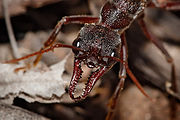 Chewing insects have two mandibles, one on each side of the head. The mandibles are positioned between the labrum and maxillae. They are typically the largest mouthparts of chewing insects, being used to masticate (cut, tear, crush, chew) food items. They open outwards (to the sides of the head) and come together medially. In carnivorous chewing insects, the mandibles can be modified to be more knife-like, whereas in herbivorous chewing insects, they are more typically broad and flat on their opposing faces (e.g., caterpillar
s). In male stag beetle
s, the mandibles are modified to such an extent that they do not serve any feeding function, but are instead used to defend mating sites from other males. In ant
s, the mandibles also serve a defensive function (particularly in soldier castes). In bull ants
, the mandibles are elongate and toothed, used as hunting (and defensive) appendages.
or chewing or, in the unusual case of the dragonfly nymph, extends out to snatch prey back to the head where mandibles can eat it.
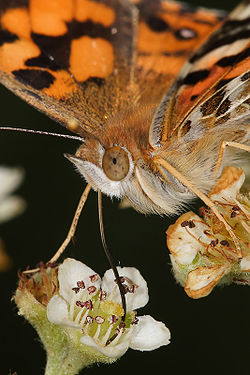 This section deals only with sucking insects, not those that pierce prior to sucking. The typical example is the moths and butterflies
, although as is always the case with insects, there are variations. Some moths have no mouthparts at all. All but a few adult Lepidoptera lack mandibles (the mandibulate moths have fully developed mandibles as adults), with the remaining mouthparts forming an elongated sucking tube, the proboscis.
within them) have mouthparts that pierce food items to enable sucking of internal fluids. Some are herbivorous, like aphid
s and leafhopper
s, while others are insectivorous, like assassin bugs and mosquito
es (females only).
is the possession of mouthparts where the mandibles and maxillae are modified into a proboscis, sheathed within a modified labium, which is capable of piercing tissues and sucking out the liquids. For example, true bugs that feed on plants, such as shield bug
s, feed on the fluids of plants. Predatory bugs such as assassin bugs have the same mouthparts, but they are used to pierce the cuticles of captured prey.
 In female mosquitoes, all mouthparts are elongate. The labium encloses all other mouthparts like a sheath. The labrum forms the main feeding tube, through which blood is sucked. Paired mandibles and maxillae are present, together forming the stylet, which is used to pierce an animal's skin. During piercing, the labium remains outside the food item's skin, folding away from the stylet. Saliva
containing anticoagulant
s, is injected into the food item and blood sucked out, each through different tubes.
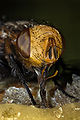
is the typical sponging insect. The labium gives the description, being articulate and possessing at its end a spongelike labellum. Paired mandibles and maxillae are present, but much reduced and non-functional. The labium forms a proboscis which is used to channel liquid food to the oesophagus. The housefly is able to eat solid food by secreting saliva and dabbing it over the food item. As the saliva dissolves the food, the solution is then drawn up into the mouth as a liquid.
The labellum's surface is covered by minute food channels, formed by the interlocking elongate hypopharynx and epipharynx, which form a tube leading to the oesophagus. The food channel draws liquid and liquified food to the oesophagus by capillary action
.
Mosquito
Mosquitoes are members of a family of nematocerid flies: the Culicidae . The word Mosquito is from the Spanish and Portuguese for little fly...
es (which are flies
Fly
True flies are insects of the order Diptera . They possess a pair of wings on the mesothorax and a pair of halteres, derived from the hind wings, on the metathorax...
) and aphid
Aphid
Aphids, also known as plant lice and in Britain and the Commonwealth as greenflies, blackflies or whiteflies, are small sap sucking insects, and members of the superfamily Aphidoidea. Aphids are among the most destructive insect pests on cultivated plants in temperate regions...
s (which are true bugs
Hemiptera
Hemiptera is an order of insects most often known as the true bugs , comprising around 50,000–80,000 species of cicadas, aphids, planthoppers, leafhoppers, shield bugs, and others...
) both pierce and suck), however female mosquitoes feed on animal blood whereas aphids feed on plant fluids. In this page, the individual mouthparts are introduced for chewing insects. Specialisations are generally described thereafter.
Chewing insects
Examples of chewing insects include dragonfliesDragonfly
A dragonfly is a winged insect belonging to the order Odonata, the suborder Epiprocta or, in the strict sense, the infraorder Anisoptera . It is characterized by large multifaceted eyes, two pairs of strong transparent wings, and an elongated body...
, grasshopper
Grasshopper
The grasshopper is an insect of the suborder Caelifera in the order Orthoptera. To distinguish it from bush crickets or katydids, it is sometimes referred to as the short-horned grasshopper...
s and beetle
Beetle
Coleoptera is an order of insects commonly called beetles. The word "coleoptera" is from the Greek , koleos, "sheath"; and , pteron, "wing", thus "sheathed wing". Coleoptera contains more species than any other order, constituting almost 25% of all known life-forms...
s. Some insects do not have chewing mouthparts as adults but do as larva
Larva
A larva is a distinct juvenile form many animals undergo before metamorphosis into adults. Animals with indirect development such as insects, amphibians, or cnidarians typically have a larval phase of their life cycle...
e, such as moths and butterflies
Lepidoptera
Lepidoptera is a large order of insects that includes moths and butterflies . It is one of the most widespread and widely recognizable insect orders in the world, encompassing moths and the three superfamilies of butterflies, skipper butterflies, and moth-butterflies...
.
Mandible
Caterpillar
Caterpillars are the larval form of members of the order Lepidoptera . They are mostly herbivorous in food habit, although some species are insectivorous. Caterpillars are voracious feeders and many of them are considered to be pests in agriculture...
s). In male stag beetle
Stag beetle
Stag beetles are a group of about 1,200 species of beetle in the family Lucanidae, presently classified in four subfamilies Some species grow up to over 12 cm , but most are about 5 cm .-Overview:...
s, the mandibles are modified to such an extent that they do not serve any feeding function, but are instead used to defend mating sites from other males. In ant
Ant
Ants are social insects of the family Formicidae and, along with the related wasps and bees, belong to the order Hymenoptera. Ants evolved from wasp-like ancestors in the mid-Cretaceous period between 110 and 130 million years ago and diversified after the rise of flowering plants. More than...
s, the mandibles also serve a defensive function (particularly in soldier castes). In bull ants
Myrmecia
Myrmecia, often called bulldog ants, bull ants, inch ants, sergeant ants, jumper ants or jack-jumpers , is a genus of ants. Bull ants can grow to over in length, with the smallest species long...
, the mandibles are elongate and toothed, used as hunting (and defensive) appendages.
Maxilla
Situated beneath the mandibles, paired maxillae manipulate food during mastication. Maxillae can have hairs and "teeth" along their inner margins. At the outer margin, the galea is a cupped or scoop-like structure, which sits over the outer edge of the labium. They also have palps, which are used to sense the characteristics of potential foods.Labium
The labium is a quadrupedal structure, although it is formed from two fused secondary maxillae. It can be described as the floor of the mouth. With the maxillae, it assists manipulation of food during masticationMastication
Mastication or chewing is the process by which food is crushed and ground by teeth. It is the first step of digestion and it increases the surface area of foods to allow more efficient break down by enzymes. During the mastication process, the food is positioned between the teeth for grinding by...
or chewing or, in the unusual case of the dragonfly nymph, extends out to snatch prey back to the head where mandibles can eat it.
Hypopharynx
The hypopharynx is a somewhat globular structure, arising from the base of the labium. It assists swallowing.Siphoning insects
Lepidoptera
Lepidoptera is a large order of insects that includes moths and butterflies . It is one of the most widespread and widely recognizable insect orders in the world, encompassing moths and the three superfamilies of butterflies, skipper butterflies, and moth-butterflies...
, although as is always the case with insects, there are variations. Some moths have no mouthparts at all. All but a few adult Lepidoptera lack mandibles (the mandibulate moths have fully developed mandibles as adults), with the remaining mouthparts forming an elongated sucking tube, the proboscis.
Proboscis
One of the more defining characteristics of lepidopterans is their coiled proboscis. It is held coiled under the head when not in use. During feeding, however, it is extended to reach the nectar of flowers. The proboscis is a long tube that is formed by heavily modified maxillae, specifically the galea.Piercing and sucking insects
A number of insect orders (or more precisely familiesFamily (biology)
In biological classification, family is* a taxonomic rank. Other well-known ranks are life, domain, kingdom, phylum, class, order, genus, and species, with family fitting between order and genus. As for the other well-known ranks, there is the option of an immediately lower rank, indicated by the...
within them) have mouthparts that pierce food items to enable sucking of internal fluids. Some are herbivorous, like aphid
Aphid
Aphids, also known as plant lice and in Britain and the Commonwealth as greenflies, blackflies or whiteflies, are small sap sucking insects, and members of the superfamily Aphidoidea. Aphids are among the most destructive insect pests on cultivated plants in temperate regions...
s and leafhopper
Leafhopper
Leafhopper is a common name applied to any species from the family Cicadellidae. Leafhoppers, colloquially known as hoppers, are minute plant-feeding insects in the superfamily Membracoidea in the order Hemiptera...
s, while others are insectivorous, like assassin bugs and mosquito
Mosquito
Mosquitoes are members of a family of nematocerid flies: the Culicidae . The word Mosquito is from the Spanish and Portuguese for little fly...
es (females only).
Proboscis
The defining feature of the order HemipteraHemiptera
Hemiptera is an order of insects most often known as the true bugs , comprising around 50,000–80,000 species of cicadas, aphids, planthoppers, leafhoppers, shield bugs, and others...
is the possession of mouthparts where the mandibles and maxillae are modified into a proboscis, sheathed within a modified labium, which is capable of piercing tissues and sucking out the liquids. For example, true bugs that feed on plants, such as shield bug
Shield bug
Pentatomoidea is a superfamily of insects in the Heteroptera suborder of the Hemiptera order and, as such, share a common arrangement of sucking mouthparts...
s, feed on the fluids of plants. Predatory bugs such as assassin bugs have the same mouthparts, but they are used to pierce the cuticles of captured prey.
Stylet
Saliva
Saliva , referred to in various contexts as spit, spittle, drivel, drool, or slobber, is the watery substance produced in the mouths of humans and most other animals. Saliva is a component of oral fluid. In mammals, saliva is produced in and secreted from the three pairs of major salivary glands,...
containing anticoagulant
Anticoagulant
An anticoagulant is a substance that prevents coagulation of blood. A group of pharmaceuticals called anticoagulants can be used in vivo as a medication for thrombotic disorders. Some anticoagulants are used in medical equipment, such as test tubes, blood transfusion bags, and renal dialysis...
s, is injected into the food item and blood sucked out, each through different tubes.
Sponging insects
Labellum
The houseflyHousefly
The housefly , Musca domestica, is a fly of the suborder Cyclorrhapha...
is the typical sponging insect. The labium gives the description, being articulate and possessing at its end a spongelike labellum. Paired mandibles and maxillae are present, but much reduced and non-functional. The labium forms a proboscis which is used to channel liquid food to the oesophagus. The housefly is able to eat solid food by secreting saliva and dabbing it over the food item. As the saliva dissolves the food, the solution is then drawn up into the mouth as a liquid.
The labellum's surface is covered by minute food channels, formed by the interlocking elongate hypopharynx and epipharynx, which form a tube leading to the oesophagus. The food channel draws liquid and liquified food to the oesophagus by capillary action
Capillary action
Capillary action, or capilarity, is the ability of a liquid to flow against gravity where liquid spontanously rise in a narrow space such as between the hair of a paint-brush, in a thin tube, or in porous material such as paper or in some non-porous material such as liquified carbon fiber, or in a...
.