

Chouannerie

Encyclopedia
The Chouannerie was a royalist
uprising in twelve of the western departements of France, particularly in the provinces of Brittany
and Maine
, against the French Revolution
, the First French Republic, and even, with its headquarters in London
rather than France, for a time, under the Empire
. It played out in three phases and lasted from the spring of 1794 until 1800.
Its members, known as Chouan
s, were motivated by their opposition to conscription and their support of the Catholic Church. They engaged in what would later be called guerrilla warfare. One of their leaders was Charles Armand Tuffin, marquis de la Rouerie
, and another was the namesake of the insurrection, Jean Chouan
.
caused the peasants around Vannes
to rise in defence of their bishop against the patriots of Lorient
who wished to impose the oath on him. The following spring, in the area around Quimper, a justice of the peace led several parishes in a rising in the king's name against the local authorities.
During the summer of 1792, incidents occurred in the districts of Carhaix (Finistère), Lannion
, Pontrieux
(Côtes-d'Armor), Craon
, Château-Gontier
and Laval
(Mayenne), where the peasants opposed a levy of volunteers for the army. At Saint-Ouën-des-Toits
, in the district of Laval, Jean Cottereau (known as Jean Chouan) led the insurgents. His nickname probably came from his imitation of the call of the tawny owl (the chouette hulotte) for a recognition signal. A reward was put on his head, but nevertheless he reached England in March 1793. The republican administration recognised him and his brother as the leaders of the revolt.
, his brother Julian, Jean Cottereau
, called Jean Chouan; Pierre Guillemot, known as the king of Bignan; Joseph de Puisaye, Louis-Charles de Sol de Grisolles, Auguste and Sébastien de La Haye de Silz, John-Louis Treton, nicknamed Jambe d'Argent; Tristan-Llhermitte, Michel Jacquet, known as Taillefer; Joseph-Juste Coquereau, Aimé du Boisguy, Boishardy, Pierre-Mathurin Mercier la Vendée, and Bonfils de Saint Loup.
In Brittany, the Chouans were supported by many nobles: Charles Armand Tuffin, marquis de la Rouerie
, the Chevalier de Boishardy, Count Louis of Rosmorduc, and the Picquet brothers of Boisguy, as well as by commoners (the brothers Cadoudal). In Lower Normandy, Count Louis de Frotte had a dominant role. One of the lieutenants in lower Maine
was Guillaume Le Métayer, who was nicknamed Rochambeau.
In the Vendee, the nobility couldn't play their normal military role; there was never any properly organised army; it consisted mostly of small elusive bands. The Chouan leaders were above all, peasant farmers.
Differently from the earlier War in the Vendee of 1793, the Chouannerie didn't possess any territory, the cities and many towns having remained republican, but some districts did carry out open revolt. There was also the Petite Vendée in lower Maine
, controlled by the Prince of Talmont. The Chouannerie was very difficult to suppress as its fighting forces hadn't been decimated in the battles of the Vendee war, its leaders were many in number and its army units were small and dispersed.
by Honoré de Balzac
and The Man in Grey
, a collection of short stories about the Chouans by Baroness Orczy
.
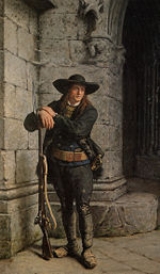
It is also depicted in paintings and popular imagery.
House of Bourbon
The House of Bourbon is a European royal house, a branch of the Capetian dynasty . Bourbon kings first ruled Navarre and France in the 16th century. By the 18th century, members of the Bourbon dynasty also held thrones in Spain, Naples, Sicily, and Parma...
uprising in twelve of the western departements of France, particularly in the provinces of Brittany
Brittany
Brittany is a cultural and administrative region in the north-west of France. Previously a kingdom and then a duchy, Brittany was united to the Kingdom of France in 1532 as a province. Brittany has also been referred to as Less, Lesser or Little Britain...
and Maine
Maine (province)
Le Maine is one of the traditional provinces of France . It corresponds to the old county of Maine, with its center, the city of Le Mans.-Location:...
, against the French Revolution
French Revolution
The French Revolution , sometimes distinguished as the 'Great French Revolution' , was a period of radical social and political upheaval in France and Europe. The absolute monarchy that had ruled France for centuries collapsed in three years...
, the First French Republic, and even, with its headquarters in London
London
London is the capital city of :England and the :United Kingdom, the largest metropolitan area in the United Kingdom, and the largest urban zone in the European Union by most measures. Located on the River Thames, London has been a major settlement for two millennia, its history going back to its...
rather than France, for a time, under the Empire
First French Empire
The First French Empire , also known as the Greater French Empire or Napoleonic Empire, was the empire of Napoleon I of France...
. It played out in three phases and lasted from the spring of 1794 until 1800.
Its members, known as Chouan
Chouan
Chouan is a French surname. It was used as a nom de guerre by the Chouan brothers, most notably Jean Cottereau, better known as Jean Chouan, who led a major revolt in Bas-Maine against the French Revolution...
s, were motivated by their opposition to conscription and their support of the Catholic Church. They engaged in what would later be called guerrilla warfare. One of their leaders was Charles Armand Tuffin, marquis de la Rouerie
Charles Armand Tuffin, marquis de la Rouerie
Charles Armand Tuffin, marquis de la Rouërie , also known in the United States as "Colonel Armand", was a Breton cavalry officer who served under the American flag during the American War of Independence. He was promoted to brigadier general after the Battle of Yorktown...
, and another was the namesake of the insurrection, Jean Chouan
Jean Chouan
Jean Chouan was the nom de guerre of the Frenchman, Jean Cottereau, who was born at Saint-Berthevin, near Laval, in the department of Mayenne on 30 October 1757 and died 18 July 1794 at Olivet, also in Mayenne...
.
Origins
From 1791, the rejection of the Civil Constitution of the ClergyCivil Constitution of the Clergy
The Civil Constitution of the Clergy was a law passed on 12 July 1790 during the French Revolution, that subordinated the Roman Catholic Church in France to the French government....
caused the peasants around Vannes
Vannes
Vannes is a commune in the Morbihan department in Brittany in north-western France. It was founded over 2000 years ago.-Geography:Vannes is located on the Gulf of Morbihan at the mouth of two rivers, the Marle and the Vincin. It is around 100 km northwest of Nantes and 450 km south west...
to rise in defence of their bishop against the patriots of Lorient
Lorient
Lorient, or L'Orient, is a commune and a seaport in the Morbihan department in Brittany in north-western France.-History:At the beginning of the 17th century, merchants who were trading with India had established warehouses in Port-Louis...
who wished to impose the oath on him. The following spring, in the area around Quimper, a justice of the peace led several parishes in a rising in the king's name against the local authorities.
During the summer of 1792, incidents occurred in the districts of Carhaix (Finistère), Lannion
Lannion
Lannion is a commune in the Côtes-d'Armor department in Brittany in northwestern France. It is a subpréfecture of Côtes-d'Armor, the capital of Trégor and the center of an urban area of almost 60,000 inhabitants.-Population:...
, Pontrieux
Pontrieux
Pontrieux is a commune in the Côtes-d'Armor department in Bretagne in northwestern France.-Population:Inhabitants of Pontrieux are called pontriviens.-External links:*...
(Côtes-d'Armor), Craon
Craon, Mayenne
Craon is a commune in the Mayenne department in north-western France.-Geography:The Oudon River flows through the middle of the commune and through the town of Craon....
, Château-Gontier
Château-Gontier
Château-Gontier is a commune in the Mayenne department in north-western France.It is about south of Laval, the préfecture of the department of Mayenne. Château-Gontier is home to the Refuge de l'Arche, a refuge for abandoned or mistreated animals.-People:...
and Laval
Laval, Mayenne
Laval is a commune in the Mayenne department in north-western France.It lies on the threshold of Brittany and on the border between Normandy and Anjou. Its citizens are called Lavallois.-Geography:...
(Mayenne), where the peasants opposed a levy of volunteers for the army. At Saint-Ouën-des-Toits
Saint-Ouën-des-Toits
Saint-Ouën-des-Toits is a commune in the Mayenne department in north-western France.-References:*...
, in the district of Laval, Jean Cottereau (known as Jean Chouan) led the insurgents. His nickname probably came from his imitation of the call of the tawny owl (the chouette hulotte) for a recognition signal. A reward was put on his head, but nevertheless he reached England in March 1793. The republican administration recognised him and his brother as the leaders of the revolt.
Chouan leaders
The principal leaders of the insurrection were Georges CadoudalGeorges Cadoudal
Georges Cadoudal , sometimes called simply Georges, was a French/Breton politician, and leader of the Chouannerie during the French Revolution....
, his brother Julian, Jean Cottereau
Jean Cottereau
Jean Cottereau was the royal treasurer to Louis XII of France. He rebuilt the ancient Château de Maintenon. Later the old château-fort was remade into a fashionable country house for Madame de Maintenon, the second wife of Louis XIV. Clément Marot's verse epitaphs, "De Messire Jean Cotereau,...
, called Jean Chouan; Pierre Guillemot, known as the king of Bignan; Joseph de Puisaye, Louis-Charles de Sol de Grisolles, Auguste and Sébastien de La Haye de Silz, John-Louis Treton, nicknamed Jambe d'Argent; Tristan-Llhermitte, Michel Jacquet, known as Taillefer; Joseph-Juste Coquereau, Aimé du Boisguy, Boishardy, Pierre-Mathurin Mercier la Vendée, and Bonfils de Saint Loup.
In Brittany, the Chouans were supported by many nobles: Charles Armand Tuffin, marquis de la Rouerie
Charles Armand Tuffin, marquis de la Rouerie
Charles Armand Tuffin, marquis de la Rouërie , also known in the United States as "Colonel Armand", was a Breton cavalry officer who served under the American flag during the American War of Independence. He was promoted to brigadier general after the Battle of Yorktown...
, the Chevalier de Boishardy, Count Louis of Rosmorduc, and the Picquet brothers of Boisguy, as well as by commoners (the brothers Cadoudal). In Lower Normandy, Count Louis de Frotte had a dominant role. One of the lieutenants in lower Maine
Maine (province)
Le Maine is one of the traditional provinces of France . It corresponds to the old county of Maine, with its center, the city of Le Mans.-Location:...
was Guillaume Le Métayer, who was nicknamed Rochambeau.
In the Vendee, the nobility couldn't play their normal military role; there was never any properly organised army; it consisted mostly of small elusive bands. The Chouan leaders were above all, peasant farmers.
Differently from the earlier War in the Vendee of 1793, the Chouannerie didn't possess any territory, the cities and many towns having remained republican, but some districts did carry out open revolt. There was also the Petite Vendée in lower Maine
Maine
Maine is a state in the New England region of the northeastern United States, bordered by the Atlantic Ocean to the east and south, New Hampshire to the west, and the Canadian provinces of Quebec to the northwest and New Brunswick to the northeast. Maine is both the northernmost and easternmost...
, controlled by the Prince of Talmont. The Chouannerie was very difficult to suppress as its fighting forces hadn't been decimated in the battles of the Vendee war, its leaders were many in number and its army units were small and dispersed.
Novelistic
This rebellion is featured in the novel Les ChouansLes Chouans
Les Chouans is an 1829 novel by French novelist and playwright Honoré de Balzac and included in the Scènes de la vie militaire section of his novel sequence La Comédie humaine. Set in the French region of Brittany, the novel combines military history with a love story between the aristocratic...
by Honoré de Balzac
Honoré de Balzac
Honoré de Balzac was a French novelist and playwright. His magnum opus was a sequence of short stories and novels collectively entitled La Comédie humaine, which presents a panorama of French life in the years after the 1815 fall of Napoleon....
and The Man in Grey
The Man in Grey (novel)
The Man in Grey by Baroness Orczy, author of The Scarlet Pimpernel, was first published in 1918. This time Orczy sets the action in post-revolutionary France....
, a collection of short stories about the Chouans by Baroness Orczy
Baroness Orczy
Baroness Emma Magdolna Rozália Mária Jozefa Borbála "Emmuska" Orczy de Orczi was a British novelist, playwright and artist of Hungarian noble origin. She was most notable for her series of novels featuring the Scarlet Pimpernel...
.
It is also depicted in paintings and popular imagery.
Historical
- Jacques Duchemin des Cépeaux, Souvenirs de la Chouannerie, 1855 ;
- Émile SouvestreÉmile SouvestreÉmile Souvestre was a French novelist who was a native of Morlaix, Finistère.He was the son of a civil engineer and was educated at the college of Pontivy, with the intention of following his father's career by entering the Polytechnic School...
, Scènes de la Chouannerie, Michel Lévy, Paris, 1856; - Abbé Jean-François Paulouin, La Chouannerie du Maine et Pays adjacents. 1793-1799-1815-1832. Avec la Biographie de plus de 120 Officiers., Monnoyer, Le MansLe MansLe Mans is a city in France, located on the Sarthe River. Traditionally the capital of the province of Maine, it is now the capital of the Sarthe department and the seat of the Roman Catholic diocese of Le Mans. Le Mans is a part of the Pays de la Loire region.Its inhabitants are called Manceaux...
, 1875 - Jean Morvan, Les Chouans de la Mayenne. 1792 - 1796, Lévy, ParisParisParis is the capital and largest city in France, situated on the river Seine, in northern France, at the heart of the Île-de-France region...
, 1900 - Abbé Almire Belin (dir.), La Révolution dans le Maine. Revue bimestrielle, Imprimerie Benderitter puis M. Vilaire, Le Mans, 1925–1937
- Marc Valin, Chouans de la Mayenne, Éditions Siloé, Laval, 1985
- Jean Barreau, La chouannerie mayennaise sous la Convention et le Directoire, Imp. Martin, Le Mans, 1988.
- Anne Bernet, Les Grandes Heures de la chouannerie, Perrin, 1993
- Roger Dupuy, Les Chouans, Hachette Littérature, 1997.
- Anne Bernet, Histoire générale de la chouannerie, Perrin, 2000.
- Jean Lepart,"Histoire de la Chouannerie dans la Sarthe", in Revue Historique et Archéologique du Maine, Le Mans,tome CLIII, p. 13-64, 2002 et tome CLV, p. 65-120, 2004.
- Hubert La Marle, Dictionnaire des Chouans de la Mayenne, Éditions régionales de l'Ouest - Mayenne. 2005.
- Bernard Coquet, Le dernier des Chouans Louis-Stanislas Sortant, 1777-1840, Éditions Ophrys-SPM, Paris, 2007.
Works of fiction
- Honoré de BalzacHonoré de BalzacHonoré de Balzac was a French novelist and playwright. His magnum opus was a sequence of short stories and novels collectively entitled La Comédie humaine, which presents a panorama of French life in the years after the 1815 fall of Napoleon....
, Les Chouans ou la Bretagne en 1799Les ChouansLes Chouans is an 1829 novel by French novelist and playwright Honoré de Balzac and included in the Scènes de la vie militaire section of his novel sequence La Comédie humaine. Set in the French region of Brittany, the novel combines military history with a love story between the aristocratic...
, La Comédie HumaineLa Comédie humaineLa Comédie humaine is the title of Honoré de Balzac's multi-volume collection of interlinked novels and stories depicting French society in the period of the Restoration and the July Monarchy .-Overview:...
, tome XIII. (also adapted as a film, Les Chouans, by Henri Calef, with Jean MaraisJean Marais-Biography:A native of Cherbourg, France, Marais starred in several movies directed by Jean Cocteau, for a time his lover, most famously Beauty and the Beast and Orphée ....
, 1946). - Victor HugoVictor HugoVictor-Marie Hugo was a Frenchpoet, playwright, novelist, essayist, visual artist, statesman, human rights activist and exponent of the Romantic movement in France....
, Quatrevingt-treize. - Jules Barbey d'Aurevilly, L'Ensorcelée. and Le Chevalier des Touches.
- Michel Ragon, les mouchoirs rouges de Cholet.
- The film Chouans !, by Philippe de BrocaPhilippe de BrocaPhilippe de Broca was a French film director.Born Philippe Claude Alex de Broca de Ferrussac in Neuilly-sur-Seine, Hauts-de-Seine, the son of a photographer of noble origins. de Broca was a cinephile from an early age, and he studied at the l'École technique de photographie et de cinématographie...
, with Philippe NoiretPhilippe NoiretPhilippe Noiret was a French film actor.-Biography:Noiret's father was in the clothes trade. Philippe was an indifferent scholar and attended several prestigious Paris schools, including the Lycée Janson de Sailly. He failed several times to pass his baccalauréat exams, so he decided to study...
, Sophie MarceauSophie MarceauSophie Marceau is a French actress director, screenwriter, and author. She has appeared in 38 films. As a teenager, Marceau achieved popularity with her debut films La boum and La boum 2 , receiving a César Award for Most Promising Actress...
, Lambert WilsonLambert WilsonLambert Wilson is a French actor. He is internationally known for his portrayal of The Merovingian in The Matrix He was born in Neuilly-sur-Seine, France, the son of Georges Wilson, who was an actor, theatrical manager and director of the Theatre National de Paris.Wilson screen tested for The...
and Stéphane FreissStéphane FreissStéphane Freiss is a French actor.-Selected filmography:* The King's Whore * Crime Spree * Monsieur N. * 5x2 * Bienvenue chez les Ch'tis -External links:...
, 1988.