

Chicago Pile-1

Encyclopedia
Chicago Pile-1 was the world's first man-made nuclear reactor
. CP-1 was built on a rackets
court, under the abandoned west stands of the original Alonzo Stagg Field stadium, at the University of Chicago
. The first self-sustaining nuclear chain reaction
was initiated in CP-1 on December 2, 1942. The site was designated a National Historic Landmark
in 1965 and was added to the newly created National Register of Historic Places a little over a year later. The site was named a Chicago Landmark
in 1971. It is one of the four Chicago Registered Historic Places from the original October 15, 1966, National Register of Historic Places list.
and graphite
blocks, assembled under the supervision of the renowned physicist Enrico Fermi
, in collaboration with Leó Szilárd
, discoverer of the chain reaction. It contained a critical mass of fissile material, together with control rod
s, and was built as a part of the Manhattan Project
by the University of Chicago Metallurgical Laboratory. The shape of the pile was intended to be roughly spherical, but as work proceeded Fermi calculated that critical mass could be achieved without finishing the entire pile as planned.
A labor strike prevented construction of the pile at the Argonne National Laboratory
, so Fermi and his associates Martin Whittaker and Walter Zinn set about building the pile (the term "nuclear reactor" was not used until 1952) in a rackets court under the abandoned west stands of the university's Stagg Field. The pile consisted of uranium pellets as a neutron-producing "core", separated from one another by graphite blocks to slow the neutrons
. Fermi himself described the apparatus as "a crude pile of black bricks and wooden timbers." The controls consisted of cadmium
-coated rods that absorbed neutrons. Withdrawing the rods would increase neutron activity in the pile, leading to a self-sustaining chain reaction. Re-inserting the rods would dampen the reaction.
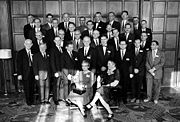 On December 2, 1942, CP-1 was ready for a demonstration. Before a group of dignitaries, a young scientist named George Weil worked the final control rod while Fermi carefully monitored the neutron activity. The pile reached "criticality" or a self-sustaining reaction at 3:25 p.m. Fermi shut it down 28 minutes later.
After the first self-sustained nuclear chain reaction was achieved, a coded phone call was made by one of the physicists, Arthur Compton
, to James Conant
, chairman of the National Defense Research Committee. The conversation was in impromptu code:
Unlike most reactors that have been built since, this first one had no radiation shielding and no cooling system of any kind. Fermi had convinced Arthur Compton that his calculations were reliable enough to rule out a runaway chain reaction or an explosion, but, as the official historians of the Atomic Energy Commission later noted, the "gamble" remained in conducting "a possibly catastrophic experiment in one of the most densely populated areas of the nation!"
Operation of CP-1 was terminated in February 1943. The reactor was then dismantled and moved to Red Gate Woods
, the future site of Argonne National Laboratory
, where it was reconstructed using the original materials, plus an enlarged radiation shield, and renamed Chicago Pile-2 (CP-2). CP-2 began operation in March 1943 and was later buried at the same site, now known as the Site A/Plot M Disposal Site.
on February 18, 1965. On October 15, 1966, which is the day that the National Historic Preservation Act of 1966
was enacted creating the National Register of Historic Places
, it was added to that as well. The site was named a Chicago Landmark
on October 27, 1971.
A small graphite block from the pile is on display at the Museum of Science and Industry
in Chicago; another can be seen at the Bradbury Science Museum
in Los Alamos, NM. The old Stagg Field plot of land is currently home to the Regenstein Library
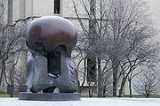
at the University of Chicago. A Henry Moore
sculpture, Nuclear Energy, in a small quadrangle commemorates the nuclear experiment.
Nuclear reactor
A nuclear reactor is a device to initiate and control a sustained nuclear chain reaction. Most commonly they are used for generating electricity and for the propulsion of ships. Usually heat from nuclear fission is passed to a working fluid , which runs through turbines that power either ship's...
. CP-1 was built on a rackets
Racquets (sport)
Rackets or Racquets is an indoor racket sport played in the United Kingdom, United States, and Canada...
court, under the abandoned west stands of the original Alonzo Stagg Field stadium, at the University of Chicago
University of Chicago
The University of Chicago is a private research university in Chicago, Illinois, USA. It was founded by the American Baptist Education Society with a donation from oil magnate and philanthropist John D. Rockefeller and incorporated in 1890...
. The first self-sustaining nuclear chain reaction
Nuclear chain reaction
A nuclear chain reaction occurs when one nuclear reaction causes an average of one or more nuclear reactions, thus leading to a self-propagating number of these reactions. The specific nuclear reaction may be the fission of heavy isotopes or the fusion of light isotopes...
was initiated in CP-1 on December 2, 1942. The site was designated a National Historic Landmark
National Historic Landmark
A National Historic Landmark is a building, site, structure, object, or district, that is officially recognized by the United States government for its historical significance...
in 1965 and was added to the newly created National Register of Historic Places a little over a year later. The site was named a Chicago Landmark
Chicago Landmark
Chicago Landmark is a designation of the Mayor of Chicago and the Chicago City Council for historic buildings and other sites in Chicago, Illinois, United States. Listed sites are selected after meeting a combination of criteria, including historical, economic, architectural, artistic, cultural,...
in 1971. It is one of the four Chicago Registered Historic Places from the original October 15, 1966, National Register of Historic Places list.
Reactor
The reactor was a pile of uraniumUranium
Uranium is a silvery-white metallic chemical element in the actinide series of the periodic table, with atomic number 92. It is assigned the chemical symbol U. A uranium atom has 92 protons and 92 electrons, of which 6 are valence electrons...
and graphite
Graphite
The mineral graphite is one of the allotropes of carbon. It was named by Abraham Gottlob Werner in 1789 from the Ancient Greek γράφω , "to draw/write", for its use in pencils, where it is commonly called lead . Unlike diamond , graphite is an electrical conductor, a semimetal...
blocks, assembled under the supervision of the renowned physicist Enrico Fermi
Enrico Fermi
Enrico Fermi was an Italian-born, naturalized American physicist particularly known for his work on the development of the first nuclear reactor, Chicago Pile-1, and for his contributions to the development of quantum theory, nuclear and particle physics, and statistical mechanics...
, in collaboration with Leó Szilárd
Leó Szilárd
Leó Szilárd was an Austro-Hungarian physicist and inventor who conceived the nuclear chain reaction in 1933, patented the idea of a nuclear reactor with Enrico Fermi, and in late 1939 wrote the letter for Albert Einstein's signature that resulted in the Manhattan Project that built the atomic bomb...
, discoverer of the chain reaction. It contained a critical mass of fissile material, together with control rod
Control rod
A control rod is a rod made of chemical elements capable of absorbing many neutrons without fissioning themselves. They are used in nuclear reactors to control the rate of fission of uranium and plutonium...
s, and was built as a part of the Manhattan Project
Manhattan Project
The Manhattan Project was a research and development program, led by the United States with participation from the United Kingdom and Canada, that produced the first atomic bomb during World War II. From 1942 to 1946, the project was under the direction of Major General Leslie Groves of the US Army...
by the University of Chicago Metallurgical Laboratory. The shape of the pile was intended to be roughly spherical, but as work proceeded Fermi calculated that critical mass could be achieved without finishing the entire pile as planned.
A labor strike prevented construction of the pile at the Argonne National Laboratory
Argonne National Laboratory
Argonne National Laboratory is the first science and engineering research national laboratory in the United States, receiving this designation on July 1, 1946. It is the largest national laboratory by size and scope in the Midwest...
, so Fermi and his associates Martin Whittaker and Walter Zinn set about building the pile (the term "nuclear reactor" was not used until 1952) in a rackets court under the abandoned west stands of the university's Stagg Field. The pile consisted of uranium pellets as a neutron-producing "core", separated from one another by graphite blocks to slow the neutrons
Neutron moderator
In nuclear engineering, a neutron moderator is a medium that reduces the speed of fast neutrons, thereby turning them into thermal neutrons capable of sustaining a nuclear chain reaction involving uranium-235....
. Fermi himself described the apparatus as "a crude pile of black bricks and wooden timbers." The controls consisted of cadmium
Cadmium
Cadmium is a chemical element with the symbol Cd and atomic number 48. This soft, bluish-white metal is chemically similar to the two other stable metals in group 12, zinc and mercury. Similar to zinc, it prefers oxidation state +2 in most of its compounds and similar to mercury it shows a low...
-coated rods that absorbed neutrons. Withdrawing the rods would increase neutron activity in the pile, leading to a self-sustaining chain reaction. Re-inserting the rods would dampen the reaction.
First nuclear reaction
After the first self-sustained nuclear chain reaction was achieved, a coded phone call was made by one of the physicists, Arthur Compton
Arthur Compton
Arthur Holly Compton was an American physicist and Nobel laureate in physics for his discovery of the Compton effect. He served as Chancellor of Washington University in St. Louis from 1945 to 1953.-Early years:...
, to James Conant
James Bryant Conant
James Bryant Conant was a chemist, educational administrator, and government official. As thePresident of Harvard University he reformed it as a research institution.-Biography :...
, chairman of the National Defense Research Committee. The conversation was in impromptu code:
Unlike most reactors that have been built since, this first one had no radiation shielding and no cooling system of any kind. Fermi had convinced Arthur Compton that his calculations were reliable enough to rule out a runaway chain reaction or an explosion, but, as the official historians of the Atomic Energy Commission later noted, the "gamble" remained in conducting "a possibly catastrophic experiment in one of the most densely populated areas of the nation!"
Operation of CP-1 was terminated in February 1943. The reactor was then dismantled and moved to Red Gate Woods
Red Gate Woods
Red Gate Woods is a forest preserve within the Palos Division of the Forest Preserve District of Cook County, Illinois. Located within the preserve is the original site of Argonne National Laboratory and the Site A/Plot M Disposal Site, which contains the buried remains of Chicago Pile-1, the...
, the future site of Argonne National Laboratory
Argonne National Laboratory
Argonne National Laboratory is the first science and engineering research national laboratory in the United States, receiving this designation on July 1, 1946. It is the largest national laboratory by size and scope in the Midwest...
, where it was reconstructed using the original materials, plus an enlarged radiation shield, and renamed Chicago Pile-2 (CP-2). CP-2 began operation in March 1943 and was later buried at the same site, now known as the Site A/Plot M Disposal Site.
Significance and commemoration
The site of the first man-made self-sustaining nuclear fission reaction received designation as a National Historic LandmarkNational Historic Landmark
A National Historic Landmark is a building, site, structure, object, or district, that is officially recognized by the United States government for its historical significance...
on February 18, 1965. On October 15, 1966, which is the day that the National Historic Preservation Act of 1966
National Historic Preservation Act of 1966
The National Historic Preservation Act is legislation intended to preserve historical and archaeological sites in the United States of America...
was enacted creating the National Register of Historic Places
National Register of Historic Places
The National Register of Historic Places is the United States government's official list of districts, sites, buildings, structures, and objects deemed worthy of preservation...
, it was added to that as well. The site was named a Chicago Landmark
Chicago Landmark
Chicago Landmark is a designation of the Mayor of Chicago and the Chicago City Council for historic buildings and other sites in Chicago, Illinois, United States. Listed sites are selected after meeting a combination of criteria, including historical, economic, architectural, artistic, cultural,...
on October 27, 1971.
A small graphite block from the pile is on display at the Museum of Science and Industry
Museum of Science and Industry (Chicago)
The Museum of Science and Industry is located in Chicago, Illinois, USA in Jackson Park, in the Hyde Park neighborhood adjacent to Lake Michigan. It is housed in the former Palace of Fine Arts from the 1893 World's Columbian Exposition...
in Chicago; another can be seen at the Bradbury Science Museum
Bradbury Science Museum
The Bradbury Science Museum is the chief public facility of the Los Alamos National Laboratory, located at 1350 Central Avenue in Los Alamos, New Mexico, in the United States. It was founded in 1963, and was named for the Laboratory's second director , Norris E. Bradbury...
in Los Alamos, NM. The old Stagg Field plot of land is currently home to the Regenstein Library
Regenstein Library
The Joseph Regenstein Library is the main library of the University of Chicago, named after industrialist and philanthropist Joseph Regenstein. Holding over 7.9 million volumes, it is one of the largest repositories of books in the world, and is noted for its brutalist architecture.-History:The...
at the University of Chicago. A Henry Moore
Henry Moore
Henry Spencer Moore OM CH FBA was an English sculptor and artist. He was best known for his semi-abstract monumental bronze sculptures which are located around the world as public works of art....
sculpture, Nuclear Energy, in a small quadrangle commemorates the nuclear experiment.
External links
- CP-1 Goes Critical Describes in detail the construction and activation of CP-1. US Department of Energy, Office of History and Heritage Resources.
- Photos of CP-1 The University of Chicago Library Archive. Includes photos and sketches of CP-1.
- Video Showing the Met Lab, Fermi, and an active experiment using CP-1
- The First Pile 11 page story about CP-1