

Cenomanian

Encyclopedia
The Cenomanian is, in the ICS
' geological timescale the oldest or earliest age of the Late Cretaceous
epoch
or the lowest stage of the Upper Cretaceous series
. An age is a unit of geochronology
: it is a unit of time; the stage is a unit in the stratigraphic column
deposited during the corresponding age. Both age and stage bear the same name.
As a unit of geologic time measure, the Cenomanian age spans the time between 99.6 ± 0.9 and 93.5 ± 0.8 (million years ago). In the geologic timescale it is preceded by the Albian
and is followed by the Turonian
.
The Cenomanian is coeval with the Woodbinian of the regional timescale of the Mexican Gulf and the Eaglefordian of the regional timescale of the US eastcoast.
At the end of the Cenomanian an anoxic event
took place, called the Cenomanian-Turonian boundary event
or the "Bonarelli Event", that is associated with a minor extinction event for marine species.
in 1847. Its name comes from the New Latin
name of the French city of Le Mans
(département Sarthe
), Cenomanum.
The base of the Cenomanian stage (which is also the base of the Upper Cretaceous series) is placed at the first appearance of foram species Rotalipora globotruncanoides in the stratigraphic record. An official reference profile for the base of the Cenomanian (a GSSP) is located in an outcrop
at the western flank of Mont Risou, near the village of Rosans
in the French Alps
(département Hautes-Alpes
, coordinates: 44°23'33"N, 5°30'43"E). The base is, in the reference profile, located 36 meters below the top of the Marnes Bleues Formation.
The top of the Cenomanian (the base of the Turonian) is at the first appearance of ammonite
species Watinoceras devonense.
Important index fossil
s for the Cenomanian are the ammonites Calycoceras naviculare, Acanthoceras rhotomagense and Mantelliceras mantelli.
eon, the past six hundred million years (approximately one hundred and fifty meters above present day sea-levels). A corollary is that the highlands were at all time lows, so the landscape on Earth was one of warm broad shallow seas inundating low lying land areas on the precursors to today's continents. What few lands rose above the waves were made of old mountains and hills, upland plateau
s, all much weathered. Tectonic mountain building was minimal and most continents were isolated by large stretches of water. Without highlands to brake winds, the climate would have been windy and waves large, adding to the weathering and fast rate of sediment deposition.
.; 2004: The Global Boundary Stratotype Section and Point (GSSP) for the base of the Cenomanian Stage, Mont Risou, Hautes-Alpes, France, Episodes 27, pp. 21–32.
International Commission on Stratigraphy
The International Commission on Stratigraphy , sometimes referred to by the unofficial "International Stratigraphic Commission" is a daughter or major subcommittee grade scientific daughter organization that concerns itself with stratigraphy, geological, and geochronological matters on a global...
' geological timescale the oldest or earliest age of the Late Cretaceous
Late Cretaceous
The Late Cretaceous is the younger of two epochs into which the Cretaceous period is divided in the geologic timescale. Rock strata from this epoch form the Upper Cretaceous series...
epoch
Epoch (geology)
An epoch is a subdivision of the geologic timescale based on rock layering. In order, the higher subdivisions are periods, eras and eons. We are currently living in the Holocene epoch...
or the lowest stage of the Upper Cretaceous series
Series (stratigraphy)
Series are subdivisions of rock layers made based on the age of the rock and corresponding to the dating system unit called an epoch, both being formally defined international conventions of the geological timescale. A series is therefore a sequence of rock depositions defining a...
. An age is a unit of geochronology
Geochronology
Geochronology is the science of determining the age of rocks, fossils, and sediments, within a certain degree of uncertainty inherent to the method used. A variety of dating methods are used by geologists to achieve this, and schemes of classification and terminology have been proposed...
: it is a unit of time; the stage is a unit in the stratigraphic column
Stratigraphic column
A stratigraphic column is a representation used in geology and its subfield of stratigraphy to describe the vertical location of rock units in a particular area....
deposited during the corresponding age. Both age and stage bear the same name.
As a unit of geologic time measure, the Cenomanian age spans the time between 99.6 ± 0.9 and 93.5 ± 0.8 (million years ago). In the geologic timescale it is preceded by the Albian
Albian
The Albian is both an age of the geologic timescale and a stage in the stratigraphic column. It is the youngest or uppermost subdivision of the Early/Lower Cretaceous epoch/series. Its approximate time range is 112.0 ± 1.0 Ma to 99.6 ± 0.9 Ma...
and is followed by the Turonian
Turonian
The Turonian is, in the ICS' geologic timescale, the second age in the Late Cretaceous epoch, or a stage in the Upper Cretaceous series. It spans the time between 93.5 ± 0.8 Ma and 89.3 ± 1 Ma...
.
The Cenomanian is coeval with the Woodbinian of the regional timescale of the Mexican Gulf and the Eaglefordian of the regional timescale of the US eastcoast.
At the end of the Cenomanian an anoxic event
Anoxic event
Oceanic anoxic events or anoxic events occur when the Earth's oceans become completely depleted of oxygen below the surface levels. Although anoxic events have not happened for millions of years, the geological record shows that they happened many times in the past. Anoxic events may have caused...
took place, called the Cenomanian-Turonian boundary event
Cenomanian-Turonian boundary event
The Cenomanian-Turonian boundary event, also known as the Cenomanian-Turonian extinction event, the Cenomanian-Turonian anoxic event, and referred to in Europe as the Bonarelli Event, was the latter of two anoxic extinction events early in the Late Cretaceous period...
or the "Bonarelli Event", that is associated with a minor extinction event for marine species.
Stratigraphic definitions
The Cenomanian was introduced in scientific literature by French palaeontologist Alcide d'OrbignyAlcide d'Orbigny
Alcide Charles Victor Marie Dessalines d'Orbigny was a French naturalist who made major contributions in many areas, including zoology , palaeontology, geology, archaeology and anthropology....
in 1847. Its name comes from the New Latin
New Latin
The term New Latin, or Neo-Latin, is used to describe the Latin language used in original works created between c. 1500 and c. 1900. Among other uses, Latin during this period was employed in scholarly and scientific publications...
name of the French city of Le Mans
Le Mans
Le Mans is a city in France, located on the Sarthe River. Traditionally the capital of the province of Maine, it is now the capital of the Sarthe department and the seat of the Roman Catholic diocese of Le Mans. Le Mans is a part of the Pays de la Loire region.Its inhabitants are called Manceaux...
(département Sarthe
Sarthe
Sarthe is a French department, named after the Sarthe River.- History :The department was created during the French Revolution on March 4, 1790, pursuant to the law of December 22, 1789, starting from a part of the province of Maine which was divided into two departments, Sarthe to the east and...
), Cenomanum.
The base of the Cenomanian stage (which is also the base of the Upper Cretaceous series) is placed at the first appearance of foram species Rotalipora globotruncanoides in the stratigraphic record. An official reference profile for the base of the Cenomanian (a GSSP) is located in an outcrop
Outcrop
An outcrop is a visible exposure of bedrock or ancient superficial deposits on the surface of the Earth. -Features:Outcrops do not cover the majority of the Earth's land surface because in most places the bedrock or superficial deposits are covered by a mantle of soil and vegetation and cannot be...
at the western flank of Mont Risou, near the village of Rosans
Rosans
Rosans is a commune in the Hautes-Alpes department in southeastern France.-Population:-References:*...
in the French Alps
Alps
The Alps is one of the great mountain range systems of Europe, stretching from Austria and Slovenia in the east through Italy, Switzerland, Liechtenstein and Germany to France in the west....
(département Hautes-Alpes
Hautes-Alpes
Hautes-Alpes is a department in southeastern France named after the Alps mountain range.- History :Hautes-Alpes is one of the original 83 departments created during the French Revolution on 4 March 1790...
, coordinates: 44°23'33"N, 5°30'43"E). The base is, in the reference profile, located 36 meters below the top of the Marnes Bleues Formation.
The top of the Cenomanian (the base of the Turonian) is at the first appearance of ammonite
Ammonite
Ammonite, as a zoological or paleontological term, refers to any member of the Ammonoidea an extinct subclass within the Molluscan class Cephalopoda which are more closely related to living coleoids Ammonite, as a zoological or paleontological term, refers to any member of the Ammonoidea an extinct...
species Watinoceras devonense.
Important index fossil
Index fossil
Index fossils are fossils used to define and identify geologic periods . They work on the premise that, although different sediments may look different depending on the conditions under which they were laid down, they may include the remains of the same species of fossil...
s for the Cenomanian are the ammonites Calycoceras naviculare, Acanthoceras rhotomagense and Mantelliceras mantelli.
Sequence stratigraphy and palaeoclimatology
The late Cenomanian represents the highest mean sea-level observed in the PhanerozoicPhanerozoic
The Phanerozoic Eon is the current eon in the geologic timescale, and the one during which abundant animal life has existed. It covers roughly 542 million years and goes back to the time when diverse hard-shelled animals first appeared...
eon, the past six hundred million years (approximately one hundred and fifty meters above present day sea-levels). A corollary is that the highlands were at all time lows, so the landscape on Earth was one of warm broad shallow seas inundating low lying land areas on the precursors to today's continents. What few lands rose above the waves were made of old mountains and hills, upland plateau
Plateau
In geology and earth science, a plateau , also called a high plain or tableland, is an area of highland, usually consisting of relatively flat terrain. A highly eroded plateau is called a dissected plateau...
s, all much weathered. Tectonic mountain building was minimal and most continents were isolated by large stretches of water. Without highlands to brake winds, the climate would have been windy and waves large, adding to the weathering and fast rate of sediment deposition.
†Belemnites
| Belemnites of the Cenomanian | ||||
|---|---|---|---|---|
| Taxa | Presence | Location | Description | Images |
Hibolites Hibolites Hibolites is a genus of belemnite, an extinct group of cephalopods.... |
||||
†Ankylosauria
| Ankylosaurs of the Cenomanian | ||||
|---|---|---|---|---|
| Taxa | Presence | Location | Description | Images |
|
Albian Albian The Albian is both an age of the geologic timescale and a stage in the stratigraphic column. It is the youngest or uppermost subdivision of the Early/Lower Cretaceous epoch/series. Its approximate time range is 112.0 ± 1.0 Ma to 99.6 ± 0.9 Ma... or Aptian Aptian The Aptian is an age in the geologic timescale or a stage in the stratigraphic column. It is a subdivision of the Early or Lower Cretaceous epoch or series and encompasses the time from 125.0 ± 1.0 Ma to 112.0 ± 1.0 Ma , approximately... to Cenomanian |
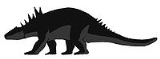
Upper Greensand Group, Cambridgeshire, England | A nodosaurid with an armor of oval plates set almost horizontally into the skin, with spikes protruding from the neck and shoulder area, along the spine. Its size has been estimated to be in the range of 3 to 5.5 meters (10 to 18 ft) long and approximately 380 kilograms (840 lb) in weight. | 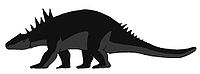 |
|
Animantarx Animantarx is a genus of nodosaurid ankylosaurian dinosaur from the Upper Cretaceous of western North America. Like other nodosaurs, it would have been a slow-moving quadrupedal herbivore covered in heavy armor scutes, but without a tail club... |
Cenomanian to Turonian Turonian The Turonian is, in the ICS' geologic timescale, the second age in the Late Cretaceous epoch, or a stage in the Upper Cretaceous series. It spans the time between 93.5 ± 0.8 Ma and 89.3 ± 1 Ma... |
Cedar Mountain Formation Cedar Mountain Formation The Cedar Mountain Formation is the name given to distinctive sedimentary rocks in eastern Utah that occur between the underlying Morrison Formation and overlying Naturita Formation . It is composed of non-marine sediments, that is, sediments deposited in rivers, lakes and on flood plains... , Utah, USA |
thought of as a nodosaurid ankylosaur, although its precise relationships within that family are uncertain | |
|
Nodosaurus Nodosaurus was a genus of herbivorous ankylosaurian dinosaur from the Late Cretaceous, the fossils of which are found in North America. Two incomplete specimens have been discovered in Wyoming and Kansas, and no skulls... |
Wyoming, Kansas, USA | A nodosaurid ankylosaur about 4 to 6 meters (13 to 20 feet) long with bony dermal plates covering the top of its body. It may have had spikes along its side as well. It had four short legs, five-toed feet, a short neck, and a long, stiff, clubless tail. | ||
|
Stegopelta Stegopelta is a genus of armored dinosaur. It is based on a partial skeleton from the latest Albian-earliest Cenomanian-age Lower and Upper Cretaceous Belle Fourche Member of the Frontier Formation of Fremont County, Wyoming.... |
Late Albian Albian The Albian is both an age of the geologic timescale and a stage in the stratigraphic column. It is the youngest or uppermost subdivision of the Early/Lower Cretaceous epoch/series. Its approximate time range is 112.0 ± 1.0 Ma to 99.6 ± 0.9 Ma... to early Cenomanian |
Frontier Formation Frontier Formation The Frontier Formation is a sedimentary geological formation whose strata date back to the Late Cretaceous. The formation's extents are: northwest Colorado, southeast Idaho, southern Montana, northern Utah, and western Wyoming. It occurs in many sedimentary basins and uplift areas.The formation... , Wyoming, USA |
A poorly known genus of nodosaurid | |
|
Tsagantegia Tsagantegia is a genus of medium-sized ankylosaurid dinosaur from the Upper Cretaceous Mongolia, during the Cenomanian stage.The holotype specimen , a complete skull, was recovered from the Bayan Shireh Formation , at the Tsagan-Teg locality, Dzun-Bayan, in the southeastern Gobi Desert, Mongolia... |
Baynshiree Svita Formation, Dzun-Bayan, Mongolia | An ankylosaurid known from the remains of its skull | ||
|
Zhejiangosaurus Zhejiangosaurus is an extinct genus of nodosaurid dinosaur from the Upper Cretaceous of Zhejiang, eastern China... |
Chaochuan Formation, Zhejiang, China | Nodosaurid | ||
|
Zhongyuansaurus Zhongyuansaurus is an extinct genus of ankylosaurid ankylosaurian dinosaur from the Cretaceous of Ruyang, Henan, China. It is known from remains including skull, arm, pelvic, and tail bones. It is distinguished by characteristics such as a flat roof to the skull, a straight ischium, and the... |
Ruyang, Henan, China | Nodosaurid | ||
†Ornithopoda
| Ornithopods of the Cenomanian | ||||
|---|---|---|---|---|
| Taxa | Presence | Location | Description | Images |
Anabisetia Anabisetia Anabisetia is a genus of ornithopod dinosaur from the Late Cretaceous Period of Patagonia, South America. It was a small bipedal herbivore, almost seven feet long.... |
Cerro Lisandro Formation Cerro Lisandro Formation The Lisandro Formation, alternatively known as the Cerro Lisandro Formation, is a geologic formation with outcrops in the Neuquén province of Argentina. It is the youngest formation within the Río Limay Subgroup, the lowest section of the Neuquén Group... , Neuquén, Argentina |
A small bipedal herbivore, almost seven feet (2 meters) long | ||
Bihariosaurus Bihariosaurus Bihariosaurus was a genus of camptosaurid dinosaur from Late Cretaceous Romania. The type species, Bihariosaurus bauxiticus, was described by Marinescu in 1989. It was similar to Camptosaurus, and was an iguanodont.... |
Bihor Bihor County Bihor is a county of Romania, in Crişana, with capital city at Oradea. Together with Hajdú-Bihar County in Hungary it constitutes the Biharia Euroregion.-Demographics:... , Romania |
An iguanodont similar to Camptosaurus Camptosaurus Camptosaurus is a genus of plant-eating, beaked ornithischian dinosaurs of the Late Jurassic period of western North America. The name means 'flexible lizard', .... |
||
Eolambia Eolambia Eolambia is a genus of herbivorous iguanodontian dinosaur from the mid-Cretaceous Period of the USA.In 1992 Carole Jones and her husband Ramal Jones near Castle Dale in Emery County, Utah, on the San Rafael Swell Anticline discovered a fossil site which would be named the Carol Quarry in her honour... |
Albian Albian The Albian is both an age of the geologic timescale and a stage in the stratigraphic column. It is the youngest or uppermost subdivision of the Early/Lower Cretaceous epoch/series. Its approximate time range is 112.0 ± 1.0 Ma to 99.6 ± 0.9 Ma... -Cenomanian |
Utah, USA | An iguanodont | |
Gadolosaurus Gadolosaurus "Gadolosaurus" is the informal name given to a genus of ornithopod dinosaur from late Cretaceous-age rocks in Mongolia. Though the name was made public in 1979, it has never been formally described, and the name is considered a nomen nudum. The name "Gadolosaurus" first appeared in a book by... |
Mongolia | |||
Notohypsilophodon Notohypsilophodon Notohypsilophodon was a genus of hypsilophodont ornithopod dinosaur. It was described as the only hypsilophodont known from South America, although this assessment is not universally supported, and Gasparinisaura is now believed to have been a hypsilophodont as well... |
Cenomanian-Turonian Turonian The Turonian is, in the ICS' geologic timescale, the second age in the Late Cretaceous epoch, or a stage in the Upper Cretaceous series. It spans the time between 93.5 ± 0.8 Ma and 89.3 ± 1 Ma... |
Bajo Barreal Formation Bajo Barreal Formation The Bajo Barreal Formation is a geological formation in Chubut, Argentina whose strata date back to the Late Cretaceous.-Dinosaurs:Dinosaur remains are among the fossils that have been recovered from the formation... , Chubut, Argentina |
A hypsilophodontid or other basal ornithopod, Notohypsilophodon would have been a bipedal herbivore. Its size has not been estimated | |
Oryctodromeus Oryctodromeus Oryctodromeus was a genus of small ornithopod dinosaur. Fossils are known from the middle Cretaceous Blackleaf Formation of southwestern Montana and the Wayan Formation of southeastern Idaho, both of the Cenomanian stage, roughly 95 million years ago... |
Blackleaf Formation, Montana, and Wayan Formation Wayan Formation The Wayan Formation is a geological formation in Idaho whose strata date back to the earliest Late Cretaceous. Dinosaur remains are among the fossils that have been recovered from the formation.-Geology and Age:... , Idaho, USA |
A burrowing hypsilophodont | ||
Protohadros Protohadros Protohadros is a genus of herbivorous ornithischian dinosaur from the Late Cretaceous , 95 million years ago.... |
Flower Mound, Texas, USA | A primitive hadrosauroid, Protohadros reached 6 m (19.5 ft) in length and had many hadrosaur-like features | ||
Shuangmiaosaurus Shuangmiaosaurus Shuangmiaosaurus is a genus of herbivorous ornithischian dinosaur which lived during the late Albian age of the Early Cretaceous Period, about 100 million years ago. It was an iguanodont euornithopod which lived in China.... |
Cenomanian-Turonian Turonian The Turonian is, in the ICS' geologic timescale, the second age in the Late Cretaceous epoch, or a stage in the Upper Cretaceous series. It spans the time between 93.5 ± 0.8 Ma and 89.3 ± 1 Ma... |
China | A poorly known iguanodont Iguanodont Iguanodonts were herbivorous dinosaurs that lived from the mid-Jurassic to Late Cretaceous. Some members include Camptosaurus, Callovosaurus, Iguanodon, Ouranosaurus, and the hadrosaurids or "duck-billed dinosaurs". Iguanodonts were one of the first groups of dinosaurs to be found... |
|
†Plesiosauria
| Plesiosaurs of the Cenomanian | ||||
|---|---|---|---|---|
| Taxa | Presence | Location | Description | Images |
Plesiopleurodon |
Belle Fourche Shale, Wyoming, USA | A pliosaurid characterized by a moderately long symphysis bearing 8 pairs of teeth, teeth that are nearly circular in cross-section and which are smooth on the outer surface (except near the base), ribs of the neck vertebrae being singled-headed (double-headed in Jurassic pliosaurs), and a long slender interpectoral bar on the coracoid | 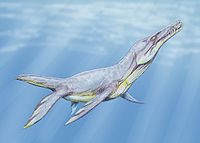 |
|
†Sauropoda
| Sauropods of the Cenomanian | ||||
|---|---|---|---|---|
| Taxa | Presence | Location | Description | Images |
Argentinosaurus Argentinosaurus Argentinosaurus is a genus of titanosaur sauropod dinosaur first discovered by Guillermo Heredia in Argentina. The generic name refers to the country in which it was discovered... |
Río Limay Formation, Neuquén, Argentina | 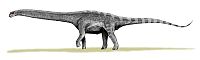 |
||
Theropoda
| Theropods of the Cenomanian | ||||
|---|---|---|---|---|
| Taxa | Presence | Location | Description | Images |
Bahariasaurus Bahariasaurus Bahariasaurus is a genus of large theropod dinosaur found in the Bahariya Formation in El-Waha el-Bahariya or Bahariya oasis in Egypt and Kem Kem Beds of North Africa, which date to the late Cretaceous Period, , about 95 million years ago... |
Bahariya Oasis Bahariya Oasis El-Wahat el-Bahariya or el-Bahariya is a depression in Egypt. It is approximately 360 km away from Cairo. Located in Giza Governorate, the main economic sectors are agriculture, iron ore mining, and tourism... , Egypt; Niger |
 |
||
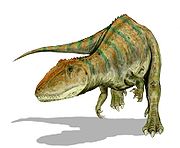
Carcharodontosaurus Carcharodontosaurus Carcharodontosaurus was a gigantic carnivorous carcharodontosaurid dinosaur that lived around 100 to 93 million years ago, during the late Albian to early Cenomanian stages of the mid-Cretaceous Period... |
Morocco; Niger | |||
Deltadromeus Deltadromeus Deltadromeus is a genus of large basal ceratosaurian theropod dinosaur from Northern Africa. It had long, unusually slender hind limbs for its size, suggesting that it was a swift runner. The skull is not known. Two fossil specimens of a single species Deltadromeus (meaning "delta runner") is a... |
Morocco | |||
Giganotosaurus Giganotosaurus Giganotosaurus is a genus of carcharodontosaurid dinosaur that lived around 97 million years ago during the early Cenomanian stage of the Late Cretaceous Period. It included some of the largest known terrestrial carnivores, slightly larger than the largest Tyrannosaurus, but smaller than the... |
Rio Limay, Argentina | |||
Mapusaurus Mapusaurus Mapusaurus was a giant carnosaurian dinosaur from the early Late Cretaceous of what is now Argentina. It was similar in size to its close relative Giganotosaurus, with the largest known individuals estimated as over in length and weighing approximately... |
Huincul Formation Huincul Formation The Huincul Formation is a geologic formation that outcrops in Río Negro and Neuquén provinces of Argentina. It is the second formation in the Río Limay Subgroup, the oldest subgroup within the Neuquén Group... , Argentina |
|||
Oxalaia Oxalaia Oxalaia is a genus of carnivorous theropod. It is a spinosaurine spinosaurid which lived during the late Cretaceous in what is now Brazil.... |
Brasil | |||
Siamosaurus Siamosaurus Siamosaurus is a genus of theropod dinosaur from Early Cretaceous Thailand. The size of the animal is unknown, but it may have reached a length of about 9.1 meters . The type species, Siamosaurus suteethorni, was formally described by Buffetaut and Ingavat in 1986... |
Thailand | |||
Sigilmassasaurus Sigilmassasaurus Sigilmassasaurus is a genus of tetanuran theropod dinosaur from the middle of the Cretaceous Period of northern Africa... |
Tafilalt Tafilalt Tafilalt or Tafilet is a region and the most important oasis of the Moroccan Sahara; it is also considered one of the largest oases in the world, the oasis is entirely located along the Ziz River. The oasis is ten days' journey south of Fez, across the Atlas Mountains... , Morocco |
|||
Spinosaurus Spinosaurus Spinosaurus is a genus of theropod dinosaur which lived in what is now North Africa, from the lower Albian to lower Cenomanian stages of the Cretaceous period, about 112 to 97 million years ago. This genus was first known from Egyptian remains discovered in 1912 and described by German... |
Bahariya Oasis, Egypt; Tunisia; Morocco | |||
Unenlagia Unenlagia Unenlagia is a genus of, possibly dromaeosaurid, theropod dinosaur from the Late Cretaceous of Argentina.... |
Comahue, Argentina | |||
unnamed enantiornithine bird Enantiornithes Enantiornithes is an extinct group of primitive birds. They were the most abundant and diverse avialans of the Mesozoic. Almost all retained teeth and clawed fingers on each wing, but otherwise looked much like modern birds externally. Over 50 species of Enantiornithines have been named, but some... |
Nammoura, Ouadi al Gabour, Lebanon | |||
Literature
; 2004: A Geologic Time Scale 2004, Cambridge University PressCambridge University Press
Cambridge University Press is the publishing business of the University of Cambridge. Granted letters patent by Henry VIII in 1534, it is the world's oldest publishing house, and the second largest university press in the world...
.; 2004: The Global Boundary Stratotype Section and Point (GSSP) for the base of the Cenomanian Stage, Mont Risou, Hautes-Alpes, France, Episodes 27, pp. 21–32.
External links
- GeoWhen Database - Cenomanian
- Late Cretaceous timescale, at the website of the subcommission for stratigraphic information of the ICS
- Stratigraphic chart of the Lower Cretaceous (including the Cenomanian), at the website of Norges Network of offshore records of geology and stratigraphy
- Cenomanian Microfossils: 20+ images of Foraminifera