

Argentinosaurus

Encyclopedia
Argentinosaurus is a genus
of titanosaur
sauropod dinosaur
first discovered by Guillermo Heredia in Argentina
. The generic name refers to the country
in which it was discovered ("Argentina" is derived from the Latin
argentum). The dinosaur lived on the then-island continent of South America
somewhere between 97 and 94 million years ago, during the mid Cretaceous
Period.
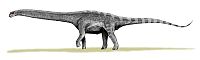 Not much of Argentinosaurus has been recovered. The holotype
included three anterior dorsal vertebrae, three posterior dorsal vertebrae, first to fifth sacrum vertebrae (only ventral sector the vertebral bodies), most of the sacral ribs of the right side, great part of a fragmented dorsal rib, and the right tibia
. One vertebra had a length of 1.59 meters (spine to the ventral border) and the tibia was about 155 centimeters (58 inches). Besides these, an incomplete femur
(MLP-DP 46-VIII-21-3) is assigned to Argentinosaurus; this incomplete femur shaft is about 1.18 meters. The proportions of these bones and comparisons with other sauropod relatives allow paleontologists to estimate the size of the animal
.
An early reconstruction by Gregory S. Paul
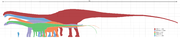
estimated Argentinosaurus at between 30–35 m (98.4–114.8 ft) in length and with a weight of up to 80–100 t (88.2–110.2 ST).
Other estimates have compared the fragmentary material to relatively complete titanosaur
s to help estimate the size of Argentinosaurus. In 2006 Carpenter used the more complete Saltasaurus
as a guide and estimated Argentinosaurus at 30 metres (98.4 ft) in length. An unpublished estimate used published reconstructions of Saltasaurus
, Opisthocoelicaudia
, and Rapetosaurus
as guides and gave shorter length estimates of between 22–26 m (72.2–85.3 ft). Weight estimates are less common, but Mazzetta et al. (2004) provide a range of 60–88 t (66.1–97 ST), and consider 73 tonnes (80.5 ST) to be the most likely, making it the heaviest sauropod known from good material.
.jpg) The type species of Argentinosaurus, A. huinculensis, was described and published in 1993 by the Argentinian palaeontologists José F. Bonaparte and Rodolfo Coria
The type species of Argentinosaurus, A. huinculensis, was described and published in 1993 by the Argentinian palaeontologists José F. Bonaparte and Rodolfo Coria
. Its more specific time-frame within the Cretaceous is the late Cenomanian
faunal stage
, ~96 to 94 million years ago. The fossil
discovery site is in the Huincul Formation
of the Río Limay Subgroup in Neuquén Province
, Argentina
(the Huincul Formation was a member of the Río Limay Formation according to the naming of the time).
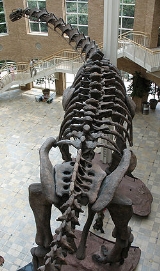
in Atlanta, Georgia, USA. This display depicts a hypothetical encounter between Argentinosaurus and the carnivorous theropod dinosaur Giganotosaurus
. Contemporary fossils of Cretaceous Period plants and animals are included in the exhibition, including two species of pterosaurs, providing a snapshot of a prehistoric ecosystem in what is now the modern Patagonia region of Argentina. At 37 m long, this skeletal reconstruction represents the largest dinosaur mount ever to be assembled.
Genus
In biology, a genus is a low-level taxonomic rank used in the biological classification of living and fossil organisms, which is an example of definition by genus and differentia...
of titanosaur
Titanosaur
Titanosaurs were a diverse group of sauropod dinosaurs, which included Saltasaurus and Isisaurus. It includes some of the heaviest creatures ever to walk the earth, such as Argentinosaurus and Paralititan — which some believe have weighed up to 100 tonnes...
sauropod dinosaur
Dinosaur
Dinosaurs are a diverse group of animals of the clade and superorder Dinosauria. They were the dominant terrestrial vertebrates for over 160 million years, from the late Triassic period until the end of the Cretaceous , when the Cretaceous–Paleogene extinction event led to the extinction of...
first discovered by Guillermo Heredia in Argentina
Argentina
Argentina , officially the Argentine Republic , is the second largest country in South America by land area, after Brazil. It is constituted as a federation of 23 provinces and an autonomous city, Buenos Aires...
. The generic name refers to the country
Country
A country is a region legally identified as a distinct entity in political geography. A country may be an independent sovereign state or one that is occupied by another state, as a non-sovereign or formerly sovereign political division, or a geographic region associated with a previously...
in which it was discovered ("Argentina" is derived from the Latin
Latin
Latin is an Italic language originally spoken in Latium and Ancient Rome. It, along with most European languages, is a descendant of the ancient Proto-Indo-European language. Although it is considered a dead language, a number of scholars and members of the Christian clergy speak it fluently, and...
argentum). The dinosaur lived on the then-island continent of South America
South America
South America is a continent situated in the Western Hemisphere, mostly in the Southern Hemisphere, with a relatively small portion in the Northern Hemisphere. The continent is also considered a subcontinent of the Americas. It is bordered on the west by the Pacific Ocean and on the north and east...
somewhere between 97 and 94 million years ago, during the mid Cretaceous
Cretaceous
The Cretaceous , derived from the Latin "creta" , usually abbreviated K for its German translation Kreide , is a geologic period and system from circa to million years ago. In the geologic timescale, the Cretaceous follows the Jurassic period and is followed by the Paleogene period of the...
Period.
Description
Holotype
A holotype is a single physical example of an organism, known to have been used when the species was formally described. It is either the single such physical example or one of several such, but explicitly designated as the holotype...
included three anterior dorsal vertebrae, three posterior dorsal vertebrae, first to fifth sacrum vertebrae (only ventral sector the vertebral bodies), most of the sacral ribs of the right side, great part of a fragmented dorsal rib, and the right tibia
Tibia
The tibia , shinbone, or shankbone is the larger and stronger of the two bones in the leg below the knee in vertebrates , and connects the knee with the ankle bones....
. One vertebra had a length of 1.59 meters (spine to the ventral border) and the tibia was about 155 centimeters (58 inches). Besides these, an incomplete femur
Femur
The femur , or thigh bone, is the most proximal bone of the leg in tetrapod vertebrates capable of walking or jumping, such as most land mammals, birds, many reptiles such as lizards, and amphibians such as frogs. In vertebrates with four legs such as dogs and horses, the femur is found only in...
(MLP-DP 46-VIII-21-3) is assigned to Argentinosaurus; this incomplete femur shaft is about 1.18 meters. The proportions of these bones and comparisons with other sauropod relatives allow paleontologists to estimate the size of the animal
Animal
Animals are a major group of multicellular, eukaryotic organisms of the kingdom Animalia or Metazoa. Their body plan eventually becomes fixed as they develop, although some undergo a process of metamorphosis later on in their life. Most animals are motile, meaning they can move spontaneously and...
.
An early reconstruction by Gregory S. Paul
Gregory S. Paul
Gregory Scott Paul is a freelance researcher, author and illustrator who works in paleontology, and more recently has examined sociology and theology. He is best known for his work and research on theropod dinosaurs and his detailed illustrations, both live and skeletal...
estimated Argentinosaurus at between 30–35 m (98.4–114.8 ft) in length and with a weight of up to 80–100 t (88.2–110.2 ST).
Other estimates have compared the fragmentary material to relatively complete titanosaur
Titanosaur
Titanosaurs were a diverse group of sauropod dinosaurs, which included Saltasaurus and Isisaurus. It includes some of the heaviest creatures ever to walk the earth, such as Argentinosaurus and Paralititan — which some believe have weighed up to 100 tonnes...
s to help estimate the size of Argentinosaurus. In 2006 Carpenter used the more complete Saltasaurus
Saltasaurus
Saltasaurus is a genus of titanosaurid sauropod dinosaur of the Late Cretaceous Period. Relatively small among sauropods, though still massive by the standards of modern creatures, Saltasaurus was characterized by a diplodocid-like head...
as a guide and estimated Argentinosaurus at 30 metres (98.4 ft) in length. An unpublished estimate used published reconstructions of Saltasaurus
Saltasaurus
Saltasaurus is a genus of titanosaurid sauropod dinosaur of the Late Cretaceous Period. Relatively small among sauropods, though still massive by the standards of modern creatures, Saltasaurus was characterized by a diplodocid-like head...
, Opisthocoelicaudia
Opisthocoelicaudia
Opisthocoelicaudia was 12-metre-long sauropod dinosaur of the Late Cretaceous Period discovered in Mongolia in 1965 by Polish and Mongolian scientists in what is now the Gobi Desert...
, and Rapetosaurus
Rapetosaurus
Rapetosaurus is a genus of sauropod dinosaur that lived in Madagascar from 70 to 65 million years ago, at the end of the Cretaceous Period. Only one species Rapetosaurus is a genus of sauropod dinosaur that lived in Madagascar from 70 to 65 million years ago, at the end of the Cretaceous Period....
as guides and gave shorter length estimates of between 22–26 m (72.2–85.3 ft). Weight estimates are less common, but Mazzetta et al. (2004) provide a range of 60–88 t (66.1–97 ST), and consider 73 tonnes (80.5 ST) to be the most likely, making it the heaviest sauropod known from good material.
Classification and history
Rodolfo Coria
Dr. Rodolfo Coria is an Argentine paleontologist.He is best known for having directed the field study and co-naming of the Argentinosaurus in 1993, and the Giganotosaurus , in 1996 among other landmark South American dinosaurs...
. Its more specific time-frame within the Cretaceous is the late Cenomanian
Cenomanian
The Cenomanian is, in the ICS' geological timescale the oldest or earliest age of the Late Cretaceous epoch or the lowest stage of the Upper Cretaceous series. An age is a unit of geochronology: it is a unit of time; the stage is a unit in the stratigraphic column deposited during the corresponding...
faunal stage
Faunal stage
In chronostratigraphy, a stage is a succession of rock strata laid down in a single age on the geologic timescale, which usually represents millions of years of deposition. A given stage of rock and the corresponding age of time will by convention have the same name, and the same boundaries.Rock...
, ~96 to 94 million years ago. The fossil
Fossil
Fossils are the preserved remains or traces of animals , plants, and other organisms from the remote past...
discovery site is in the Huincul Formation
Huincul Formation
The Huincul Formation is a geologic formation that outcrops in Río Negro and Neuquén provinces of Argentina. It is the second formation in the Río Limay Subgroup, the oldest subgroup within the Neuquén Group...
of the Río Limay Subgroup in Neuquén Province
Neuquén Province
Neuquén is a province of Argentina, located in the west of the country, at the northern end of Patagonia. It borders Mendoza Province to the north, Rio Negro Province to the southeast, and Chile to the west...
, Argentina
Argentina
Argentina , officially the Argentine Republic , is the second largest country in South America by land area, after Brazil. It is constituted as a federation of 23 provinces and an autonomous city, Buenos Aires...
(the Huincul Formation was a member of the Río Limay Formation according to the naming of the time).
Museum exhibits
Argentinosaurus is featured prominently in the permanent exhibition Giants of the Mesozoic at Fernbank Museum of Natural HistoryFernbank Museum of Natural History
Fernbank Museum of Natural History, in Atlanta, is a museum in that presents exhibitions and programming about natural history that are meant to entertain as well as educate the public. Its mission is to encourage a greater appreciation of the planet and its people...
in Atlanta, Georgia, USA. This display depicts a hypothetical encounter between Argentinosaurus and the carnivorous theropod dinosaur Giganotosaurus
Giganotosaurus
Giganotosaurus is a genus of carcharodontosaurid dinosaur that lived around 97 million years ago during the early Cenomanian stage of the Late Cretaceous Period. It included some of the largest known terrestrial carnivores, slightly larger than the largest Tyrannosaurus, but smaller than the...
. Contemporary fossils of Cretaceous Period plants and animals are included in the exhibition, including two species of pterosaurs, providing a snapshot of a prehistoric ecosystem in what is now the modern Patagonia region of Argentina. At 37 m long, this skeletal reconstruction represents the largest dinosaur mount ever to be assembled.