

Carlsbad Caverns National Park

Encyclopedia
Carlsbad Caverns National Park is a United States National Park in the Guadalupe Mountains
in southeastern New Mexico
. The primary attraction of the park for most visitors is the show cave
, Carlsbad Caverns. Visitors to the cave can hike in on their own via the natural entrance, or take the elevator (the exit for everyone) directly to the Underground Lunchroom some 750 feet (228.6 m) below.
The park has two entries on the National Register of Historic Places
: The Caverns Historic District
and the Rattlesnake Springs Historic District
. Approximately two thirds of the park has been set aside as a wilderness area, helping to ensure no future changes will be made to the habitat.
Peak visitation typically occurs on the weekends following Memorial Day
and the Fourth of July
. The park entrance is located on US Highway 62
/180
approximately 18 miles (29 km) southwest of Carlsbad, New Mexico
. The park participates in the Junior Ranger Program
.
Carlsbad Caverns includes a large cave chamber, the Big Room, a natural limestone chamber which is almost 4000 feet (1,219.2 m) long, 625 feet (190.5 m) wide, and 350 feet (106.7 m) high at the highest point. It is the third largest chamber in North America and the seventh largest in the world. The largest in the world is the Sarawak Chamber
in Malaysia.
explored the caverns with his homemade wire ladder. When he grew older, most people did not even believe such caves existed. He gave many of the rooms their names, including the Big Room, New Mexico Room, King's Palace, Queen's Chamber, Papoose Room, and Green Lake Room. He also named many of the cave's more prominent formations, such as the Totem Pole, Witch's Finger, Giant Dome, Bottomless Pit, Fairyland, Iceberg Rock, Temple of the Sun, and Rock of Ages.
The town of Carlsbad, which lends its name to the Caverns and National Park, is in turn named after the Czech
town formerly known by the German
name Karlsbad (modern spelling Carlsbad) and now known by the Czech
name Karlovy Vary
, both of which mean "Charles
' Bath[s]."
Until 1932, visitors to the cavern had to walk down a switch back ramp-sidewalk that took them 750 feet below the surface. The walk back up was hard on a lot of visitors. In 1932 the National Park opened up a large visitor center building that contained two elevators that would take visitors to the caverns below. The new center included a cafeteria, waiting room, museum and first aid area.
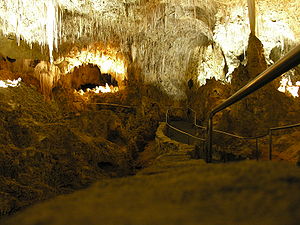
 Balloon Ballroom:Located in the ceiling above the main entrance hall, this small room was first accessed by tying a rope to a whole bunch of balloons and floating them up into the passage.
Bat Cave:A large, unadorned rocky passage connected to the main entrance corridor. The majority of the cave's bat population lives in this portion of the cave, which was mined for bat guano in the early 20th century.
Bell Cord Room:Named for a long, narrow stalactite
coming through a hole in the ceiling, resembling the rope coming through a church steeple to ring the bell. This room is located at the end of the Left Hand Tunnel.
Bifrost Room:Discovered in 1982, it is located in the ceiling above Lake of the Clouds. Its name refers to a Norse myth about a world in the sky that was accessed from Earth by a rainbow. The room was given this name because of its location above the Lake of the Clouds and its colorful oxide-stained formations.
Big Room or The Hall of the Giants:The largest chamber in Carlsbad Caverns, with a floor space of 357469 square feet (33,210 m²).
Chocolate High:A maze of small passages totalling nearly a mile (1500 m) in combined length, discovered in 1993 above a mud-filled pit in the New Mexico Room known as Chocolate Drop.
Green Lake Room:The uppermost of the "Scenic Rooms", it is named for a deep, malachite
-colored pool in the corner of the room. In the 1940s, when the military was testing the feasibility of Carlsbad Cavern as an emergency fallout shelter, the Green Lake was used to look for ripples caused by a nuclear bomb test many miles away. None appeared.
Guadalupe Room:Discovered by a park ranger in 1966, this is the second largest room in Carlsbad Caverns. It is known for its dense collection of "soda straw" stalactite
s.
Hall of the White Giant:A large chamber containing a large, white stalagmite. Rangers regularly lead special wild-cave tours to this room.
King's Palace:The first of four chambers in a wing known as the "scenic rooms", it is named for a large castle-like formation in the center of the room.
Lake of the Clouds:The lowest known point in the cave. It is located in a side passage off the Left Hand Tunnel. It is named for its large lake containing globular, cloud-like rock formations that formed under water when the lake level was much higher.
Left Hand Tunnel:A long, straight passage marked by deep fissures in the floor. These fissures are not known to lead anywhere. The Left Hand Tunnel leads to the Lake of the Clouds and the Bell Cord Room.
Mabel's Room:A moderate-sized room located past the Talcum Passage in Lower Cave.
Mystery Room:A large, sloping room located off the Queen's Chamber, named for an unexplained noise heard only here.
New Mexico Room:Located adjacent to the Green Lake Room and accessed by means of a somewhat narrow corridor.
New Section:A section of fissures east of the White Giant formation and paralleling the Bat Cave. New discoveries are still being made in this section.
Papoose Room:Located between the King's Palace and Queen's Chamber.
Queen's Chamber:Widely regarded as the most beautiful and scenic area of the cave. Jim White's lantern went out in this chamber while he was exploring, and he was in the dark for over half an hour.
Spirit World:Located in the ceiling of the Big Room at its highest point (an area known as the Top of the Cross), this area is filled with white stalagmites that resembled angels to the room's discoverers.
Talcum Passage:A room located in Lower Cave where the floor is coated with gypsum
dust.
The Rookery:One of the larger rooms in Lower Cave. A large number of cave pearls are found in this area.
Underground Lunchroom:Located in the Big Room at the head of the Left Hand Tunnel. It contains a cafeteria that was built in the 1950s, and is where the elevators from the visitor center exit into the cave.
-filled balloon
s attached, the explorers—after several tries over several years—floated a lightweight cord that snagged the target stalagmite. Once the cord was in position up, over, and back to the ground, a climbing rope was pulled into position, and the explorers ascended into what they named The Spirit World. A similar, smaller room was found in the main entrance corridor, and was named Balloon Ballroom in honor of this technique.
In 1993, a series of small passages totaling nearly a mile in combined length was found in the ceiling of the New Mexico Room. Named "Chocolate High", it was the largest discovery in the cave since the Guadalupe Room was found in 1966.
The Bottomless Pit was originally said to have no bottom. Stones were tossed into it, but no sound of the stones striking the bottom was heard. Later exploration revealed the bottom was about 140 feet (40m) deep and covered with soft dirt. The stones made no sound when they struck the bottom because they were lodged in the soft soil.
Lechuguilla Cave
, discovered in 1986, is the focus of much current cave exploration at the park. It has been mapped to a depth of 1600 feet (487.7 m), making it the deepest limestone cave in the U.S. The entrance is in an old mining pit called Misery Hole in an obscure corner of the park. It is not accessible to the general public, and the exact location of Misery Hole is kept relatively hidden in an attempt to preserve the cave undisturbed.
s live in the park, including a large number of Mexican Free-tailed Bat
s. It has been estimated that the population of Mexican Free-tailed Bats once numbered in the millions but has declined drastically in modern times. The cause of this decline is unknown but the pesticide DDT
is often listed as a primary cause. Populations appear to be on the increase in recent years but are nowhere near the levels that may have been historically present. A study published in 2009 by a team from Boston University
questions whether large numbers of bats were ever present at the caverns.
Many techniques have been used to estimate the bat population in the cave. The most recent and most successful of these attempts involved the use of thermal imaging camera to track and count the bats. A count from 2005 estimated a peak of 793,000.
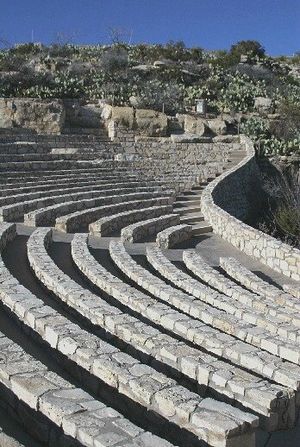
The Mexican Free-tailed Bats are present from April or May to late October or early November. They emerge in a dense group, corkscrewing upwards and counterclockwise, usually starting around sunset and lasting about three hours. (Jim White decided to investigate the caverns when he saw the bats from a distance and at first thought they were a volcano or a whirlwind.) Every early evening from Memorial Day weekend to mid October (with possible exceptions for bad weather), a ranger gives a talk on the bats while visitors sitting in the amphitheater wait to watch the bats come out.
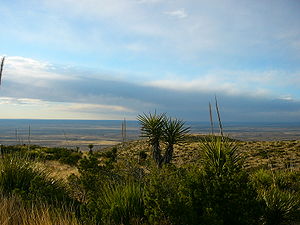
 Three hiking trails and an unpaved drive provide access to the desert scenery and ecosystem. The developed portion around the cave entrance has been designated as The Caverns Historic District
.
A detached part of the park, Rattlesnake Springs Picnic Area, is a natural oasis
with landscaping, picnic tables, and wildlife habitats. As a wooded riparian area in the desert, it has a remarkable variety of birds—over 300 species have been recorded—which makes it "the unofficial Mecca of New Mexico birders". (About 500 species have been recorded in the whole state of New Mexico.) Rattlesnake Springs is designated a historic district on the National Register of Historic Places
. The National Audubon Society
has designated Rattlesnake Springs an Important Bird Area
(IBA). The natural entrance to the caverns is also an IBA because of its colony of Cave Swallow
s, possibly the world's biggest.
Guadalupe Mountains
The Guadalupe Mountains are a mountain range located in West Texas and southeastern New Mexico. The range includes the highest summit in Texas, Guadalupe Peak, , and the "signature peak" of West Texas, El Capitan, both located within Guadalupe Mountains National Park, as well as Carlsbad Caverns...
in southeastern New Mexico
New Mexico
New Mexico is a state located in the southwest and western regions of the United States. New Mexico is also usually considered one of the Mountain States. With a population density of 16 per square mile, New Mexico is the sixth-most sparsely inhabited U.S...
. The primary attraction of the park for most visitors is the show cave
Show cave
Show caves — also called tourist caves, public caves, and in the United States, commercial caves — are caves that are managed by a government or commercial organization and made accessible to the general public, usually for an entrance fee...
, Carlsbad Caverns. Visitors to the cave can hike in on their own via the natural entrance, or take the elevator (the exit for everyone) directly to the Underground Lunchroom some 750 feet (228.6 m) below.
The park has two entries on the National Register of Historic Places
National Register of Historic Places
The National Register of Historic Places is the United States government's official list of districts, sites, buildings, structures, and objects deemed worthy of preservation...
: The Caverns Historic District
The Caverns Historic District
The Caverns Historic District comprises the central developed area of Carlsbad Caverns National Park. The complex was built between the early 1920s and 1942, initially in Pueblo Revival style, and later in New Mexico Territorial Revival style in the area around the natural entrance to Carlsbad...
and the Rattlesnake Springs Historic District
Rattlesnake Springs Historic District
The Rattlesnake Springs Historic District is part of an isolated unit of Carlsbad Caverns National Park, surrounding a spring that creates an oasis in the Chihuahuan Desert. The area was homesteaded and farmed in 1880 by William Henry Harrison. Harrison, who claimed kinship with U.S...
. Approximately two thirds of the park has been set aside as a wilderness area, helping to ensure no future changes will be made to the habitat.
Peak visitation typically occurs on the weekends following Memorial Day
Memorial Day
Memorial Day is a United States federal holiday observed on the last Monday of May. Formerly known as Decoration Day, it originated after the American Civil War to commemorate the fallen Union soldiers of the Civil War...
and the Fourth of July
Independence Day (United States)
Independence Day, commonly known as the Fourth of July, is a federal holiday in the United States commemorating the adoption of the Declaration of Independence on July 4, 1776, declaring independence from the Kingdom of Great Britain...
. The park entrance is located on US Highway 62
U.S. Route 62
U.S. Route 62 runs from the US-Mexico border at El Paso, Texas to Niagara Falls, New York, near the United States-Canada border. It is the only east-west US Route that connects Mexico and Canada.Parts of U.S...
/180
U.S. Route 180
U.S. Route 180 is an east–west United States highway. Like many three-digit routes, US 180 no longer meets its "parent", US 80. US 80 was decommissioned west of Mesquite, Texas, and was replaced in Texas by Interstate 20 and Interstate 10. The highway's eastern terminus is in Hudson Oaks,...
approximately 18 miles (29 km) southwest of Carlsbad, New Mexico
Carlsbad, New Mexico
Carlsbad is a city in and the county seat of Eddy County, New Mexico, in the United States. As of the 2010 census, the city population was 26,138. Carlsbad is the center of the designated micropolitan area of Carlsbad-Artesia, which has a total population of 55,435...
. The park participates in the Junior Ranger Program
Junior Ranger Program
The "Junior Ranger Programs" are activities prepared especially for 5–12 year old visitors to the properties of the National Park Service. Children and their families participate in the program by completing prepared activity books which are generally free, but in a few cases can cost up to $3...
.
Carlsbad Caverns includes a large cave chamber, the Big Room, a natural limestone chamber which is almost 4000 feet (1,219.2 m) long, 625 feet (190.5 m) wide, and 350 feet (106.7 m) high at the highest point. It is the third largest chamber in North America and the seventh largest in the world. The largest in the world is the Sarawak Chamber
Sarawak chamber
The Sarawak Chamber is a huge chamber in Gua Nasib Bagus , which is located in Gunung Mulu National Park, in the Malaysian state of Sarawak on the island of Borneo. It is considered to be the largest known underground chamber in the world....
in Malaysia.
History
From a young age, Jim WhiteJames Larkin White
James Larkin White , better known as Jim White, was a cowboy, guano miner, cave explorer, and park ranger for the National Park Service...
explored the caverns with his homemade wire ladder. When he grew older, most people did not even believe such caves existed. He gave many of the rooms their names, including the Big Room, New Mexico Room, King's Palace, Queen's Chamber, Papoose Room, and Green Lake Room. He also named many of the cave's more prominent formations, such as the Totem Pole, Witch's Finger, Giant Dome, Bottomless Pit, Fairyland, Iceberg Rock, Temple of the Sun, and Rock of Ages.
The town of Carlsbad, which lends its name to the Caverns and National Park, is in turn named after the Czech
Czech Republic
The Czech Republic is a landlocked country in Central Europe. The country is bordered by Poland to the northeast, Slovakia to the east, Austria to the south, and Germany to the west and northwest....
town formerly known by the German
German language
German is a West Germanic language, related to and classified alongside English and Dutch. With an estimated 90 – 98 million native speakers, German is one of the world's major languages and is the most widely-spoken first language in the European Union....
name Karlsbad (modern spelling Carlsbad) and now known by the Czech
Czech language
Czech is a West Slavic language with about 12 million native speakers; it is the majority language in the Czech Republic and spoken by Czechs worldwide. The language was known as Bohemian in English until the late 19th century...
name Karlovy Vary
Karlovy Vary
Karlovy Vary is a spa city situated in western Bohemia, Czech Republic, on the confluence of the rivers Ohře and Teplá, approximately west of Prague . It is named after King of Bohemia and Holy Roman Emperor Charles IV, who founded the city in 1370...
, both of which mean "Charles
Charles IV, Holy Roman Emperor
Charles IV , born Wenceslaus , was the second king of Bohemia from the House of Luxembourg, and the first king of Bohemia to also become Holy Roman Emperor....
' Bath[s]."
Until 1932, visitors to the cavern had to walk down a switch back ramp-sidewalk that took them 750 feet below the surface. The walk back up was hard on a lot of visitors. In 1932 the National Park opened up a large visitor center building that contained two elevators that would take visitors to the caverns below. The new center included a cafeteria, waiting room, museum and first aid area.
Legislative history
- October 25, 1923 – President Calvin CoolidgeCalvin CoolidgeJohn Calvin Coolidge, Jr. was the 30th President of the United States . A Republican lawyer from Vermont, Coolidge worked his way up the ladder of Massachusetts state politics, eventually becoming governor of that state...
signed a proclamation (1679-Oct. 25, 1923-43 Stat. 1929) establishing Carlsbad Cave National Monument. - April 2, 1924 – President Calvin Coolidge issued an executive order (3984) for a possible national park or monument at the site.
- May 3, 1928 – a supplemental executive order (4870) was issued reserving additional land for the possible monument or park.
- May 14, 1930 – an act of the United States CongressUnited States CongressThe United States Congress is the bicameral legislature of the federal government of the United States, consisting of the Senate and the House of Representatives. The Congress meets in the United States Capitol in Washington, D.C....
(46 Stat. 279) established Carlsbad Caverns National Park to be directed by the Secretary of the InteriorUnited States Secretary of the InteriorThe United States Secretary of the Interior is the head of the United States Department of the Interior.The US Department of the Interior should not be confused with the concept of Ministries of the Interior as used in other countries...
and administered by the National Park ServiceNational Park ServiceThe National Park Service is the U.S. federal agency that manages all national parks, many national monuments, and other conservation and historical properties with various title designations...
. - June 17, 1930 – President Herbert HooverHerbert HooverHerbert Clark Hoover was the 31st President of the United States . Hoover was originally a professional mining engineer and author. As the United States Secretary of Commerce in the 1920s under Presidents Warren Harding and Calvin Coolidge, he promoted partnerships between government and business...
signed Executive Order 5370 reserving additional land for classification. - 1978 – Carlsbad Caverns Wilderness was established with the National Parks and Recreation Act (95-625) signed by President Jimmy CarterJimmy CarterJames Earl "Jimmy" Carter, Jr. is an American politician who served as the 39th President of the United States and was the recipient of the 2002 Nobel Peace Prize, the only U.S. President to have received the Prize after leaving office...
.
Named rooms
Bat Cave:A large, unadorned rocky passage connected to the main entrance corridor. The majority of the cave's bat population lives in this portion of the cave, which was mined for bat guano in the early 20th century.
Bell Cord Room:Named for a long, narrow stalactite
Stalactite
A stalactite , "to drip", and meaning "that which drips") is a type of speleothem that hangs from the ceiling of limestone caves. It is a type of dripstone...
coming through a hole in the ceiling, resembling the rope coming through a church steeple to ring the bell. This room is located at the end of the Left Hand Tunnel.
Bifrost Room:Discovered in 1982, it is located in the ceiling above Lake of the Clouds. Its name refers to a Norse myth about a world in the sky that was accessed from Earth by a rainbow. The room was given this name because of its location above the Lake of the Clouds and its colorful oxide-stained formations.
Big Room or The Hall of the Giants:The largest chamber in Carlsbad Caverns, with a floor space of 357469 square feet (33,210 m²).
Chocolate High:A maze of small passages totalling nearly a mile (1500 m) in combined length, discovered in 1993 above a mud-filled pit in the New Mexico Room known as Chocolate Drop.
Green Lake Room:The uppermost of the "Scenic Rooms", it is named for a deep, malachite
Malachite
Malachite is a copper carbonate mineral, with the formula Cu2CO32. This green-colored mineral crystallizes in the monoclinic crystal system, and most often forms botryoidal, fibrous, or stalagmitic masses. Individual crystals are rare but do occur as slender to acicular prisms...
-colored pool in the corner of the room. In the 1940s, when the military was testing the feasibility of Carlsbad Cavern as an emergency fallout shelter, the Green Lake was used to look for ripples caused by a nuclear bomb test many miles away. None appeared.
Guadalupe Room:Discovered by a park ranger in 1966, this is the second largest room in Carlsbad Caverns. It is known for its dense collection of "soda straw" stalactite
Stalactite
A stalactite , "to drip", and meaning "that which drips") is a type of speleothem that hangs from the ceiling of limestone caves. It is a type of dripstone...
s.
Hall of the White Giant:A large chamber containing a large, white stalagmite. Rangers regularly lead special wild-cave tours to this room.
King's Palace:The first of four chambers in a wing known as the "scenic rooms", it is named for a large castle-like formation in the center of the room.
Lake of the Clouds:The lowest known point in the cave. It is located in a side passage off the Left Hand Tunnel. It is named for its large lake containing globular, cloud-like rock formations that formed under water when the lake level was much higher.
Left Hand Tunnel:A long, straight passage marked by deep fissures in the floor. These fissures are not known to lead anywhere. The Left Hand Tunnel leads to the Lake of the Clouds and the Bell Cord Room.
Mabel's Room:A moderate-sized room located past the Talcum Passage in Lower Cave.
Mystery Room:A large, sloping room located off the Queen's Chamber, named for an unexplained noise heard only here.
New Mexico Room:Located adjacent to the Green Lake Room and accessed by means of a somewhat narrow corridor.
New Section:A section of fissures east of the White Giant formation and paralleling the Bat Cave. New discoveries are still being made in this section.
Papoose Room:Located between the King's Palace and Queen's Chamber.
Queen's Chamber:Widely regarded as the most beautiful and scenic area of the cave. Jim White's lantern went out in this chamber while he was exploring, and he was in the dark for over half an hour.
Spirit World:Located in the ceiling of the Big Room at its highest point (an area known as the Top of the Cross), this area is filled with white stalagmites that resembled angels to the room's discoverers.
Talcum Passage:A room located in Lower Cave where the floor is coated with gypsum
Gypsum
Gypsum is a very soft sulfate mineral composed of calcium sulfate dihydrate, with the chemical formula CaSO4·2H2O. It is found in alabaster, a decorative stone used in Ancient Egypt. It is the second softest mineral on the Mohs Hardness Scale...
dust.
The Rookery:One of the larger rooms in Lower Cave. A large number of cave pearls are found in this area.
Underground Lunchroom:Located in the Big Room at the head of the Left Hand Tunnel. It contains a cafeteria that was built in the 1950s, and is where the elevators from the visitor center exit into the cave.
Recent exploration
In 1985 a very distinctive method of exploration was invented. In a dome area 255 feet (77.7 m) above the Big Room floor not far from the Bottomless Pit, a stalagmite leaned out. Using a balsa wood loop with heliumHelium
Helium is the chemical element with atomic number 2 and an atomic weight of 4.002602, which is represented by the symbol He. It is a colorless, odorless, tasteless, non-toxic, inert, monatomic gas that heads the noble gas group in the periodic table...
-filled balloon
Balloon
A balloon is an inflatable flexible bag filled with a gas, such as helium, hydrogen, nitrous oxide, oxygen, or air. Modern balloons can be made from materials such as rubber, latex, polychloroprene, or a nylon fabric, while some early balloons were made of dried animal bladders, such as the pig...
s attached, the explorers—after several tries over several years—floated a lightweight cord that snagged the target stalagmite. Once the cord was in position up, over, and back to the ground, a climbing rope was pulled into position, and the explorers ascended into what they named The Spirit World. A similar, smaller room was found in the main entrance corridor, and was named Balloon Ballroom in honor of this technique.
In 1993, a series of small passages totaling nearly a mile in combined length was found in the ceiling of the New Mexico Room. Named "Chocolate High", it was the largest discovery in the cave since the Guadalupe Room was found in 1966.
The Bottomless Pit was originally said to have no bottom. Stones were tossed into it, but no sound of the stones striking the bottom was heard. Later exploration revealed the bottom was about 140 feet (40m) deep and covered with soft dirt. The stones made no sound when they struck the bottom because they were lodged in the soft soil.
Other caves
The park contains 116 caves. The only other one open to the public is Slaughter Canyon Cave, which also has striking rock formations. No paving or lighting has been installed, and visitors may enter only on guided tours with a ranger.Lechuguilla Cave
Lechuguilla Cave
Lechuguilla Cave is, as of June 2011, the sixth longest cave known to exist in the world, and the deepest in the continental United States , but it is most famous for its unusual geology, rare formations, and pristine condition....
, discovered in 1986, is the focus of much current cave exploration at the park. It has been mapped to a depth of 1600 feet (487.7 m), making it the deepest limestone cave in the U.S. The entrance is in an old mining pit called Misery Hole in an obscure corner of the park. It is not accessible to the general public, and the exact location of Misery Hole is kept relatively hidden in an attempt to preserve the cave undisturbed.
Bats
Seventeen species of batBat
Bats are mammals of the order Chiroptera "hand" and pteron "wing") whose forelimbs form webbed wings, making them the only mammals naturally capable of true and sustained flight. By contrast, other mammals said to fly, such as flying squirrels, gliding possums, and colugos, glide rather than fly,...
s live in the park, including a large number of Mexican Free-tailed Bat
Mexican Free-tailed Bat
The Mexican free-tailed bat , also known as the Brazilian free-tailed bat, is a medium-sized bat that is native to the Americas and is widely regarded as one of the most abundant mammals in North America...
s. It has been estimated that the population of Mexican Free-tailed Bats once numbered in the millions but has declined drastically in modern times. The cause of this decline is unknown but the pesticide DDT
DDT
DDT is one of the most well-known synthetic insecticides. It is a chemical with a long, unique, and controversial history....
is often listed as a primary cause. Populations appear to be on the increase in recent years but are nowhere near the levels that may have been historically present. A study published in 2009 by a team from Boston University
Boston University
Boston University is a private research university located in Boston, Massachusetts. With more than 4,000 faculty members and more than 31,000 students, Boston University is one of the largest private universities in the United States and one of Boston's largest employers...
questions whether large numbers of bats were ever present at the caverns.
Many techniques have been used to estimate the bat population in the cave. The most recent and most successful of these attempts involved the use of thermal imaging camera to track and count the bats. A count from 2005 estimated a peak of 793,000.
The Mexican Free-tailed Bats are present from April or May to late October or early November. They emerge in a dense group, corkscrewing upwards and counterclockwise, usually starting around sunset and lasting about three hours. (Jim White decided to investigate the caverns when he saw the bats from a distance and at first thought they were a volcano or a whirlwind.) Every early evening from Memorial Day weekend to mid October (with possible exceptions for bad weather), a ranger gives a talk on the bats while visitors sitting in the amphitheater wait to watch the bats come out.
Other attractions
The Caverns Historic District
The Caverns Historic District comprises the central developed area of Carlsbad Caverns National Park. The complex was built between the early 1920s and 1942, initially in Pueblo Revival style, and later in New Mexico Territorial Revival style in the area around the natural entrance to Carlsbad...
.
A detached part of the park, Rattlesnake Springs Picnic Area, is a natural oasis
Oasis
In geography, an oasis or cienega is an isolated area of vegetation in a desert, typically surrounding a spring or similar water source...
with landscaping, picnic tables, and wildlife habitats. As a wooded riparian area in the desert, it has a remarkable variety of birds—over 300 species have been recorded—which makes it "the unofficial Mecca of New Mexico birders". (About 500 species have been recorded in the whole state of New Mexico.) Rattlesnake Springs is designated a historic district on the National Register of Historic Places
National Register of Historic Places
The National Register of Historic Places is the United States government's official list of districts, sites, buildings, structures, and objects deemed worthy of preservation...
. The National Audubon Society
National Audubon Society
The National Audubon Society is an American non-profit environmental organization dedicated to conservation. Incorporated in 1905, Audubon is one of the oldest of such organizations in the world and uses science, education and grassroots advocacy to advance its conservation mission...
has designated Rattlesnake Springs an Important Bird Area
Important Bird Area
An Important Bird Area is an area recognized as being globally important habitat for the conservation of bird populations. Currently there are about 10,000 IBAs worldwide. The program was developed and sites are identified by BirdLife International...
(IBA). The natural entrance to the caverns is also an IBA because of its colony of Cave Swallow
Cave Swallow
The Cave Swallow, Petrochelidon fulva, is a medium-sized, squarish tailed swallow belonging to the same genus as the more familiar and widespread Cliff Swallow of North America...
s, possibly the world's biggest.
Gallery
For more images on Wikipedia, see Commons:Category:Carlsbad Caverns National ParkSee also
- U.S. Forest Service Blanchard Springs CavernsBlanchard Springs CavernsBlanchard Springs Caverns is a cave system located in the Ozark National Forest in Stone County in northern Arkansas, 2 miles off Highway 14 a short distance north of Mountain View. Blanchard Springs Caverns is a three-level cave system, two of which are open for guided tours. The Dripstone Trail...
- Mammoth Cave National ParkMammoth Cave National ParkMammoth Cave National Park is a U.S. National Park in central Kentucky, encompassing portions of Mammoth Cave, the longest cave system known in the world. The official name of the system is the Mammoth-Flint Ridge Cave System for the ridge under which the cave has formed. The park was established...
- Guadalupe Mountains National ParkGuadalupe Mountains National ParkGuadalupe Mountains National Park is located in the Guadalupe Mountains of West Texas and contains Guadalupe Peak, the highest point in Texas at in elevation. It also contains El Capitan, long used as a landmark by people traveling along the old route later followed by the Butterfield Overland...
- McKittrick CanyonMcKittrick CanyonMcKittrick Canyon is a scenic canyon within the Guadalupe Mountains of West Texas. The steep towering walls of McKittrick Canyon protect a rich riparian oasis in the midst of the Chihuahuan Desert....
- Wind Cave National ParkWind Cave National ParkWind Cave National Park is a United States national park north of the town of Hot Springs in western South Dakota. Established in 1903 by President Theodore Roosevelt, it was the seventh U.S. National Park and the first cave to be designated a national park anywhere in the world. The cave is...
- List of areas in the National Park System of the United States
External links
- Official site: Carlsbad Caverns National Park
- Climate data for Carlsbad Caverns National Park
- USGS 3D Photographic Geology Tour for Carlsbad Caverns National Park
- Historical Dates in the history of Carlsbad Caverns National Park and SouthEast New Mexico
- NPS geology fieldnotes website for Carlsbad Caverns National Park
- Carlsbad Caverns at AmazingPlanet.info
- Another World, Underground: Carlsbad Caverns National Park in New Mexico, an April 2011 radio and Internet feature by the Special EnglishSpecial EnglishSpecial English is a controlled version of the English language first used on October 19, 1959, and still presented daily by the United States broadcasting service Voice of America. World news and other programs are read one-third slower than regular VOA English. Reporters avoid idioms and use a...
service of the Voice of AmericaVoice of AmericaVoice of America is the official external broadcast institution of the United States federal government. It is one of five civilian U.S. international broadcasters working under the umbrella of the Broadcasting Board of Governors . VOA provides a wide range of programming for broadcast on radio...
.