


Canary Wharf

Encyclopedia
Canary Wharf is a major business district
located in London
, United Kingdom
. It is one of London's two main financial centres, alongside the traditional City of London
, and contains many of the UK's tallest buildings, including the second-tallest (and tallest completed), One Canada Square
. Canary Wharf contains around 14000000 square feet (1,300,642.6 m²) of office and retail space, of which around 7900000 square feet (733,934 m²) is owned by Canary Wharf Group
. Around 90,000 people work in Canary Wharf and it is home to the world or European headquarters of numerous major banks, professional services firms and media organisations including Barclays, Citigroup
, Clifford Chance
, Credit Suisse
, HSBC
, KPMG
, MetLife, Skadden
, State Street and Thomson Reuters
.
Canary Wharf is located in the West India Docks
on the Isle of Dogs
in the Borough of Tower Hamlets
in East London
. The West India Docks once formed part of the busiest port in the world. After the docks were closed in 1980 the British Government
adopted various policies to stimulate the redevelopment of the area, including through the creation of the London Docklands Development Corporation
in 1981 and granting the Isle of Dogs Enterprise Zone
status in 1982. In 1987 the Canadian
company Olympia and York
agreed to construct a major office development on the Isle of Dogs, with construction commencing in 1988.
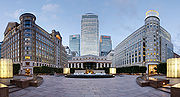 Canary Wharf is located on the site of the West India Docks
on the Isle of Dogs
. From 1802, the area was one of the busiest docks in the world. By the 1950s, the port industry began to decline, leading to the docks closing by 1980.
Canary Wharf itself takes its name from No. 32 berth of the West Wood Quay of the Import Dock. This was built in 1936 for Fruit Lines Ltd, a subsidiary of Fred Olsen Lines for the Mediterranean and Canary Island (Insula Canaria (from canis) "Island of Dogs") fruit trade. At their request, the quay and warehouse were given the name Canary Wharf.
The Canary Wharf of today began when Michael von Clemm
, former chairman of Credit Suisse First Boston
(CSFB), came up with the idea to convert Canary Wharf into back office
. Further discussions with G Ware Travelstead
led to proposals for a new business district. The project was sold to Olympia & York and construction began in 1988, master-planned by Skidmore Owings & Merrill and subsequently by Koetter Kim. The first buildings were completed in 1991 which included One Canada Square
that became the UK's tallest building and a powerful symbol of the regeneration of Docklands. Upon opening, the London commercial property market had collapsed and Olympia and York Canary Wharf Limited filed for bankruptcy in May 1992.
However, over the course of the development relations with the local community have improved and more than 7,000 local (Tower Hamlets) residents work at Canary Wharf.
In 1997, some residents living on the Isle of Dogs launched a lawsuit against Canary Wharf Ltd for private nuisance because the tower caused interference with television signals. The residents lost the case.
.
Recovery in the property market generally, coupled with continuing demand for high floor-plate grade A office accommodation, slowly improved the level of interest in the estate. A critical event in the recovery of Canary Wharf was the much-delayed start of work on the Jubilee Line, which the government wanted ready for the Millennium
celebrations.
In March 2004 Canary Wharf Group plc was forced to be taken over by a consortium of investors backed by its largest shareholder Glick Family Investments and led by Morgan Stanley
using a vehicle named Songbird Estates plc. At the peak of property prices in 2007, the HSBC building sold for a record £1.1 billion.
, and with an interchange to the London Underground
. London City Airport
DLR station
is situated immediately adjacent to the terminal building, with enclosed access to and from the elevated platforms.
and terminates at Crossharbour, the 277
route that begins at Highbury & Islington and ends at Leamouth
, and the N550 night bus route that travels from Canning Town
and ends at Trafalgar Square
. Canary Wharf is also served by local buses that goes mostly around the London Docklands area, that include routes D3, D6, D7 and D8. There's also the Docklands Buses
, of which includes 6 more bus routes in the Docklands.
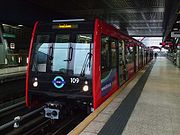
plans, but when the DLR opened in August 1987 the station was not ready. It was originally planned that the station would be similar to the original station at Heron Quays
, with two small platforms either side of the tracks.The station is located on the DLR between Heron Quays station and the West India Quay station, in Travelcard Zone 2
, which are in fact the three closest train stations on the same line in the world.
The station has two platforms in use, is in Travelcard Zone 2
, and is on the Lewisham
branch of the Docklands Light Railway
, between Canary Wharf and South Quay.
The station was moved 200 metres south (to fit inside the new buildings) and a longer platform was built at this new site to accommodate three-unit trains planned as part of the DLR Capacity Enhancement; the station re-opened on 18 December 2002.
is a two platform station designed by Norman Foster and opened in 1999 as part of the Jubilee Line Extension
from Charing Cross to Stratford. Canary Wharf station has increasingly become one of the busiest stations on the network, serving the ever-expanding Canary Wharf business district.
The station was used as a location for some scenes of Danny Boyle
's 2002 film 28 Days Later
and its sequel 28 Weeks Later
which was mostly based in Canary Wharf.
project. The station will have two platforms and will be in the Travelcard Zone 2
.
Central business district
A central business district is the commercial and often geographic heart of a city. In North America this part of a city is commonly referred to as "downtown" or "city center"...
located in London
London
London is the capital city of :England and the :United Kingdom, the largest metropolitan area in the United Kingdom, and the largest urban zone in the European Union by most measures. Located on the River Thames, London has been a major settlement for two millennia, its history going back to its...
, United Kingdom
United Kingdom
The United Kingdom of Great Britain and Northern IrelandIn the United Kingdom and Dependencies, other languages have been officially recognised as legitimate autochthonous languages under the European Charter for Regional or Minority Languages...
. It is one of London's two main financial centres, alongside the traditional City of London
City of London
The City of London is a small area within Greater London, England. It is the historic core of London around which the modern conurbation grew and has held city status since time immemorial. The City’s boundaries have remained almost unchanged since the Middle Ages, and it is now only a tiny part of...
, and contains many of the UK's tallest buildings, including the second-tallest (and tallest completed), One Canada Square
One Canada Square
One Canada Square is a skyscraper in Canary Wharf in the London Borough of Tower Hamlets. It is the tallest completed building in the United Kingdom since 1991, standing at above ground level and containing 50 storeys...
. Canary Wharf contains around 14000000 square feet (1,300,642.6 m²) of office and retail space, of which around 7900000 square feet (733,934 m²) is owned by Canary Wharf Group
Canary Wharf Group
Canary Wharf Group plc is the owner and developer of nearly of property at Canary Wharf in London. It is notable because over the last 10 years it has constructed more office space in London than any other developer...
. Around 90,000 people work in Canary Wharf and it is home to the world or European headquarters of numerous major banks, professional services firms and media organisations including Barclays, Citigroup
Citigroup
Citigroup Inc. or Citi is an American multinational financial services corporation headquartered in Manhattan, New York City, New York, United States. Citigroup was formed from one of the world's largest mergers in history by combining the banking giant Citicorp and financial conglomerate...
, Clifford Chance
Clifford Chance
Clifford Chance LLP is a global law firm headquartered in London, United Kingdom and a member of the 'Magic Circle' of leading UK law firms. It is one of the ten largest law firms in the world measured by both number of lawyers and revenue...
, Credit Suisse
Credit Suisse
The Credit Suisse Group AG is a Swiss multinational financial services company headquartered in Zurich, with more than 250 branches in Switzerland and operations in more than 50 countries.-History:...
, HSBC
HSBC
HSBC Holdings plc is a global banking and financial services company headquartered in Canary Wharf, London, United Kingdom. it is the world's second-largest banking and financial services group and second-largest public company according to a composite measure by Forbes magazine...
, KPMG
KPMG
KPMG is one of the largest professional services networks in the world and one of the Big Four auditors, along with Deloitte, Ernst & Young and PwC. Its global headquarters is located in Amstelveen, Netherlands....
, MetLife, Skadden
Skadden, Arps, Slate, Meagher & Flom
Skadden, Arps, Slate, Meagher & Flom LLP and Affiliates , founded in 1948, is a prominent law firm based in New York City. With over 2,000 attorneys, it is one of the largest and highest-grossing law firms in the world. Forbes magazine calls Skadden "Wall Street's most powerful law firm"...
, State Street and Thomson Reuters
Thomson Reuters
Thomson Reuters Corporation is a provider of information for the world's businesses and professionals and is created by the Thomson Corporation's purchase of Reuters Group on 17 April 2008. Thomson Reuters is headquartered at 3 Times Square, New York City, USA...
.
Canary Wharf is located in the West India Docks
West India Docks
The West India Docks are a series of three docks on the Isle of Dogs in London, the first of which opened in 1802. The docks closed to commercial traffic in 1980 and the Canary Wharf development was built on the site.-History:...
on the Isle of Dogs
Isle of Dogs
The Isle of Dogs is a former island in the East End of London that is bounded on three sides by one of the largest meanders in the River Thames.-Etymology:...
in the Borough of Tower Hamlets
London Borough of Tower Hamlets
The London Borough of Tower Hamlets is a London borough to the east of the City of London and north of the River Thames. It is in the eastern part of London and covers much of the traditional East End. It also includes much of the redeveloped Docklands region of London, including West India Docks...
in East London
East End of London
The East End of London, also known simply as the East End, is the area of London, England, United Kingdom, east of the medieval walled City of London and north of the River Thames. Although not defined by universally accepted formal boundaries, the River Lea can be considered another boundary...
. The West India Docks once formed part of the busiest port in the world. After the docks were closed in 1980 the British Government
Government of the United Kingdom
Her Majesty's Government is the central government of the United Kingdom of Great Britain and Northern Ireland. The Government is led by the Prime Minister, who selects all the remaining Ministers...
adopted various policies to stimulate the redevelopment of the area, including through the creation of the London Docklands Development Corporation
London Docklands Development Corporation
The London Docklands Development Corporation was a quango agency set up by the UK Government in 1981 to regenerate the depressed Docklands area of east London. During its eighteen-year existence it was responsible for regenerating an area of in the London Boroughs of Newham, Tower Hamlets and...
in 1981 and granting the Isle of Dogs Enterprise Zone
Urban Enterprise Zone
In the United States, Urban Enterprise Zones , also known as Enterprise Zones, are intended to encourage development in blighted neighborhoods through tax and regulatory relief to entrepreneurs and investors who launch businesses in the area. UEZs are areas where companies can locate free of...
status in 1982. In 1987 the Canadian
Canada
Canada is a North American country consisting of ten provinces and three territories. Located in the northern part of the continent, it extends from the Atlantic Ocean in the east to the Pacific Ocean in the west, and northward into the Arctic Ocean...
company Olympia and York
Olympia and York
Olympia & York was once a major international property development firm based in Canada. The firm built major financial office complexes like Canary Wharf in London, the World Financial Center in New York City and First Canadian Place in Toronto...
agreed to construct a major office development on the Isle of Dogs, with construction commencing in 1988.
History
West India Docks
The West India Docks are a series of three docks on the Isle of Dogs in London, the first of which opened in 1802. The docks closed to commercial traffic in 1980 and the Canary Wharf development was built on the site.-History:...
on the Isle of Dogs
Isle of Dogs
The Isle of Dogs is a former island in the East End of London that is bounded on three sides by one of the largest meanders in the River Thames.-Etymology:...
. From 1802, the area was one of the busiest docks in the world. By the 1950s, the port industry began to decline, leading to the docks closing by 1980.
Canary Wharf itself takes its name from No. 32 berth of the West Wood Quay of the Import Dock. This was built in 1936 for Fruit Lines Ltd, a subsidiary of Fred Olsen Lines for the Mediterranean and Canary Island (Insula Canaria (from canis) "Island of Dogs") fruit trade. At their request, the quay and warehouse were given the name Canary Wharf.
The Canary Wharf of today began when Michael von Clemm
Michael von Clemm
Dr Michael von Clemm was an American businessman, restaurateur, anthropologist and President of Templeton College, Oxford. Although in one interpretation of his life, he was merely a high-flying banker, he could also have been said to have helped start the restaurant revolution in the UK of the...
, former chairman of Credit Suisse First Boston
Credit Suisse First Boston
Credit Suisse First Boston was the former name of the banking firm Credit Suisse.-History:In 1978, Credit Suisse and First Boston Corporation formed a London-based 50-50 investment banking joint venture called the Financière Crédit Suisse-First Boston...
(CSFB), came up with the idea to convert Canary Wharf into back office
Back office
A back office is a part of most corporations where tasks dedicated to running the company itself takes place. The term "Back office" comes from the building layout of early companies where the front office would contain the sales and other customer-facing staff and the back office would be those...
. Further discussions with G Ware Travelstead
G Ware Travelstead
Gooch Ware "G" Travelstead is an American property developer and entrepreneur, born in Kentucky in 1938.While head of First Boston Real Estate, a subsidiary of Credit Suisse First Boston, Travelstead was the original designer and promoter of the Canary Wharf estate in London Docklands.- Family...
led to proposals for a new business district. The project was sold to Olympia & York and construction began in 1988, master-planned by Skidmore Owings & Merrill and subsequently by Koetter Kim. The first buildings were completed in 1991 which included One Canada Square
One Canada Square
One Canada Square is a skyscraper in Canary Wharf in the London Borough of Tower Hamlets. It is the tallest completed building in the United Kingdom since 1991, standing at above ground level and containing 50 storeys...
that became the UK's tallest building and a powerful symbol of the regeneration of Docklands. Upon opening, the London commercial property market had collapsed and Olympia and York Canary Wharf Limited filed for bankruptcy in May 1992.
Local opposition
The idea of a new financial services district was not popular with local residents as the expectation was that the development would provide no local jobs or transport improvements.However, over the course of the development relations with the local community have improved and more than 7,000 local (Tower Hamlets) residents work at Canary Wharf.
In 1997, some residents living on the Isle of Dogs launched a lawsuit against Canary Wharf Ltd for private nuisance because the tower caused interference with television signals. The residents lost the case.
Rescue and recovery
In December 1995 an international consortium, backed by the former owners of Olympia & York and other investors, bought the scheme. The new company was called Canary Wharf Limited, and later became Canary Wharf GroupCanary Wharf Group
Canary Wharf Group plc is the owner and developer of nearly of property at Canary Wharf in London. It is notable because over the last 10 years it has constructed more office space in London than any other developer...
.
Recovery in the property market generally, coupled with continuing demand for high floor-plate grade A office accommodation, slowly improved the level of interest in the estate. A critical event in the recovery of Canary Wharf was the much-delayed start of work on the Jubilee Line, which the government wanted ready for the Millennium
Millennium
A millennium is a period of time equal to one thousand years —from the Latin phrase , thousand, and , year—often but not necessarily related numerically to a particular dating system....
celebrations.
In March 2004 Canary Wharf Group plc was forced to be taken over by a consortium of investors backed by its largest shareholder Glick Family Investments and led by Morgan Stanley
Morgan Stanley
Morgan Stanley is a global financial services firm headquartered in New York City serving a diversified group of corporations, governments, financial institutions, and individuals. Morgan Stanley also operates in 36 countries around the world, with over 600 offices and a workforce of over 60,000....
using a vehicle named Songbird Estates plc. At the peak of property prices in 2007, the HSBC building sold for a record £1.1 billion.
Completed buildings over 60 metres
| Ranking by height | Image | Name | Height | Floors | Completion date | Commentary | |
|---|---|---|---|---|---|---|---|
| Metres | Feet | ||||||
| 1 | One Canada Square One Canada Square One Canada Square is a skyscraper in Canary Wharf in the London Borough of Tower Hamlets. It is the tallest completed building in the United Kingdom since 1991, standing at above ground level and containing 50 storeys... |
235 | 771 | 50 | 1991 | This is the 15th-tallest building in Europe and currently the tallest completed building in the United Kingdom. Designed by Cesar Pelli, it was the tallest building in Europe upon completion in 1991. Multi-tenanted; occupiers include The Bank of New York Mellon, the CFA Institute CFA Institute CFA Institute is headquartered in the United States of America at Charlottesville, Virginia, with offices in Hong Kong and London. Formerly known as the Association for Investment Management and Research , CFA Institute awards the Chartered Financial Analyst designation... , Clearstream Clearstream Clearstream Banking S.A. is the clearing and settlement division of Deutsche Börse, based in Luxembourg and Frankfurt. Clearstream was created in January 2000 through the merger of Cedel International and Deutsche Börse Clearing... , Euler Hermes Euler Hermes Euler Hermes is a French credit insurance company majority-owned by Allianz France which is in turn owned by Germany's Allianz SE.It claims to have 36% of the total credit insurance market. Euler Hermes is the result of the acquisition of Allianz's Hermes by AGF's Euler in 2002... , the International Sugar Organization International Sugar Organization The International Sugar Organization is an intergovernmental organization, based in London, which was established by the International Sugar Agreement of 1968, as the body responsible for administering the Agreement... , Mahindra Satyam, MetLife, Moody's Analytics Moody's Analytics Moody’s Analytics provides capital markets and risk management professionals with credit analysis, economic research, financial risk management software, and advisory services... and Trinity Mirror Trinity Mirror Trinity Mirror plc is a large British newspaper and magazine publisher. It is Britain's biggest newspaper group, publishing 240 regional papers as well as the national Daily Mirror, Sunday Mirror and People, and the Scottish Sunday Mail and Daily Record. Its headquarters are at Canary Wharf in... . |
|
| 2= | 8 Canada Square | 200 | 655 | 42 | 2002 | The 26th tallest building in Europe, third-tallest completed building in the United Kingdom. Occupied by HSBC HSBC HSBC Holdings plc is a global banking and financial services company headquartered in Canary Wharf, London, United Kingdom. it is the world's second-largest banking and financial services group and second-largest public company according to a composite measure by Forbes magazine... as their world headquarters. |
|
| 2= | 25 Canada Square | 200 | 655 | 42 | 2001 | The 26th tallest building in Europe, third-tallest completed building in the United Kingdom. 25 Canada Square and 33 Canada Square together form a single complex known as the Citigroup Centre. Primarily occupied by Citigroup Citigroup Citigroup Inc. or Citi is an American multinational financial services corporation headquartered in Manhattan, New York City, New York, United States. Citigroup was formed from one of the world's largest mergers in history by combining the banking giant Citicorp and financial conglomerate... as their EMEA EMEA EMEA may stand for:* the previous acronym of the European Medicines Agency, an EU regulatory agency for the evaluation of medicinal products* Europe, the Middle East and Africa... headquarters. Other tenants include 3i Infotech 3i Infotech Limited 3i Infotech Ltd is an IT global information technology company, based in India. It is also among the top 3 Indian Software Products Companies.... , Crossrail Crossrail Crossrail is a project to build a major new railway link under central London. The name refers to the first of two routes which are the responsibility of Crossrail Ltd. It is based on an entirely new east-west tunnel with a central section from to Liverpool Street station... , Instinet Instinet Instinet is an institutional, agency-only broker. As such, it executes trades for roughly 1,500 “buyside” clients such as asset management firms, hedge funds, insurance companies, mutual funds and pension funds... , Munich Re Munich Re Munich Re Group is a reinsurance company based in Munich, Germany. It is one of the world’s leading reinsurers. ERGO, a Munich Re subsidiary, is the Group’s primary insurance arm.... , MWB Group MWB Group Holdings MWB Group Holdings is a British-based property investment and development business. It is headquartered in London and is listed on the London Stock Exchange. In 2008, the group had revenues of £277.8 million.-History:... , SunGard SunGard SunGard is a multinational company based in Wayne, Pennsylvania, which provides software and services to education, financial services, and public sector organizations. It was formed in 1983, as a spin-off of the computer services division of Sun Oil Company, during a period of low crude oil... and Wells Fargo Wells Fargo Wells Fargo & Company is an American multinational diversified financial services company with operations around the world. Wells Fargo is the fourth largest bank in the U.S. by assets and the largest bank by market capitalization. Wells Fargo is the second largest bank in deposits, home... . |
|
| 4 | 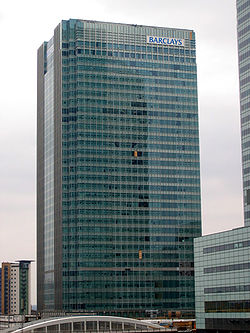 |
One Churchill Place One Churchill Place One Churchill Place is a 156 m tall skyscraper with 32 floors, serving as the headquarters of Barclays Bank. It is in the Docklands area of London in Canary Wharf... |
156 | 513 | 32 | 2005 | Occupied by Barclays as their world headquarters. Currently the seventh-tallest building in the United Kingdom, it was originally planned to be 50 stories in height, but was scaled down to 31 after the September 11 attacks. |
| 5= |  |
40 Bank Street 40 Bank Street 40 Bank Street is a skyscraper in Heron Quays, Docklands, London. It is tall and has 33 floors. The building was designed by Cesar Pelli & Associates and it was built by Canary Wharf Contractors.... |
153 | 502 | 33 | 2003 | Multi-tenanted; occupiers include Allen & Overy Allen & Overy Allen & Overy is a global law firm headquartered in London, United Kingdom.A member of the UK's Magic Circle of leading law firms, Allen & Overy is widely considered to be one of the world's elite law firms, advising national and multinational corporations, financial institutions, and... , ANZ Bank ANZ Bank The Australia and New Zealand Banking Group Limited , commonly called ANZ, is the fourth largest bank in Australia, after the Commonwealth Bank, Westpac Banking Corporation and the National Australia Bank. Australian operations make up the largest part of ANZ's business, with commercial and retail... , China Construction Bank China Construction Bank China Construction Bank is one of the 'big four' banks in the People's Republic of China. To date, it is ranked as the nation's second largest and the second largest bank in the world by market capitalization and 12th largest company in the world. The bank has approximately 13,629 domestic branches... , Duff & Phelps Duff & Phelps Duff & Phelps Corporation a publicly traded financial advisory and investment banking firm, providing services principally in the areas of valuation, transactions, financial restructuring, dispute and taxation... , Saxo Bank Saxo Bank Saxo Bank is an online Danish investment bank. It was founded as a brokerage firm in 1992, under the name Midas Fondsmæglerselskab, by Lars Seier Christensen, Kim Fournais and Marc Hauschildt. The name was changed to Saxo when the company obtained a banking license in 2001. Saxo offers trading... and Skadden, Arps, Slate, Meagher & Flom Skadden, Arps, Slate, Meagher & Flom Skadden, Arps, Slate, Meagher & Flom LLP and Affiliates , founded in 1948, is a prominent law firm based in New York City. With over 2,000 attorneys, it is one of the largest and highest-grossing law firms in the world. Forbes magazine calls Skadden "Wall Street's most powerful law firm"... . |
| 5= |  |
25 Bank Street 25 Bank Street 25 Bank Street is an office tower in the Canary Wharf business district of London. It was developed in 2001-2003 by Canary Wharf Group as one of five new buildings on its Heron Quays site... |
153 | 502 | 33 | 2003 | Multi-tenanted; occupiers include Jones Lang LaSalle Jones Lang LaSalle Jones Lang LaSalle, Inc. is a multinational financial and professional services company specializing in real estate. Global headquarters are located in Chicago, with an operational remit covering the Americas regional market... , Nomura Group Nomura Group The formerly Nomura zaibatsu is a company headquartered in Chuo, Tokyo.Nomura is one of the major industrial and financial conglomerate groupings of Japan. Osaka Nomura bank was founded by Tokushichi Nomura II in 1919 after many successful business ventures; it was established on the Mitsui... and NYSE Euronext. |
| 7 | 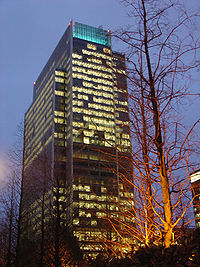 |
10 Upper Bank Street 10 Upper Bank Street 10 Upper Bank Street is a skyscraper in Canary Wharf, Docklands, London.It was designed by the architectural firm of Kohn Pedersen Fox and built by Canary Wharf Contractors.The 32 storey building was completed in 2003 and is 151 meters tall... |
151 | 495 | 32 | 2003 | Occupied by Clifford Chance Clifford Chance Clifford Chance LLP is a global law firm headquartered in London, United Kingdom and a member of the 'Magic Circle' of leading UK law firms. It is one of the ten largest law firms in the world measured by both number of lawyers and revenue... as their world headquarters. Other occupiers include FTSE Group FTSE Group FTSE Group is a world-leader in the provision of global index and analytical solutions. FTSE calculates indices across a wide range of asset classes, on both a standard and custom basis... , Infosys Infosys Infosys Limited, formerly Infosys Technologies Limited is a global technology services company headquartered in Bangalore, India. It is the second largest IT exporter in India with 133,560 employees as of March 2011. It has offices in 33 countries and development centers in India, China,... , MasterCard MasterCard Mastercard Incorporated or MasterCard Worldwide is an American multinational financial services corporation with its headquarters in the MasterCard International Global Headquarters, Purchase, Harrison, New York, United States... and Total Total S.A. Total S.A. is a French multinational oil company and one of the six "Supermajor" oil companies in the world.Its businesses cover the entire oil and gas chain, from crude oil and natural gas exploration and production to power generation, transportation, refining, petroleum product marketing, and... . |
| 8 | Pan Peninsula Pan Peninsula Pan Peninsula, also known as 1 Millharbour, is an exclusive luxury residential development in the Docklands area of London, near South Quay DLR and Canary Wharf Underground stations... |
147 | 484 | 48 | 2008 | Residential, twin-tower development containing 762 apartments. The East tower is 44 stories and the West Tower is 34 stories. The footprint of the building consists of a joint single lobby on the ground floor that connects the East and West towers. | |
| 9 | 22 Marsh Wall 22 Marsh Wall 22 Marsh Wall, also known as The Landmark, is a pair of residential skyscrapers in Docklands, London, and is among the twenty tallest structures in the city.... |
140 | 458 | 44 | 2010 | Residential, twin-tower development containing 276 apartments. The taller tower is 140 m tall and comprises 44 storeys, making it one of the tallest residential buildings in Europe. The second tower is 98 m (322 ft) tall and comprises 30 storeys. The towers are located on the south-western edge of the Canary Wharf estate. | |
| 10 | 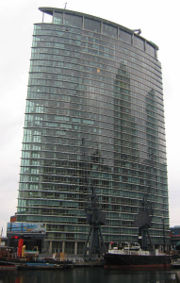 |
1 West India Quay 1 West India Quay 1 West India Quay is a skyscraper designed by HOK in the Docklands area of London which was completed in 2004. It is 111 metres tall and has 33 floors . The bottom 12 floors house a Marriott Hotel, including 47 serviced suites on floors 9-12. Floors 13-33 house 158 apartments... |
108 | 354 | 36 | 2004 | Floors 1-12 are occupied by a Marriott Hotel Marriott Hotels & Resorts Marriott Hotels & Resorts is Marriott International's flagship brand of full service hotels and resorts. The company, based in Washington D.C., is repeatedly included on the Forbes Best Companies to Work for list, and was voted the 4th best company to work for in the UK by The Times in 2009.As of... . Floors 13-33 house 158 apartments. |
| 11 | 33 Canada Square | 105 | 344 | 18 | 1999 | 33 Canada Square and 25 Canada Square together form a single complex, see above for details. | |
| 12 | 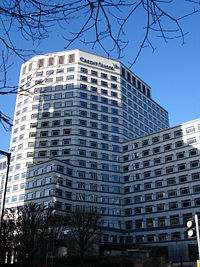 |
1 Cabot Square 1 Cabot Square 1 Cabot Square is a 21 floor office building occupied by Credit Suisse in the Canary Wharf development in London, England. Original plans called for a skyscraper on this site for CSFB, however the slump at the end of the 1980s saw these plans scaled back.The architect on the project was Pei Cobb... |
89 | 292 | 21 | 1991 | Occupied by Credit Suisse Credit Suisse The Credit Suisse Group AG is a Swiss multinational financial services company headquartered in Zurich, with more than 250 branches in Switzerland and operations in more than 50 countries.-History:... . |
| 13 | 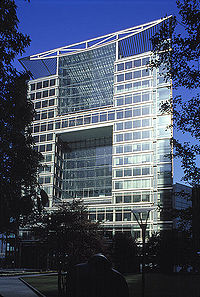 |
5 Canada Square 5 Canada Square 5 Canada Square is a 15-floor office building in the Canary Wharf financial district development in London, England.-Overview:5 Canada Square was completed in 2003 and is 88 metres tall with a floorspace of 46,450 square metres... |
88 | 288 | 16 | 2003 | Occupied by Bank of America Merrill Lynch Bank of America Merrill Lynch Bank of America Merrill Lynch is the corporate and investment banking division of Bank of America. It provides services in mergers and acquisitions, equity and debt capital markets, lending, trading, risk management, research, and liquidity and payments management... . |
| 14 | 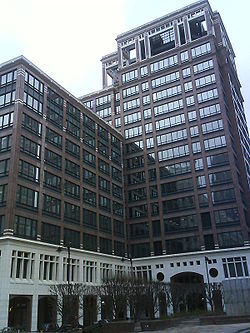 |
25 Cabot Square 25 Cabot Square 25 Cabot Square is a 17 floor office building occupied by Morgan Stanley in the Canary Wharf development in London, England.The architect on the project was Skidmore Owings & Merrill, and the building was completed in 1991... |
81 | 265 | 17 | 1991 | Occupied by Morgan Stanley Morgan Stanley Morgan Stanley is a global financial services firm headquartered in New York City serving a diversified group of corporations, governments, financial institutions, and individuals. Morgan Stanley also operates in 36 countries around the world, with over 600 offices and a workforce of over 60,000.... . Morgan Stanley also occupies 20 Bank Street as their headquarters in the same area. The architect was Skidmore Owings & Merrill. |
| 15 | 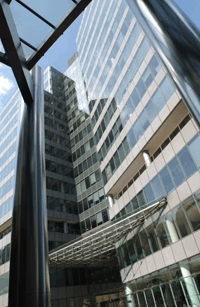 |
25 North Colonnade 25 North Colonnade 25 North Colonnade is a skyscraper in Canary Wharf, London and is occupied solely by the Financial Services Authority . It is tall, with 15 floors. Built in 1991, its developer was the Canary Wharf Group, and its architect was John McAslan and Partners.... |
80 | 262 | 15 | 1991 | Occupied by the Financial Services Authority Financial Services Authority The Financial Services Authority is a quasi-judicial body responsible for the regulation of the financial services industry in the United Kingdom. Its board is appointed by the Treasury and the organisation is structured as a company limited by guarantee and owned by the UK government. Its main... . The architect was John McAslan and Partners. |
| 16 | 20 Bank Street 20 Bank Street (London) 20 Bank Street is a 14-storey office building in the Canary Wharf development in London, United Kingdom.... |
68 | 223 | 14 | 2003 | 20 Bank Street (Heron Quays 1 (HQ1) or the Morgan Stanley Building). The building was designed by Skidmore, Owings & Merrill. | |
Buildings in development
| Name | Height | Floors | Expected Completion Date | Status | Notes | |
|---|---|---|---|---|---|---|
| metres | feet | |||||
| Riverside South, Tower 1 Riverside South (Canary Wharf) Riverside South is a proposed skyscraper development in Canary Wharf, London. Some below ground-level work has been carried out by the investment bank JP Morgan, which bought a 999 year lease on the site with the intention of making the building its London office, but the firm now plans to move... |
236 | 774 | 45 | 2012 | Under Construction | Due to become Canary Wharf's tallest building upon completion. |
| Riverside South, Tower 2 Riverside South (Canary Wharf) Riverside South is a proposed skyscraper development in Canary Wharf, London. Some below ground-level work has been carried out by the investment bank JP Morgan, which bought a 999 year lease on the site with the intention of making the building its London office, but the firm now plans to move... |
189 | 610 | 38 | 2012 | Under Construction | |
Approved buildings
| Name | Height | Floors | Probable Completion Date | Status | Notes | |
|---|---|---|---|---|---|---|
| metres | feet | |||||
| Columbus Tower | 237 | 778 | 63 | ? | Planning permission granted | Due to become Canary Wharf's tallest building upon completion. Construction is delayed due to the Crossrail construction. |
| North Quay, Tower 1 North Quay North Quay is an approved office development, consisting of three towers on the north side of Canary Wharf in London. The developer is Canary Wharf Group and the architect is Cesar Pelli.The heights of the towers will be:*Tower 1 - 221m - 40 floors... |
221 | 727 | 44 | 2017 | Planning permission granted | |
| Heron Quays West Heron Quays West Heron Quays West is a skyscraper development approved for construction in Canary Wharf, London. The current design is for two large skyscrapers connected by a large atrium at the base, not unlike the Riverside South development. The site is at the south west of the Canary Wharf site off Bank Street... |
214 | 702 | 40 | 2017 | Planning permission granted | |
| Wood Wharf Wood Wharf Wood Wharf is a redevelopment project on the Isle of Dogs in the Docklands of London.- The site today:The of Wood Wharf was historically used for the shipping and storage of timber and the repair of ships. This use continued throughout most of the 20th Century until the late 1960s and 1970s, when... W07B |
206 | 676 | 51 | 2019 | Planning permission granted | |
| North Quay, Tower 3 North Quay North Quay is an approved office development, consisting of three towers on the north side of Canary Wharf in London. The developer is Canary Wharf Group and the architect is Cesar Pelli.The heights of the towers will be:*Tower 1 - 221m - 40 floors... |
209 | 667 | 38 | 2017 | Planning permission granted | |
| The Pride | 215 | 672 | 62 | 2012 | Planning permission granted | |
| Wood Wharf Wood Wharf Wood Wharf is a redevelopment project on the Isle of Dogs in the Docklands of London.- The site today:The of Wood Wharf was historically used for the shipping and storage of timber and the repair of ships. This use continued throughout most of the 20th Century until the late 1960s and 1970s, when... W06 |
187 | 618 | 45 | 2019 | Planning permission granted | |
| Wood Wharf Wood Wharf Wood Wharf is a redevelopment project on the Isle of Dogs in the Docklands of London.- The site today:The of Wood Wharf was historically used for the shipping and storage of timber and the repair of ships. This use continued throughout most of the 20th Century until the late 1960s and 1970s, when... W02 |
182 | 598 | 40+ | 2019 | Planning permission granted | |
| Wood Wharf Wood Wharf Wood Wharf is a redevelopment project on the Isle of Dogs in the Docklands of London.- The site today:The of Wood Wharf was historically used for the shipping and storage of timber and the repair of ships. This use continued throughout most of the 20th Century until the late 1960s and 1970s, when... W07A |
128 | 418 | 30+ | 2019 | Planning permission granted | |
| North Quay, Tower 2 North Quay North Quay is an approved office development, consisting of three towers on the north side of Canary Wharf in London. The developer is Canary Wharf Group and the architect is Cesar Pelli.The heights of the towers will be:*Tower 1 - 221m - 40 floors... |
120 | 393 | 18 | 2017 | Planning permission granted | |
Aviation
London City Airport is linked to London's new financial district at Canary Wharf and to the traditional financial district of the City of London via the Docklands Light RailwayCanary Wharf DLR station
Canary Wharf DLR station is a Docklands Light Railway station in London, England. Built into the base of One Canada Square, between two parts of a shopping centre, it serves the Canary Wharf office complex...
, and with an interchange to the London Underground
London Underground
The London Underground is a rapid transit system serving a large part of Greater London and some parts of Buckinghamshire, Hertfordshire and Essex in England...
. London City Airport
London City Airport
London City Airport is a single-runway airport. It principally serves the financial district of London and is located on a former Docklands site, east of the City of London, opposite the London Regatta Centre, in the London Borough of Newham in east London. It was developed by the engineering...
DLR station
Canary Wharf DLR station
Canary Wharf DLR station is a Docklands Light Railway station in London, England. Built into the base of One Canada Square, between two parts of a shopping centre, it serves the Canary Wharf office complex...
is situated immediately adjacent to the terminal building, with enclosed access to and from the elevated platforms.
Buses
Canary Wharf is served by several bus routes, including the 135 which begins at Old Street StationOld Street station
Old Street station is a central London National Rail and London Underground station located at the junction of Old Street and City Road just north of the City of London. It lies close to the border between the boroughs of Islington and Hackney...
and terminates at Crossharbour, the 277
London Buses route 277
London Buses route 277 is a Transport for London contracted bus route in London, United Kingdom. The service is currently contracted to Stagecoach London.-History:...
route that begins at Highbury & Islington and ends at Leamouth
Leamouth
Leamouth is the area to the west of the mouth of the River Lea at the River Thames at . The northern part of the area lies within a meander of the Lea; the southern part is bounded in the west by the former East India Docks, on two sides by the Lea and by the River Thames to the south...
, and the N550 night bus route that travels from Canning Town
Canning Town
Canning Town is an area of east London, England. It is part of the London Borough of Newham and is situated in the area of the former London docks on the north side of the River Thames. It is the location of Rathbone Market...
and ends at Trafalgar Square
Trafalgar Square
Trafalgar Square is a public space and tourist attraction in central London, England, United Kingdom. At its centre is Nelson's Column, which is guarded by four lion statues at its base. There are a number of statues and sculptures in the square, with one plinth displaying changing pieces of...
. Canary Wharf is also served by local buses that goes mostly around the London Docklands area, that include routes D3, D6, D7 and D8. There's also the Docklands Buses
Docklands Buses
Docklands Buses is one of many bus companies operating contracted services on behalf of London Buses.-History:The company was formed by Transit Holdings in 1993 as 'Docklands Transit'. It initially operated local commercial routes using minibuses, but these proved not to be viable so it switched to...
, of which includes 6 more bus routes in the Docklands.
Docklands Light Railway
Canary Wharf Station
Canary Wharf Station had been part of the original DLRDocklands Light Railway
The Docklands Light Railway is an automated light metro or light rail system opened on 31 August 1987 to serve the redeveloped Docklands area of London...
plans, but when the DLR opened in August 1987 the station was not ready. It was originally planned that the station would be similar to the original station at Heron Quays
Heron Quays
Heron Quays forms part of the Canary Wharf area the Docklands, east London. It has a Docklands Light Railway station, which was moved south after the development was expanded....
, with two small platforms either side of the tracks.The station is located on the DLR between Heron Quays station and the West India Quay station, in Travelcard Zone 2
Travelcard Zone 2
Fare zone 2 is an inner zone of Transport for London's zonal fare system used for calculating the price of tickets for travel on the London Underground, London Overground, Docklands Light Railway and, since 2007, on National Rail services.-Background:...
, which are in fact the three closest train stations on the same line in the world.
Heron Quays Station
One of the first stations to be built in the Canary Wharf estate. The station first opened up in 1987.The station has two platforms in use, is in Travelcard Zone 2
Travelcard Zone 2
Fare zone 2 is an inner zone of Transport for London's zonal fare system used for calculating the price of tickets for travel on the London Underground, London Overground, Docklands Light Railway and, since 2007, on National Rail services.-Background:...
, and is on the Lewisham
Lewisham
Lewisham is a district in South London, England, located in the London Borough of Lewisham. It is situated south-east of Charing Cross. The area is identified in the London Plan as one of 35 major centres in Greater London.-History:...
branch of the Docklands Light Railway
Docklands Light Railway
The Docklands Light Railway is an automated light metro or light rail system opened on 31 August 1987 to serve the redeveloped Docklands area of London...
, between Canary Wharf and South Quay.
The station was moved 200 metres south (to fit inside the new buildings) and a longer platform was built at this new site to accommodate three-unit trains planned as part of the DLR Capacity Enhancement; the station re-opened on 18 December 2002.
London Underground
The Canary Wharf tube stationCanary Wharf tube station
Canary Wharf tube station is a London Underground station on the Jubilee Line, between and . It is in Travelcard Zone 2 and was opened by Ken Livingstone setting an escalator in motion on 17 September 1999 as part of the Jubilee Line Extension. It is maintained by Tube Lines...
is a two platform station designed by Norman Foster and opened in 1999 as part of the Jubilee Line Extension
Jubilee Line Extension
The Jubilee Line Extension is the extension of the London Underground Jubilee line from to through south and east London. An eastward extension of the Jubilee line was first proposed in the 1970s and a modified route was constructed during the 1990s...
from Charing Cross to Stratford. Canary Wharf station has increasingly become one of the busiest stations on the network, serving the ever-expanding Canary Wharf business district.
The station was used as a location for some scenes of Danny Boyle
Danny Boyle
Daniel "Danny" Boyle is an English filmmaker and producer. He is best known for his work on films such as Slumdog Millionaire, 127 Hours, 28 Days Later, Sunshine and Trainspotting. For Slumdog Millionaire, Boyle won numerous awards in 2008, including the Academy Award for Best Director...
's 2002 film 28 Days Later
28 Days Later
28 Days Later is an acclaimed 2002 British horror film directed by Danny Boyle. The screenplay was written by Alex Garland, and the film stars Cillian Murphy, Naomie Harris, Brendan Gleeson, Megan Burns, and Christopher Eccleston...
and its sequel 28 Weeks Later
28 Weeks Later
28 Weeks Later is a 2007 British/Spanish film sequel to the 2002 post-apocalyptic horror film 28 Days Later. 28 Weeks Later was directed by Juan Carlos Fresnadillo and released in the United Kingdom and United States on 11 May 2007...
which was mostly based in Canary Wharf.
National Rail
Canary Wharf railway station began construction in May 2009 and will be completed in 2017 as part of the £17 billion CrossrailCrossrail
Crossrail is a project to build a major new railway link under central London. The name refers to the first of two routes which are the responsibility of Crossrail Ltd. It is based on an entirely new east-west tunnel with a central section from to Liverpool Street station...
project. The station will have two platforms and will be in the Travelcard Zone 2
Travelcard Zone 2
Fare zone 2 is an inner zone of Transport for London's zonal fare system used for calculating the price of tickets for travel on the London Underground, London Overground, Docklands Light Railway and, since 2007, on National Rail services.-Background:...
.