


Boost converter

Encyclopedia
A boost converter is a power converter
with an output DC voltage greater than its input DC voltage. It is a class of switching-mode power supply (SMPS)
containing at least two semiconductor
switches (a diode
and a transistor
) and at least one energy
storage element. Filters made of capacitor
s (sometimes in combination with inductor
s) are normally added to the output of the converter to reduce output voltage ripple.
with an output voltage greater than the source voltage. A boost converter is sometimes called a step-up converter since it “steps up” the source voltage. Since power ( ) must be conserved, the output current is lower than the source current.
switch must turn on and off quickly and have low losses. The advent of a commercial semiconductor
switch in the 1950s represented a major milestone
that made SMPSs such as the boost converter possible. Semiconductor switches turned on and off more quickly and lasted longer than other switches such as vacuum tube
s and electromechanical relays. The major DC to DC converter
s were developed in the early 1960s when semiconductor switches had become available. The aerospace
industry’s need for small, lightweight, and efficient power converters led to the converter’s rapid development.
Switched systems such as SMPS are a challenge to design since its model depends on whether a switch is opened or closed. R.D. Middlebrook from Caltech in 1977 published the models for DC to DC converters used today. Middlebrook averaged the circuit configurations for each switch state in a technique called state-space averaging. This simplification reduced two systems into one. The new model led to insightful design equations which helped SMPS growth.
(HEV) and lighting systems.
The NHW20 model Toyota Prius
HEV uses a 500 V motor. Without a boost converter, the Prius would need nearly 417 cells to power the motor. However, a Prius actually uses only 168 cells and boosts the battery voltage from 202 V to 500 V. Boost converters also power devices at smaller scale applications, such as portable lighting systems. A white LED typically requires 3.3 V to emit light, and a boost converter can step up the voltage from a single 1.5 V alkaline cell to power the lamp. Boost converters can also produce higher voltages to operate cold cathode
fluorescent tubes (CCFL) in devices such as LCD
backlight
s and some flashlight
s.
A boost converter is used as the voltage increase mechanism in the circuit known as the 'Joule thief
'. This circuit topology is used with low power battery applications, and is aimed at the ability of a boost converter to 'steal' the remaining energy in a battery. This energy would otherwise be wasted since the low voltage of a nearly depleted battery makes it unusable for a normal load. This energy would otherwise remain untapped because many applications do not allow enough current to flow through a load when voltage decreases. This voltage decrease occurs as batteries become depleted, and is a characteristic of the ubiquitous alkaline battery
. Since ( ) as well, and R tends to be stable, power available to the load goes down significantly as voltage decreases.
to resist changes in current.
When being charged it acts as a load and absorbs energy (somewhat like a resistor); when being
discharged it acts as an energy source (somewhat like a battery). The voltage it produces during the
discharge phase is related to the rate of change of current, and not to the original charging
voltage, thus allowing different input and output voltages.
The basic principle of a Boost converter consists of 2 distinct states (see figure 2):
 ) never falls to zero. Figure 3 shows the typical waveforms of currents and voltages in a converter operating in this mode.
The output voltage can be calculated as follows, in the case of an ideal converter (i.e. using components with an ideal behaviour) operating in steady conditions:
During the On-state, the switch S is closed, which makes the input voltage ( ) appear across the inductor, which causes a change in current (
 ) flowing through the inductor during a time period (t) by the formula:

At the end of the On-state, the increase of IL is therefore:

D is the duty cycle. It represents the fraction of the commutation period T during which the switch is On. Therefore D ranges between 0 (S is never on) and 1 (S is always on).
During the Off-state, the switch S is open, so the inductor current flows through the load. If we consider zero voltage drop in the diode, and a capacitor large enough for its voltage to remain constant, the evolution of IL is:
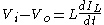
Therefore, the variation of IL during the Off-period is:

As we consider that the converter operates in steady-state conditions, the amount of energy stored in each of its components has to be the same at the beginning and at the end of a commutation cycle. In particular, the energy stored in the inductor is given by:

So, the inductor current has to be the same at the start and end of the commutation cycle. This means the overall change in the current (the sum of the changes) is zero:

Substituting and
and  by their expressions yields:

This can be written as:

Which in turns reveals the duty cycle to be:

From the above expression it can be seen that the output voltage is always higher than the input voltage (as the duty cycle goes from 0 to 1), and that it increases with D, theoretically to infinity as D approaches 1. This is why this converter is sometimes referred to as a step-up converter.
As the inductor current at the beginning of the cycle is zero, its maximum value (at
(at  ) is
) is

During the off-period, IL falls to zero after :
:

Using the two previous equations, δ is:

The load current Io is equal to the average diode current (ID). As can be seen on figure 4, the diode current is equal to the inductor current during the off-state. Therefore the output current can be written as:
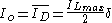
Replacing ILmax and δ by their respective expressions yields:

Therefore, the output voltage gain can be written as follows:

Compared to the expression of the output voltage for the continuous mode, this expression is much more complicated. Furthermore, in discontinuous operation, the output voltage gain not only depends on the duty cycle, but also on the inductor value, the input voltage, the switching frequency, and the output current.
Power converter
A power converter is an electrical or electro-mechanical device for converting electrical energy. It may be converting AC to or from DC, or the voltage or frequency, or some combination of these.Amongst the many devices that are used for this purpose are;...
with an output DC voltage greater than its input DC voltage. It is a class of switching-mode power supply (SMPS)
Switched-mode power supply
A switched-mode power supply is an electronic power supply that incorporates a switching regulator in order to be highly efficient in the conversion of electrical power...
containing at least two semiconductor
Semiconductor
A semiconductor is a material with electrical conductivity due to electron flow intermediate in magnitude between that of a conductor and an insulator. This means a conductivity roughly in the range of 103 to 10−8 siemens per centimeter...
switches (a diode
Diode
In electronics, a diode is a type of two-terminal electronic component with a nonlinear current–voltage characteristic. A semiconductor diode, the most common type today, is a crystalline piece of semiconductor material connected to two electrical terminals...
and a transistor
Transistor
A transistor is a semiconductor device used to amplify and switch electronic signals and power. It is composed of a semiconductor material with at least three terminals for connection to an external circuit. A voltage or current applied to one pair of the transistor's terminals changes the current...
) and at least one energy
Energy
In physics, energy is an indirectly observed quantity. It is often understood as the ability a physical system has to do work on other physical systems...
storage element. Filters made of capacitor
Capacitor
A capacitor is a passive two-terminal electrical component used to store energy in an electric field. The forms of practical capacitors vary widely, but all contain at least two electrical conductors separated by a dielectric ; for example, one common construction consists of metal foils separated...
s (sometimes in combination with inductor
Inductor
An inductor is a passive two-terminal electrical component used to store energy in a magnetic field. An inductor's ability to store magnetic energy is measured by its inductance, in units of henries...
s) are normally added to the output of the converter to reduce output voltage ripple.
Overview
Power can also come from DC sources such as batteries, solar panels, rectifiers and DC generators. A process that changes one DC voltage to a different DC voltage is called DC to DC conversion. A boost converter is a DC to DC converterDC to DC converter
A DC-to-DC converter is an electronic circuit which converts a source of direct current from one voltage level to another. It is a class of power converter.- Usage :...
with an output voltage greater than the source voltage. A boost converter is sometimes called a step-up converter since it “steps up” the source voltage. Since power (
) must be conserved, the output current is lower than the source current.History
For high efficiency, the SMPSSwitched-mode power supply
A switched-mode power supply is an electronic power supply that incorporates a switching regulator in order to be highly efficient in the conversion of electrical power...
switch must turn on and off quickly and have low losses. The advent of a commercial semiconductor
Semiconductor
A semiconductor is a material with electrical conductivity due to electron flow intermediate in magnitude between that of a conductor and an insulator. This means a conductivity roughly in the range of 103 to 10−8 siemens per centimeter...
switch in the 1950s represented a major milestone
Milestone (Project management)
Within the framework of project management, a milestone is the end of a stage that marks the completion of a work package or phase, typically marked by a high level event such as completion, endorsement or signing of a deliverable, document or a high level review meeting.In addition to signaling...
that made SMPSs such as the boost converter possible. Semiconductor switches turned on and off more quickly and lasted longer than other switches such as vacuum tube
Vacuum tube
In electronics, a vacuum tube, electron tube , or thermionic valve , reduced to simply "tube" or "valve" in everyday parlance, is a device that relies on the flow of electric current through a vacuum...
s and electromechanical relays. The major DC to DC converter
DC to DC converter
A DC-to-DC converter is an electronic circuit which converts a source of direct current from one voltage level to another. It is a class of power converter.- Usage :...
s were developed in the early 1960s when semiconductor switches had become available. The aerospace
Aerospace
Aerospace comprises the atmosphere of Earth and surrounding space. Typically the term is used to refer to the industry that researches, designs, manufactures, operates, and maintains vehicles moving through air and space...
industry’s need for small, lightweight, and efficient power converters led to the converter’s rapid development.
Switched systems such as SMPS are a challenge to design since its model depends on whether a switch is opened or closed. R.D. Middlebrook from Caltech in 1977 published the models for DC to DC converters used today. Middlebrook averaged the circuit configurations for each switch state in a technique called state-space averaging. This simplification reduced two systems into one. The new model led to insightful design equations which helped SMPS growth.
Applications
Battery powered systems often stack cells in series to achieve higher voltage. However, sufficient stacking of cells is not possible in many high voltage applications due to lack of space. Boost converters can increase the voltage and reduce the number of cells. Two battery-powered applications that use boost converters are hybrid electric vehiclesHybrid vehicle
A hybrid vehicle is a vehicle that uses two or more distinct power sources to move the vehicle. The term most commonly refers to hybrid electric vehicles , which combine an internal combustion engine and one or more electric motors.-Power:...
(HEV) and lighting systems.
The NHW20 model Toyota Prius
Toyota Prius
The Toyota Prius is a full hybrid electric mid-size hatchback, formerly a compact sedan developed and manufactured by the Toyota Motor Corporation...
HEV uses a 500 V motor. Without a boost converter, the Prius would need nearly 417 cells to power the motor. However, a Prius actually uses only 168 cells and boosts the battery voltage from 202 V to 500 V. Boost converters also power devices at smaller scale applications, such as portable lighting systems. A white LED typically requires 3.3 V to emit light, and a boost converter can step up the voltage from a single 1.5 V alkaline cell to power the lamp. Boost converters can also produce higher voltages to operate cold cathode
Cold cathode
A cold cathode is a cathode used within nixie tubes, gas discharge lamps, discharge tubes, and some types of vacuum tube which is not electrically heated by the circuit to which it is connected...
fluorescent tubes (CCFL) in devices such as LCD
Liquid crystal display
A liquid crystal display is a flat panel display, electronic visual display, or video display that uses the light modulating properties of liquid crystals . LCs do not emit light directly....
backlight
Backlight
A backlight is a form of illumination used in liquid crystal displays . As LCDs do not produce light themselves , they need illumination to produce a visible image...
s and some flashlight
Flashlight
A flashlight is a hand-held electric-powered light source. Usually the light source is a small incandescent lightbulb or light-emitting diode...
s.
A boost converter is used as the voltage increase mechanism in the circuit known as the 'Joule thief
Joule thief
"Joule thief" is a nickname for a minimalist self-oscillating voltage booster that is small, low-cost, and easy-to-build; typically used for driving light loads. It can use nearly all of the energy in a single-cell electric battery, even far below the voltage where other circuits consider the...
'. This circuit topology is used with low power battery applications, and is aimed at the ability of a boost converter to 'steal' the remaining energy in a battery. This energy would otherwise be wasted since the low voltage of a nearly depleted battery makes it unusable for a normal load. This energy would otherwise remain untapped because many applications do not allow enough current to flow through a load when voltage decreases. This voltage decrease occurs as batteries become depleted, and is a characteristic of the ubiquitous alkaline battery
Alkaline battery
Alkaline batteries are a type of primary batteries dependent upon the reaction between zinc and manganese dioxide . A rechargeable alkaline battery allows reuse of specially designed cells....
. Since (
) as well, and R tends to be stable, power available to the load goes down significantly as voltage decreases.Operating principle
The key principle that drives the boost converter is the tendency of an inductorInductor
An inductor is a passive two-terminal electrical component used to store energy in a magnetic field. An inductor's ability to store magnetic energy is measured by its inductance, in units of henries...
to resist changes in current.
When being charged it acts as a load and absorbs energy (somewhat like a resistor); when being
discharged it acts as an energy source (somewhat like a battery). The voltage it produces during the
discharge phase is related to the rate of change of current, and not to the original charging
voltage, thus allowing different input and output voltages.
The basic principle of a Boost converter consists of 2 distinct states (see figure 2):
- in the On-state, the switch S (see figure 1) is closed, resulting in an increase in the inductor current;
- in the Off-state, the switch is open and the only path offered to inductor current is through the flyback diodeFlyback diodeA flyback diode is a diode used to eliminate flyback, the sudden voltage spike seen across an inductive load when its supply voltage is suddenly reduced or removed.- Working principle :In its most simplified form with a voltage source connected to an inductor with a switch, we...
D, the capacitor C and the load R. This results in transferring the energy accumulated during the On-state into the capacitor. - The input current is the same as the inductor current as can be seen in figure 2. So it is not discontinuous as in the buck converterBuck converterA buck converter is a step-down DC to DC converter. Its design is similar to the step-up boost converter, and like the boost converter it is a switched-mode power supply that uses two switches , an inductor and a capacitor....
and the requirements on the input filter are relaxed compared to a buck converter.
Continuous mode
When a boost converter operates in continuous mode, the current through the inductor () never falls to zero. Figure 3 shows the typical waveforms of currents and voltages in a converter operating in this mode.The output voltage can be calculated as follows, in the case of an ideal converter (i.e. using components with an ideal behaviour) operating in steady conditions:
During the On-state, the switch S is closed, which makes the input voltage (
) appear across the inductor, which causes a change in current () flowing through the inductor during a time period (t) by the formula:At the end of the On-state, the increase of IL is therefore:
D is the duty cycle. It represents the fraction of the commutation period T during which the switch is On. Therefore D ranges between 0 (S is never on) and 1 (S is always on).
During the Off-state, the switch S is open, so the inductor current flows through the load. If we consider zero voltage drop in the diode, and a capacitor large enough for its voltage to remain constant, the evolution of IL is:
Therefore, the variation of IL during the Off-period is:
As we consider that the converter operates in steady-state conditions, the amount of energy stored in each of its components has to be the same at the beginning and at the end of a commutation cycle. In particular, the energy stored in the inductor is given by:
So, the inductor current has to be the same at the start and end of the commutation cycle. This means the overall change in the current (the sum of the changes) is zero:
Substituting
and by their expressions yields:This can be written as:
Which in turns reveals the duty cycle to be:
From the above expression it can be seen that the output voltage is always higher than the input voltage (as the duty cycle goes from 0 to 1), and that it increases with D, theoretically to infinity as D approaches 1. This is why this converter is sometimes referred to as a step-up converter.
Discontinuous mode
In some cases, the amount of energy required by the load is small enough to be transferred in a time smaller than the whole commutation period. In this case, the current through the inductor falls to zero during part of the period. The only difference in the principle described above is that the inductor is completely discharged at the end of the commutation cycle (see waveforms in figure 4). Although slight, the difference has a strong effect on the output voltage equation. It can be calculated as follows:As the inductor current at the beginning of the cycle is zero, its maximum value
(at ) isDuring the off-period, IL falls to zero after
:Using the two previous equations, δ is:
The load current Io is equal to the average diode current (ID). As can be seen on figure 4, the diode current is equal to the inductor current during the off-state. Therefore the output current can be written as:
Replacing ILmax and δ by their respective expressions yields:
Therefore, the output voltage gain can be written as follows:
Compared to the expression of the output voltage for the continuous mode, this expression is much more complicated. Furthermore, in discontinuous operation, the output voltage gain not only depends on the duty cycle, but also on the inductor value, the input voltage, the switching frequency, and the output current.
See also
- Joule thiefJoule thief"Joule thief" is a nickname for a minimalist self-oscillating voltage booster that is small, low-cost, and easy-to-build; typically used for driving light loads. It can use nearly all of the energy in a single-cell electric battery, even far below the voltage where other circuits consider the...
- Buck ConverterBuck converterA buck converter is a step-down DC to DC converter. Its design is similar to the step-up boost converter, and like the boost converter it is a switched-mode power supply that uses two switches , an inductor and a capacitor....
- Buck–boost ConverterBuck-boost converterThe buck–boost converter is a type of DC-to-DC converter that has an output voltage magnitude that is either greater than or less than the input voltage magnitude.Two different topologies are called buck–boost converter....
- Split-PiSplit-PiIn electronics, a split-pi topology is a pattern of component interconnections used in a kind of power converter that can theoretically produce an arbitrary output voltage, either higher or lower than the input voltage. In practice the upper voltage output is limited to the voltage rating of...
(patented boost–buck converter technology) - Voltage doublerVoltage doublerA voltage doubler is an electronic circuit which charges capacitors from the input voltage and switches these charges in such a way that, in the ideal case, exactly twice the voltage is produced at the output as at its input....
- Voltage multiplierVoltage multiplierthumb|right|280px|Villard cascade voltage multiplier.A voltage multiplier is an electrical circuit that converts AC electrical power from a lower voltage to a higher DC voltage, typically by means of a network of capacitors and diodes....
- The hydraulic ramHydraulic ramA hydraulic ram, or hydram, is a cyclic water pump powered by hydropower. It functions as a hydraulic transformer that takes in water at one "hydraulic head" and flow-rate, and outputs water at a higher hydraulic-head and lower flow-rate...
can be seen as analogous to a boost converter, using the electronic–hydraulic analogyHydraulic analogyThe electronic–hydraulic analogy is the most widely used analogy for "electron fluid" in a metal conductor. Since electric current is invisible and the processes at play in electronics are often difficult to demonstrate, the various electronic components are represented by hydraulic...
.