
|
|
|
|
Toyota Prius
|
| |
|
| |
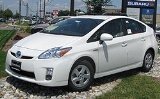
The Toyota Prius is a hybrid electric mid-size car developed and manufactured by the Toyota Motor Corporation.
The Prius first went on sale in Japan in 1997, making it the first mass-produced hybrid vehicle. It was subsequently introduced worldwide in 2001. The Prius is sold in more than 40 countries and regions, with its largest markets being those of Japan and North America.
According to the United States Environmental Protection Agency, in 2007, the 2008 Prius is the most fuel efficient car sold in the U.S.

Discussion
Ask a question about 'Toyota Prius'
Start a new discussion about 'Toyota Prius'
Answer questions from other users
|
Encyclopedia
The Toyota Prius is a hybrid electric mid-size car developed and manufactured by the Toyota Motor Corporation.
The Prius first went on sale in Japan in 1997, making it the first mass-produced hybrid vehicle. It was subsequently introduced worldwide in 2001. The Prius is sold in more than 40 countries and regions, with its largest markets being those of Japan and North America.
According to the United States Environmental Protection Agency, in 2007, the 2008 Prius is the most fuel efficient car sold in the U.S. The UK Department for Transport also reported the Prius is tied as the sixth least CO2-emitting vehicle on sale in the UK.
Models
| Feature | Model code |
|---|
| NHW10 | NHW11 | NHW20 |
|---|
| Body style | 4-door Sedan | 4-door Sedan | 5-door Hatchback | | First sales | 1997 | 2000 | 2003 | | Battery | Modules | 40 | 38 | 28 | | Cells per module | 6 | 6 | 6 | | Total cells | 240 | 228 | 168 | | Volts per cell | 1.2 | 1.2 | 1.2 | | Total volts (nominal) | 288 | 273.6 | 201.6 | | Capacity amp hours | 6.0 | 6.5 | 6.5 | | Capacity Watt hours | 1728 | 1778.4 | 1310.4 | | Weight kg | 57 | 50 | 45 | | Gasoline Engine | Power kW/HP | 43/58 | 52/70 | 57/76 | | Max rpm | 4000 | 4500 | 5000 | | Electric Motor | Operating Voltage | 288 | 273 | 500 | | Power kW/HP | 30/40 | 33/44 | 50/67 | | Combined | Power kW/HP | ?/? | 73/98 | 82/110 |
1997–2000 (model NHW10) The first Prius, model NHW10, went on sale in December 1997. It was sold only in Japan, though it has been imported privately to the United Kingdom, Australia, and New Zealand. Many of these cars are now being exported as second-hand vehicles to New Zealand and other countries.
2001–2003 (model NHW11) The 2001–2003 Prius for the United States market was powered by a 1.5-liter 4 cylinder gasoline engine, a permanent magnet AC electric motor, and a 274-volt nickel-metal hydride (Ni-MH) battery pack. The gasoline engine developed and of torque. The electric motor generated a maximum of and of torque. Japanese versions were less powerful.
The engine and motor power were increased over the previous model.
Air conditioning and a continuously variable transmission were standard equipment.
In the United States, the NHW11 was the first Prius to be sold. The Prius was marketed between the smaller Echo and the larger Corolla. The published retail price of the car was US$19,995. The California Air Resources Board (CARB) classified the car as a Super Ultra Low Emission Vehicle (SULEV).
European sales began in September 2000.
The official launch of the Prius in Australia occurred in 2001 after the Sydney Motor Show.
2004–2009 (model NHW20) The Prius was completely redesigned into a mid-size liftback which is between the Corolla and the Camry in size, with redistributed mechanical and interior space that significantly increased the rear-seat legroom to exceed that of many larger automobiles. The new model is longer than the previous version. Its more aerodynamic body resulted in a drag coefficient of 0.26.
The new Hybrid Synergy Drive (HSD) uses an all-electric compressor for cooling. Combined with a smaller and lighter NiMH battery, the NHW20 is more powerful and more efficient than the NHW11. Air conditioning is now operated independently of the gasoline engine, an industry first. In the U.S., the battery pack of the 2004 Prius is warranted for or 8 years.. The warranty in California is or 10 years for the Prius and in the seven Northeastern states that have adopted the stricter California emission control standards
It is classified as a SULEV (Super Ultra Low Emissions Vehicle) and is certified by California Air Resources Board as an "Advanced Technology Partial Zero Emission Vehicle" (AT-PZEV).
Among the Prius's options are Toyota's implementation of a Smart Key System (the feature can be user-deactivated), DVD navigation on the MFD, Vehicle Stability Control and Bluetooth for hands-free calling.
A new Intelligent Parking Assist system was available in Japan and Europe since its launch.
Production of the Prius for the Chinese market began in December 2005 by Sichuan FAW Toyota Motor, a joint venture with First Automobile Works.
Model year changes
The 2006 model introduced some minor cosmetic changes, such as a higher-resolution liquid crystal display, as well as new optional features such as a rear-view camera, advanced airbags and an upgraded audio system with an auxiliary input.
The 2007 Prius adds advanced and side-curtain airbags standard on all models. A Touring Edition was introduced that includes an elongated larger rear spoiler as well as larger, sharper-pointed 7-spoke 16" alloy wheels with plastic hub cap cover to protect it from scratches when parking against the curb. The Touring Edition also comes with a firmer European-style tuned suspension, standard high-intensity-discharge (HID) headlights and integrated (non-HID) fog lights.
Crash testing
NHTSA (United States) crash testing of the 2004 Prius yielded a five star driver and four star passenger rating in the frontal collision test (out of five stars). Side crash results were four out of five stars for both front and rear seats. The car scored four out of five stars in rollover testing.
IIHS crash tests score the Prius Good overall in frontal collisions and Good overall in side impact collisions in models equipped with side airbags. A Poor score is given to models without side airbags. Side airbags became standard on 2007 American models.
In 2004, EuroNCAP tested the Prius. It earned the following ratings:
Adult Occupant:
Child Occupant:
Pedestrian: .
2010– Toyota debuted the 2010 Prius at the 2009 North American International Auto Show, with sales to follow in late spring 2009. Its new body design is more aerodynamic, with a coefficient of drag reduced from 0.26 (Cd) to 0.25 (Cd), and its EPA estimated combined fuel economy cycle is 50 mpg (4.7 L per 100 km), a 4 mpg increase (0.59 L per 100 km decrease) over the previous generation.
The 1.8 liter gasoline engine (previously 1.5 liters) generates 98 hp and with the added power of the electric motor total horsepower is 134 hp (previously 110). The larger engine's displacement allows for increased torque reducing engine speeds (RPM) which helps improve fuel economy at highway speeds. With an electric water pump, the 1.8 liter Prius engine is the first Toyota engine that requires no belts which further improves fuel economy.
The Prius will offer three optional packages:
- A Navigation Package which includes a voice-activated touch-screen DVD-based navigation system and a 8-speaker JBL audio system with XM satellite radio, MP3/WMA playback capability, Bluetooth and backup camera.
- A Solar Roof Package includes the Navigation Package and adds a power tilt/slide moonroof along with a solar powered ventilation system which uses an electric fan to help keep the vehicle cooler when parked under the sun.
- An Advanced Technology Package includes the Navigation Package while adding a Pre-Collision System, Dynamic Radar Cruise Control, Lane Keep Assist (LKA) and Intelligent Parking Assist.
Other options include LED headlamps and Safety Connect.
Toyota filed over one thousand patents during the development of the new Prius. Toyota's global goal is to sell about 400,000 units annually by 2010.
Plug-in
On January 10, 2009, Toyota Vice President of Environmental and External Affairs Irv Miller announced that Prius PHVs (plug-in hybrid vehicles) powered by lithium-ion batteries will be available for fleet buyers beginning late 2009.
Background
History
In 1994, Toyota executive Takeshi Uchiyamada was given the task of creating a new car which would be both fuel efficient and environmentally friendly. After reviewing over 100 hybrid designs, the engineering team settled on a hybrid engine design based on a 1974 TRW patent, but many technical and engineering problems had to be solved within the three years that the team was given to bring the car to the Japanese market, a goal they barely achieved as the first Prius went on sale in December 1997. A main problem was the longevity of the battery, which needed to last between 7 and 10 years. The solution the engineers came up with was to keep the battery pack between 60% and 40% charged, proving to be the "sweet spot" for extending the battery life to roughly that of the other car components.
The car was a modest success in Japan and after gathering several years of test data from the Japanese early adopters, the company felt it was safe to put it on sale in the U.S. and European markets in 2001. Sales were limited and customer waiting lists of up to 6 months were common during the first few years. In 2004, a complete redesign, increased production, and soaring fuel prices led to significant increases in sales.
Name
The word prius is a Latin word meaning "[to go] before." A Toyota spokesperson stated that "Toyota chose this name because the Prius vehicle is the predecessor of cars to come."
Prius is not a verb but a Latin comparative adjective or adverb, the neuter nominative singular form of the adjective whose corresponding masculine and feminine nominative singular forms are prior (see also Latin declension - Irregular adverbs and their comparative and superlative forms) with meanings "ahead, in front, leading; previous, earlier, preceding, prior; former; basic".
Some enthusiasts enjoy using Prii as the plural, which would be correct if prius were a regular second declension Latin noun. The actual Latin plural of the adjective is priora (Reference is slightly in error here). All of these forms are nominative case and there are several other forms for the other cases. As for the plural of Prius in English, Toyota has said that it is simply Prius and also that owners are welcome to use whatever they like.
Sales Toyota announced on June 7, 2007 that it had sold 1 million hybrid vehicles globally, and that of those 757,600 were Prius. Nearly 345,000 of the first 1 million hybrid cars made by Toyota were sold in Japan. In May 2008, Toyota announced that its worldwide cumulative sales of the Prius had passed the 1 million mark. The Prius, which is sold in more than 40 countries and regions, has its largest markets in Japan and North America. Nearly 60% of all Prius sales have been in North America, where 183,800 vehicles were sold in 2007. That sales pace has accelerated in early 2008, with 66,100 vehicles sold in North America in the first four months, a rate that would result in nearly 200,000 sales if continued through the entire year. In fact, Toyota sold 21,757 Prius hybrids in the United States in April, setting a record for April sales and making the Prius the third most popular vehicle in the Toyota line, trailing the Corolla and the Camry.
U.S. sales of the Prius began in August 2000. By 2001 sales there totaled 15,556, and by 2002 had reached 20,119. In 2004 sales there were 53,991, and doubled in 2005 to 107,897, about 60% of the world total of 180,000. By June 7, 2007, 266,212 Prius had been sold in the U.S., and accounted for 40% of the hybrid market there in 2006. As of November 2007 Toyota has sold 510,325 Prius in the US since its initial launch in 2000.
Prius gas-electric hybrid mid-size sedan reported sales of 14,212 units for a best-ever December and best-ever year-end sales of 181,221 units, up 68.9 percent over 2006.
| US Calendar Year | Sales |
|---|
| 2000 | 5,562 | | 2001 | 15,556 | | 2002 | 20,119 | | 2003 | 24,627 | | 2004 | 53,991 | | 2005 | 107,897 | | 2006 | 106,971 | | 2007 | 181,221 | | 2008 | 158,884 |
Design and technology
The Prius is a combined hybrid (sometimes referred to as series-parallel), a vehicle that can be propelled by gasoline (petrol) and/or electric power. Components of the system include:
- Regenerative braking, using motor-generators, which converts kinetic energy of motion into electrical energy that is stored in the traction battery and reduces wear on the brake pads;
- A 1NZ-FXE internal combustion engine (ICE) using Atkinson cycle which is 12-14% more efficient than the more powerful Otto cycle. The gasoline engine normally shuts off during traffic stops and the accessories (including the air conditioning) are powered by the battery pack. The engine is used both to propel the vehicle and to recharge the batteries. Because of the availability of extra power from the electric motors for rapid acceleration the engine is sized smaller than usual for increased fuel efficiency and lowered emissions with acceptable acceleration; The penalty of the Atkinson cycle is low specific power, so the battery and generator is needed to give extra power when accelerating, whilst allowing the vehicle to cruise on the low powered engine,
- Two electric motor/generators: MG1 and MG2. MG1, reversible and up to 10,000 rpm, starts the engine and provides counter torque for the Continuously Variable Transmission (CVT). MG2 provides 50 kW (67 hp) between 1,200 to 1,540 rpm and 400 N·m (295 lb·ft) torque between 0 to 1,200 rpm, contributing to performance and economy. These motor-generators are used as generators when used for regenerative braking, and as motors are capable of starting the vehicle (and gas engine if needed) and low speed (<~, in NHW20) travel;
- A Hybrid Synergy Drive (HSD) unit that combines a planetary gearset that behaves like a Continuously Variable Transmission (CVT) called the Power Split Device to increase efficiency. The computer controlled HSD transaxle adjusts and blends the amount of power from the gasoline engine and electric motor-generator(s) as needed by the front drive wheels and rechargeable batteries;
- A sealed 38-module nickel metal hydride (NiMH) battery pack providing 273.6 volts, 6.5 A·h capacity and weighing is supplied by Japan's Panasonic. They are normally charged to 40–60% of maximum capacity to prolong battery life as well as provide a reserve for regenerative braking;
- Wind resistance is reduced by a drag coefficient of 0.26 (0.29 for 2000 model) with a Kammback design to reduce air resistance. Lower rolling-resistance tires are used to reduce road friction;
- A vacuum flask for storing hot coolant when the vehicle is powered off for reuse so as to reduce warm-up time (US market);
- An EV mode (or stealth mode) that allows drivers to operate on electric power only under low-power conditions for a limited duration of time (Europe and Asian markets, aftermarket in the US). Advocates for the blind warn that the Prius is silent, and that it could be hazardous to blind pedestrians and others accustomed to engine noise to warn of a nearby vehicle;
- Vehicle weight is reduced by the use of a flexible resin gasoline tank and by the use of aluminum instead of steel for the engine bay hood and hatchback.
- Starting with the 2010 model year (3rd generation), the gasoline engine uses an electric water pump, permitting an engine design with no serpentine belts, improving efficiency.

The computer program used in the Prius shuts off the engine when the car is stopped, is reversing, or is descending hills, thereby dramatically decreasing fuel consumption in city driving . The HSD's on-board computer program determines when and how to use the engine, motor, or both to power the car and recharge the battery so as to maximize efficiency. Typically, a gasoline engine runs inefficiently at half-throttle, creating a choking condition called pumping loss, a major reason for the inefficiency of gasoline engines compared to diesels. The Prius minimizes pumping loss by using a high torque range as much as possible with the throttle fully open. Drive-by-wire throttle control technology and Toyota's Hybrid Synergy Drive (a torque combiner, electric drive, and computer control) are essential to this engine control. In addition to the immediate benefit of reducing fuel consumption and emissions, stopping the gasoline engine also improves the performance of the catalytic converter, as the exhaust gases from an idling engine tend to cool the catalyst below its optimal temperature.
Typical gasoline- or diesel-engined vehicles consume fuel when the vehicle is stopped, as is common in city driving. The Prius typically shuts down the gasoline engine and runs solely off the battery pack at low speeds and when stopped. A non-hybrid car also gets worse fuel consumption in city driving because its engine is continually used to accelerate the car to driving speed and then this energy is lost to friction brakes during stop-and-go driving. The Prius recaptures some of this energy by using regenerative braking to charge its battery pack while slowing down with its motor-generators in generator mode. For acceptable acceleration the IC engine on a "standard" car typically is much larger than needed for constant-speed travel, and is a relatively high power to rate weight ratio Otto cycle engine. By using both an Atkinson cycle gasoline engine, which whilst more efficient, has a much poorer power to weight ratio and an electric motors for acceleration the Prius engine can nevertheless be a smaller size and still provide acceptable acceleration . This means such a hybrid are can have high fuel efficiency when cruising on the Atkinson cycle engine, and in city driving, though factors including driving style, air conditioning use, and short trips may offset some of this advantage. The frequent starting and stopping of the Prius engine does not cause noticeable additional wear and tear or emission problems because the electric drive motors have enough power to quickly spin the engine to optimal speed (around 1,000 rpm) before fuel is admitted.
For any car, aerodynamic losses, which vary roughly as the velocity squared due to air drag are much greater on the highway than in low speed city driving. The Prius hybrid has less of an advantage in higher speed open road driving, typical of intercity driving. Nevertheless, the Prius still obtains improved fuel consumption under these circumstances since it can use a smaller and more efficient engine than would otherwise be required. The electric motor(s), powered by the battery pack, can provide the extra peak power needed for acceleration, passing and limited hill climbing. The lower weight, cross sectional area and lowest drag coefficient of a production car in the U.S. market (since the cancellation of the Honda Insight) make the Prius a very efficient highway traveler, getting on the highway according to the U.S. EPA.
The environmental impact of the car's batteries has been questioned. To encourage battery recycling, dealers are paid a $200 fee for return of the car's batteries.
Toyota has laboratory reports that some Prius battery packs have lasted the equivalent of . As the cars start to age, early reports have shown that in at least some cases the batteries can last in excess of . Individual battery longevity will vary depending upon the treatment and use history of the battery pack. A degraded battery pack will reduce performance and fuel economy, but not leave the car inoperable.
Fuel consumption, CO2 emission, and airborne emissions Fuel consumption, or fuel-efficiency in cars is generally measured as distance travelled per unit volume of fuel, as in miles per gallon (mpg), or as the volume of fuel required to cover a given distance, as in litres per 100 kilometres (L/100 km). Diesel fuel does have about an 11% higher energy density than gasoline (petrol), so that needs to be taken into account in pure energy-efficiency calculations and comparisons. Fuel-price-efficiency calculations will vary between various parts of the world, with diesel fuel pump prices being higher than gasoline prices in some countries, whilst in others it is less expensive than gasoline.
Official government data
United States
In the United States, the Environmental Protection Agency (EPA) test results must be posted on new vehicle windows, and are the only fuel consumption figures that can be advertised. EPA testing procedures for all vehicles were revised in 2007 in an attempt to better match what the average driver would achieve. The following data is taken from these figures:
2008 Prius:
- for city driving
- for highway driving
- combined
2001 Prius:
- city driving
- highway driving
The Prius is the most efficient car available in the U.S. in 2008, based on the official rating.
United Kingdom
The official fuel consumption data, provided by the Department for Transport, rates the Prius as: urban, extra urban and combined. Eleven diesel-powered cars, some of them smaller, have a better fuel-efficiency (by fuel volume) than the Prius for combined use.
According to the Department for Transport, the Prius is tied with the MINI Cooper D as the third least CO2-emitting vehicles at 104 g/km, behind the tied Volkswagen Polo 1.4 TDI and SEAT Ibiza 1.4 TDI at 99 g/km - it is the least CO2-emitting petrol-powered car, the Polo and the Ibiza being diesel (being these city cars).
Independent test data and comparisons with other vehicles
Several organizations have tested the fuel economy of the Prius and compared it directly with other cars.
Consumer tests have shown that petrol-electric hybrid cars in general are a little more fuel-efficient (by fuel volume) than top of the range manual transmission diesels. However, diesel fuel has a significantly higher energy density than the gasoline used by the Prius, and in some countries diesel is less expensive than gasoline, so overall diesel with manual transmission may be competitive with hybrid technology in some cases.
- January 2009: Edmunds.com compared the 2009 Prius to the all new 2010 Honda Insight. The Prius returned 54.4 MPG compared to the Insight's 51.5 MPG.
- September 2008: A Popular Mechanics comparison shows that the 2009 Volkswagen Jetta TDi diesel has slightly better highway fuel economy than the 2008 Prius with 45.4 MPG compared to 44.8 MPG. The Prius beats the Jetta in city fuel economy, however: 44.7 MPG compared to 32 MPG.
- August 2008: Edmunds.com test of Prius and Honda Fit, resulted in the Prius averaging . While the non-hybrid Fit averaged . The Honda Fit was priced $8,425 less in this test. Considering all vehicle factors, Edmunds.com awarded the overall win in this comparison by a narrow margin to the Honda Fit.
- June 2008: The Prius is the most fuel efficient car that Consumer Reports has tested since the discontinuation of the 3-door Honda Insight. Consumer Reports gave a real-world fuel consumption rating of for the Prius.
- May 2008: The Prius was the overall winner of the Edmunds.com "Gas-Sipper Smackdown" fuel economy test, winning three of the five tests. The 2005 VW Jetta TDI won the remaining two tests, but due to the higher cost of diesel the Jetta ranked third in fuel costs behind both the Prius and Smart Fortwo. The other car tested was the North American Ford Focus.
- March 2008: The UK's Sunday Times did a comparison of the Prius with another car in long distance town and country driving. The results showed that the other car, a BMW 520d SE with a diesel engine and regenerative braking, averaged whilst the Prius averaged over exactly the same route. The comparison was performed on a journey of from London to Geneva, including of urban driving, about of driving on rural roads, and about of motorway driving at speeds of up to on one French autoroute.
- August 2007: UK's Auto Express magazine performed independent fuel efficiency tests, on public roads, on a number of hatchbacks, and in August 2007 published their list of the ten most efficient. The Prius achieved 10th place in the list, returning . A Citroën C4 Coupé 1.6 HDi got 1st place with .
- December 2005: Edmunds.com test of the Prius and Honda Civic Hybrid resulted in the Prius outperforming its competitor by an additional 4.5 mpg–U.S. (0.50 L/100 km / 5.4 mpg–imp) at .
- Motor Trend conducted a test comparing the Prius with a Honda Civic Hybrid. The Prius had the better fuel economy with compared to for the Civic.
Air Pollution
While CO2 emission is theorized to cause climate change, it does not pose a threat to health or create smog. In the United States the EPA measures a vehicle's air-borne pollution based on hydrocarbons, nitrogen oxides, carbon monoxide, particulate matter and formaldehyde before assigning them a score. In most states the NHW20 Prius is rated Tier II Bin 3. CARB also does its own emission scoring, the NHW20 Prius meets AT-PZEV certification in California and states that adopted CARB emission rules.
Controversies
CO2 advertising claims
In the UK, the Advertising Standards Authority, an independent body charged with policing the rules of the advertising industry, ruled that a television advert for the Toyota Prius should not be broadcast again in the same form, having breached rules concerning misleading advertising. The advert claimed the Prius "emits up to one tonne less CO2 per year," while on-screen text included: "1 tonne of CO2 less than an equivalent family vehicle with a diesel engine. Average calculated on 20,000 km a year." Points of contention were the vehicles chosen for comparison, whether "up to one tonne less" adequately communicated that reductions could be lower, and whether the distance used was appropriate: 20,000 km per year is around a U.S. car's average annual driving distance, while a UK car's is 13,440 km.
An earlier complaint to the New Zealand Advertising Standards Authority, decision 03/360 2003 was also upheld. It was ruled that Toyota was in breach of the New Zealand advertising standards code of ethics, by claiming "up to 89% fewer smog forming emissions”. The figure was based on comparison with Euro 3 standards, which most new cars also met comfortably at the time.
Lifetime energy usage
The British Government and British media have requested Toyota release detailed figures for the energy use and CO2 emissions resulting from the building and disposal of the Prius. The UK Government Car Service runs 130 Priuses. Toyota has not supplied the detailed data they requested to support claims that the lifetime energy usage of the Prius (including the increased environmental cost of manufacture and disposal of the nickel-metal hydride battery) are outweighed by lower lifetime fuel consumption.
Toyota states that lifetime CO2 saving is 43 percent.
Repair Costs
Prius owners for years have wondered about systematic higher costs for Prius repairs. While the cars are extremely reliable, owners end up paying more for repairs when they do have to be made. A study by Autadex (a company that automates processing for insurance claims) confirms this. Repairs on the Prius cost more than for cars of a similar size. To be precise, 8.4% more. The difference was most pronounced for earlier cars (2001-2006) and seems to have vanished almost completely for the two most recent model years (2007 and 2008).
Political symbolism
The large number of Prius-owning progressive celebrities in 2002 prompted the Washington Post to dub hybrids "Hollywood's latest politically correct status symbol." While conservative "Prius Patriots" were also cited in 2005,
the vehicle carries an image as being a car for politically liberal environmentalists. A 2007 San Francisco Chronicle article said "Prius Progressives" were becoming an archetype, quoting conservative U.S. pundit Rush Limbaugh opining that "these liberals think they're ahead of the game on these things, and they're just suckers."
Some conservatives promote use of the Toyota Prius. For example, Jim Road from What Would Jesus Drive? encouraged people to drive hybrid cars because of the damage that large SUVs can do to others.
Former CIA chief R. James Woolsey, Jr. drives a Prius because of its low fuel consumption. Woolsey noted the volatility of the Middle East, coupled with anti-US sentiment in much of the region. Noting that the high percentage of oil drilled in the Middle East gives vast profits to Middle Eastern regimes, Woolsey believes that it is a patriotic obligation to drive more efficient vehicles. In a Motor Trend magazine article, Woolsey claimed that those oil profits find their way to terrorist groups like al-Qaeda, meaning that Americans who buy inefficient vehicles would, in effect, be indirectly funding terrorism. "We're paying for both sides in this war, and that's not a good long-term strategy," said Woolsey. "I have a bumper sticker on the back of my Prius that reads, 'Bin Laden hates this car.'"
Fashion over function
The Prius's shape gives it a low 0.26 coefficient of drag.
In spite of the efficiency of the Prius's shape, in 2004, industry analyst Art Spinella of CNW Marketing Research (CNWMR), whose skepticism towards hybrids is well known (see Lifetime energy cost), said "the Prius was a fashion statement", attributing its success over the Honda Civic Hybrid, which has a nearly identical appearance to its non-hybrid versions, to its distinctive styling, which lets "other people know the driver is driving a hybrid vehicle". However, this does not explain the lack of success for the even more distinctive Honda Insight.. (Excluding the fact that demand for two-seaters is far less than that for four-seaters.)
In July 2007 the The New York Times published an article using data from CNW Marketing Research finding that 57% of Prius buyers said their main reason for buying was that "it makes a statement about me.", while just 36% cited fuel economy as a prime motivator. Shortly afterwards Washington Post columnist Robert Samuelson coined the term "Prius politics" to describe a situation where the driver's desire to "show off" is a stronger motivator than the desire to curb greenhouse gas emissions.
However the Prius first launched in 1997 prior to environmental consciousness entering mainstream society.
Quietness
The Wall Street Journal reported in February 2007 on concerns that quiet cars like the Prius may pose a safety risk to those who rely on engine noise to sense the presence or location of moving vehicles. Blind pedestrians are a primary concern, and the National Federation of the Blind advocates audio emitters on hybrid vehicles, but increased risks may also affect sighted pedestrians or bicyclists who are accustomed to aural cues from vehicles. In July 2007, a spokesperson for Toyota said the company is aware of the issue and is studying options. Both State and Federal legislation have been proposed and the National Highway Traffic Safety Administration held a public hearing. Different groups and companies are looking at solutions.
Government and corporate incentives
Government incentives
A number of governments have incentives that are intended to encourage hybrid car sales. In Belgium, the national government offers reductions in the purchase price of up to 15% for buying cars that have lower CO2 exhaust.
The federal government in Canada offers to those who buy or lease hybrid cars a rebate, however the rebate program expired on December 31, 2008. Some provincial governments also offer incentives such as in British Columbia, Manitoba, Quebec, Ontario, and Prince Edward Island.
In the United Kingdom, there are both fiscal and parking-related incentives. The fiscal incentives are general; road tax is just £15 a year. Businesses can now (from 1 April 2008) claim a 100% first year tax write-off for the Prius because the car has CO2 emissions of less than 110 grams per kilometre. The tax charge for a Prius that is provided as a company car is just 10% of its list price, rather than the heftier rates that can be up to 35% of a car's list price. Parking incentives exist in Richmond upon Thames (south west London),
Westminster (Central London) for resident parking permits, Winchester (now discontinued), Manchester, and Brighton has similar plans. Drivers can pay £10 to register for an annual exemption from the £8 daily London congestion charge Some of the incentives in the United Kingdom have been criticized in the press given that non-hybrid cars, some of which may have better fuel economy in some circumstances, are not afforded the same incentives.
In the United States, the federal government offers a tax credit to purchasers until a certain number of cars has been sold by a manufacturer. This has ranged from US$787 to $3,150, which expired in 2007 for hybrids sold by Toyota. Some state governments, including Colorado, Connecticut, Illinois offer tax incentives. Hybrid engine automobiles are exempt from high-occupancy vehicle lane restrictions in some U.S. states.) California (currently until January 1, 2011. Los Angeles and San Jose, California had exempted hybrid cars from paying for street parking. New York State offers a special "green" version of their E-Z-Pass toll payment tag for hybrid owners who use the NYS Thruway system, which gives the owners a 10% discount on tolls.
Also, the Port Authority of New York and New Jersey offers their "green E-Z-Pass" to hybrid owners, who pay $4 instead of $8 to use all the bridges and tunnels between New York and New Jersey, except in rush hours.
But it is better to get the NYS Thruway green pass, since the NYS Thruway green pass allows the user to get the Port Authority Bridges and Tunnels discount, while the Port Authority Green Pass does not allow the user to get the NYS Thruway discount. (Both the Port Authority and NYS Thruway green E-Z-Passes are issued by New York State E-Z-Pass Service Centers, but users need to make sure they are issued a NYS Thruway green E-Z-Pass if they want to use both discounts.)
In the Netherlands, the government has lowered the tax for company-cars with CO2 emissions below a certain level (such as the Prius) to 14%. The tax on all other class company-cars has been raised from 22 to 25%. As a result, in the month January alone, more than 1800 cars have been sold. The importer has already indicated that he can no longer meet the demand for the year 2008. Privately owned cars with low CO2 emissions benefit from lower road taxes.
In Sweden, private purchasers of the Prius (or any other vehicle in the environmentally less destructive class) are awarded SEK 10,000 (roughly USD 1700, €1100) after six months of ownership, in order to stimulate sales and use of such vehicles. The subsidy program has been very successful.
Corporate incentives
Several U.S. companies offer employees incentives.
Bank of America will reimburse $3000 on the purchase of new hybrid vehicles to full- and part-time associates working more than 20 hours per week. Google, software company Hyperion Solutions, and
organic food and drink producer Clif Bar & Co[broken footnote]
offer employees a $5000 credit toward their purchase of certain hybrid vehicles including the Prius. Integrated Archive Systems, a Palo Alto IT company, offers a $10,000 subsidy toward the purchase of hybrid vehicles to full-time employees employed more than one year.[broken footnote] Clothing companies Timberland and Patagonia, law firm DLA Piper, non-profit American Jewish Committee, software publisher Topics Entertainment, Logistics Giant Exel Contract Logistics, and research firm ABR, Inc. are among companies offering eligible employees significant discounts on certain hybrid vehicles including the Prius.[broken footnote]
Travelers Companies, a large insurance company, offers hybrid owners a 10% discount on auto insurance in most states. The Farmers Insurance Group offers a similar discount of up to 10% in most states.[broken footnote]
Aftermarket products
EV mode
When the vehicle is turned-on with the "start" button, it is ready to drive immediately with the electric motor, while electric pumps warm the engine with previously saved hot engine coolant, before the internal combustion engine is started. The delay between starting the car and starting the internal combustion engine is approximately seven seconds. The Asian and European versions of this vehicle provide a button labeled "EV" that maintains Electric Vehicle mode after start up, under most low-load driving conditions. This permits driving with low noise and no fuel consumption, and is advertised as a "quiet" option for short journeys, for example in residential areas at night, in the Asia manual. The car automatically reverts to normal mode if the battery becomes exhausted. The North American model does not have the "EV" button, although the "EV" mode is still supported internally by the Prius Hybrid Vehicle management computer. The PRIUS+ Project offers conversion instructions for do-it-yourselfers who wish to enable the button. Toyota has now received government approval to run on public roads for tests. Researchers at the Advanced Power and Energy Program at the University of California, Irvine and the Institute of Transportation Studies at the University of California, Berkeley will begin testing two specially made Prius and analyze driver behavior, study air quality and energy use. However, electric-only driving range remains limited to around seven miles (eleven kilometers) per charge in all-electric mode at up to 100 kilometers per hour (62 miles per hour). No date has been set for public release of EV mode, and it will not be available to the public until a great deal of additional research has been done.
Plug-in
Plug-in hybrids use a larger electric vehicle battery pack that is recharged from external sources in order to further reduce fuel consumption. The NiMH batteries in a production PHEV will be built to handle deeper discharge cycles without loss of lifespan such as the NiMH battery pack in the Toyota RAV4 EV. Operation of the vehicle will be very similar to a normal hybrid, except that the electric operation will be more prevalent. In the case of a Prius PHEV, on the highway, the gasoline engine will operate as before, leaving the car with the same ability to accelerate and use freeways. Current converted Prius also operate in a high speed blended mode which can reduce but not eliminate fuel consumption on the freeway. When driving in slower conditions or with light loads, the batteries will be used first in a charge-depleting mode, allowing moderate commutes at low speeds (particularly under 41 mph/65 km/h) to be driven entirely on electricity. Once the batteries have been sufficiently discharged the car will automatically revert back to the charge-sustaining mode of the current stock Prius.
A Raleigh, North Carolina firm, Advanced Vehicle Research Center, converts the Prius by adding a second battery, improving its fuel efficiency by increasing the distance it runs on electricity alone.
Awards
Competitors
See also
External links
|
| |
|
|