


: "twenty-one"), is the most widely played casino
banking game in the world. Blackjack is a comparing card game between a player and dealer and played with one or more French decks of 52 cards.
The player is dealt an initial two card hand with the option of drawing cards to bring the total value to 21 or less without exceeding it, so that the dealer will lose by having a lesser hand than the player or by exceeding 21. Many rule variations of blackjack exist. Since the 1960s, blackjack has been a high profile target of advantage players
, particularly card counters
, who track the profile of cards yet to be dealt, and adapt their wager and playing strategy accordingly.
Other casino games inspired by blackjack include Spanish 21 and pontoon. The recreational British
card game of black jack is a shedding-type game
and unrelated to the subject of this article.
History
Blackjack's precursor was twenty-one, a game of unknown origin. The first written reference is found in a book by the Spanishauthor
Miguel de Cervantes
, who is most famous for writing Don Quixote. Cervantes was a gambler, and the main characters of his tale Rinconete y Cortadillo, from Novelas Ejemplares
, are a couple of cheaters working in Seville
. They are proficient at cheating at ventiuna (Spanish for twenty-one), and state that the object of the game is to reach 21 points without busting and that the ace values 1 or 11. The game is played with the Spanish baraja
deck, which lacks eights, nines and tens. This short story was written between 1601 and 1602, implying that ventiuna was played in Castilia
since the beginning of the 17th Century or earlier. Later references to this game are found in France
and Spain
.
When twenty-one was introduced in the United States
, gambling
houses offered bonus payouts to stimulate players' interest. One such bonus was a ten to one payout if the player's hand consisted of the ace of spades and a black jack (either the jack of clubs or the jack of spades). This hand was called a "blackjack" and the name stuck to the game, even though the ten to one bonus was soon withdrawn. In the modern game, a blackjack refers to any hand of an ace plus a ten or face card, regardless of suits or colours.
Rules of play at casinos
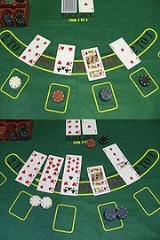
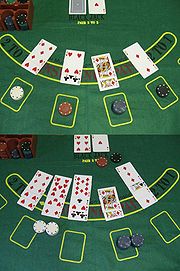
At a casino blackjack table, the dealer faces between five to seven playing positions from behind a semicircular table. At the beginning of each round, up to three players place their bets in the "betting box" at each position in play. The player whose bet is at the front of the betting box is deemed to have control over the position, and the dealer will consult the controlling player for playing decisions regarding the hand; the other players of that box are said to "play behind". Any player is usually allowed to control or bet in as many boxes as desired at a single table, but it is prohibited to play on more than one table at a time or to place multiple bets in a single box.Each box is dealt an initial hand of two cards visible to the people playing on it, and often to any other players. The dealer's hand receives its first card face up, and in "hole card" games receives its second card face down immediately (the hole card), which the dealer peeks at but does not reveal unless it makes the dealer's hand a blackjack. Hole card games are sometimes played on tables with a small mirror or electronic sensor which are used to peek securely at the hole card. In European casinos, "no hole card" games are prevalent; the dealer's second card is neither drawn nor consulted until the players have all played their hands.
Cards are dealt either from one or two hand-held decks, from a dealer's shoe, or from a shuffling machine
. Single cards are dealt to each of wagered-on position clockwise from the dealer's leftmost position, followed by a single card to the dealer, followed by an additional card to each of the positions in play. The players' initial cards may be dealt face-up, or face-down (more common in single-deck games).
The players' object is to win money by creating card totals which will turn out to be higher than the dealer's hand, but without exceeding 21 ("busting"/"breaking"). On their turn, players must choose whether to "hit" (take a card), "stand" (end their turn), "double" (double wager, take a single card and finish), "split" (if the two cards have the same value, separate them to make two hands) or "surrender" (give up a half-bet and retire from the game). Number-cards count as their natural value; the jack, queen, and king (also known as "face cards" or "pictures") count as 10; aces are valued as either 1 or 11 according to the player's best interest. If the hand value exceeds 21 points, it busts, and all bets on it are immediately forfeit. After all boxes have finished playing, the dealer's hand is resolved by drawing cards until the hand busts or achieves a value of 17 or higher (a dealer total of 17 including an ace, or "soft 17", must be drawn to in some games and must stand in others). The dealer never doubles, splits nor surrenders. If the dealer busts, all remaining player hands win. If the dealer does not bust, each remaining bet wins if its hand is higher than the dealer's, and loses if it is lower. In the case of a tied score, known as "push" or "standoff", bets are normally returned without adjustment; however, a blackjack beats any hand which is not a blackjack, even with value 21. Blackjack vs. blackjack is a push. Wins are paid out at 1:1, or equal to the wager, except for winning blackjacks, which are traditionally paid at 3:2, or one and a half times the wager. Many casinos today pay blackjacks at less than 3:2 at some tables.
Player decisions
After receiving an initial two cards, the player has up to four standard options: "hit," "stand," "double down," or "split". Each option has a corresponding hand signal. Some games give the player a fifth option, "surrender".- Hit: Take another card from the dealer.
- signal: (handheld) Scrape cards against table. (face up) Tap the table or wave hand toward body
- Stand: Take no more cards; also known as "stand pat", "stick", or "stay".
- signal: (handheld) Slide cards under chips. (face up) Wave hand horizontally.
- Double down (only available as first decision of a hand): The player is allowed to increase the initial bet by up to 100% in exchange for committing to stand after receiving exactly one more card. The additional bet is placed in the betting box next to the original bet. Some games do not permit the player to increase the bet by amounts other than 100%. Non-controlling players may double their wager or decline to do so, but they are bound by the controlling player's decision to take only one card.
- signal: Place additional chips beside the original bet, and point with one finger.
- Split (only available as first decision of a hand): If the first two cards have the same value, the player can split them into two hands, by moving a second bet equal to the first into an area outside the betting box of the original bet. The dealer separates the two cards and draws a further card on each, placing one bet with each hand. The player then plays out the two separate hands in turn, with some restrictions. Occasionally, in the case of ten-valued cards, some casinos allow splitting only when the cards have the identical ranks; for instance, a hand of T-T may be split, but not of T-K. However, usually all ten-value cards are treated the same. Doubling and further splitting of post-split hands may be restricted, and blackjacks after a split are counted as non-blackjack 21 when comparing against the dealer's hand. Hitting split aces is usually not allowed. Non-controlling players may follow the controlling player by putting down an additional bet, or decline to do so, instead associating their existing wager with one of the two post-split hands. In that case they must choose which hand to play behind before the second cards are drawn.
- signal: Place additional chips next to the original bet outside the betting box. Point with two fingers spread into a V formation.
- Surrender (only available as first decision of a hand): Some games offer the option to "surrender", usually in hole card games and directly after the dealer has checked for blackjack (but see below for variations). When the player surrenders, the house takes half the player's bet and return the other half to the player; this terminates the player's interest in the hand. The request to surrender is made verbally, there being no standard hand signal.
Hand signals are used to assist the "eye in the sky
", a person or video camera
located above the table and sometimes concealed behind one-way glass. The eye in the sky usually makes a video recording of the table, which helps in resolving disputes and identifying dealer mistakes, and is also used to protect the casino against dealers who steal chips or players who cheat. The recording can further be used to identify advantage players whose activities, while legal, make them undesirable customers. In the event of a disagreement between a player's hand signals and their words, the hand signal takes precedence.
Each hand may normally "hit" as many times as desired so long as the total is not above hard-20. On reaching 21 (including soft 21), the hand is normally required to stand; busting is an irrevocable loss and the players' wagers are immediately forfeited to the house. After a bust or a stand, play proceeds to the next hand clockwise around the table. When the last hand has finished being played, the dealer reveals the hole card, and stands or draws further cards according to the rules of the game for dealer drawing. When the outcome of the dealer's hand is established, any hands with bets remaining on the table are resolved (usually in counter-clockwise order): bets on losing hands are forfeited, the bet on a push is left on the table, and winners are paid out.
Insurance
If the dealer's upcard is an ace, the player is offered the option of taking "insurance" before the dealer checks the hole card.Insurance is a side bet that the dealer has blackjack and is treated independently of the main wager. It pays 2:1 and is available when the dealer's exposed card is an ace. The idea is that the dealer's second card has a fairly high probability (nearly one-third) to be ten-valued, giving the dealer blackjack and disappointment for the player. It is attractive (although not necessarily wise) for the player to insure against the possibility of a dealer blackjack by making a maximum "insurance" bet, in which case the "insurance proceeds" will make up for the concomitant loss on the original bet. The player may add up to half the value of their original bet to the insurance and these extra chips are placed on a portion of the table usually marked "Insurance Pays 2 to 1".
Players with a blackjack may also take insurance, and in taking maximum insurance they commit themselves to winning an amount exactly equal to their main wager, regardless of the dealer's outcome. Fully insuring a blackjack against blackjack is thus referred to as "taking even money", and paid out immediately, before the dealer's hand is resolved; the players need not produce to place more chips for the insurance wager.
Insurance bets are expected to lose money in the long run, because the dealer is likely to have blackjack less than one-third of the time. However the insurance outcome is strongly anti-correlated
with that of the main wager, and if the player's priority is to reduce variation
, it is reasonable to pay for this.
Furthermore, the insurance bet is susceptible to advantage play. It is advantageous to make an insurance bet whenever the hole card has more than a chance of one in three of being a ten. Advantage play techniques can sometimes identify such situations. In a multi-hand, face-up, single deck game, it is possible to establish whether insurance is a good bet simply by observing the other cards on the table after the deal; even if there are just 2 player hands exposed, and neither of their two initial cards is a ten, then 16 in 47 of the remaining cards are tens, which is larger than 1 in 3, so insurance is a good bet. This is an elementary example of the family of advantage play techniques known as card counting.
Bets to insure against blackjack are slightly less likely to be advantageous than insurance bets in general, since the ten in the player's blackjack makes it less likely that the dealer has blackjack too.
Rule variations and their consequences for the house edge
The rules of casino blackjack are generally determined by law or regulation, which establishes certain rule variations allowed at the discretion of the casino. The rules of any particular game are generally posted on or near the table, failing which there is an expectation that casino staff will provide them on request. Over 100 variations of blackjack have been documented.As with all casino games, blackjack incorporates a "house edge", a statistical advantage for the casino which is built into the game. The advantage of the dealer's position in blackjack relative to the player comes from the fact that if the player busts, the player loses, regardless of whether the dealer subsequently busts. Nonetheless, blackjack players using basic strategy will lose less than 1% of their total wagered amount with strictly average luck; this is very favorable to the player compared to other casino games. The loss rate of players who deviate from basic strategy through ignorance is in general expected to be greater.
- Dealer hits soft 17
- Each game has a rule about whether the dealer must hit or stand on soft 17, which is generally printed on the table surface. The variation where the dealer must hit soft 17 is abbreviated "H17" in blackjack literature, with "S17" used for the stand-on-soft-17 variation. Substituting an "H17" rule with an "S17" rule in a game benefits the player, decreasing the house edge by about 0.2%.
- Number of decks
- All things being equal, using fewer decks decreases the house edge. This mainly reflects an increased likelihood of player blackjack, since if the players draws a ten on their first card, the subsequent probability of drawing an ace is higher with fewer decks. It also reflects a decreased likelihood of blackjack-blackjack push in a game with fewer decks.
- Casinos generally compensate by tightening other rules in games with fewer decks, in order to preserve the house edge. When offering single deck blackjack games, casinos are more likely to disallow doubling on soft hands or after splitting, to restrict resplitting, and to pay the player less than 3:2 for a winning blackjack.
- The following table illustrates the mathematical effect on the house edge of the number of decks, by considering games with various deck counts under the following ruleset: double after split allowed, resplit to four hands allowed, no hitting split aces, no surrender, double on any two cards, original bets only lost on dealer blackjack, dealer hits soft 17, and cut-card used. The increase in house edge per unit increase in the number of decks is most dramatic when comparing the single deck game to the two-deck game, and becomes progressively smaller as more decks are added.
| Number of Decks | House Advantage |
|---|---|
| Single deck | 0.17% |
| Double deck | 0.46% |
| Four decks | 0.60% |
| Six decks | 0.64% |
| Eight decks | 0.66% |
Late/early surrender:
Surrender, for those games that allow it, is usually not permitted against a dealer blackjack; if the dealer's first card is an ace or ten, the hole card is checked to make sure there is no blackjack before surrender is offered. This rule protocol is consequently known as "late" surrender. The alternative, "early" surrender, gives player the option to surrender before the dealer checks for blackjack, or in a no-hole-card game. Early surrender was originally the norm in Atlantic City
casinos but is much more favourable to the player than late surrender, and has largely disappeared from the United States. Nonetheless early surrender games can still be found in several countries. Most medium-strength hands should be surrendered against a dealer Ace if the hole card has not been checked.
For late surrender, however, while it is tempting opt for surrender on any hand which will probably lose, the correct strategy is to only surrender on the very worst hands, because having even a one in four chance of winning the full bet is better than losing half the bet and pushing the other half, as entailed by surrendering.
Resplitting: If the cards of a post-split hand have the same value, most games allow the player to split again, or "resplit". The player places a further wager and the dealer separates the new pair dealing a further card to each as before. Some games allow unlimited resplitting, while others may limit it to a certain number of hands, such as four hands (for example, "resplit to 4").
Hit/resplit split aces: After splitting aces, the common rule is that only one card will be dealt to each ace; the player cannot split, double, or take another hit on either hand. Rule variants include allowing resplitting aces or allowing the player to hit split aces. Games allowing aces to be resplit are not uncommon, but those allowing the player to hit split aces are extremely rare. Allowing the player to hit hands resulting from split aces reduces the house edge by about 0.13%; allowing resplitting of aces reduces house edge by about 0.03%. Note that a ten-value card dealt on a split ace (or vice versa) is a "soft 21" and not a "natural".
No double after split: After a split, most games allow doubling down on the new two-card hands. Disallowing doubling after a split increases the house edge by about 0.12%.
Double on 9/10/11 or 10/11 only: Under the "Reno
rule", double down is only permitted on hard totals of 9, 10, or 11 (under a similar European rule, only 10 or 11). Basic strategy would otherwise call for some doubling down with hard 9 and soft 13-18, and advanced players can identify situations where doubling on soft 19-20 and hard 8,7 and even 6 is advantageous. The Reno rule prevents the player from taking advantage of double down in these situations and thereby increases the player's expected loss. The Reno rule increases the house edge by around one in 1000, and its European version by around two in 1000.
No hole card and OBO:
In most non-U.S. casinos, a 'no hole card' game is played, meaning that the dealer does not draw nor consult his or her second card until after all players have finished making decisions. With no hole card, it is almost never correct basic strategy to double or split against a dealer ten or ace, since a dealer blackjack will result in the loss of the split and double bets; the only exception is with a pair of A's against a dealer 10, where it is still correct to split. In all other cases, a stand, hit or surrender is called for. For instance, holding 11 against a dealer 10, the correct strategy is to double in a hole card game (where the player knows the dealer's second card is not an ace), but to hit in a no hole card game. The no hole card rule adds approximately 0.11% to the house edge.
The "original bets only" rule variation appearing in certain no hole card games states that if the player's hand loses to a dealer blackjack, only the mandatory initial bet ("original") is forfeited, and all optional bets, meaning doubles and splits, are pushed. "Original bets only" is also known by the acronym OBO; it has the same effect on basic strategy and house edge as reverting to a hole card game.
Altered payout for a winning blackjack: In many casinos, a blackjack pays only 6:5 or even 1:1 instead of the usual 3:2. This is usually at tables with the lowest table minimums
and single-deck games. Among common rule variations in the U.S., these altered payouts for blackjack are the most damaging to the player, causing the greatest increase in house edge. Since blackjack occurs in approximately 4.8% of hands, the 1:1 game increases the house edge by 2.3%, while the 6:5 game adds 1.4% to the house edge. Video blackjack machines generally pay 1:1 payout for a blackjack. The 6:5 rule is most commonly employed on table blackjack at single deck games, where they help the house to compensate for low house edge intrinsic in using one deck only.
Dealer wins ties: The rule that bets on tied hands are lost rather than pushed is catastrophic to the player. Though rarely used in standard blackjack, it is sometimes seen in "blackjack-like" games such as in some charity casinos.
Basic strategy
Each blackjack game has a basic strategy, which is the way of playing a hand with any total value against any dealer upcard which will lose least money to the house in the long term with strictly average luck.An example of basic strategy is shown in the table below for a common ruleset:
- 4 to 8 decks
- Dealer stands on soft 17
- Double on any 2 cards
- Double after split allowed
- Only original bets lost on dealer blackjack
- Late surrender
| Player hand | Dealer's face-up card | |||||||||
|---|---|---|---|---|---|---|---|---|---|---|
| 2 | 3 | 4 | 5 | 6 | 7 | 8 | 9 | 10 | A | |
| Hard totals (excluding pairs) | ||||||||||
| 17-20 | S | S | S | S | S | S | S | S | S | S |
| 16 | S | S | S | S | S | H | H | SU | SU | SU |
| 15 | S | S | S | S | S | H | H | H | SU | H |
| 13–14 | S | S | S | S | S | H | H | H | H | H |
| 12 | H | H | S | S | S | H | H | H | H | H |
| 11 | Dh | Dh | Dh | Dh | Dh | Dh | Dh | Dh | Dh | H |
| 10 | Dh | Dh | Dh | Dh | Dh | Dh | Dh | Dh | H | H |
| 9 | H | Dh | Dh | Dh | Dh | H | H | H | H | H |
| 5–8 | H | H | H | H | H | H | H | H | H | H |
| Soft totals | ||||||||||
| 2 | 3 | 4 | 5 | 6 | 7 | 8 | 9 | 10 | A | |
| A,8–A,9 | S | S | S | S | S | S | S | S | S | S |
| A,7 | S | Ds | Ds | Ds | Ds | S | S | H | H | H |
| A,6 | H | Dh | Dh | Dh | Dh | H | H | H | H | H |
| A,4–A,5 | H | H | Dh | Dh | Dh | H | H | H | H | H |
| A,2–A,3 | H | H | H | Dh | Dh | H | H | H | H | H |
| Pairs | ||||||||||
| 2 | 3 | 4 | 5 | 6 | 7 | 8 | 9 | 10 | A | |
| A,A | SP | SP | SP | SP | SP | SP | SP | SP | SP | SP |
| 10,10 | S | S | S | S | S | S | S | S | S | S |
| 9,9 | SP | SP | SP | SP | SP | S | SP | SP | S | S |
| 8,8 | SP | SP | SP | SP | SP | SP | SP | SP | SP | SP |
| 7,7 | SP | SP | SP | SP | SP | SP | H | H | H | H |
| 6,6 | SP | SP | SP | SP | SP | H | H | H | H | H |
| 5,5 | Dh | Dh | Dh | Dh | Dh | Dh | Dh | Dh | H | H |
| 4,4 | H | H | H | SP | SP | H | H | H | H | H |
| 2,2–3,3 | SP | SP | SP | SP | SP | SP | H | H | H | H |
Key:
- S = Stand
- H = Hit
- Dh = Double (if not allowed, then hit)
- Ds = Double (if not allowed, then stand)
- SP = Split
- SU = Surrender (if not allowed, then hit except stand on 16v10 if not first two cards.)
The bulk of basic strategy is common to all blackjack games, with most rule variations calling for changes in only a few situations. For example, if the above game used the hit soft 17 rule, common in Las Vegas Strip
casinos, only 5 cells of the table would need to be changed: double on 11 vs. A, double on A/7 vs. 2, double on A/8 vs. 6 and surrender 15 or 17 vs. A.
Estimates of the house edge for blackjack games quoted by casinos and gaming regulators are generally based on the assumption that the players follow basic strategy and do not systematically change their bet size. Most blackjack games have a house edge of between 0.5% and 1%, placing blackjack among the cheapest casino table games. Casino promotions such as complimentary matchplay vouchers or 2:1 blackjack payouts allow the player to acquire an advantage without deviating from basic strategy.
Composition-dependent strategy
Basic strategy is based upon a player's point total and the dealer's visible card. Players may be able to improve on this decision by considering the precise composition of their hand, not just the point total. For example, players should ordinarily stand when holding 12 against a dealer 4. However, in a single deck game, players should hit if their 12 consists of a 10 and a 2. The presence of a 10 in the players' hand has two consequences:- It makes the players' 12 a worse hand to stand on (since the only way to avoid losing is for the dealer to go bust, which is less likely if there are fewer 10s left in the shoe).
- It makes hitting safer, since the only way of going bust is to draw a 10, and this is less likely with a 10 already in the hand.
However, even when basic and composition-dependent strategy lead to different actions, the difference in expected reward is small. Additionally, as the number of decks used in a blackjack game rises, both the number of situations in which composition determines the correct strategy and the house edge improvement from using a composition-dependent strategy falls. Using a composition-dependent strategy rather than basic strategy in a single deck game reduces the house edge by 4 in 10,000, which falls to 3 in 100,000 for a six-deck game.
Advantage play
Blackjack has been a high profile target for advantage players since the 1960s. Advantage play is the attempt to win more using "honest" skills such as memory, computation and observation. These techniques, while generally legal, can be powerful enough to give the player a long-term edge in the game, making them an undesirable customer for the casino and leading to ejection or blacklisting if they are detected. The main techniques of advantage play in blackjack are as follows:
Card counting
During the course of a blackjack shoe, the dealer progressively exposes cards which are dealt to his or her own and the players' hands. Careful accounting of the exposed cards allows a player to make inferences about the cards which remain to be dealt, and use these inferences in one of two ways:- The players can make larger bets when they have the advantage. For example, the players can increase the starting bet if there are many aces and tens left in the deck, in the hope of hitting a blackjack
- The players can deviate from basic strategy according to the composition of their undealt cards. For example, with many tens left in the deck, the players may double down in more situations since there is a better chance of getting a good hand.
A typical card counting system assigns a point score to each rank of card (e.g., 1 point for 2–6, 0 points for 7–9 and −1 point for 10–A). Whenever a card is exposed, a counter adds the score of that card to a running total, the 'count'; the count is used to make betting and playing decisions according to a table which they have learned. The count starts at 0 for a freshly shuffled deck for "balanced" counting systems. Unbalanced counts are often started at a value which depends on the number of decks used in the game.
In comparison to the house edge of 0.5-1% which can be achieved by playing basic strategy in most blackjack games, card counting can give the player an advantage of up to 2% over the house.
Card counting is most rewarding near the end of a complete shoe when as few as possible cards remain. Single deck games are therefore particularly susceptible to card counting. As a result, casinos are more likely to insist that players do not reveal their cards to one another in single deck games. In games with more decks of cards, casinos limit penetration by ending the shoe and initiating a reshuffle when one or more decks remain undealt, or by using a shuffling machine to reintroduce the exhausted cards every time a deck has been played.
Card counting mentally is legal and is not considered cheating. However, it usually needs to be done discreetly; if a player is detected while counting, the casino may inform them that they are no longer welcome to play blackjack there, or they may be completely banned from the property.
The use of any external devices to assist with counting cards is illegal in all US states that license blackjack card games.
Shuffle tracking
Techniques other than card-counting can swing the advantage of casino blackjack toward the player. All such techniques are based on the value of the cards to the player and the casino, as originally conceived by Edward O. Thorp. One technique, mainly applicable in multi-deck games, involves tracking groups of cards (aka slugs, clumps, packs) during the play of the shoe, following them through the shuffle and then playing and betting accordingly when those cards come into play from the new shoe. Shuffle tracking requires excellent eyesight and powers of visual estimation, but is more difficult to detect since the player's actions are largely unrelated to the composition of the cards in the shoe.
Arnold Snyder's articles in Blackjack Forum
magazine brought shuffle tracking to the general public. His book, The Shuffle Tracker's Cookbook, mathematically analyzed the player edge available from shuffle tracking based on the actual size of the tracked slug. Jerry L. Patterson
also developed and published a shuffle-tracking method for tracking favorable clumps of cards and cutting them into play and tracking unfavorable clumps of cards and cutting them out of play.
Identifying concealed cards
The player can also gain an advantage by identifying cards from distinctive wear markings on their backs, or by hole carding (observing during the dealing process the front of a card dealt face down). These methods are generally legal although their status in particular jurisdictions may vary.Side bets
Many blackjack tables offer a side bet on various outcomes including:- Player hand and dealer's up card sum to 19, 20, or 21 ("Lucky Lucky")
- Player initial hand is a pair ("Perfect pairs")
- Player initial hand is suited, suited and connected, or a suited K-Q ("Royal match")
- Player initial hand plus dealer's card makes a flush, straight, or three-of-a-kind pokerThree card pokerPoker played with three cards dates back to the origins of the game of poker. As a result it's as unclear as the origins of poker, but includes the 16th century British card game of Brag. Rules for three card poker are included in Hoyle's Rules of Games from 1983 along with a hi-low...
hand ("21+3") - Player initial hand totals 20 ("Lucky Ladies")
- Dealer upcard is in between the value of the players two cards ("In Bet")
- First card drawn to the dealer will result in a dealer bust ("Bust It!")
- One or both of the players cards is the same as the dealers card ("Match the Dealer")
- Player allowed to make optional second hand, and effectively receive the hand of 10,8, or 18 without drawings cards ("Instant 18")
The side wager is typically placed in a designated area next to the box for the main wager. A player wishing to wager on a side bet is usually required to place a wager on blackjack. Some games require that the blackjack wager should equal or exceed any side bet wager. A non-controlling player of a blackjack hand is usually permitted to place a side bet regardless of whether the controlling player does so.
The house edge for side games is generally higher than for the blackjack game itself. Nonetheless side games can be susceptible to card counting, often requiring bespoke counting systems. Most side games do not offer sufficient win rate to justify the effort of advantage play; exceptions are "Lucky ladies" and "Over/Under".
In team play it is common for team members to be dedicated toward counting only a sidebet using a specialized count.
Blackjack tournaments
Blackjack can be played in tournament form, where players start with equal numbers of chips and the aim is to finish among the top chip-holders. Depending on the number of competitors, tournaments may be held over several rounds, with one or two players qualifying from each table after a set number of deals to meet the qualifiers from the other tables in the next round. Alternatively the Elimination Blackjackformat drops the lowest-stacked player from the table at pre-determined points in the tournament, for instance after every four deals. Good strategy for blackjack tournaments can be very different from non-tournament strategy, and has the added dimension of choosing the amount to be wagered. As in poker tournaments, players pay the casino an initial entry fee to participate in a tournament, and re-buys are sometimes permitted.
Video blackjack
Some casinos, as well as general betting outlets, provide blackjack among a selection of casino-style games at electronic consoles. Video blackjack game rules are generally more favorable to the house; e.g., paying out only even money for winning blackjacks. Video and online blackjack games deal each coup from a fresh shoe, rendering card counting much less effective.Variants of the game
Blackjack is a member of a large family of traditional card games played recreationally all around the world. Most of these games have not been adapted for casino play. Furthermore, the casino game development industry is very active in producing blackjack variants, most of which are ultimately not adopted for widespread use in casinos. The following are the prominent twenty-one themed comparing card games which have been adapted or invented for use in casinos and have become established in the gambling industry.- Spanish 21Spanish 21Spanish 21 is a blackjack variant owned by Masque Publishing Inc., a gaming publishing company based in Colorado. Unlicensed, but equivalent, versions may be called Spanish blackjack. In Australia and Malaysia, an unlicensed version of the game, with no dealer hole card and significant rule...
provides players with many liberal blackjack rules, such as doubling down any number of cards (with the option to rescue, or surrender only one wager to the house), payout bonuses for five or more card 21s, 6-7-8 21s, 7-7-7 21s, late surrender, and player blackjacks always winning and player 21s always winning, at the cost of having no 10 cards in the deck (though there are jacks, queens, and kings). An unlicensed version of Spanish 21 played without a hole card is found in Australian casinos under the name "Pontoon" (presumably borrowed from the British recreational blackjack-like game "Pontoon" which has substantially different rules).
- 21st-Century Blackjack (also known as "Vegas Style" Blackjack) is found in California card rooms. In this form of the game, a player bust does not always result in an automatic loss; depending on the casino, the player can still push if the dealer busts as well, although the dealer typically has to bust with a higher total.
- Double Exposure BlackjackDouble Exposure BlackjackDouble Exposure Blackjack is a variant of the casino game blackjack in which the dealer receives two cards face-up in part of the initial deal. Knowing the dealer's hand provides significant information to the player...
deals the first two cards of the dealer hand face up. Blackjacks pay even moneyEven moneyEven money describes a wagering proposition with even odds - if the bettor loses a bet, he or she stands to lose the same amount of money that the winner of the bet would win . The term has come to have meaning in the wider English usage beyond actual gambling, however, as a way of describing an...
, and players lose on ties.
- Double Attack BlackjackDouble Attack BlackjackDouble Attack Blackjack is dealt primarily in Atlantic City casinos. The game is a variation of Spanish 21 that pays even money on a blackjack and gives the player the opportunity to double their initial wager after seeing the dealer's upcard. The game also offers a bonus side bet on whether or...
has very liberal blackjack rules and the option of increasing one's wager after seeing the dealer's up card. This game is dealt from a Spanish shoe, and blackjacks only pay even money.
- Blackjack SwitchBlackjack switchBlackjack Switch is a variant of blackjack in which two hands are dealt to each playing position, and the player is initially allowed to exchange the top two cards between hands. For example, if the player is dealt 10-5 and 6-10, then the player may switch to transform the two hands into 10-10...
is played over two hands whose second cards the player is allowed to interchange. For example, if the player is dealt 10-6 and 5-10, then the player can switch two cards to make hands of 10-10 and 6-5. Natural blackjacks are paid 1:1 instead of the standard 3:2, and a dealer 22 is a push.
- Multiple Action Blackjack involves a player places between 2 or 3 bets on a single hand. The dealer then gets a hand for each bet the player places on a hand. This essentially doubles the number of hands a single dealer can play per hour. Splitting and doubling are still allowed, but often limited due to limited space on the felt for additional chips. Strategy for this game is the same as strategy for conventional blackjack regardless of how many places are bet.
Examples of the many local traditional and recreational blackjack-like games include French/German Blackjack, called Vingt-et-un (French
: Twenty-one) or "Siebzehn und Vier" (German
: Seventeen and Four). The French/German game does not allow splitting. An ace can only count as eleven, but two aces count as a blackjack. It is mostly played in private circles and barracks. A British variation is called "Pontoon", the name being probably a corruption of "Vingt-et-un".
Blackjack Hall of Fame
In 2002, professional gamblers around the world were invited to nominate great blackjack players for admission into the Blackjack Hall of Fame. Seven members were inducted in 2002, with new people inducted every year after. The Hall of Fame is at the Barona Casino in San Diego. Members include Edward O. Thorp
, author of the 1960s book Beat the Dealer which proved that the game could be beaten with a combination of basic strategy and card counting
; Ken Uston
, who popularized the concept of team play; Arnold Snyder
, author and editor of the Blackjack Forum
trade journal; Stanford Wong
, author and popularizer of the "Wonging" technique of only playing at a positive count, and several others.
Blackjack literature
- Beat the Dealer : A Winning Strategy for the Game of Twenty-One, Edward O. ThorpEdward O. ThorpEdward Oakley Thorp is an American mathematics professor, author, hedge fund manager, and blackjack player. He was a pioneer in modern applications of probability theory, including the harnessing of very small correlations for reliable financial gain.He was the author of Beat the Dealer, the first...
, 1966, ISBN 978-0-394-70310-7 - Blackbelt in Blackjack, Arnold SnyderArnold SnyderArnold Snyder is a professional gambler and gambling author. He was elected by professional blackjack players as one of the seven original inductees into the Blackjack Hall of Fame for his record as a blackjack player and his innovations in professional gambling techniques...
, 1998 (1980), ISBN 978-0-910575-05-8 - Blackjack and the Law, I. Nelson RoseI. Nelson RoseI. Nelson Rose is an internationally known author and public speaker, and is recognized as one of the world's leading experts on gambling and gaming law. He is currently a Distinguished Senior Professor at Whittier Law School and a Visiting Professor at the University of Macau...
and Robert A. Loeb, 1998, ISBN 0-910575-08-8 - Blackjack: A Winner's Handbook, Jerry L. PattersonJerry L. PattersonJerry L. Patterson is an American writer. He authored several gambling books as well as a gambling newspaper column.-Bibliography:His first book, Blackjack: A Winner's Handbook, was published in 1977. Patterson wrote Casino Gambling: A Winner’s Guide to Blackjack, Craps, Roulette, Baccarat and...
, 2001, (1978), ISBN 978-0-399-52683-1 - Ken Uston on Blackjack, Ken UstonKen UstonKen Uston was a famous blackjack player, strategist, and author, credited with popularizing the concept of team play at blackjack...
, 1986, ISBN 978-0-8184-0411-5 - Knock-Out Blackjack, Olaf Vancura and Ken Fuchs, 1998, ISBN 978-0-929712-31-4
- Luck, Logic, and White Lies: The Mathematics of Games, Jörg Bewersdorff, 2004, ISBN 978-1-56881-210-6, 121-134
- Million Dollar Blackjack, Ken UstonKen UstonKen Uston was a famous blackjack player, strategist, and author, credited with popularizing the concept of team play at blackjack...
, 1994 (1981), ISBN 978-0-89746-068-2 - Playing Blackjack as a Business, Lawrence RevereLawrence RevereLawrence Revere was an author, casino pit boss, and professional blackjack player best known for his book Playing Blackjack as a Business. Revere played under multiple aliases, including Leonard "Speck" Parsons and Paul Mann...
, 1998 (1971), ISBN 978-0-8184-0064-3 - Professional Blackjack, Stanford WongStanford WongStanford Wong is the pen name of John Ferguson, a gambling author who is best known for his book Professional Blackjack, which was first published in 1975 and is still in print. Wong's computer program "Blackjack Analyzer", initially created for personal use, was one of the first pieces of...
, 1994 (1975), ISBN 978-0-935926-21-7 - The Theory of Blackjack, Peter Griffin, 1996 (1979), ISBN 978-0-929712-12-3
- The Theory of Gambling and Statistical Logic, Richard A. EpsteinRichard A. EpsteinRichard Arnold Epstein , also known under the pseudonym E. P. Stein, is a notable American game theorist.-Education:...
, 1977, ISBN 978-0-12-240761-1, 215-251 - The World's Greatest Blackjack Book, Lance Humble and Carl Cooper, 1980, ISBN 978-0385153829
- BlackjackinColor
Regulation in the United Kingdom
- The Gaming Clubs (Bankers' Games) No. 2899 Regulation 7 1994
- The Gaming Clubs (Bankers' Games) (Amendment) No. 597 Regulation 3 2000
- The Gaming Clubs (Bankers' Games)(Amendment) No. 1130 Regulation 2 2002