

Bigtooth Maple

Encyclopedia
Acer grandidentatum is a species of maple
native to interior western North America
, occurring in scattered populations from western Montana
in the United States
south to Coahuila
in northern Mexico
. It is closely related to Acer saccharum (Sugar Maple), and is treated as a subspecies
of it by some botanists, as Acer saccharum subsp. grandidentatum (Nutt.) Desmarais.
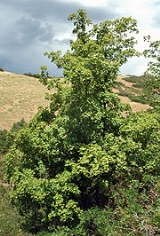
 It is a small to medium-sized deciduous
tree
growing to 10–15 m tall and a trunk of 20–35 cm diameter. The bark
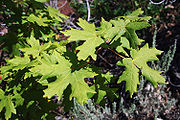
is dark brown to gray, with narrow fissures and flat ridges creating plate-like scales; it is thin and easily damaged. The leaves
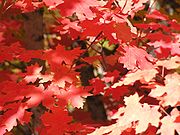
are opposite, simple, 6–12 cm long and broad, with three to five deep, bluntly-pointed lobes, three of the lobes large and two small ones (not always present) at the leaf base; the three major lobes each have 3–5 small subsidiary lobules. The leaves turn golden yellow to red in fall (this trait is less reliable in warmer areas).
The flower
s appear with the leaves in mid spring; they are produced in corymbs of 5–15 together, each flower yellow-green, about 4–5 mm diameter, with no petals. The fruit
is a paired samara (two winged seed
s joined at the base), green to reddish-pink in color, maturing brown in early fall; each seed is globose, 7–10 mm diameter, with a single wing 2–3 cm long.
 It commonly grows in limestone
soils but can adapt to a wide range of well-drained soils, from sand to clays to even white limestone areas. It prefers valleys, canyons, and the banks of mountain streams, primarily at higher elevations such as the sheltered canyons of the Edwards Plateau
in Texas
(where a population is protected in the Lost Maples State Natural Area
). Although continental climate
s prevail over all of its natural range, it grows well in the maritime climate of Vancouver. It is slow growing when young, and does not have many pests.
It is occasionally planted as an ornamental tree, valued for its drought tolerance and ability to grow in rocky landscapes.
Other vernacular names occasionally used include Lost Maple, Sabinal Maple, Western Sugar Maple, Uvalde Big Tooth Maple, Canyon Maple, Southwestern Big Tooth Maple, Plateau Big Tooth Maple, Limerock Maple, Wasatch Maple and Rocky Mountain Sugar Maple.
Maple
Acer is a genus of trees or shrubs commonly known as maple.Maples are variously classified in a family of their own, the Aceraceae, or together with the Hippocastanaceae included in the family Sapindaceae. Modern classifications, including the Angiosperm Phylogeny Group system, favour inclusion in...
native to interior western North America
North America
North America is a continent wholly within the Northern Hemisphere and almost wholly within the Western Hemisphere. It is also considered a northern subcontinent of the Americas...
, occurring in scattered populations from western Montana
Montana
Montana is a state in the Western United States. The western third of Montana contains numerous mountain ranges. Smaller, "island ranges" are found in the central third of the state, for a total of 77 named ranges of the Rocky Mountains. This geographical fact is reflected in the state's name,...
in the United States
United States
The United States of America is a federal constitutional republic comprising fifty states and a federal district...
south to Coahuila
Coahuila
Coahuila, formally Coahuila de Zaragoza , officially Estado Libre y Soberano de Coahuila de Zaragoza is one of the 31 states which, with the Federal District, comprise the 32 Federal Entities of Mexico...
in northern Mexico
Mexico
The United Mexican States , commonly known as Mexico , is a federal constitutional republic in North America. It is bordered on the north by the United States; on the south and west by the Pacific Ocean; on the southeast by Guatemala, Belize, and the Caribbean Sea; and on the east by the Gulf of...
. It is closely related to Acer saccharum (Sugar Maple), and is treated as a subspecies
Subspecies
Subspecies in biological classification, is either a taxonomic rank subordinate to species, ora taxonomic unit in that rank . A subspecies cannot be recognized in isolation: a species will either be recognized as having no subspecies at all or two or more, never just one...
of it by some botanists, as Acer saccharum subsp. grandidentatum (Nutt.) Desmarais.
Deciduous
Deciduous means "falling off at maturity" or "tending to fall off", and is typically used in reference to trees or shrubs that lose their leaves seasonally, and to the shedding of other plant structures such as petals after flowering or fruit when ripe...
tree
Tree
A tree is a perennial woody plant. It is most often defined as a woody plant that has many secondary branches supported clear of the ground on a single main stem or trunk with clear apical dominance. A minimum height specification at maturity is cited by some authors, varying from 3 m to...
growing to 10–15 m tall and a trunk of 20–35 cm diameter. The bark
Bark
Bark is the outermost layers of stems and roots of woody plants. Plants with bark include trees, woody vines and shrubs. Bark refers to all the tissues outside of the vascular cambium and is a nontechnical term. It overlays the wood and consists of the inner bark and the outer bark. The inner...
is dark brown to gray, with narrow fissures and flat ridges creating plate-like scales; it is thin and easily damaged. The leaves
Leaf
A leaf is an organ of a vascular plant, as defined in botanical terms, and in particular in plant morphology. Foliage is a mass noun that refers to leaves as a feature of plants....
are opposite, simple, 6–12 cm long and broad, with three to five deep, bluntly-pointed lobes, three of the lobes large and two small ones (not always present) at the leaf base; the three major lobes each have 3–5 small subsidiary lobules. The leaves turn golden yellow to red in fall (this trait is less reliable in warmer areas).
The flower
Flower
A flower, sometimes known as a bloom or blossom, is the reproductive structure found in flowering plants . The biological function of a flower is to effect reproduction, usually by providing a mechanism for the union of sperm with eggs...
s appear with the leaves in mid spring; they are produced in corymbs of 5–15 together, each flower yellow-green, about 4–5 mm diameter, with no petals. The fruit
Fruit
In broad terms, a fruit is a structure of a plant that contains its seeds.The term has different meanings dependent on context. In non-technical usage, such as food preparation, fruit normally means the fleshy seed-associated structures of certain plants that are sweet and edible in the raw state,...
is a paired samara (two winged seed
Seed
A seed is a small embryonic plant enclosed in a covering called the seed coat, usually with some stored food. It is the product of the ripened ovule of gymnosperm and angiosperm plants which occurs after fertilization and some growth within the mother plant...
s joined at the base), green to reddish-pink in color, maturing brown in early fall; each seed is globose, 7–10 mm diameter, with a single wing 2–3 cm long.
Limestone
Limestone is a sedimentary rock composed largely of the minerals calcite and aragonite, which are different crystal forms of calcium carbonate . Many limestones are composed from skeletal fragments of marine organisms such as coral or foraminifera....
soils but can adapt to a wide range of well-drained soils, from sand to clays to even white limestone areas. It prefers valleys, canyons, and the banks of mountain streams, primarily at higher elevations such as the sheltered canyons of the Edwards Plateau
Edwards Plateau
The Edwards Plateau is a region of west-central Texas which is bounded by the Balcones Fault to the south and east, the Llano Uplift and the Llano Estacado to the north, and the Pecos River and Chihuahuan Desert to the west. San Angelo, Austin, San Antonio and Del Rio roughly outline the area...
in Texas
Texas
Texas is the second largest U.S. state by both area and population, and the largest state by area in the contiguous United States.The name, based on the Caddo word "Tejas" meaning "friends" or "allies", was applied by the Spanish to the Caddo themselves and to the region of their settlement in...
(where a population is protected in the Lost Maples State Natural Area
Lost Maples State Natural Area
Lost Maples State Natural Area is a state park in the Edwards Plateau of Texas, United States.- Location :Lost Maples State Natural Area is located about north of Vanderpool, Texas and west of San Antonio...
). Although continental climate
Continental climate
Continental climate is a climate characterized by important annual variation in temperature due to the lack of significant bodies of water nearby...
s prevail over all of its natural range, it grows well in the maritime climate of Vancouver. It is slow growing when young, and does not have many pests.
It is occasionally planted as an ornamental tree, valued for its drought tolerance and ability to grow in rocky landscapes.
Other vernacular names occasionally used include Lost Maple, Sabinal Maple, Western Sugar Maple, Uvalde Big Tooth Maple, Canyon Maple, Southwestern Big Tooth Maple, Plateau Big Tooth Maple, Limerock Maple, Wasatch Maple and Rocky Mountain Sugar Maple.