

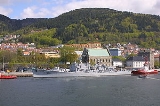
Bergenhus Fortress

Encyclopedia
Bergenhus fortress is a fortress located in Bergen
, Norway
. Bergenhus fortress is located in the entrance to the harbor in Bergen. This is one of the oldest and best preserved castles in Norway.
. The extent of the enclosed area of today dates from the early 19th century. In medieval times, the area of the present-day Bergenhus Fortress was known as Holmen (The islet), and contained the royal residence in Bergen, as well as a cathedral and several churches, the bishop's residence, and a Dominican
monastery
. Excavations have revealed foundations of buildings believed to date back to before 1100, which might have been erected by King Olav Kyrre
. In the 13th century, until 1299, Bergen was the capital of Norway and Holmen was thus the main seat of Norway's rulers. It was first enclosed by stone walls in the 1240s.
Of the medieval buildings, a medieval hall and a defensive tower remain. The royal hall, today known as Haakon's Hall, built around 1260, is the largest medieval secular building in Norway. The defensive tower, known in the Middle Ages as the keep by the sea, was built around 1270 by King Magnus VI Lagabøte
, and contained a royal apartment on the top floor. In the 1560s it was incorporated by the commander of the castle, Erik Rosenkrantz, into a larger structure, which is today known as the Rosenkrantz Tower.
In the Middle Ages, several churches, including the Christ Church
, Bergen's cathedral, were situated on the premises. These however were torn down in the period 1526 to 1531, as the area of Holmen was converted into a purely military fortification under Danish rule. From around this time, the name Bergenhus came into use. Building work on the Christ Church probably started around 1100. It contained the shrine of saint Sunniva
, the patron saint of Bergen and western Norway. In the 12th and 13th centuries it was the site of several royal coronations and weddings. It was also the burial site of at least six kings, as well as other members of the royal family. The site of its altar is today marked by a memorial stone.
In the 19th century, the fortress lost its function as a defensive fortification, but it was retained by the military as an administrative base. After restoration in the 1890s, and again after destruction sustained during World War II
, Bergenhus is today again used as a feast hall for public events. During World War II, the German navy used several of its buildings for their headquarters, and they also constructed a large concrete bunker within the fortress walls. The buildings, including the Haakon's Hall, were severely damaged when a Dutch ship in the service of the German navy, carrying approximately 120 tons of dynamite, exploded on 20 April 1944 in the harbour just outside the fortress walls, but the buildings were later restored.
Bergenhus is currently under the command of the Royal Norwegian Navy
, which has about 150 military personnel stationed there. The fortifications Sverresborg fortress and Fredriksberg fortress
also lie in the centre of Bergen. Haakon's Hall and the Rosenkrantz Tower are open for visits by the public.
stone hall located inside the fortress. The hall was constructed in the middle of the 13th century, during the reign of King Håkon Håkonsson
(1217–1263). In medieval times, it was the largest building of the royal palace in Bergen, then the capital of Norway. It was built as a replacement for older wooden structures on the site. It is the largest secular medieval building in Norway.
No written records survive of the construction of the hall. According to Håkon Håkonsson's saga
the building was not there at the coronation of King Håkon in 1247. It does however state that it was used during the wedding celebrations of king Magnus Håkonsson
and the Danish
princess Ingebjørg Eriksdatter on 11 September 1261. The hall is built in Gothic
style. In addition to the great hall itself, there were two more levels, a cellar and a middle floor. The hall's similarity to English structures of the same time, and the fact that monumental stone building was relatively uncommon in Norway at the time, has led to an assumption that the hall was designed by English architects, possibly the court architect of King Henry III of England
, with whom King Håkon was on friendly terms.
 The hall has been hit by several fires, the first one as early as 1266. From the death of King Eirik II
in 1299, Bergen lost its status as the main royal residence, and from 1380 until 1814, Norway was in a personal union with Denmark, which meant that the royal castle in Bergen gradually fell into decay. In 1429 it was captured and burnt by the Victual Brothers
, but a new stone portal from the mid-15th century shows that the hall was rebuilt after this event. Soon after that, however, as the old royal residence was transformed into a purely military fortress, the Hall was turned into a storage building.
By the 19th century, its original function had been completely forgotten, and it was sometimes referred to as "the old church". However, the 19th century saw the rise of national romanticism in Norway as the country gradually regained its independence. As a result, the independent medieval kingdom was used as a source of new national symbols to rally around. In 1840, it was proven that the great stone building in Bergenhus fortress was, in fact, king Håkon Håkonsson's old feast hall. For the next half-century, its restoration back to its original function was debated. Henrik Ibsen
wrote a poem in the hall's honor, and poet Henrik Wergeland
first used the name Haakons hall in one of his poems. The hall was finally restored in the 1890s, and in the 1910s it was decorated with fresco
s with motives from Håkon Håkonsson's saga, and stained glass
windows.
The hall was severely damaged on 20 April 1944, when a Dutch ship in the service of the German navy, carrying over 120 tons of dynamite
, accidentally exploded whilst docked on the harbour outside the walls of Bergenhus fortress. The stone structure was undamaged, but the wooden roof caught fire and burned up. The fire also destroyed all the decorations from the first restoration. A second restoration took place in the 1950s, and the hall was reopened on 11 September 1961, the 700th anniversary of its first use. It is now decorated more discreetly, primarily with tapestries
.
Haakon's Hall is now administered by the Bergen Museum
, which also takes care of the Rosenkrantz Tower and other protected buildings in the city. The hall is occasionally used for concerts, especially choir song and chamber music
, and for banquets, mainly for official functions. A popular restaurant and bar at the edge of the Columbia University campus in New York is named Haakon's Hall.
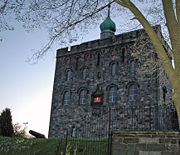 The Rosenkrantz Tower is one of the most prominent buildings of Bergenhus fortress. The tower
derives its name from governor Erik Rosenkrantz (1519-1575). It was during his administration (1559–1568) that the tower received its present shape and structure. The oldest part of the building, however, is made up of a medieval
tower, known as the "Keep by the Sea", built by King Magnus the Lawmender
in the 1270s as part of the royal castle in Bergen.
The keep was slightly modified c. 1520, then extensively modified and expanded in the 1560s by Scottish stonemasons and architects in the service of Erik Rosenkrantz to attain its present form. Rosenkrantz' building contained dungeon
s on the ground floor, residential rooms for the governor higher up, and positions for cannons on the top floor. In the 1740s, the tower was converted to a magazine
for gunpowder, a function it served until the 1930s. The whole building has been open to the general public since 1966. Today, the tower serves primarily as a tourist attraction
.
Bergen
Bergen is the second largest city in Norway with a population of as of , . Bergen is the administrative centre of Hordaland county. Greater Bergen or Bergen Metropolitan Area as defined by Statistics Norway, has a population of as of , ....
, Norway
Norway
Norway , officially the Kingdom of Norway, is a Nordic unitary constitutional monarchy whose territory comprises the western portion of the Scandinavian Peninsula, Jan Mayen, and the Arctic archipelago of Svalbard and Bouvet Island. Norway has a total area of and a population of about 4.9 million...
. Bergenhus fortress is located in the entrance to the harbor in Bergen. This is one of the oldest and best preserved castles in Norway.
History
The fortress contains buildings dating as far back as the 1240s, as well as later constructions built as recently as World War IIWorld War II
World War II, or the Second World War , was a global conflict lasting from 1939 to 1945, involving most of the world's nations—including all of the great powers—eventually forming two opposing military alliances: the Allies and the Axis...
. The extent of the enclosed area of today dates from the early 19th century. In medieval times, the area of the present-day Bergenhus Fortress was known as Holmen (The islet), and contained the royal residence in Bergen, as well as a cathedral and several churches, the bishop's residence, and a Dominican
Dominican Order
The Order of Preachers , after the 15th century more commonly known as the Dominican Order or Dominicans, is a Catholic religious order founded by Saint Dominic and approved by Pope Honorius III on 22 December 1216 in France...
monastery
Monastery
Monastery denotes the building, or complex of buildings, that houses a room reserved for prayer as well as the domestic quarters and workplace of monastics, whether monks or nuns, and whether living in community or alone .Monasteries may vary greatly in size – a small dwelling accommodating only...
. Excavations have revealed foundations of buildings believed to date back to before 1100, which might have been erected by King Olav Kyrre
Olaf III of Norway
Olaf Kyrre , or Olaf III Haraldsson, was King of Norway from 1067 to 1093. He was present at the Battle of Stamford Bridge in England in 1066 where his father, Harald Hardrada, saw defeat and was killed in action...
. In the 13th century, until 1299, Bergen was the capital of Norway and Holmen was thus the main seat of Norway's rulers. It was first enclosed by stone walls in the 1240s.
Of the medieval buildings, a medieval hall and a defensive tower remain. The royal hall, today known as Haakon's Hall, built around 1260, is the largest medieval secular building in Norway. The defensive tower, known in the Middle Ages as the keep by the sea, was built around 1270 by King Magnus VI Lagabøte
Magnus VI of Norway
Magnus VI Lagabøte or Magnus Håkonsson , was king of Norway from 1263 until 1280.-Early life:...
, and contained a royal apartment on the top floor. In the 1560s it was incorporated by the commander of the castle, Erik Rosenkrantz, into a larger structure, which is today known as the Rosenkrantz Tower.
In the Middle Ages, several churches, including the Christ Church
Christ Church, Bergen
Christ Church or the Old Cathedral on Holmen was the main church and cathedral of Bergen.The church was built by King Olav Kyrre during the period 1066-1093. The church was situated north of Haakon's hall, the King's hall. It was dedicated to the Holy Trinity but was always known as Christ Church...
, Bergen's cathedral, were situated on the premises. These however were torn down in the period 1526 to 1531, as the area of Holmen was converted into a purely military fortification under Danish rule. From around this time, the name Bergenhus came into use. Building work on the Christ Church probably started around 1100. It contained the shrine of saint Sunniva
Sunniva
Saint Sunniva is the patron saint of the Norwegian Diocese of Bjørgvin, as well as all of Western Norway.According to legend, Sunniva was the heir of an Irish kingdom, but had to flee when a heathen king, who wanted to marry her, invaded. At the Norwegian island of Selja, in the present-day...
, the patron saint of Bergen and western Norway. In the 12th and 13th centuries it was the site of several royal coronations and weddings. It was also the burial site of at least six kings, as well as other members of the royal family. The site of its altar is today marked by a memorial stone.
In the 19th century, the fortress lost its function as a defensive fortification, but it was retained by the military as an administrative base. After restoration in the 1890s, and again after destruction sustained during World War II
World War II
World War II, or the Second World War , was a global conflict lasting from 1939 to 1945, involving most of the world's nations—including all of the great powers—eventually forming two opposing military alliances: the Allies and the Axis...
, Bergenhus is today again used as a feast hall for public events. During World War II, the German navy used several of its buildings for their headquarters, and they also constructed a large concrete bunker within the fortress walls. The buildings, including the Haakon's Hall, were severely damaged when a Dutch ship in the service of the German navy, carrying approximately 120 tons of dynamite, exploded on 20 April 1944 in the harbour just outside the fortress walls, but the buildings were later restored.
Bergenhus is currently under the command of the Royal Norwegian Navy
Royal Norwegian Navy
The Royal Norwegian Navy is the branch of the Norwegian Defence Force responsible for naval operations. , the RNoN consists of approximately 3,700 personnel and 70 vessels, including 5 heavy frigates, 6 submarines, 14 patrol boats, 4 minesweepers, 4 minehunters, 1 mine detection vessel, 4 support...
, which has about 150 military personnel stationed there. The fortifications Sverresborg fortress and Fredriksberg fortress
Fredriksberg fortress
Fredriksberg fort is a Norwegian fortification located at the highest point of Nordnes in Bergen.-History:The Norwegian fortress Fredriskberg lay strategically placed on Nordnes’ highest point with a precipitous cliff face to the sea on the west side...
also lie in the centre of Bergen. Haakon's Hall and the Rosenkrantz Tower are open for visits by the public.
Haakon's Hall
Haakon's Hall is a medievalMiddle Ages
The Middle Ages is a periodization of European history from the 5th century to the 15th century. The Middle Ages follows the fall of the Western Roman Empire in 476 and precedes the Early Modern Era. It is the middle period of a three-period division of Western history: Classic, Medieval and Modern...
stone hall located inside the fortress. The hall was constructed in the middle of the 13th century, during the reign of King Håkon Håkonsson
Haakon IV of Norway
Haakon Haakonarson , also called Haakon the Old, was king of Norway from 1217 to 1263. Under his rule, medieval Norway reached its peak....
(1217–1263). In medieval times, it was the largest building of the royal palace in Bergen, then the capital of Norway. It was built as a replacement for older wooden structures on the site. It is the largest secular medieval building in Norway.
No written records survive of the construction of the hall. According to Håkon Håkonsson's saga
Hákonar saga Hákonarsonar
Hákonar saga Hákonarsonar is an Old Norse kings' saga, telling the story of the life and reign of King Haakon Haakonarson of Norway. The saga was written by the Icelandic historian and chieftain Sturla Þórðarson, in the 1260s...
the building was not there at the coronation of King Håkon in 1247. It does however state that it was used during the wedding celebrations of king Magnus Håkonsson
Magnus VI of Norway
Magnus VI Lagabøte or Magnus Håkonsson , was king of Norway from 1263 until 1280.-Early life:...
and the Danish
Denmark
Denmark is a Scandinavian country in Northern Europe. The countries of Denmark and Greenland, as well as the Faroe Islands, constitute the Kingdom of Denmark . It is the southernmost of the Nordic countries, southwest of Sweden and south of Norway, and bordered to the south by Germany. Denmark...
princess Ingebjørg Eriksdatter on 11 September 1261. The hall is built in Gothic
Gothic architecture
Gothic architecture is a style of architecture that flourished during the high and late medieval period. It evolved from Romanesque architecture and was succeeded by Renaissance architecture....
style. In addition to the great hall itself, there were two more levels, a cellar and a middle floor. The hall's similarity to English structures of the same time, and the fact that monumental stone building was relatively uncommon in Norway at the time, has led to an assumption that the hall was designed by English architects, possibly the court architect of King Henry III of England
Henry III of England
Henry III was the son and successor of John as King of England, reigning for 56 years from 1216 until his death. His contemporaries knew him as Henry of Winchester. He was the first child king in England since the reign of Æthelred the Unready...
, with whom King Håkon was on friendly terms.
Eirik II of Norway
Eirik Magnusson was the King of Norway from 1273/80 until 1299.-Background:He was the eldest surviving son of King Magnus the Lawmender of Norway, and his wife Ingeborg Eriksdatter, daughter of King Eric IV of Denmark. Eric descended from St...
in 1299, Bergen lost its status as the main royal residence, and from 1380 until 1814, Norway was in a personal union with Denmark, which meant that the royal castle in Bergen gradually fell into decay. In 1429 it was captured and burnt by the Victual Brothers
Victual Brothers
The Victual Brothers were a companionship of privateers who later turned to piracy. They were hired in 1392 by the Dukes of Mecklenburg to fight against Denmark, because the Danish Queen Margaret I had imprisoned Albrecht of Mecklenburg and his son in order to subdue the kingdom of Sweden...
, but a new stone portal from the mid-15th century shows that the hall was rebuilt after this event. Soon after that, however, as the old royal residence was transformed into a purely military fortress, the Hall was turned into a storage building.
By the 19th century, its original function had been completely forgotten, and it was sometimes referred to as "the old church". However, the 19th century saw the rise of national romanticism in Norway as the country gradually regained its independence. As a result, the independent medieval kingdom was used as a source of new national symbols to rally around. In 1840, it was proven that the great stone building in Bergenhus fortress was, in fact, king Håkon Håkonsson's old feast hall. For the next half-century, its restoration back to its original function was debated. Henrik Ibsen
Henrik Ibsen
Henrik Ibsen was a major 19th-century Norwegian playwright, theatre director, and poet. He is often referred to as "the father of prose drama" and is one of the founders of Modernism in the theatre...
wrote a poem in the hall's honor, and poet Henrik Wergeland
Henrik Wergeland
Henrik Arnold Thaulow Wergeland was a Norwegian writer, most celebrated for his poetry but also a prolific playwright, polemicist, historian, and linguist...
first used the name Haakons hall in one of his poems. The hall was finally restored in the 1890s, and in the 1910s it was decorated with fresco
Fresco
Fresco is any of several related mural painting types, executed on plaster on walls or ceilings. The word fresco comes from the Greek word affresca which derives from the Latin word for "fresh". Frescoes first developed in the ancient world and continued to be popular through the Renaissance...
s with motives from Håkon Håkonsson's saga, and stained glass
Stained glass
The term stained glass can refer to coloured glass as a material or to works produced from it. Throughout its thousand-year history, the term has been applied almost exclusively to the windows of churches and other significant buildings...
windows.
The hall was severely damaged on 20 April 1944, when a Dutch ship in the service of the German navy, carrying over 120 tons of dynamite
Dynamite
Dynamite is an explosive material based on nitroglycerin, initially using diatomaceous earth , or another absorbent substance such as powdered shells, clay, sawdust, or wood pulp. Dynamites using organic materials such as sawdust are less stable and such use has been generally discontinued...
, accidentally exploded whilst docked on the harbour outside the walls of Bergenhus fortress. The stone structure was undamaged, but the wooden roof caught fire and burned up. The fire also destroyed all the decorations from the first restoration. A second restoration took place in the 1950s, and the hall was reopened on 11 September 1961, the 700th anniversary of its first use. It is now decorated more discreetly, primarily with tapestries
Tapestry
Tapestry is a form of textile art, traditionally woven on a vertical loom, however it can also be woven on a floor loom as well. It is composed of two sets of interlaced threads, those running parallel to the length and those parallel to the width ; the warp threads are set up under tension on a...
.
Haakon's Hall is now administered by the Bergen Museum
Bergen Museum
The Bergen Museum is a university museum in Bergen, Norway. Founded in 1825 with the intent of building large collections in the fields of culture and natural history, it became the grounds for most of the academic activity in the city, a tradition which has prevailed since the museum became part...
, which also takes care of the Rosenkrantz Tower and other protected buildings in the city. The hall is occasionally used for concerts, especially choir song and chamber music
Chamber music
Chamber music is a form of classical music, written for a small group of instruments which traditionally could be accommodated in a palace chamber. Most broadly, it includes any art music that is performed by a small number of performers with one performer to a part...
, and for banquets, mainly for official functions. A popular restaurant and bar at the edge of the Columbia University campus in New York is named Haakon's Hall.
Rosenkrantz Tower
Tower
A tower is a tall structure, usually taller than it is wide, often by a significant margin. Towers are distinguished from masts by their lack of guy-wires....
derives its name from governor Erik Rosenkrantz (1519-1575). It was during his administration (1559–1568) that the tower received its present shape and structure. The oldest part of the building, however, is made up of a medieval
Middle Ages
The Middle Ages is a periodization of European history from the 5th century to the 15th century. The Middle Ages follows the fall of the Western Roman Empire in 476 and precedes the Early Modern Era. It is the middle period of a three-period division of Western history: Classic, Medieval and Modern...
tower, known as the "Keep by the Sea", built by King Magnus the Lawmender
Magnus VI of Norway
Magnus VI Lagabøte or Magnus Håkonsson , was king of Norway from 1263 until 1280.-Early life:...
in the 1270s as part of the royal castle in Bergen.
The keep was slightly modified c. 1520, then extensively modified and expanded in the 1560s by Scottish stonemasons and architects in the service of Erik Rosenkrantz to attain its present form. Rosenkrantz' building contained dungeon
Dungeon
A dungeon is a room or cell in which prisoners are held, especially underground. Dungeons are generally associated with medieval castles, though their association with torture probably belongs more to the Renaissance period...
s on the ground floor, residential rooms for the governor higher up, and positions for cannons on the top floor. In the 1740s, the tower was converted to a magazine
Magazine
Magazines, periodicals, glossies or serials are publications, generally published on a regular schedule, containing a variety of articles. They are generally financed by advertising, by a purchase price, by pre-paid magazine subscriptions, or all three...
for gunpowder, a function it served until the 1930s. The whole building has been open to the general public since 1966. Today, the tower serves primarily as a tourist attraction
Tourist attraction
A tourist attraction is a place of interest where tourists visit, typically for its inherent or exhibited cultural value, historical significance, natural or built beauty, or amusement opportunities....
.
Other sources
- Guthorm KavliGuthorm KavliGuthorm Kavli was a Norwegian architect and writer.He was born in Trondheim, and took the dr.techn. degree at the Norwegian Institute of Technology in 1967...
Norges festninger, fra Fredriksten til Vardøhus (Universitetsforlaget. 1987)