


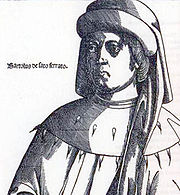
Bartolus de Saxoferrato

Encyclopedia
Italy
Italy , officially the Italian Republic languages]] under the European Charter for Regional or Minority Languages. In each of these, Italy's official name is as follows:;;;;;;;;), is a unitary parliamentary republic in South-Central Europe. To the north it borders France, Switzerland, Austria and...
law professor and one of the most prominent continental jurists of Medieval Roman Law
Medieval Roman law
Medieval Roman law is the continuation and development of ancient Roman law that developed in the European Late Middle Ages. Based on the ancient text of Roman law, the Corpus iuris civilis, it added many new concepts, and formed the basis of the later civil law systems that prevail in most...
. He belonged to the school known as the commentators or postglossator
Postglossator
The postglossators or commentators formed a European legal school which arose in France in the fourteenth century. They form the highest point of development of medieval Roman law....
s. The admiration of later generations of civil lawyers is shown by the adage nemo bonus íurista nisi bartolista — no one is a good jurist unless he is a Bartolist (i.e. a follower of Bartolus).
Life and works
Bartolus was born in the village of Venatura, near SassoferratoSassoferrato
Sassoferrato is a town and comune of the province of Ancona in the Marche region of Italy.-History:To the south of the town lie the ruins of the ancient Sentinum, on the Via Flaminia...
, in the Italian region of Marche
Marche
The population density in the region is below the national average. In 2008, it was 161.5 inhabitants per km2, compared to the national figure of 198.8. It is highest in the province of Ancona , and lowest in the province of Macerata...
. His father was Franciscus Severi, and his mother was of the Alfani family. He read civil law at the universities of Perugia
Perugia
Perugia is the capital city of the region of Umbria in central Italy, near the River Tiber, and the capital of the province of Perugia. The city is located about north of Rome. It covers a high hilltop and part of the valleys around the area....
under Cinus
Cino da Pistoia
Cino da Pistoia was an Italian jurist and poet.He was born in Pistoia, Tuscany. His full name was Guittoncino dei Sinibaldi de Candia Pistoia or, Latinised as Cinus de Sighibuldis, his father was from a noble man from the House of Sinibaldi and his mother a noble lady of the House of Candia Pistoia...
, and Bologna
Bologna
Bologna is the capital city of Emilia-Romagna, in the Po Valley of Northern Italy. The city lies between the Po River and the Apennine Mountains, more specifically, between the Reno River and the Savena River. Bologna is a lively and cosmopolitan Italian college city, with spectacular history,...
under Oldradus
Oldradus de Ponte
Oldradus de Ponte was an Italian jurist born in Lodi, active in the Roman curia in the early fourteenth century. Previously he had taught at the University of Padua. According to Joseph Canning he was an authority in both canon law and civil law, and his consilia are the earliest surviving...
and Belviso
Jacobus de Belviso
Jacobus de Belviso was an Italian jurist from Bologna. His later reputation was based on the text Practica criminalis on criminal law printed under his name in 1515. This is, however, no longer believed to be his work.-External links:*...
, and graduated to doctor of law in 1334. In 1339 he started teaching himself first in Pisa
Pisa
Pisa is a city in Tuscany, Central Italy, on the right bank of the mouth of the River Arno on the Tyrrhenian Sea. It is the capital city of the Province of Pisa...
, then in Perugia. He raised the character of Perugia's law school to a level with that of Bologna
Bologna
Bologna is the capital city of Emilia-Romagna, in the Po Valley of Northern Italy. The city lies between the Po River and the Apennine Mountains, more specifically, between the Reno River and the Savena River. Bologna is a lively and cosmopolitan Italian college city, with spectacular history,...
, and this city made him an honorary citizen in 1348. In 1355, Emperor Charles IV
Charles IV, Holy Roman Emperor
Charles IV , born Wenceslaus , was the second king of Bohemia from the House of Luxembourg, and the first king of Bohemia to also become Holy Roman Emperor....
appointed him as his consiliarius. In Perugia Baldus de Ubaldis
Baldus de Ubaldis
Baldus de Ubaldis was an Italian jurist, a leading figure in Medieval Roman Law.-Life:A member of the noble family of the Ubaldi , Baldus was born at Perugia in 1327, and studied civil law there under Bartolus de Saxoferrato, being admitted to the degree of doctor of civil law at the early age of...
and his brothers Angelus and Petrus became pupils of Bartolus. At the early age of 43, Bartolus died in Perugia, where a magnificent monument recorded the interment of his remains in the church of San Francisco, by the simple inscription of "Ossa Bartoli".
Despite his short life, Bartolus left an extraordinary number of works. He wrote commentaries on all parts of the Corpus Juris Civilis
Corpus Juris Civilis
The Corpus Juris Civilis is the modern name for a collection of fundamental works in jurisprudence, issued from 529 to 534 by order of Justinian I, Eastern Roman Emperor...
(except Justinian's Institutes
Corpus Juris Civilis
The Corpus Juris Civilis is the modern name for a collection of fundamental works in jurisprudence, issued from 529 to 534 by order of Justinian I, Eastern Roman Emperor...
). He is also the author of a large number of treatises on specific subjects. Among these treatises is his famous book on the law relating to rivers (De fluminibus seu Tyberiadis). There are also almost 400 legal opinions (consilia) written at the request of judges or private parties seeking legal advice.
Bartolus developed many novel legal concepts, which became part of the civil law tradition. Among his most important contributions were those to the area of conflict of laws — a field of great importance in 14th century Italy, where every city-state
City-state
A city-state is an independent or autonomous entity whose territory consists of a city which is not administered as a part of another local government.-Historical city-states:...
had its own statutes and customs. Bartolus also dealt with a variety of constitutional law
Constitutional law
Constitutional law is the body of law which defines the relationship of different entities within a state, namely, the executive, the legislature and the judiciary....
issues. In his treatise De insigniis et armis he discussed not only the law of Arms
Law of Arms
The law of heraldic arms governs the "bearing of arms", that is, the possession, use or display of arms, also called coats of arms, coat armour or armorial bearings. Although it is believed that the original function of coats of arms was to enable knights to identify each other on the battlefield,...
but also some problems of trademark
Trademark
A trademark, trade mark, or trade-mark is a distinctive sign or indicator used by an individual, business organization, or other legal entity to identify that the products or services to consumers with which the trademark appears originate from a unique source, and to distinguish its products or...
law.
Bartolus also wrote on political issues, including the legitimacy of city government
Local government
Local government refers collectively to administrative authorities over areas that are smaller than a state.The term is used to contrast with offices at nation-state level, which are referred to as the central government, national government, or federal government...
s, partisan divisions and the regimes of Italy's petty tyrants. His political thought balanced respect for the Empire
Holy Roman Empire
The Holy Roman Empire was a realm that existed from 962 to 1806 in Central Europe.It was ruled by the Holy Roman Emperor. Its character changed during the Middle Ages and the Early Modern period, when the power of the emperor gradually weakened in favour of the princes...
with defense of the legitimacy of local Italian governments.
Legacy
Already famous at his lifetime, Bartolus was later regarded the greatest jurist after the renaissance of Roman lawRoman law
Roman law is the legal system of ancient Rome, and the legal developments which occurred before the 7th century AD — when the Roman–Byzantine state adopted Greek as the language of government. The development of Roman law comprises more than a thousand years of jurisprudence — from the Twelve...
. This is not only evident from the above-quoted saying, but also from the fact that statutes in Spain
Spain
Spain , officially the Kingdom of Spain languages]] under the European Charter for Regional or Minority Languages. In each of these, Spain's official name is as follows:;;;;;;), is a country and member state of the European Union located in southwestern Europe on the Iberian Peninsula...
1427/1433 and Portugal
Portugal
Portugal , officially the Portuguese Republic is a country situated in southwestern Europe on the Iberian Peninsula. Portugal is the westernmost country of Europe, and is bordered by the Atlantic Ocean to the West and South and by Spain to the North and East. The Atlantic archipelagos of the...
1446 provided that his opinions should be followed where the Roman source texts and the Accursian gloss were silent. Lorenzo Valla
Lorenzo Valla
Lorenzo Valla was an Italian humanist, rhetorician, and educator. His family was from Piacenza; his father, Luciave della Valla, was a lawyer....
was driven out of the university of Pavia
Pavia
Pavia , the ancient Ticinum, is a town and comune of south-western Lombardy, northern Italy, 35 km south of Milan on the lower Ticino river near its confluence with the Po. It is the capital of the province of Pavia. It has a population of c. 71,000...
in 1431 for his critique of Bartolus' Latin style. Even in England, where the civil law
Civil law (legal system)
Civil law is a legal system inspired by Roman law and whose primary feature is that laws are codified into collections, as compared to common law systems that gives great precedential weight to common law on the principle that it is unfair to treat similar facts differently on different...
he had worked on was not applicable, Bartolus was held in high esteem. He influenced civilian writers such as Alberico Gentili
Alberico Gentili
Alberico Gentili was an Italian jurist. He left Italy due to his Protestant faith, travelled in Central Europe, and emigrated to England. In 1580 he became regius professor of civil law at the University of Oxford...
and Richard Zouch
Richard Zouch
Richard Zouch also Richard Zouche was an English jurist.-Life:He was born at Ansty, Wiltshire, son of Francis Zouche. His mother is said to have been Philippa, sixth daughter of George Ludlow of Hill Deverel, Wiltshire. He was educated at Winchester and afterwards at New College, Oxford, where he...
.
Due to Bartolus' fame, his name was used for the character of a (usually stiff and pedantic) lawyer in many Italian plays. A well-known example is Dr. Bartolo in Gioachino Rossini's opera The Barber of Seville
The Barber of Seville
The Barber of Seville, or The Futile Precaution is an opera buffa in two acts by Gioachino Rossini with a libretto by Cesare Sterbini. The libretto was based on Pierre Beaumarchais's comedy Le Barbier de Séville , which was originally an opéra comique, or a mixture of spoken play with music...
and in Mozart's
Wolfgang Amadeus Mozart
Wolfgang Amadeus Mozart , baptismal name Johannes Chrysostomus Wolfgangus Theophilus Mozart , was a prolific and influential composer of the Classical era. He composed over 600 works, many acknowledged as pinnacles of symphonic, concertante, chamber, piano, operatic, and choral music...
The Marriage of Figaro
The Marriage of Figaro
Le nozze di Figaro, ossia la folle giornata , K. 492, is an opera buffa composed in 1786 in four acts by Wolfgang Amadeus Mozart, with Italian libretto by Lorenzo Da Ponte, based on a stage comedy by Pierre Beaumarchais, La folle journée, ou le Mariage de Figaro .Although the play by...
.
Catalogs of Manuscripts
Catalogs:- Casamassima, Emanuele, Codices operum Bartoli a Saxoferrato recensiti 1, Iter Germanicum (Firenze: Olschki, 1971).
- Dolezalek, Gero, Verzeichnis der Handschriften zum römischen Recht bis 1600, 4 vols. (Frankfurt: Max-Planck-Institut für europäische Rechtsgeschichte, 1972).
- García y García, Antonio, Codices operum Bartoli a Saxoferrato recensiti 2, Iter Hispanicum (Firenze: Olschki, 1973).
- Izbicki, Thomas M., and Patrick Lally, "Texts Attributed to Bartolus de Saxoferrato in North American Manuscript Collections," Manuscripta 35 (1991): 146-155.
- Krafzik, Sebastian: Die Herrschereinsetzung aus der Sicht des Bartolus von Sassoferato In: Journal on European History of Law, London: STS Science Centre, Vol. 1, No. 2, pp. 39 – 43, (ISSN 2042-6402).
- Kuttner, Stephan, and Reinhard Elze, A Catalogue of Canon and Roman Law Manuscripts in the Vatican Library, 2 vols. (Città del Vaticano: Biblioteca Apostolica Vaticana, 1986–1987). Volume 1: Codices Vaticani latini 541-2299; volume 2: Codices Vaticani latini 2300-2746.