


Bardyllis

Encyclopedia
Bardyllis was a king of the Dardanian Kingdom and probably its founder.
Bardyllis created one of the most powerful Illyria
n states, that of the Dardanians. He achieved an extended Illyrian reign over Macedonia and Epirus
and added the lakeland (Lynkcetia) to his dominions.
Bardyllis lived over 90 years according to ancient sources, implying that he died around 358 BC.
Although his name appears in much later sources, in the events of 359 BC, it seems that he headed the Dardanian State long before the Illyrians. According to these sources, Bardyllis lived a long time and was at an advanced age when he faced Philip II.
His background was apparently in coal mining. He took land from the kingdom of Macedon, killing their king Perdiccas III.
In 385 BC, the Illyrians attacked the Molossians
. Dionysius
of Syracuse
aided the Illyrian attack in order to place Alcetas, a refugee in his court, on the throne. Dionysius
planned to control all the Ionian Sea. Sparta intervened on behalf of the Molossians despite having been aided by 2000 Greek hoplites and five hundred suits of Greek armour. The Illyrians were defeated by the Sparta
ns led by Agesilaus
but not before ravaging the region and killing 15,000 Molossians.
Grabos
became the most powerful Illyrian king after the death of Bardyllis in 358 BC. Bardyllis had a son named Cleitus the Illyrian
, a daughter named Bircenna
, and a grandson named Bardyllis II.
Bardyllis was killed in battle against Phillip of Macedon after Philip rejected his offer of peace based on retaining conquered lands.
. Special interest related to Bardyllis' image is that he became king with low backgrounds, an early charcoal-burner and coal miner, who had gained power by force and enjoyed the sympathy of the Dardanian warriors, since the division of spoils was fair and impartial. Bardyllis was not the heir of Sirras
, but instead over through the previous Illyrian king who had entered in a peace treaty with Amyntas II over the control of Lyncestia. Bardyllis succeeded in bringing various tribes in a single organisation and soon made Dardania into a formidable power in the Balkans
resulting in a change of relations with Macedonia. Only by acknowledging this fact, can there be given an explanation of the change that occurred in relations with the Illyrians and Macedonians
in 393 BC
. Nothing stands on the record to locate the center of his power, save for the fact that Philip's victory in 358 BC gained control of Lyncestia. Therefor in this very region, Bardyllis' capital may be located. However a more reasonable seat of power might by located in the heart of the Dardanian State, corresponding to today's Kosovo.
Bardyllis, unlike previous Illyrian kings, combined military and economic developments. His subjects, the Damastini, began to issue a fine silver coinage from c.395 BC in the Illyrian city of Damastion
. These coins adopted a version of the standard and some emblems of the then powerful Chalcidian League. They also exported silver in ingot form. Another coinage began c.365 under the actions of Bardyllis, that of Daparria, a mining city in Kosovo
which used the same standard and types as the coinage of the Damastini. The distribution of the coinages shows that Bardyllis built up a wide region of trade within the central Balkans
and northwards to the Danube
, which was quite distant from the areas of Greek
trade. Dionysius of Syracuse tried to tap Bardyllis' region of trade when he planted colonies in the Adriatic. It is probable that Bardyllis, unlike previous Illyrian kings, built a few fortified cities, for Lychnidus and Pelion
in the lakeland were walled sites probably before the accession of Philip.
Baraliris was an imagined Illyrian ruler, who (according to Tertullian
) after seeing a sign in a dream, embarked on a series of military victories which allowed him to extend Illyrian rule over the Molossians
and other tribes, as far as the frontiers of Macedon
. This king was probably the same as Bardyllis since he fits these actions.
Amyntas III allied himself with the Thessalians and took Macedonia under his rule from the Dardanians. However the Illyrians were constantly raiding and ruling over the northern frontiers of Macedonia. After continuous invasions Bardyllis forced the Macedon's to pay him an annual tribute in 372 BC
. In 370 BC the worthy Amyntas died full of years, having restored the fortunes of his kingdom after Illyrian disasters. His marriage to Eurydice of the Illyrian Sirras produced three sons and a daughter. His eldest son was Alexander II. In 369 BC Bardyllis succeeded in braking the efforts of Alexander II
in trying to eliminate the Dardanians from Macedonia. After the battle Alexander II was said to have brought his youngest brother Philip II, to Bardyllis as a hostage but this was brief. In 365 BC Alexander II was succeeded by his brother Periccas III.
The Paeonians began a series of raids against the Macedonians in support of a Dardanian invasion from the north. Perdiccas III, king of Macedonia, humiliated by the indignity of having to pay tribute to the Dardanians, marched north in the spring of 358 BC at the Macedonian army to resolve the issue by battle. This was not the first occasion he had fought against Bardyllis. Bardyllis heavily defeated the Macedonians. Among the 4,000 Macedonian dead, was the king himself. The remainder, panic-stricken, having become exceedingly afraid of the Illyrian army had lost heart for continuing the war. This was the worst loss suffered by the Macedonians in the range of their efforts to free themselves from the Illyrians. The Dardanians followed up their victory by expanding their control southward to Lake Lychnitis (Lake Ohrid
) and westward into upper Macedonia. By the actions of Bardyllis the Dradanians had brought Macedonia close to collapse.
When Philip II
, the youngest of the three brothers assumed the throne was determined to subdue the Illyians under Bardyllis once and for all and destroy the Illyrian menace.
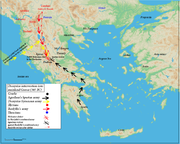 In 385 BC
the Illyrians formed an alliance with the powerful tyrant Dionysius of Syracuse
. The purpose of the agreement was the restoration of the throne to the Molossian Alcetas
which had remained as a refugee in his throne. Both sides were interested in this, because this alliance would secure Illyrian power and weaken the impact of the Sparta
ns and Macedonians consequently in Epirus. This would also give Dionysius an opportunity to strengthen trade positions on the shores of the Adriatic and Ionian
. Dionysius sent a military aid of 2 000 men and 5,000 weapons to the Illyrians who were prepared to go to war. With these new supplies Bardyllis and his army burst into Epirus
and slaughtered 15,000 Molossians. At this point Bardyllis had extended the borders of the Dardanian State as far south as the Ionian. This military aid seems to have not made it a little easier for the Illyrians because Sparta
had intervened as soon as the events became known and expelled the Illyrians who were led by Bardyllis. Despite being aided by 2000 Greek hoplites and five hundred suits of Greek armour
, the Illyrians were defeated by the Sparta
ns led by Agesilaus
but not before ravaging the region and killing 15,000 Molossians. Bardyllis' short rule over Epirus of northern Greece was over.
In 360 BC
, another Illyrian attack forced the Molossian king Arymbas
to evacuate his non-combatant population to Aetolia
and let the Illyrians loot freely. The stratagem worked and the Molossians fell upon the Illyrians who were encumbered with booty and defeated them. In the same year Arymbas of the Mollosians defeats the Illyrians after they raided and looted Epirus.
This policy explains the events that followed with Bardyllis's western neighbors. Apparently, the alliance with Dionysius had been a healthy support in the fight against Epirus and creating external allies.
Macedonia could come back to the field of battle against the Illyrians
, but now it had overcome the internal state of political chaos and have removed the risk of attack from other opponents. When Philip II assumed the Macedonian throne, substantial areas of upper Macedonia remained in control of Bardyllis. In order to concentrate on the internal struggle necessary to secure his crown, Philip reaffirmed the treaty the Dardanians had imposed on Macedonia by force of arms and sealed the alliance by his marriage of Audata
, probably a niece or daughter of Bardyllis. This action undoubtedly deterred a full-scale Dardanian invasion of Macedonia at a time when the country was most vulnerable.
By the spring of 358 BC, Philip had at last secured his throne and was now able to address the occupation of northwest Macedonia by Bardyllis. When word of the mobilization of the Macedonian army came to Bardyllis' attention, he proposed to Philip that they sign a treaty to maintain the status quo, provided that both parties maintain the cities that were already in their possession at the time. This was of course unacceptable to Philip, because he was not prepared to accept any terms other than a full Dardanian withdrawal from north west Macedonia. Bardyllis, however, was not inclined to give up his winnings without a fight. Philip mobilized every able-bodied soldier in Macedonia for the battle. Bardyllis as before was not likely to take any prisoners, so any Macedonian defeat would probably result in crippling casualties.
Although the two armies were almost equal in numbers - Bardyllis 500 cavalry and 10,000 infantry against Philp's force of 600 cavalry and 10,000 infantry, however the Macedonians were by far the better trained and equipped. The armies met in battle on a plain in the Erigon Valley near Bitola
, just south of the Drdanian State. Bardyllis initially deployed in a linear formation with his strongest troops in the center, similar to the phalanx
. Philip concentrated his best troops, the hypaspists, on his right flank. As Philip advanced to engage Bardyllis, his cavalry turned one or two of Bardyllis' flanks, forcing him to redeploy into a defensive square
formation. The Illyrians for quite some time withstood the assaults of the enemy. At first victory was not swayed by either one or the other party, and so continued the battle for a long time, because the two armies fought with bravery. Eventually Philips hypaspists succeeded in achieving a penetration into the right corner of the Dradanian that the companions were able to widen. This threw Bardyllis' entire formation into disorder, after which it was quickly broken by the phalanx and routed of the battlefield.
In 358 BC
Phillip of Macedon defeated Bardyllis, Diodorus Siculus
(1st century BC) writes this of the event;
The battle had cost the Dardanians 7,000 casualties, almost three quarters of their initial army.
Bardyllis himself was probably killed in this battle as he rode on horseback in the advanced age of 90. Although the Macedonians finally won the battle
, Philip II saw that he was not able to follow the enemy and chase them. The Illyrians later sent representatives and concluded peace, since releasing all the cities they had conquered from Macedonia. In this battle, the troubling issue of Lynkestia was solved and this changed the situation in the western borders in favor of Macedonia. Philip secured Macedonians north-west frontier by annexing Dardanian territory as far as Lake Lynkcesta (Lae Ohrid). This would form a defensive buffer against any future Illyrian raids attempted through the Drilon Valley. The borders between the Illyrian and the Macedonians remained around Lake Ohrid
for a long time.
Bardyllis created one of the most powerful Illyria
Illyria
In classical antiquity, Illyria was a region in the western part of the Balkan Peninsula inhabited by the Illyrians....
n states, that of the Dardanians. He achieved an extended Illyrian reign over Macedonia and Epirus
Epirus
The name Epirus, from the Greek "Ήπειρος" meaning continent may refer to:-Geographical:* Epirus - a historical and geographical region of the southwestern Balkans, straddling modern Greece and Albania...
and added the lakeland (Lynkcetia) to his dominions.
Bardyllis lived over 90 years according to ancient sources, implying that he died around 358 BC.
Although his name appears in much later sources, in the events of 359 BC, it seems that he headed the Dardanian State long before the Illyrians. According to these sources, Bardyllis lived a long time and was at an advanced age when he faced Philip II.
His background was apparently in coal mining. He took land from the kingdom of Macedon, killing their king Perdiccas III.
In 385 BC, the Illyrians attacked the Molossians
Molossians
The Molossians were an ancient Greek tribe that inhabited the region of Epirus since the Mycenaean era. On their northeast frontier they had the Chaonians and to their southern frontier the kingdom of the Thesprotians, to their north were the Illyrians. The Molossians were part of the League of...
. Dionysius
Dionysius I of Syracuse
Dionysius I or Dionysius the Elder was a Greek tyrant of Syracuse, in what is now Sicily, southern Italy. He conquered several cities in Sicily and southern Italy, opposed Carthage's influence in Sicily and made Syracuse the most powerful of the Western Greek colonies...
of Syracuse
Syracuse, Italy
Syracuse is a historic city in Sicily, the capital of the province of Syracuse. The city is notable for its rich Greek history, culture, amphitheatres, architecture, and as the birthplace of the preeminent mathematician and engineer Archimedes. This 2,700-year-old city played a key role in...
aided the Illyrian attack in order to place Alcetas, a refugee in his court, on the throne. Dionysius
Dionysius I of Syracuse
Dionysius I or Dionysius the Elder was a Greek tyrant of Syracuse, in what is now Sicily, southern Italy. He conquered several cities in Sicily and southern Italy, opposed Carthage's influence in Sicily and made Syracuse the most powerful of the Western Greek colonies...
planned to control all the Ionian Sea. Sparta intervened on behalf of the Molossians despite having been aided by 2000 Greek hoplites and five hundred suits of Greek armour. The Illyrians were defeated by the Sparta
Sparta
Sparta or Lacedaemon, was a prominent city-state in ancient Greece, situated on the banks of the River Eurotas in Laconia, in south-eastern Peloponnese. It emerged as a political entity around the 10th century BC, when the invading Dorians subjugated the local, non-Dorian population. From c...
ns led by Agesilaus
Agesilaus II
Agesilaus II, or Agesilaos II was a king of Sparta, of the Eurypontid dynasty, ruling from approximately 400 BC to 360 BC, during most of which time he was, in Plutarch's words, "as good as thought commander and king of all Greece," and was for the whole of it greatly identified with his...
but not before ravaging the region and killing 15,000 Molossians.
Grabos
Grabos
Grabos was an Illyrian king of the Grabaei State. Grabos also spelt Grabus, was the most powerful Illyrian king after the death of Bardyllis in 358 BC...
became the most powerful Illyrian king after the death of Bardyllis in 358 BC. Bardyllis had a son named Cleitus the Illyrian
Cleitus the Illyrian
Cleitus was an Illyrian king of the Dardanian State attested in 335 BC. Cleitus was the son of Bardyllis and the father of Bardyllis II.....
, a daughter named Bircenna
Bircenna
Bircenna was an Illyrian princess and later an Epirote queen.Bircenna was the daughter of Bardylis II of the Dardanian Kingdom. Bircenna was one of the five wives of Pyrrhus of Epirus; she married him around 292 BC...
, and a grandson named Bardyllis II.
Bardyllis was killed in battle against Phillip of Macedon after Philip rejected his offer of peace based on retaining conquered lands.
Early life
Bardyllis was born around the year 448 BC448 BC
Year 448 BC was a year of the pre-Julian Roman calendar. At the time, it was known as the Year of the Consulship of Coritinesanus and Caeliomontanus...
. Special interest related to Bardyllis' image is that he became king with low backgrounds, an early charcoal-burner and coal miner, who had gained power by force and enjoyed the sympathy of the Dardanian warriors, since the division of spoils was fair and impartial. Bardyllis was not the heir of Sirras
Sirras
Sirras , of Lyncestian origins, was a member of the royalty, perhaps prince-regent, of Lyncestis in Upper Macedonia. Some suggest that he was an Illyrian because Plutarch mentions that his daughter, Eurydice was derisively called by her enemies "a thrice barbarian Illyrian",...
, but instead over through the previous Illyrian king who had entered in a peace treaty with Amyntas II over the control of Lyncestia. Bardyllis succeeded in bringing various tribes in a single organisation and soon made Dardania into a formidable power in the Balkans
Balkans
The Balkans is a geopolitical and cultural region of southeastern Europe...
resulting in a change of relations with Macedonia. Only by acknowledging this fact, can there be given an explanation of the change that occurred in relations with the Illyrians and Macedonians
Ancient Macedonians
The Macedonians originated from inhabitants of the northeastern part of the Greek peninsula, in the alluvial plain around the rivers Haliacmon and lower Axios...
in 393 BC
393 BC
Year 393 BC was a year of the pre-Julian Roman calendar. At the time, it was known as the Year of the Consulship of Poplicola and Cornelius...
. Nothing stands on the record to locate the center of his power, save for the fact that Philip's victory in 358 BC gained control of Lyncestia. Therefor in this very region, Bardyllis' capital may be located. However a more reasonable seat of power might by located in the heart of the Dardanian State, corresponding to today's Kosovo.
Bardyllis, unlike previous Illyrian kings, combined military and economic developments. His subjects, the Damastini, began to issue a fine silver coinage from c.395 BC in the Illyrian city of Damastion
Damastion
Damastion was an ancient city in the area of central Balkans. Various sites in Serbia and Macedonia and Albania have been considered as the location of this ancient town....
. These coins adopted a version of the standard and some emblems of the then powerful Chalcidian League. They also exported silver in ingot form. Another coinage began c.365 under the actions of Bardyllis, that of Daparria, a mining city in Kosovo
Kosovo
Kosovo is a region in southeastern Europe. Part of the Ottoman Empire for more than five centuries, later the Autonomous Province of Kosovo and Metohija within Serbia...
which used the same standard and types as the coinage of the Damastini. The distribution of the coinages shows that Bardyllis built up a wide region of trade within the central Balkans
Balkans
The Balkans is a geopolitical and cultural region of southeastern Europe...
and northwards to the Danube
Danube
The Danube is a river in the Central Europe and the Europe's second longest river after the Volga. It is classified as an international waterway....
, which was quite distant from the areas of Greek
Greeks
The Greeks, also known as the Hellenes , are a nation and ethnic group native to Greece, Cyprus and neighboring regions. They also form a significant diaspora, with Greek communities established around the world....
trade. Dionysius of Syracuse tried to tap Bardyllis' region of trade when he planted colonies in the Adriatic. It is probable that Bardyllis, unlike previous Illyrian kings, built a few fortified cities, for Lychnidus and Pelion
Pelion
Pelion or Pelium is a mountain at the southeastern part of Thessaly in central Greece, forming a hook-like peninsula between the Pagasetic Gulf and the Aegean Sea...
in the lakeland were walled sites probably before the accession of Philip.
Baraliris was an imagined Illyrian ruler, who (according to Tertullian
Tertullian
Quintus Septimius Florens Tertullianus, anglicised as Tertullian , was a prolific early Christian author from Carthage in the Roman province of Africa. He is the first Christian author to produce an extensive corpus of Latin Christian literature. He also was a notable early Christian apologist and...
) after seeing a sign in a dream, embarked on a series of military victories which allowed him to extend Illyrian rule over the Molossians
Molossians
The Molossians were an ancient Greek tribe that inhabited the region of Epirus since the Mycenaean era. On their northeast frontier they had the Chaonians and to their southern frontier the kingdom of the Thesprotians, to their north were the Illyrians. The Molossians were part of the League of...
and other tribes, as far as the frontiers of Macedon
Macedon
Macedonia or Macedon was an ancient kingdom, centered in the northeastern part of the Greek peninsula, bordered by Epirus to the west, Paeonia to the north, the region of Thrace to the east and Thessaly to the south....
. This king was probably the same as Bardyllis since he fits these actions.
Macedonian campaigns
It seems that Bardhylis opposed the deal with Amyntas II and Sirras and invaded Macedonia in 393 BC. Bardyllis used new warfare tactics never before used by any of the Illyrians and won a decisive battle against Amyntas III expelling him and ruling Macedonia through a puppet king. In 392 BC392 BC
Year 392 BC was a year of the pre-Julian Roman calendar. At the time, it was known as the Year of the Consulship of Poplicola and Capitolinus...
Amyntas III allied himself with the Thessalians and took Macedonia under his rule from the Dardanians. However the Illyrians were constantly raiding and ruling over the northern frontiers of Macedonia. After continuous invasions Bardyllis forced the Macedon's to pay him an annual tribute in 372 BC
372 BC
Year 372 BC was a year of the pre-Julian Roman calendar. At the time, it was known as the Fourth year without Tribunate or Consulship...
. In 370 BC the worthy Amyntas died full of years, having restored the fortunes of his kingdom after Illyrian disasters. His marriage to Eurydice of the Illyrian Sirras produced three sons and a daughter. His eldest son was Alexander II. In 369 BC Bardyllis succeeded in braking the efforts of Alexander II
Alexander II
Alexander II may refer to:* Alexander II of Macedon, King of Macedon from 370 to 368 BC* Alexander II of Epirus , King of Epirus in 272 BC* Pope Alexander II, Pope from 1061 to 1073* Alexander II of Scotland , the King of Scotland...
in trying to eliminate the Dardanians from Macedonia. After the battle Alexander II was said to have brought his youngest brother Philip II, to Bardyllis as a hostage but this was brief. In 365 BC Alexander II was succeeded by his brother Periccas III.
The Paeonians began a series of raids against the Macedonians in support of a Dardanian invasion from the north. Perdiccas III, king of Macedonia, humiliated by the indignity of having to pay tribute to the Dardanians, marched north in the spring of 358 BC at the Macedonian army to resolve the issue by battle. This was not the first occasion he had fought against Bardyllis. Bardyllis heavily defeated the Macedonians. Among the 4,000 Macedonian dead, was the king himself. The remainder, panic-stricken, having become exceedingly afraid of the Illyrian army had lost heart for continuing the war. This was the worst loss suffered by the Macedonians in the range of their efforts to free themselves from the Illyrians. The Dardanians followed up their victory by expanding their control southward to Lake Lychnitis (Lake Ohrid
Lake Ohrid
Lake Ohrid straddles the mountainous border between the southwestern Macedonia and eastern Albania. It is one of Europe's deepest and oldest lakes, preserving a unique aquatic ecosystem with more than 200 endemic species that is of worldwide importance...
) and westward into upper Macedonia. By the actions of Bardyllis the Dradanians had brought Macedonia close to collapse.
When Philip II
Philip II
-People:* Philip II of Macedon * Philip II Philoromaeus * Philip II of France * Philip II of Navarre * Philip II of Taranto * Philip II, Duke of Burgundy * Philip II, Duke of Savoy...
, the youngest of the three brothers assumed the throne was determined to subdue the Illyians under Bardyllis once and for all and destroy the Illyrian menace.
Subjection of Epirus
385 BC
Year 385 BC was a year of the pre-Julian Roman calendar. At the time, it was known as the Year of the Tribunate of Capitolinus, Cornelius, Capitolinus, Papirius, Capitolinus and Fidenas...
the Illyrians formed an alliance with the powerful tyrant Dionysius of Syracuse
Dionysius I of Syracuse
Dionysius I or Dionysius the Elder was a Greek tyrant of Syracuse, in what is now Sicily, southern Italy. He conquered several cities in Sicily and southern Italy, opposed Carthage's influence in Sicily and made Syracuse the most powerful of the Western Greek colonies...
. The purpose of the agreement was the restoration of the throne to the Molossian Alcetas
Alcetas
Alcetas , the brother of Perdiccas and son of Orontes from Orestis, is first mentioned as one of Alexander the Great's generals in his Indian expedition...
which had remained as a refugee in his throne. Both sides were interested in this, because this alliance would secure Illyrian power and weaken the impact of the Sparta
Sparta
Sparta or Lacedaemon, was a prominent city-state in ancient Greece, situated on the banks of the River Eurotas in Laconia, in south-eastern Peloponnese. It emerged as a political entity around the 10th century BC, when the invading Dorians subjugated the local, non-Dorian population. From c...
ns and Macedonians consequently in Epirus. This would also give Dionysius an opportunity to strengthen trade positions on the shores of the Adriatic and Ionian
Ionian Sea
The Ionian Sea , is an arm of the Mediterranean Sea, south of the Adriatic Sea. It is bounded by southern Italy including Calabria, Sicily and the Salento peninsula to the west, southern Albania to the north, and a large number of Greek islands, including Corfu, Zante, Kephalonia, Ithaka, and...
. Dionysius sent a military aid of 2 000 men and 5,000 weapons to the Illyrians who were prepared to go to war. With these new supplies Bardyllis and his army burst into Epirus
Epirus
The name Epirus, from the Greek "Ήπειρος" meaning continent may refer to:-Geographical:* Epirus - a historical and geographical region of the southwestern Balkans, straddling modern Greece and Albania...
and slaughtered 15,000 Molossians. At this point Bardyllis had extended the borders of the Dardanian State as far south as the Ionian. This military aid seems to have not made it a little easier for the Illyrians because Sparta
Sparta
Sparta or Lacedaemon, was a prominent city-state in ancient Greece, situated on the banks of the River Eurotas in Laconia, in south-eastern Peloponnese. It emerged as a political entity around the 10th century BC, when the invading Dorians subjugated the local, non-Dorian population. From c...
had intervened as soon as the events became known and expelled the Illyrians who were led by Bardyllis. Despite being aided by 2000 Greek hoplites and five hundred suits of Greek armour
Armour
Armour or armor is protective covering used to prevent damage from being inflicted to an object, individual or a vehicle through use of direct contact weapons or projectiles, usually during combat, or from damage caused by a potentially dangerous environment or action...
, the Illyrians were defeated by the Sparta
Sparta
Sparta or Lacedaemon, was a prominent city-state in ancient Greece, situated on the banks of the River Eurotas in Laconia, in south-eastern Peloponnese. It emerged as a political entity around the 10th century BC, when the invading Dorians subjugated the local, non-Dorian population. From c...
ns led by Agesilaus
Agesilaus II
Agesilaus II, or Agesilaos II was a king of Sparta, of the Eurypontid dynasty, ruling from approximately 400 BC to 360 BC, during most of which time he was, in Plutarch's words, "as good as thought commander and king of all Greece," and was for the whole of it greatly identified with his...
but not before ravaging the region and killing 15,000 Molossians. Bardyllis' short rule over Epirus of northern Greece was over.
In 360 BC
360 BC
Year 360 BC was a year of the pre-Julian Roman calendar. At the time, it was known as the Year of the Consulship of Ambustus and Visolus...
, another Illyrian attack forced the Molossian king Arymbas
Arymbas
Arybbas was king of the Molossians. He was son of Alcetas and brother of Neoptolemus and grandfather of Pyrrhus. He married Troas . In ca. 360 BC, against an Illyrian attack, Arybbas evacuated his non-combatant population to Aetolia and let the Illyrians loot freely...
to evacuate his non-combatant population to Aetolia
Aetolia
Aetolia is a mountainous region of Greece on the north coast of the Gulf of Corinth, forming the eastern part of the modern prefecture of Aetolia-Acarnania.-Geography:...
and let the Illyrians loot freely. The stratagem worked and the Molossians fell upon the Illyrians who were encumbered with booty and defeated them. In the same year Arymbas of the Mollosians defeats the Illyrians after they raided and looted Epirus.
This policy explains the events that followed with Bardyllis's western neighbors. Apparently, the alliance with Dionysius had been a healthy support in the fight against Epirus and creating external allies.
Battle of Erigon Valley
In 359 BC359 BC
Year 359 BC was a year of the pre-Julian Roman calendar. At the time, it was known as the Year of the Consulship of Laenas and Imperiosus...
Macedonia could come back to the field of battle against the Illyrians
Illyrians
The Illyrians were a group of tribes who inhabited part of the western Balkans in antiquity and the south-eastern coasts of the Italian peninsula...
, but now it had overcome the internal state of political chaos and have removed the risk of attack from other opponents. When Philip II assumed the Macedonian throne, substantial areas of upper Macedonia remained in control of Bardyllis. In order to concentrate on the internal struggle necessary to secure his crown, Philip reaffirmed the treaty the Dardanians had imposed on Macedonia by force of arms and sealed the alliance by his marriage of Audata
Audata
Audata was an Illyrian princess and later a Macedonian queen when she married Philip II of Macedon in 359 BC. She was the daughter or niece daughter of Bardyllis, the Illyrian king of the Dardanian State...
, probably a niece or daughter of Bardyllis. This action undoubtedly deterred a full-scale Dardanian invasion of Macedonia at a time when the country was most vulnerable.
By the spring of 358 BC, Philip had at last secured his throne and was now able to address the occupation of northwest Macedonia by Bardyllis. When word of the mobilization of the Macedonian army came to Bardyllis' attention, he proposed to Philip that they sign a treaty to maintain the status quo, provided that both parties maintain the cities that were already in their possession at the time. This was of course unacceptable to Philip, because he was not prepared to accept any terms other than a full Dardanian withdrawal from north west Macedonia. Bardyllis, however, was not inclined to give up his winnings without a fight. Philip mobilized every able-bodied soldier in Macedonia for the battle. Bardyllis as before was not likely to take any prisoners, so any Macedonian defeat would probably result in crippling casualties.
Although the two armies were almost equal in numbers - Bardyllis 500 cavalry and 10,000 infantry against Philp's force of 600 cavalry and 10,000 infantry, however the Macedonians were by far the better trained and equipped. The armies met in battle on a plain in the Erigon Valley near Bitola
Bitola
Bitola is a city in the southwestern part of the Republic of Macedonia. The city is an administrative, cultural, industrial, commercial, and educational centre. It is located in the southern part of the Pelagonia valley, surrounded by the Baba and Nidže mountains, 14 km north of the...
, just south of the Drdanian State. Bardyllis initially deployed in a linear formation with his strongest troops in the center, similar to the phalanx
Phalanx formation
The phalanx is a rectangular mass military formation, usually composed entirely of heavy infantry armed with spears, pikes, sarissas, or similar weapons...
. Philip concentrated his best troops, the hypaspists, on his right flank. As Philip advanced to engage Bardyllis, his cavalry turned one or two of Bardyllis' flanks, forcing him to redeploy into a defensive square
Infantry square
An infantry square is a combat formation an infantry unit forms in close order when threatened with cavalry attack.-Very early history:The formation was described by Plutarch and used by the Romans, and was developed from an earlier circular formation...
formation. The Illyrians for quite some time withstood the assaults of the enemy. At first victory was not swayed by either one or the other party, and so continued the battle for a long time, because the two armies fought with bravery. Eventually Philips hypaspists succeeded in achieving a penetration into the right corner of the Dradanian that the companions were able to widen. This threw Bardyllis' entire formation into disorder, after which it was quickly broken by the phalanx and routed of the battlefield.
In 358 BC
358 BC
Year 358 BC was a year of the pre-Julian Roman calendar. At the time, it was known as the Year of the Consulship of Ambustus and Proculus...
Phillip of Macedon defeated Bardyllis, Diodorus Siculus
Diodorus Siculus
Diodorus Siculus was a Greek historian who flourished between 60 and 30 BC. According to Diodorus' own work, he was born at Agyrium in Sicily . With one exception, antiquity affords no further information about Diodorus' life and doings beyond what is to be found in his own work, Bibliotheca...
(1st century BC) writes this of the event;
And at first for a long while the battle was evenly poised because of the exceeding gallantry displayed on both sides, and as many were slain and still more wounded, the fortune of battle vacillated first one way then the other, being constantly swayed by the valorous deeds of the combatants; but later as the horsemen pressed on from the flank and rear and Philip with the flower of his troops fought with true heroism, the mass of the Illyrians was compelled to take hastily to flight.When the pursuit had been kept up for a considerable distance and many had been slain in their flight, Philip recalled the Macedonians with the trumpet and erecting a trophy of victory buried his own dead, while the Illyrians, having sent ambassadors and withdrawn from all the Macedonian cities, obtained peace. But more than seven thousand Illyrians were slain in this battle.
The battle had cost the Dardanians 7,000 casualties, almost three quarters of their initial army.
Bardyllis himself was probably killed in this battle as he rode on horseback in the advanced age of 90. Although the Macedonians finally won the battle
Battle
Generally, a battle is a conceptual component in the hierarchy of combat in warfare between two or more armed forces, or combatants. In a battle, each combatant will seek to defeat the others, with defeat determined by the conditions of a military campaign...
, Philip II saw that he was not able to follow the enemy and chase them. The Illyrians later sent representatives and concluded peace, since releasing all the cities they had conquered from Macedonia. In this battle, the troubling issue of Lynkestia was solved and this changed the situation in the western borders in favor of Macedonia. Philip secured Macedonians north-west frontier by annexing Dardanian territory as far as Lake Lynkcesta (Lae Ohrid). This would form a defensive buffer against any future Illyrian raids attempted through the Drilon Valley. The borders between the Illyrian and the Macedonians remained around Lake Ohrid
Lake Ohrid
Lake Ohrid straddles the mountainous border between the southwestern Macedonia and eastern Albania. It is one of Europe's deepest and oldest lakes, preserving a unique aquatic ecosystem with more than 200 endemic species that is of worldwide importance...
for a long time.