
Home      Discussion      Topics      Dictionary      Almanac
Signup       Login
Myriapoda

Myriapoda

Overview
Myriapoda is a subphylum
Subphylum
In life, a subphylum is a taxonomic rank intermediate between phylum and superclass. The rank of subdivision in plants and fungi is equivalent to subphylum.Not all phyla are divided into subphyla...

 of arthropod
Arthropod
An arthropod is an invertebrate animal having an exoskeleton , a segmented body, and jointed appendages. Arthropods are members of the phylum Arthropoda , and include the insects, arachnids, crustaceans, and others...

s containing millipede
Millipede
Millipedes are arthropods that have two pairs of legs per segment . Each segment that has two pairs of legs is a result of two single segments fused together as one...

s, centipede
Centipede
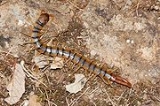
Centipedes are arthropods belonging to the class Chilopoda of the subphylum Myriapoda. They are elongated metameric animals with one pair of legs per body segment. Despite the name, centipedes can have a varying number of legs from under 20 to over 300. Centipedes have an odd number of pairs of...

s, and others. The group contains 13,000 species, all of which are terrestrial
Terrestrial animal
Terrestrial animals are animals that live predominantly or entirely on land , as compared with aquatic animals, which live predominantly or entirely in the water , or amphibians, which rely on a combination of aquatic and terrestrial habitats...

. Although their name suggests they have myriad
Myriad
Myriad , "numberlesscountless, infinite", is a classical Greek word for the number 10,000. In modern English, the word refers to an unspecified large quantity.-History and usage:...

 (10,000) legs, myriapods range from having over 750 legs (Illacme plenipes
Illacme plenipes
Illacme plenipes is a millipede found in the central region of the U.S. state of California. It has 750 legs, more than any other millipede. It was first seen in 1926, but was not rediscovered until 2005.-Legs:...

) to having fewer than ten legs.
Discussion
Ask a question about 'Myriapoda'
Start a new discussion about 'Myriapoda'
Answer questions from other users
Full Discussion Forum
 
Unanswered Questions
Encyclopedia
Myriapoda is a subphylum
Subphylum
In life, a subphylum is a taxonomic rank intermediate between phylum and superclass. The rank of subdivision in plants and fungi is equivalent to subphylum.Not all phyla are divided into subphyla...

 of arthropod
Arthropod
An arthropod is an invertebrate animal having an exoskeleton , a segmented body, and jointed appendages. Arthropods are members of the phylum Arthropoda , and include the insects, arachnids, crustaceans, and others...

s containing millipede
Millipede
Millipedes are arthropods that have two pairs of legs per segment . Each segment that has two pairs of legs is a result of two single segments fused together as one...

s, centipede
Centipede
Centipedes are arthropods belonging to the class Chilopoda of the subphylum Myriapoda. They are elongated metameric animals with one pair of legs per body segment. Despite the name, centipedes can have a varying number of legs from under 20 to over 300. Centipedes have an odd number of pairs of...

s, and others. The group contains 13,000 species, all of which are terrestrial
Terrestrial animal
Terrestrial animals are animals that live predominantly or entirely on land , as compared with aquatic animals, which live predominantly or entirely in the water , or amphibians, which rely on a combination of aquatic and terrestrial habitats...

. Although their name suggests they have myriad
Myriad
Myriad , "numberlesscountless, infinite", is a classical Greek word for the number 10,000. In modern English, the word refers to an unspecified large quantity.-History and usage:...

 (10,000) legs, myriapods range from having over 750 legs (Illacme plenipes
Illacme plenipes
Illacme plenipes is a millipede found in the central region of the U.S. state of California. It has 750 legs, more than any other millipede. It was first seen in 1926, but was not rediscovered until 2005.-Legs:...

) to having fewer than ten legs.

The fossil record of myriapods reaches back into the late Silurian
Silurian
The Silurian is a geologic period and system that extends from the end of the Ordovician Period, about 443.7 ± 1.5 Mya , to the beginning of the Devonian Period, about 416.0 ± 2.8 Mya . As with other geologic periods, the rock beds that define the period's start and end are well identified, but the...

, although molecular evidence suggests a diversification in the Cambrian Period, and Cambrian fossils exist which resemble myriapods.

The scientific study of myriapods is myriapodology, and those who study myriapods are myriapodologists.

Anatomy


Myriapods have a single pair of antennae
Antenna (biology)
Antennae in biology have historically been paired appendages used for sensing in arthropods. More recently, the term has also been applied to cilium structures present in most cell types of eukaryotes....

 and, in most cases, simple eyes. The mouthparts lie on the underside of the head, with an "epistome" and labrum forming the upper lip, and a pair of maxillae
Maxilla (arthropod)
In arthropods, the maxillae are paired structures present on the head as mouthparts in members of the clade Mandibulata, used for tasting and manipulating food. Embryologically, the maxillae are derived from the 4th and 5th segment of the head and the maxillary palps; segmented appendages extending...

 forming the lower lip. A pair of mandibles
Mandible (arthropod)
thumb|250px|The mandibles of a [[Bull ant]]The mandible of an arthropod is either of a pair of mouthparts used for biting, cutting and holding food. Mandibles are often simply referred to as jaws. Mandibles are present in the extant subphyla Myriapoda , Crustacea and Hexapoda...

 lie inside the mouth. Myriapods breathe through spiracle
Spiracle
Spiracles are openings on the surface of some animals that usually lead to respiratory systems.-Vertebrates:The spiracle is a small hole behind each eye that opens to the mouth in some fishes. In the primitive jawless fish the first gill opening immediately behind the mouth is essentially similar...

s that connect to a tracheal system
Invertebrate trachea
The invertebrate trachea refers to the open respiratory system composed of spiracles, tracheae, and tracheoles that terrestrial arthropods have to transport metabolic gases to and from tissues....

 similar to that of insects. There is a long tubular heart that extends through much of the body, but usually few, if any, blood vessels.

Malpighian tubules excrete nitrogenous waste into the digestive system, which typically consists of a simple tube. Although the ventral nerve cord has a ganglion
Ganglion
In anatomy, a ganglion is a biological tissue mass, most commonly a mass of nerve cell bodies. Cells found in a ganglion are called ganglion cells, though this term is also sometimes used to refer specifically to retinal ganglion cells....

 in each segment, the brain is relatively poorly developed.

During mating, male myriapods produce a packet of sperm, or spermatophore
Spermatophore
A spermatophore or sperm ampulla is a capsule or mass created by males of various animal species, containing spermatozoa and transferred in entirety to the female's ovipore during copulation...

, which they must transfer to the female externally; this process is often complex and highly developed. The female lays eggs which hatch as much shortened versions of the adults, with only a few segments and as few as three pairs of legs. The young add additional segments and limbs as they repeatedly moult
Ecdysis
Ecdysis is the moulting of the cuticula in many invertebrates. This process of moulting is the defining feature of the clade Ecdysozoa, comprising the arthropods, nematodes, velvet worms, horsehair worms, rotifers, tardigrades and Cephalorhyncha...

 to reach the adult form.

Ecology


Myriapods are most abundant in moist forests, where they fulfill an important role in breaking down decaying plant material, although a few live in grassland
Grassland
Grasslands are areas where the vegetation is dominated by grasses and other herbaceous plants . However, sedge and rush families can also be found. Grasslands occur naturally on all continents except Antarctica...

s, semi-arid
Semi-arid
A semi-arid climate or steppe climate describes climatic regions that receive precipitation below potential evapotranspiration, but not extremely...

 habitats or even deserts. The majority are detritivorous
Detritivore
Detritivores, also known as detritophages or detritus feeders or detritus eaters or saprophages, are heterotrophs that obtain nutrients by consuming detritus . By doing so, they contribute to decomposition and the nutrient cycles...

, with the exception of centipede
Centipede
Centipedes are arthropods belonging to the class Chilopoda of the subphylum Myriapoda. They are elongated metameric animals with one pair of legs per body segment. Despite the name, centipedes can have a varying number of legs from under 20 to over 300. Centipedes have an odd number of pairs of...

s, which are chiefly nocturnal predators. Pauropodans and symphylans are small, sometimes microscopic animals that resemble centipedes superficially and live in soil
Soil
Soil is a natural body consisting of layers of mineral constituents of variable thicknesses, which differ from the parent materials in their morphological, physical, chemical, and mineralogical characteristics...

s. Millipedes differ from the other groups in having their body segments fused into pairs, giving the appearance that each segment bears two pairs of legs
Arthropod leg
The arthropod leg is a form of jointed appendage of arthropods, usually used for walking. Many of the terms used for arthropod leg segments are of Latin origin, and may be confused with terms for bones: coxa , trochanter , femur, tibia, tarsus, ischium, metatarsus, carpus, dactylus ,...

, while the other three groups have a single pair of legs on each body segment.

Although not generally considered dangerous to humans, many myriapods produce noxious secretion
Secretion
Secretion is the process of elaborating, releasing, and oozing chemicals, or a secreted chemical substance from a cell or gland. In contrast to excretion, the substance may have a certain function, rather than being a waste product...

s (often containing benzoquinones
Benzoquinones
Benzoquinone is a quinone with a single benzene ring, of which there are only two:* 1,4-Benzoquinone, most commonly...

) which can cause temporary blister
Blister
A blister is a small pocket of fluid within the upper layers of the skin, typically caused by forceful rubbing , burning, freezing, chemical exposure or infection. Most blisters are filled with a clear fluid called serum or plasma...

ing and discolouration of the skin.

Classification


There has been much debate as to which arthropod group is most closely related to the Myriapoda. Under the Mandibulata
Mandibulata
The Mandibulata or mandibulates is a clade of arthropods that comprises the extant subphyla Myriapoda , Crustacea and Hexapoda . Mandibulata is currently believed to be the sister group of the clade Arachnomorpha, which comprises the rest of arthropods...

 hypothesis, Myriapoda is the sister taxon to Pancrustacea
Pancrustacea
Pancrustacea is a clade, comprising all crustaceans and hexapods. This grouping is contrary to the Atelocerata hypothesis, in which Myriapoda and Hexapoda are sister taxa, and Crustacea are only more distantly related. As of 2010, the Pancrustacea taxon is considered well accepted. The clade has...

, a group comprising the Crustacea and Hexapoda
Hexapoda
The subphylum Hexapoda constitutes the largest grouping of arthropods and includes the insects as well as three much smaller groups of wingless arthropods: Collembola, Protura, and Diplura . The Collembola are very abundant in terrestrial environments...

. Under the Atelocerata
Atelocerata
Atelocerata Heymons, 1901 is a proposed clade of arthropods that includes Hexapoda and Myriapoda , but excludes Crustacea and Chelicerata...

 hypothesis, Hexapoda
Hexapoda
The subphylum Hexapoda constitutes the largest grouping of arthropods and includes the insects as well as three much smaller groups of wingless arthropods: Collembola, Protura, and Diplura . The Collembola are very abundant in terrestrial environments...

 is the closest, whereas under the Paradoxopoda hypothesis, Chelicerata
Chelicerata
The subphylum Chelicerata constitutes one of the major subdivisions of the phylum Arthropoda, and includes horseshoe crabs, scorpions, spiders and mites...

 is the closest. This last hypothesis, although supported by few, if any, morphological characters, is supported by a number of molecular studies
Molecular biology
Molecular biology is the branch of biology that deals with the molecular basis of biological activity. This field overlaps with other areas of biology and chemistry, particularly genetics and biochemistry...

.

There are four classes of extant myriapods, Chilopoda
Centipede
Centipedes are arthropods belonging to the class Chilopoda of the subphylum Myriapoda. They are elongated metameric animals with one pair of legs per body segment. Despite the name, centipedes can have a varying number of legs from under 20 to over 300. Centipedes have an odd number of pairs of...

 (centipedes), Diplopoda
Millipede
Millipedes are arthropods that have two pairs of legs per segment . Each segment that has two pairs of legs is a result of two single segments fused together as one...

, Pauropoda
Pauropoda
Pauropods are small, pale, centipede-like arthropods. They form the order Pauropodina, belonging to the monotypic class Pauropoda. About 500 species in four families are found worldwide, living in soil and leaf mold...

 and Symphyla
Symphyla
Symphylans, also known as garden centipedes or glasshouse symphylans, are soil-dwelling arthropods of the class Symphyla in the subphylum Myriapoda. Symphylans resemble centipedes, but are smaller and translucent. They can move rapidly through the pores between soil particles, and are typically...

, containing a total of around 12,000 species
Species
In biology, a species is one of the basic units of biological classification and a taxonomic rank. A species is often defined as a group of organisms capable of interbreeding and producing fertile offspring. While in many cases this definition is adequate, more precise or differing measures are...

. While each of these groups of myriapods is believed to be monophyletic
Monophyly
In common cladistic usage, a monophyletic group is a taxon which forms a clade, meaning that it contains all the descendants of the possibly hypothetical closest common ancestor of the members of the group. The term is synonymous with the uncommon term holophyly...

, relationships among them are less certain.

Centipedes


Centipede
Centipede
Centipedes are arthropods belonging to the class Chilopoda of the subphylum Myriapoda. They are elongated metameric animals with one pair of legs per body segment. Despite the name, centipedes can have a varying number of legs from under 20 to over 300. Centipedes have an odd number of pairs of...

s make up the order Chilopoda. They are fast, predatory and venom
Venom
Venom is the general term referring to any variety of toxins used by certain types of animals that inject it into their victims by the means of a bite or a sting...

ous, hunting mostly at night. There are around 3,300 species, ranging from the diminutive Nannarup hoffmani (less than half an inch in length,  mm) to the giant Scolopendra gigantea
Scolopendra gigantea
Scolopendra gigantea is the largest representative of the genus Scolopendra, regularly reaching lengths of and can exceed . It inhabits the northern and western regions of South America and the islands of Trinidad, Puerto Rico, Saint Thomas, U.S...

, which may exceed 30 centimetres (12 in).

Millipedes


Most millipede
Millipede
Millipedes are arthropods that have two pairs of legs per segment . Each segment that has two pairs of legs is a result of two single segments fused together as one...

s are slower than centipedes, and feed on leaf litter and detritus
Detritus
Detritus is a biological term used to describe dead or waste organic material.Detritus may also refer to:* Detritus , a geological term used to describe the particles of rock produced by weathering...

. They are distinguished by the fusion of each pair of body segments into a single unit, giving the appearance of having two pairs of legs per segment. Around 8,000 species have been described, which may represent less than a tenth of the true global millipede diversity. One species, Illacme plenipes
Illacme plenipes
Illacme plenipes is a millipede found in the central region of the U.S. state of California. It has 750 legs, more than any other millipede. It was first seen in 1926, but was not rediscovered until 2005.-Legs:...

has the greatest number of legs of any animal, with 750. The name "millipede" is a compound word formed from the Latin
Latin
Latin is an Italic language originally spoken in Latium and Ancient Rome. It, along with most European languages, is a descendant of the ancient Proto-Indo-European language. Although it is considered a dead language, a number of scholars and members of the Christian clergy speak it fluently, and...

 roots milli ("thousand") and ped ("foot"), although millipedes typically have between 36 and 400 legs. Pill millipede
Pill millipede
Pill millipedes make up two orders of millipedes, often grouped together into a single superorder, Oniscomorpha. The name Oniscomorpha refers to the resemblance of pill millipedes to certain woodlice, namely the pillbugs of the family Armadillidiidae, also called "potato bugs", "doodlebugs", or...

s are much shorter, and are capable of rolling up into a ball, like pillbugs
Armadillidiidae
Armadillidiidae is a family of woodlice, a terrestrial crustacean group in the order Isopoda. Unlike members of other woodlouse families, members of this family can roll into a ball, an ability they share with the outwardly similar but unrelated pill millipedes and other animals...

.

Symphyla


About 200 species of symphyla
Symphyla
Symphylans, also known as garden centipedes or glasshouse symphylans, are soil-dwelling arthropods of the class Symphyla in the subphylum Myriapoda. Symphylans resemble centipedes, but are smaller and translucent. They can move rapidly through the pores between soil particles, and are typically...

ns are known worldwide. They resemble centipedes but are smaller and translucent. Many spend their lives as soil infauna, but some live arboreally. Juveniles have six pairs of legs, but, over a lifetime of several years, add an additional pair at each moult
Ecdysis
Ecdysis is the moulting of the cuticula in many invertebrates. This process of moulting is the defining feature of the clade Ecdysozoa, comprising the arthropods, nematodes, velvet worms, horsehair worms, rotifers, tardigrades and Cephalorhyncha...

 so that the adult instar
Instar
An instar is a developmental stage of arthropods, such as insects, between each molt , until sexual maturity is reached. Arthropods must shed the exoskeleton in order to grow or assume a new form. Differences between instars can often be seen in altered body proportions, colors, patterns, or...

 has twelve pairs of legs.

Pauropoda


Pauropoda
Pauropoda
Pauropods are small, pale, centipede-like arthropods. They form the order Pauropodina, belonging to the monotypic class Pauropoda. About 500 species in four families are found worldwide, living in soil and leaf mold...

 is another small group of small myriapods. They are typically 0.5–2.0 mm long and live in the soil on all continents except Antarctica. Over 700 species have been described. They are believed to be the sister group to millipedes, and have the dorsal tergites fused across pairs of segments, similar to the more complete fusion of segments seen in millipedes.

Arthropleuridea


Arthropleuridea
Arthropleuridea
Arthropleuridea was a subclass of myriapod arthropods that flourished during the Carboniferous period, having first arose during the Silurian, and perishing due to climate change during the Early Permian. Members are defined by diplosomy, paranotal tergal lobes separated from the axis by a suture,...

 were ancient myriapods that are now extinct. The most famous members are from the genus
Genus
In biology, a genus is a low-level taxonomic rank used in the biological classification of living and fossil organisms, which is an example of definition by genus and differentia...

 Arthropleura
Arthropleura
Arthropleura was a 0.3–2.6 metre long relative of centipedes and millipedes, native to the Upper Carboniferous of what is now northeastern North America and Scotland...

, which was a giant, probably herbivorous
Herbivore
Herbivores are organisms that are anatomically and physiologically adapted to eat plant-based foods. Herbivory is a form of consumption in which an organism principally eats autotrophs such as plants, algae and photosynthesizing bacteria. More generally, organisms that feed on autotrophs in...

, animal that could be up to 3 metres (9.8 ft) long. Arthropleuridea may be a division of the millipede
Millipede
Millipedes are arthropods that have two pairs of legs per segment . Each segment that has two pairs of legs is a result of two single segments fused together as one...

s.