

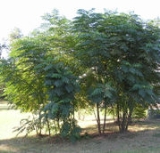
Aralia spinosa

Encyclopedia
Aralia spinosa, commonly known as Devil's Walkingstick, is a woody species of plants in the genus Aralia
, family Araliaceae
, native to eastern North America
. The various names refer to the viciously sharp, spiny stems, petioles, and even leaf midribs. It has also been known as Angelica-tree.
This species is sometimes called Hercules' Club, Prickly Ash, or Prickly Elder, common names it shares with the unrelated Zanthoxylum clava-herculis
. For this reason, Aralia spinosa is sometimes confused with that species and mistakenly called the Toothache Tree, but it does not have the medicinal properties of Zanthoxylum clava-herculis.
Aralia spinosa is occasionally cultivated for its exotic, tropical appearance, having large lacy compound leaves. It is closely related to the Asian species Aralia elata
, a more commonly cultivated species with which it is easily confused.
shrub
or small tree growing 2–8 m (6–25 ft) tall, with a simple or occasionally branched stem with very large bipinnate leaves
70–120 cm (28–48 in) long. The trunks are up to 15–20 cm (6–8 in) in diameter, with the plants umbrella-like in habit with open crowns. The young stems are stout and thickly covered with sharp spines. The plants generally grow in clusters of branchless trunks, although stout wide-spreading branches are occasionally produced.
The flower
s are creamy-white, individually small (about 5 mm or 0.2 in across) but produced in large composite panicles 30–60 cm (12–24 in) long; flowering is in the late summer. The fruit
is a purplish-black berry
6–8 mm (0.24–0.3 in) in diameter, ripening in the fall. The roots are thick and fleshy.
The doubly or triply compound leaves are the largest of any temperate tree in the continental United States, often about a meter (three feet) long and 60 cm (two feet) wide, with leaflets about 5-8 cm (2-3 in) long. The petioles are prickly, with swollen bases. In the autumn the leaves turn to a peculiar bronze red touched with yellow which makes the tree conspicuous and attractive.
The habit of growth and general appearance of Aralia spinosa and related tree-forming Aralia species are unique. It is usually found as a group of unbranched stems, rising to the height of 3.5–6 m (12–20 ft), which bear upon their summits a crowded cluster of doubly or triply compound leaves, thus giving to each stem a certain tropical palm-like appearance. In the south it is said to reach the height of 15 m (50 ft), still retaining its palm-like aspect. However, further north, the slender, swaying, palm-like appearance is most characteristic of younger plants that have not been damaged by winter storms.
, ranging from New York
to Florida
along the Atlantic coast, and westward to Ohio
, Illinois
, and Texas
.
It prefers a deep moist soil. The plants typically grow in the forest understory or at the edges of forests, often forming clonal
thickets by sprouting from the roots.
Aralia spinosa was introduced into cultivation in 1688 and is still grown for its decorative foliage, prickly stems, large showy flower panicles, and distinctive fall color. These plants are slow growing, tough and durable, do well in urban settings, but bear numerous prickles on their stems, petioles, and leaflets. These plants can be propagated from seeds or root cuttings.
United States Department of Agriculture Web page:
Aralia
Aralia , or Spikenard, is a genus of the plant family Araliaceae, consisting of 68 accepted species of deciduous or evergreen trees, shrubs, and rhizomatous herbaceous perennials. The genus is native to Asia and the Americas, with most species occurring in mountain woodlands...
, family Araliaceae
Araliaceae
Araliaceae is a family of flowering plants, also known as the Aralia family or Ivy family. The family includes 254 species of trees, shrubs, lianas and perennial herbaceous plants into 2 subfamilies...
, native to eastern North America
North America
North America is a continent wholly within the Northern Hemisphere and almost wholly within the Western Hemisphere. It is also considered a northern subcontinent of the Americas...
. The various names refer to the viciously sharp, spiny stems, petioles, and even leaf midribs. It has also been known as Angelica-tree.
This species is sometimes called Hercules' Club, Prickly Ash, or Prickly Elder, common names it shares with the unrelated Zanthoxylum clava-herculis
Zanthoxylum clava-herculis
Zanthoxylum clava-herculis, the Hercules' Club , pepperwood, or Southern prickly ash, is a spiny tree or shrub native to the southeastern United States. It grows to 10-17 m tall and has distinctive spined thick, corky lumps 2-3 cm long on the bark...
. For this reason, Aralia spinosa is sometimes confused with that species and mistakenly called the Toothache Tree, but it does not have the medicinal properties of Zanthoxylum clava-herculis.
Aralia spinosa is occasionally cultivated for its exotic, tropical appearance, having large lacy compound leaves. It is closely related to the Asian species Aralia elata
Aralia elata
Aralia elata or Japanese Angelica-tree is a woody plant belonging to the Aralia family .-Description:It is an upright deciduous small tree or shrub growing up to 6 m in height, native to eastern Russia, China, Korea, and Japan....
, a more commonly cultivated species with which it is easily confused.
Description
Aralia spinosa is an aromatic spiny deciduousDeciduous
Deciduous means "falling off at maturity" or "tending to fall off", and is typically used in reference to trees or shrubs that lose their leaves seasonally, and to the shedding of other plant structures such as petals after flowering or fruit when ripe...
shrub
Shrub
A shrub or bush is distinguished from a tree by its multiple stems and shorter height, usually under 5–6 m tall. A large number of plants may become either shrubs or trees, depending on the growing conditions they experience...
or small tree growing 2–8 m (6–25 ft) tall, with a simple or occasionally branched stem with very large bipinnate leaves
Leaf
A leaf is an organ of a vascular plant, as defined in botanical terms, and in particular in plant morphology. Foliage is a mass noun that refers to leaves as a feature of plants....
70–120 cm (28–48 in) long. The trunks are up to 15–20 cm (6–8 in) in diameter, with the plants umbrella-like in habit with open crowns. The young stems are stout and thickly covered with sharp spines. The plants generally grow in clusters of branchless trunks, although stout wide-spreading branches are occasionally produced.
The flower
Flower
A flower, sometimes known as a bloom or blossom, is the reproductive structure found in flowering plants . The biological function of a flower is to effect reproduction, usually by providing a mechanism for the union of sperm with eggs...
s are creamy-white, individually small (about 5 mm or 0.2 in across) but produced in large composite panicles 30–60 cm (12–24 in) long; flowering is in the late summer. The fruit
Fruit
In broad terms, a fruit is a structure of a plant that contains its seeds.The term has different meanings dependent on context. In non-technical usage, such as food preparation, fruit normally means the fleshy seed-associated structures of certain plants that are sweet and edible in the raw state,...
is a purplish-black berry
Berry
The botanical definition of a berry is a fleshy fruit produced from a single ovary. Grapes are an example. The berry is the most common type of fleshy fruit in which the entire ovary wall ripens into an edible pericarp. They may have one or more carpels with a thin covering and fleshy interiors....
6–8 mm (0.24–0.3 in) in diameter, ripening in the fall. The roots are thick and fleshy.
The doubly or triply compound leaves are the largest of any temperate tree in the continental United States, often about a meter (three feet) long and 60 cm (two feet) wide, with leaflets about 5-8 cm (2-3 in) long. The petioles are prickly, with swollen bases. In the autumn the leaves turn to a peculiar bronze red touched with yellow which makes the tree conspicuous and attractive.
The habit of growth and general appearance of Aralia spinosa and related tree-forming Aralia species are unique. It is usually found as a group of unbranched stems, rising to the height of 3.5–6 m (12–20 ft), which bear upon their summits a crowded cluster of doubly or triply compound leaves, thus giving to each stem a certain tropical palm-like appearance. In the south it is said to reach the height of 15 m (50 ft), still retaining its palm-like aspect. However, further north, the slender, swaying, palm-like appearance is most characteristic of younger plants that have not been damaged by winter storms.
- Bark: Light brown, divided into rounded broken ridges. Branchlets one-half to two-thirds of an inch in diameter, armed with stout, straight or curved, scattered prickles and nearly encircled by narrow leaf scars. At first light yellow brown, shining and dotted, later light brown.
- Wood: Brown with yellow streaks; light, soft, brittle, close-grained.
- Winter buds: Terminal bud chestnut brown, one-half to three-fourths of an inch long, conical, blunt; axillary buds flattened, triangular, one-fourth of an inch in length.
- Leaves: Clustered at the end of the branches, compound, bi- and tri-pinnate, three to four feet long, two and a half feet broad. The pinnae are unequally pinnate, having five or six pairs of leaflets and a long stalked terminal leaflet; these leaflets are often themselves pinnate. The last leaflets are ovate, two to three inches long, wedge-shaped or rounded at base, serrate or dentate, acute; midrib and primary veins prominent. They come out of the bud a bronze green, shining, somewhat hairy; when full grown are dark green above, pale beneath; midribs frequently furnished with prickles. Petioles stout, light brown, eighteen to twenty inches in length, clasping, armed with prickles. Stipules acute, one-half inch long.
- Flowers: July, August. Perfect or polygamomonoeciousPolygamomonoeciousThe term polygamomonoecious has two meanings in botany:*an individual plant with male, female, and perfect flowers on the same plant, called trimonoecious or polygamomonoecious plants;...
, cream white, borne in many-flowered umbels arranged in compound panicles, forming a terminal racemose cluster, three to four feet in length which rises, solitary or two or three together, above the spreading leaves. Bracts and bractlets lanceolate, acute, persistent. - Calyx: Calyx tube coherent with the ovary, minutely five-toothed.
- Corolla: Petals five, white, inserted on margin of the disk, acute, slightly inflexed at the apex, imbricate in bud.
- Stamens: Five, inserted on margin of the disk, alternate with the petals; filaments thread-like; anthers oblong, attached on the back, introrse, two-celled; cells opening longitudinally.
- Pistil: Ovary inferior, five-celled; styles five, connivent; stigmas capitate.
- Fruit: Berry-like drupe, globular, black, one-fourth of an inch long, five-angled, crowned with the blackened styles. Flesh thin, dark.
Distribution and habitat
Aralia spinosa is widespread in the eastern United StatesUnited States
The United States of America is a federal constitutional republic comprising fifty states and a federal district...
, ranging from New York
New York
New York is a state in the Northeastern region of the United States. It is the nation's third most populous state. New York is bordered by New Jersey and Pennsylvania to the south, and by Connecticut, Massachusetts and Vermont to the east...
to Florida
Florida
Florida is a state in the southeastern United States, located on the nation's Atlantic and Gulf coasts. It is bordered to the west by the Gulf of Mexico, to the north by Alabama and Georgia and to the east by the Atlantic Ocean. With a population of 18,801,310 as measured by the 2010 census, it...
along the Atlantic coast, and westward to Ohio
Ohio
Ohio is a Midwestern state in the United States. The 34th largest state by area in the U.S.,it is the 7th‑most populous with over 11.5 million residents, containing several major American cities and seven metropolitan areas with populations of 500,000 or more.The state's capital is Columbus...
, Illinois
Illinois
Illinois is the fifth-most populous state of the United States of America, and is often noted for being a microcosm of the entire country. With Chicago in the northeast, small industrial cities and great agricultural productivity in central and northern Illinois, and natural resources like coal,...
, and Texas
Texas
Texas is the second largest U.S. state by both area and population, and the largest state by area in the contiguous United States.The name, based on the Caddo word "Tejas" meaning "friends" or "allies", was applied by the Spanish to the Caddo themselves and to the region of their settlement in...
.
It prefers a deep moist soil. The plants typically grow in the forest understory or at the edges of forests, often forming clonal
Vegetative reproduction
Vegetative reproduction is a form of asexual reproduction in plants. It is a process by which new individuals arise without production of seeds or spores...
thickets by sprouting from the roots.
Uses
The young leaves can be eaten if gathered before the prickles harden. They are chopped finely and cooked as a potherb.Aralia spinosa was introduced into cultivation in 1688 and is still grown for its decorative foliage, prickly stems, large showy flower panicles, and distinctive fall color. These plants are slow growing, tough and durable, do well in urban settings, but bear numerous prickles on their stems, petioles, and leaflets. These plants can be propagated from seeds or root cuttings.
External links
- Aralia spinosa images at bioimages.vanderbilt.edu
- Grieve, M. Mrs. (1931) A Modern Herbal: Aralia spinosa
United States Department of Agriculture Web page: