
Home      Discussion      Topics      Dictionary      Almanac
Signup       Login
Aralia

Aralia

Overview
Aralia or Spikenard, is a genus
Genus
In biology, a genus is a low-level taxonomic rank used in the biological classification of living and fossil organisms, which is an example of definition by genus and differentia...

 of the plant
Plant
Plants are living organisms belonging to the kingdom Plantae. Precise definitions of the kingdom vary, but as the term is used here, plants include familiar organisms such as trees, flowers, herbs, bushes, grasses, vines, ferns, mosses, and green algae. The group is also called green plants or...

 family
Family (biology)
In biological classification, family is* a taxonomic rank. Other well-known ranks are life, domain, kingdom, phylum, class, order, genus, and species, with family fitting between order and genus. As for the other well-known ranks, there is the option of an immediately lower rank, indicated by the...

 Araliaceae
Araliaceae
Araliaceae is a family of flowering plants, also known as the Aralia family or Ivy family. The family includes 254 species of trees, shrubs, lianas and perennial herbaceous plants into 2 subfamilies...

, consisting of 68 accepted species of deciduous
Deciduous
Deciduous means "falling off at maturity" or "tending to fall off", and is typically used in reference to trees or shrubs that lose their leaves seasonally, and to the shedding of other plant structures such as petals after flowering or fruit when ripe...

 or evergreen
Evergreen
In botany, an evergreen plant is a plant that has leaves in all seasons. This contrasts with deciduous plants, which completely lose their foliage during the winter or dry season.There are many different kinds of evergreen plants, both trees and shrubs...

 tree
Tree
A tree is a perennial woody plant. It is most often defined as a woody plant that has many secondary branches supported clear of the ground on a single main stem or trunk with clear apical dominance. A minimum height specification at maturity is cited by some authors, varying from 3 m to...

s, shrub
Shrub
A shrub or bush is distinguished from a tree by its multiple stems and shorter height, usually under 5–6 m tall. A large number of plants may become either shrubs or trees, depending on the growing conditions they experience...

s, and rhizomatous herbaceous
Herbaceous
A herbaceous plant is a plant that has leaves and stems that die down at the end of the growing season to the soil level. They have no persistent woody stem above ground...

 perennial
Perennial plant
A perennial plant or simply perennial is a plant that lives for more than two years. The term is often used to differentiate a plant from shorter lived annuals and biennials. The term is sometimes misused by commercial gardeners or horticulturalists to describe only herbaceous perennials...

s. The genus is native to Asia and the Americas, with most species occurring in mountain woodlands. Aralia plants vary in size, with some herbaceous species only reaching 50 centimetres (19.7 in) tall, while some are trees growing to 20 metres (65.6 ft) tall.
Discussion
Ask a question about 'Aralia'
Start a new discussion about 'Aralia'
Answer questions from other users
Full Discussion Forum
 
Unanswered Questions
Encyclopedia
Aralia or Spikenard, is a genus
Genus
In biology, a genus is a low-level taxonomic rank used in the biological classification of living and fossil organisms, which is an example of definition by genus and differentia...

 of the plant
Plant
Plants are living organisms belonging to the kingdom Plantae. Precise definitions of the kingdom vary, but as the term is used here, plants include familiar organisms such as trees, flowers, herbs, bushes, grasses, vines, ferns, mosses, and green algae. The group is also called green plants or...

 family
Family (biology)
In biological classification, family is* a taxonomic rank. Other well-known ranks are life, domain, kingdom, phylum, class, order, genus, and species, with family fitting between order and genus. As for the other well-known ranks, there is the option of an immediately lower rank, indicated by the...

 Araliaceae
Araliaceae
Araliaceae is a family of flowering plants, also known as the Aralia family or Ivy family. The family includes 254 species of trees, shrubs, lianas and perennial herbaceous plants into 2 subfamilies...

, consisting of 68 accepted species of deciduous
Deciduous
Deciduous means "falling off at maturity" or "tending to fall off", and is typically used in reference to trees or shrubs that lose their leaves seasonally, and to the shedding of other plant structures such as petals after flowering or fruit when ripe...

 or evergreen
Evergreen
In botany, an evergreen plant is a plant that has leaves in all seasons. This contrasts with deciduous plants, which completely lose their foliage during the winter or dry season.There are many different kinds of evergreen plants, both trees and shrubs...

 tree
Tree
A tree is a perennial woody plant. It is most often defined as a woody plant that has many secondary branches supported clear of the ground on a single main stem or trunk with clear apical dominance. A minimum height specification at maturity is cited by some authors, varying from 3 m to...

s, shrub
Shrub
A shrub or bush is distinguished from a tree by its multiple stems and shorter height, usually under 5–6 m tall. A large number of plants may become either shrubs or trees, depending on the growing conditions they experience...

s, and rhizomatous herbaceous
Herbaceous
A herbaceous plant is a plant that has leaves and stems that die down at the end of the growing season to the soil level. They have no persistent woody stem above ground...

 perennial
Perennial plant
A perennial plant or simply perennial is a plant that lives for more than two years. The term is often used to differentiate a plant from shorter lived annuals and biennials. The term is sometimes misused by commercial gardeners or horticulturalists to describe only herbaceous perennials...

s. The genus is native to Asia and the Americas, with most species occurring in mountain woodlands. Aralia plants vary in size, with some herbaceous species only reaching 50 centimetres (19.7 in) tall, while some are trees growing to 20 metres (65.6 ft) tall.

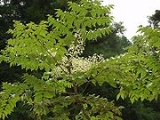
Aralia plants have large bipinnate (doubly compound)
Pinnate
Pinnate is a term used to describe feather-like or multi-divided features arising from both sides of a common axis in plant or animal structures, and comes from the Latin word pinna meaning "feather", "wing", or "fin". A similar term is pectinate, which refers to a comb-like arrangement of parts...

 leaves clustered at the ends of their stems or branches; in some species the leaves are covered with bristles. The stems of some woody species are quite prickly, as in Aralia spinosa
Aralia spinosa
Aralia spinosa, commonly known as Devil's Walkingstick, is a woody species of plants in the genus Aralia, family Araliaceae, native to eastern North America. The various names refer to the viciously sharp, spiny stems, petioles, and even leaf midribs...

. The flower
Flower
A flower, sometimes known as a bloom or blossom, is the reproductive structure found in flowering plants . The biological function of a flower is to effect reproduction, usually by providing a mechanism for the union of sperm with eggs...

s are whitish or greenish occurring in terminal panicle
Panicle
A panicle is a compound raceme, a loose, much-branched indeterminate inflorescence with pedicellate flowers attached along the secondary branches; in other words, a branched cluster of flowers in which the branches are racemes....

s, and the spherical dark purple berry-like fruit
Fruit
In broad terms, a fruit is a structure of a plant that contains its seeds.The term has different meanings dependent on context. In non-technical usage, such as food preparation, fruit normally means the fleshy seed-associated structures of certain plants that are sweet and edible in the raw state,...

s are popular with bird
Bird
Birds are feathered, winged, bipedal, endothermic , egg-laying, vertebrate animals. Around 10,000 living species and 188 families makes them the most speciose class of tetrapod vertebrates. They inhabit ecosystems across the globe, from the Arctic to the Antarctic. Extant birds range in size from...

s.

Aralia species are used as food plants by the larva
Larva
A larva is a distinct juvenile form many animals undergo before metamorphosis into adults. Animals with indirect development such as insects, amphibians, or cnidarians typically have a larval phase of their life cycle...

e of some Lepidoptera
Lepidoptera
Lepidoptera is a large order of insects that includes moths and butterflies . It is one of the most widespread and widely recognizable insect orders in the world, encompassing moths and the three superfamilies of butterflies, skipper butterflies, and moth-butterflies...

 species, including the Common Emerald (Hemithea aestivaria)
Common Emerald
The Common Emerald is a moth of the family Geometridae. The species is found throughout the Nearctic and Palearctic regions and the Near East. In the British Isles it is not found in Scotland but is a common species elsewhere...

.


Genus concept


The taxonomic circumscription of the genus
Genus
In biology, a genus is a low-level taxonomic rank used in the biological classification of living and fossil organisms, which is an example of definition by genus and differentia...

 Aralia has varied greatly. Species formerly included in wider views of the genus are now included in such separate genera as Fatsia
Fatsia
Fatsia is a small genus of three species of evergreen shrubs native to southern Japan and Taiwan. They have stout, sparsely branched stems bearing spirally-arranged, large leathery, palmately lobed leaves 20-50 cm in width, on a petiole up to 50 cm long, and small creamy-white flowers in...

, Macropanax
Macropanax
Macropanax is a genus of flowering plants of family Araliaceae, comprising 20 species. They are distributed from Central China to Sikkim, Nepal and Bhutan and to western Malaysia.Species include:*Macropanax baviensis*Macropanax chienii...

, Oreopanax
Oreopanax
Oreopanax is a genus of shrubs and trees in the family Araliaceae, comprising between 80 and 150 species depending on source. They are native to the Americas, with a range extending from Mexico and the Antilles to Argentina and Brazil, with most species occurring above 500 m.a.s.l. Sinopanax was...

, Panax, Polyscias
Polyscias
Polyscias is a genus of flowering plant of family Araliaceae, comprising 114 species. They bear pinnate leaves....

, Pseudopanax
Pseudopanax
Pseudopanax is a small genus of 12–20 species of evergreen plants, the majority of which are endemic to New Zealand, although they also occur in Tasmania and some plants from South America have at times been included in this genus. Flowers of the genus occur in terminal umbels.-Natural...

, Schefflera
Schefflera
Schefflera is a genus of flowering plants in the family Araliaceae. The plants are trees, shrubs or lianas, growing tall, with woody stems and palmately compound leaves. The circumscription of the genus has varied greatly...

, and Tetrapanax
Tetrapanax
Tetrapanax papyriferus is an evergreen shrub in the family Araliaceae, the sole species in the genus Tetrapanax. Its botanical name is unusual in that its specific epithet varies from one source to another, sometimes being rendered as "papyriferum" or "papyrifer"...

.

The genus Dimorphanthus, formerly considered distinct by some, is now included within Aralia as a section within that genus.

External links