

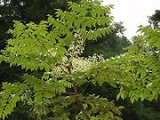
Araliaceae

Encyclopedia
Araliaceae is a family of flowering plant
s, also known as the Aralia family (after its type genus
Aralia
) or Ivy family. The family includes 254 species of tree
s, shrub
s, liana
s and perennial herbaceous
plants into 2 subfamilies. Species usually bear pinnate
ly or palmately compound leaves, and usually have small flowers produced in large panicles.
The family is closely related to Apiaceae
and Pittosporaceae
, and the boundaries between these families and other members of Apiales
are still uncertain. Some recent systems included Araliaceae in an expanded Apiaceae but this has not been widely followed. Molecular phylogenies suggest that at least some of the genera traditionally included in Apiaceae as subfamily Hydrocotyloideae appear to be more closely related to Araliaceae, and the inclusion of Hydrocotyle
and Trachymene
in Araliaceae has been recommended (Chandler & Plunkett 2004).
The generic level classification of Araliaceae has been unstable; in particular, numerous genera have been synonymized under Schefflera
. Recent molecular phylogenies have shown that this large pantropical genus is polyphyletic and some believe it should be divided again into several genera, though these would probably not correspond with the previously recognized genera.
Flowering plant
The flowering plants , also known as Angiospermae or Magnoliophyta, are the most diverse group of land plants. Angiosperms are seed-producing plants like the gymnosperms and can be distinguished from the gymnosperms by a series of synapomorphies...
s, also known as the Aralia family (after its type genus
Type genus
In biological classification, a type genus is a representative genus, as with regard to a biological family. The term and concept is used much more often and much more formally in zoology than it is in botany, and the definition is dependent on the nomenclatural Code that applies:* In zoological...
Aralia
Aralia
Aralia , or Spikenard, is a genus of the plant family Araliaceae, consisting of 68 accepted species of deciduous or evergreen trees, shrubs, and rhizomatous herbaceous perennials. The genus is native to Asia and the Americas, with most species occurring in mountain woodlands...
) or Ivy family. The family includes 254 species of tree
Tree
A tree is a perennial woody plant. It is most often defined as a woody plant that has many secondary branches supported clear of the ground on a single main stem or trunk with clear apical dominance. A minimum height specification at maturity is cited by some authors, varying from 3 m to...
s, shrub
Shrub
A shrub or bush is distinguished from a tree by its multiple stems and shorter height, usually under 5–6 m tall. A large number of plants may become either shrubs or trees, depending on the growing conditions they experience...
s, liana
Liana
A liana is any of various long-stemmed, woody vines that are rooted in the soil at ground level and use trees, as well as other means of vertical support, to climb up to the canopy to get access to well-lit areas of the forest. Lianas are especially characteristic of tropical moist deciduous...
s and perennial herbaceous
Herbaceous
A herbaceous plant is a plant that has leaves and stems that die down at the end of the growing season to the soil level. They have no persistent woody stem above ground...
plants into 2 subfamilies. Species usually bear pinnate
Pinnate
Pinnate is a term used to describe feather-like or multi-divided features arising from both sides of a common axis in plant or animal structures, and comes from the Latin word pinna meaning "feather", "wing", or "fin". A similar term is pectinate, which refers to a comb-like arrangement of parts...
ly or palmately compound leaves, and usually have small flowers produced in large panicles.
The family is closely related to Apiaceae
Apiaceae
The Apiaceae , commonly known as carrot or parsley family, is a group of mostly aromatic plants with hollow stems. The family is large, with more than 3,700 species spread across 434 genera, it is the sixteenth largest family of flowering plants...
and Pittosporaceae
Pittosporaceae
Pittosporaceae is a family of flowering plants. The family includes approximately 200 species of trees, shrubs, and lianas in 9-10 genera. The species of Pittosporaceae range from tropical to temperate climates of the Afrotropic, Indomalaya, Oceania, and Australasia ecozones.-Genera:* Auranticarpa...
, and the boundaries between these families and other members of Apiales
Apiales
The Apiales are an order of flowering plants. The families given at right are those recognized in the APG III system. This is typical of the newer classifications, though there is some slight variation, and in particular the Torriceliaceae may be divided...
are still uncertain. Some recent systems included Araliaceae in an expanded Apiaceae but this has not been widely followed. Molecular phylogenies suggest that at least some of the genera traditionally included in Apiaceae as subfamily Hydrocotyloideae appear to be more closely related to Araliaceae, and the inclusion of Hydrocotyle
Hydrocotyle
Hydrocotyle sometimes called water pennywort, Indian Pennywort, Marsh Penny, Thick-leaved Pennywort and even White Rot...
and Trachymene
Trachymene
Trachymene is a genus of herbs in the family Apiaceae. The species are native to Australia, Malesia, New Caledonia and Fiji.Species include:*Trachymene anisocarpa *Trachymene bialata B.L.Burtt...
in Araliaceae has been recommended (Chandler & Plunkett 2004).
The generic level classification of Araliaceae has been unstable; in particular, numerous genera have been synonymized under Schefflera
Schefflera
Schefflera is a genus of flowering plants in the family Araliaceae. The plants are trees, shrubs or lianas, growing tall, with woody stems and palmately compound leaves. The circumscription of the genus has varied greatly...
. Recent molecular phylogenies have shown that this large pantropical genus is polyphyletic and some believe it should be divided again into several genera, though these would probably not correspond with the previously recognized genera.