
All Topics  
Appalachian Trail

 
Appalachian Trail

   Email Print
   Bookmark   Link


Appalachian Trail


The Appalachian National Scenic Trail, generally known as the Appalachian Trail or simply The A.T., is a marked hiking
Hiking

Hiking is an outdoor activity which consists of walking in natural environments, often on trail. It is such a popular activity that there are numerous :Category:Hiking organizations worldwide....
 trail in the eastern United States
United States

The United States of America is a Federal government constitutional republic comprising U.S. state and a federal district. The country is situated mostly in central North America, where its Contiguous United States and Washington, D.C., the Capital districts and territories, lie between the Pacific Ocean and Atlantic Oceans, Borders of the U...
, extending between Springer Mountain
Springer Mountain

Springer Mountain is located in the Chattahoochee National Forest in Fannin County, Georgia of northern Georgia . It is now the southern terminus of the Appalachian Trail....
 in Georgia
Georgia (U.S. state)

Georgia is a U.S. state in the United States and was one of the original Thirteen Colonies that revolted against United Kingdom rule in the American Revolution....
 and Katahdin
Mount Katahdin

Mount Katahdin is the highest mountain in Maine. Named Katahdin by the Penobscot Indians, the term means "The Greatest Mountain". Katahdin is the centerpiece of Baxter State Park: a steep, tall mountain formed from laccolith....
 in Maine
Maine

The State of Maine is a U.S. state in the New England region of the northeastern United States of America, bordering the Atlantic Ocean to the southeast, New Hampshire to the southwest, the Canadian provinces of Quebec to the northwest and New Brunswick to the northeast....
. It is approximately long. The path is maintained by thirty trail clubs and multiple partnerships. The majority of the trail is in wilderness
Wilderness

Wilderness or wildland is a natural environment on Earth that has not been significantly modified by human activity. It may also be defined as: "The most intact, undisturbed wild natural areas left on our planet - those last truly wild places that humans do not control and have not developed with roads, pipelines or other industrial i...
, although some portions do traverse towns and roads, and cross rivers.

The Appalachian Trail is famous for its many hikers, some of whom, called thru-hikers
Thru-hiking

Thru-hiking is the process of hiking a long-distance trail from end to end. The term is most commonly associated with the Appalachian Trail, but is also used for other lengthy trails and long distance hikes, including the Pacific Crest Trail, and the Continental Divide Trail....
, attempt to hike it in its entirety in a single season.


Discussion
Ask a question about 'Appalachian Trail'
Start a new discussion about 'Appalachian Trail'
Answer questions from other users
Full Discussion Forum


Encyclopedia


The Appalachian National Scenic Trail, generally known as the Appalachian Trail or simply The A.T., is a marked hiking
Hiking

Hiking is an outdoor activity which consists of walking in natural environments, often on trail. It is such a popular activity that there are numerous :Category:Hiking organizations worldwide....
 trail in the eastern United States
United States

The United States of America is a Federal government constitutional republic comprising U.S. state and a federal district. The country is situated mostly in central North America, where its Contiguous United States and Washington, D.C., the Capital districts and territories, lie between the Pacific Ocean and Atlantic Oceans, Borders of the U...
, extending between Springer Mountain
Springer Mountain

Springer Mountain is located in the Chattahoochee National Forest in Fannin County, Georgia of northern Georgia . It is now the southern terminus of the Appalachian Trail....
 in Georgia
Georgia (U.S. state)

Georgia is a U.S. state in the United States and was one of the original Thirteen Colonies that revolted against United Kingdom rule in the American Revolution....
 and Katahdin
Mount Katahdin

Mount Katahdin is the highest mountain in Maine. Named Katahdin by the Penobscot Indians, the term means "The Greatest Mountain". Katahdin is the centerpiece of Baxter State Park: a steep, tall mountain formed from laccolith....
 in Maine
Maine

The State of Maine is a U.S. state in the New England region of the northeastern United States of America, bordering the Atlantic Ocean to the southeast, New Hampshire to the southwest, the Canadian provinces of Quebec to the northwest and New Brunswick to the northeast....
. It is approximately long. The path is maintained by thirty trail clubs and multiple partnerships. The majority of the trail is in wilderness
Wilderness

Wilderness or wildland is a natural environment on Earth that has not been significantly modified by human activity. It may also be defined as: "The most intact, undisturbed wild natural areas left on our planet - those last truly wild places that humans do not control and have not developed with roads, pipelines or other industrial i...
, although some portions do traverse towns and roads, and cross rivers.

The Appalachian Trail is famous for its many hikers, some of whom, called thru-hikers
Thru-hiking

Thru-hiking is the process of hiking a long-distance trail from end to end. The term is most commonly associated with the Appalachian Trail, but is also used for other lengthy trails and long distance hikes, including the Pacific Crest Trail, and the Continental Divide Trail....
, attempt to hike it in its entirety in a single season. Earl Shaffer
Earl Shaffer

Earl V. Shaffer , was an United States outdoorsman and author known from 1948 as The Crazy One for attempting what became the first documented hiking trip over the entire length of the Appalachian Trail ....
 was the first to do so. Many books, memoirs, web sites and fan organizations are dedicated to this pursuit.

Along the way, the trail passes through the states of Georgia
Georgia (U.S. state)

Georgia is a U.S. state in the United States and was one of the original Thirteen Colonies that revolted against United Kingdom rule in the American Revolution....
, North Carolina
North Carolina

North Carolina is a U.S. state located on the Atlantic Seaboard in the southeastern United States. The state borders South Carolina and Georgia to the south, Tennessee to the west and Virginia to the north....
, Tennessee
Tennessee

Tennessee is a U.S. state located in the Southern United States United States. In 1796, it became the sixteenth state to join the United States....
, Virginia
Virginia

The Commonwealth of Virginia is an United States U.S. state on the East Coast of the United States of the Southern United States. The state is known as the "Old Dominion" and sometimes as "Mother of Presidents", because it is the birthplace of Lists of United States Presidents by place of birth#By state....
, West Virginia
West Virginia

West Virginia is a U.S. state in the Appalachian, Upland South, and Mid-Atlantic States regions of the United States, bordered by Virginia on the southeast, Kentucky on the southwest, Ohio on the northwest, and Pennsylvania and Maryland on the northeast....
, Maryland
Maryland

Maryland is a U.S. state located in the Mid Atlantic States of the United States, bordering Virginia, West Virginia and the Washington, D.C. to the south and west, Pennsylvania to the north, and Delaware to the east....
, Pennsylvania
Pennsylvania

The Commonwealth of Pennsylvania , often colloquially referred to as PA by natives and Northeasterners, is a U.S. state located in the Northeastern United States and Mid-Atlantic States regions of the United States....
, New Jersey
New Jersey

New Jersey is a state in the Mid-Atlantic States and Northeastern United States regions of the United States. It is bordered on the north by New York, on the east by the Hudson River and the Atlantic Ocean, on the southwest by Delaware, and on the west by Pennsylvania....
, New York
New York

The State of New York is a U.S. state in the Mid-Atlantic States and Northeastern United States regions of the United States and is the nation's List of U.S....
, Connecticut
Connecticut

Connecticut is a U.S. state located in the New England region of the northeastern United States. The state borders New York to the west and south , Massachusetts to the north, and Rhode Island to the east....
, Massachusetts
Massachusetts

The Commonwealth of Massachusetts is a U.S. state located in the New England region of the Northeastern United States United States. It borders Rhode Island and Connecticut to the south, New York to the west, and Vermont and New Hampshire to the north....
, Vermont
Vermont

Vermont is a U.S. state in the New England region of the Northeastern United States United States. The state ranks 43rd by land area, , and 45th by total area....
, New Hampshire
New Hampshire

New Hampshire is a U.S. state in the New England region of the Northeastern United States United States of America. The state was named after the southern English Counties of England of Hampshire....
, and Maine
Maine

The State of Maine is a U.S. state in the New England region of the northeastern United States of America, bordering the Atlantic Ocean to the southeast, New Hampshire to the southwest, the Canadian provinces of Quebec to the northwest and New Brunswick to the northeast....
. An extension, the International Appalachian Trail
International Appalachian Trail

The International Appalachian Trail is a hiking trail which runs from the northern terminus of the Appalachian Trail at Mount Katahdin, Maine through the Gaspe Peninsula of Quebec to the northernmost tip of the Appalachian Mountains at Belle Isle , Newfoundland and Labrador....
, continues north into Canada and to the end of the range, where it enters the North Atlantic Ocean.

The Appalachian Trail, the Continental Divide Trail
Continental Divide Trail

The Continental Divide National Scenic Trail is a United States National Scenic Trail running 3,100 miles between Mexico and Canada. It follows the Continental Divide along the Rocky Mountains and traverses five U.S....
 and the Pacific Crest Trail
Pacific Crest Trail

The Pacific Crest Trail is a long-distance mountain hiking and Equestrianism trail that runs from the United States border with Mexico to its border with Canada and follows the highest portion of the Sierra Nevada and Cascade Range which parallel the Pacific Ocean by ....
 form the Triple Crown of long-distance hiking in the United States.

History

The trail was conceived by Benton MacKaye
Benton MacKaye

Benton MacKaye was an United States forester, planner and conservationist. Born in Stamford, Connecticut, MacKaye's father was Steele MacKaye, an actor and dramatist....
, a forester who wrote his original plan shortly after the death of his wife in 1921. MacKaye's idea detailed a grand trail that would connect a series of farms and wilderness work/study camps for city-dwellers. In 1922, at the suggestion of Major William A. Welch
William A. Welch

Major William Addams Welch was an American engineer and environmentalist who would have a major impact on the state and national park systems of the United States....
, director of the Palisades Interstate Park Commission
Palisades Interstate Park Commission

Palisades Interstate Park and its creator, the Palisades Interstate Park Commission, was formed in 1900 by governors Theodore Roosevelt of New York and Foster M....
, his idea was publicized by Raymond H. Torrey
Raymond H. Torrey

Raymond Hezekiah Torrey was the author of weekly column , Outings and The Long Brown Path in the New York Evening Post in the 1920s and 1930s....
 with a story in the New York Evening Post under a full-page banner headline reading "A Great Trail from Maine to Georgia!" The idea was quickly adopted by the new Palisades Interstate Park Trail Conference as their main project.

Bear Mtn Bridge
On October 7, 1923, the first section of the trail, from Bear Mountain
Bear Mountain State Park

Bear Mountain State Park is located on the west side of the Hudson River in Rockland County, New York. The park offers biking, hiking, boating, picnicking, swimming, cross-country skiing, cross-country running, sledding and ice-skating as well as a zoos, trailside museums, a hotel called Bear Mountain Inn, a carousel and a dining facility....
 west through Harriman State Park
Harriman State Park

At 46,613 acres , Harriman State Park is one of the largest state parks in New York. Located in Rockland County, New York and Orange County, New York counties 30 miles north of New York City, it is a haven for hikers with over 200 miles of hiking trails....
 to Arden, New York
Arden, New York

Arden, is a Political subdivisions of New York State#Hamlet around the town line of Tuxedo, New York and Monroe , New York, New York, in the United States....
, was opened. MacKaye then called for a two-day Appalachian Trail conference to be held in March 1925 in Washington, D.C.
Washington, D.C.

Washington, D.C. , formally the District of Columbia and commonly referred to as Washington, the District, or simply D.C., is the Capital of the United States, founded on July 16, 1790....
 This resulted in the formation of the Appalachian Trail Conference
Appalachian Trail Conservancy

The Appalachian Trail Conservancy is a nonprofit organization dedicated to the conservation of the Appalachian Trail, which runs from Maine to Georgia ....
 (now called the Appalachian Trail Conservancy), though little progress was made on the trail for several years.

At the end of the 1920s and beginning of the 1930s, a retired judge named Arthur Perkins and his younger associate Myron Avery
Myron Avery

Myron Haliburton Avery was an United States lawyer, hiker and explorer. Born in Lubec, Maine, Avery was a prot?g? of Judge Arthur Perkins and a collaborator and sometimes rival of Benton MacKaye....
 took up the cause. Avery, who soon took over the ATC, adopted the more practical goal of building a simple hiking trail. He and MacKaye clashed over the ATC's response to a major commercial development along the trail's path; MacKaye left the organization, while Avery was willing to simply reroute the trail.

Avery became the first to walk the trail end-to-end, though not as a thru-hike
Thru-hiking

Thru-hiking is the process of hiking a long-distance trail from end to end. The term is most commonly associated with the Appalachian Trail, but is also used for other lengthy trails and long distance hikes, including the Pacific Crest Trail, and the Continental Divide Trail....
, in 1936. In August 1937, the trail was completed to Sugarloaf Mountain
Sugarloaf Mountain (Franklin County, Maine)

Sugarloaf Mountain is a mountain located in Franklin County, Maine, Maine. It is the second highest mountain in the state, after Mount Katahdin....
 in Maine, and the ATC shifted its focus toward protecting the trail lands and mapping the trail for hikers. From 1938 to the end of World War II
World War II

World War II, or the Second World War , was a global military conflict which involved a Participants in World War II, including all of the great powers, organised into two opposing military alliances: the Allies of World War II and the Axis powers....
, the trail suffered a series of natural and man-made setbacks. At the end of the war, the damage to the trail was repaired.

In 1948, Earl Shaffer
Earl Shaffer

Earl V. Shaffer , was an United States outdoorsman and author known from 1948 as The Crazy One for attempting what became the first documented hiking trip over the entire length of the Appalachian Trail ....
 of York, Pennsylvania
York, Pennsylvania

York, known as the White Rose City , is a city located in South Central Pennsylvania. The population was 40,862 at the United States Census 2000....
, brought a great deal of attention to the project by completing the first documented thru-hike. (In 1994, a story appeared in the Appalachian Trailway News describing a 121-day Maine to Georgia thru-hike in 1936 by six Boy Scouts
Scouting in New York

Scouting in New York has a long history, from the 1910s to the present day, serving thousands of youth in programs that suit the environment in which they live....
 from the Bronx. The story has been accepted by some individual members of ALDHA, though a great deal of doubt has also been expressed; this earlier thru-hike has never been verified or accepted by any responsible hiking organization or group; therefore, Shaffer's 1948 journey is still universally recognized as the first A.T. thru-hike.) Later, Shaffer also completed the first north-to-south thru-hike (all documented thru-hikes before that had been south-to-north). In 1998 Mr. Shaffer, nearly 80 years old, again hiked the entirety of the trail, making him the oldest person ever to complete a thru-hike.

In the 1960s, the ATC made progress toward protecting the trail from development, thanks to many sympathetic politicians and officials. The National Trails System Act of 1968 paved the way for a series of National Scenic Trail
National Scenic Trail

National Scenic Trail is a designation for protected areas in the United States that consist of trails of particular natural beauty.National Scenic Trails were authorized under the National Trails System Act of 1968 along with National Historic Trails and National Recreation Trails....
s within the National Park and National Forest systems. Trail volunteers worked with the National Park Service
National Park Service

The National Park Service is the List of United States federal agencies that manages all List of areas in the United States National Park System, many U.S....
 to map a permanent route for the trail, and by 1971 a permanent route had been marked (though minor changes continue to this day). By the close of the 20th century, the Park Service had completed the purchase of all but a few miles of the trail's span.

Extensions

The International Appalachian Trail
International Appalachian Trail

The International Appalachian Trail is a hiking trail which runs from the northern terminus of the Appalachian Trail at Mount Katahdin, Maine through the Gaspe Peninsula of Quebec to the northernmost tip of the Appalachian Mountains at Belle Isle , Newfoundland and Labrador....
 is a extension running north from Maine into New Brunswick
New Brunswick

New Brunswick is one of Canada's three Maritime provinces and is the only Constitution of Canada bilingual province in the federation. The provincial capital is Fredericton....
 and Quebec
Quebec

Quebec , in French language, Qu?bec , is a Provinces and territories of Canada in the Central Canada and Eastern Canada regions of Canada....
. It is a separate trail, not an official extension of the Appalachian Trail. A further extension to Newfoundland
Newfoundland and Labrador

Newfoundland and Labrador is a Provinces and territories of Canada of Canada, on the country's Atlantic Ocean coast in northeastern North America....
 is still under construction.

In 2008, the Pinhoti Trail in Alabama was connected to the southern terminus of the Appalachian Trail.

Flora and fauna

The Appalachian Trail is home to thousands of species of plants and animals, including 2,000 distinct rare, threatened, endangered, and sensitive plant and animal species.

Animals

Black Bear Large
The American black bear
American black bear

The American Black Bear is the most common bear species native to North America. It lives throughout much of the continent, from northern Alaska south into Mexico and from the Atlantic Ocean to the Pacific Ocean....
 (Ursus americanus) is the largest omnivore that may be encountered on the trail, and it inhabits all regions of the Appalachians. However, bear sightings on the trail are uncommon, and confrontations rarer still, as black bears typically avoid humans and can usually be frightened away by loud noises.

Other hazards include venomous snakes, including the Eastern timber rattlesnake
Crotalus horridus

Crotalus horridus is a Venomous snake Crotalinae species found in the eastern United States. This is the only rattlesnake species in most of the populous northeastern United States and was featured prominently in the American Revolution, specifically as the symbol of the first Continental Navy in the First Navy Jack....
 and copperhead
Agkistrodon contortrix

Agkistrodon contortrix is a venomous snake Crotalinae species found in North America. Five subspecies are currently recognized, including the nominate subspecies described here....
, which are common along the trail. Both snakes are generally found in drier, rockier sections of the trail; the copperhead's range extends north to around the New Jersey
New Jersey

New Jersey is a state in the Mid-Atlantic States and Northeastern United States regions of the United States. It is bordered on the north by New York, on the east by the Hudson River and the Atlantic Ocean, on the southwest by Delaware, and on the west by Pennsylvania....
-New York
New York

The State of New York is a U.S. state in the Mid-Atlantic States and Northeastern United States regions of the United States and is the nation's List of U.S....
 state line, while rattlesnakes are commonly found along the trail in Connecticut
Connecticut

Connecticut is a U.S. state located in the New England region of the northeastern United States. The state borders New York to the west and south , Massachusetts to the north, and Rhode Island to the east....
 and have been reported, although rarely, as far north as New Hampshire
New Hampshire

New Hampshire is a U.S. state in the New England region of the Northeastern United States United States of America. The state was named after the southern English Counties of England of Hampshire....
. Other large fauna include deer; elk
Elk

Elk may refer to:* Various species of deer:** European Elk , also known as Moose** North American Elk , also known as Wapiti** Indian Elk , also known as sambar ...
, reintroduced in the Smoky Mountains; and moose
Moose

File:Alces alces NA.svgThe moose or elk , , is the largest Extant taxon species in the deer family . Moose are distinguished by the palmate antlers of the males; other members of the family have antlers with a "twig-like" configuration....
, which live as far south as Massachusetts
Massachusetts

The Commonwealth of Massachusetts is a U.S. state located in the New England region of the Northeastern United States United States. It borders Rhode Island and Connecticut to the south, New York to the west, and Vermont and New Hampshire to the north....
 but are more commonly seen in Maine
Maine

The State of Maine is a U.S. state in the New England region of the northeastern United States of America, bordering the Atlantic Ocean to the southeast, New Hampshire to the southwest, the Canadian provinces of Quebec to the northwest and New Brunswick to the northeast....
. For most hikers, the most persistent pests along the trail are mice
MICE

MICE is an acronym for:*International Muon Ionization Cooling Experiment*"Money, Ideology, Compromise, Ego", four factors by which spies may be recruited....
, which inhabit shelters, and bugs, which includes ticks, mosquitos, and black flies.

Plants

Plant life along the trail is varied. The trail passes through several different biomes from south to north, and the climate changes significantly, particularly dependent upon elevation. In the south, lowland forests consist mainly of second-growth; nearly the entire trail has been logged at one time or another. There are, however, a few old growth locations along the trail, such as Sages Ravine in Massachusetts and The Hermitage
The Hermitage

The Hermitage is a historical plantation and museum located in Davidson County, Tennessee, Tennessee, United States, east of downtown Nashville, Tennessee....
, near Gulf Hagas in Maine. In the south, the forest is dominated by hardwoods, including oak
Oak

The term oak can be used as part of the common name of any of about 400 species of trees and shrubs in the genus Quercus , which are listed in the List of Quercus species, and some related genera, notably Lithocarpus....
 and tulip trees
Liriodendron tulipifera

Liriodendron tulipifera, commonly known as the American tulip tree, tulip poplar or yellow poplar, is the Western Hemisphere representative of the two-species Liriodendron genus and the tallest eastern hardwood....
, also known as yellow poplar. Further north, tulip trees are gradually replaced by maples and birches. Oaks begin to disappear in Massachusetts. By Vermont, the lowland forest is made up of maples, birch and beech, which provide spectacular foliage displays for hikers in September and October. While the vast majority of lowland forest south of the White Mountains
White Mountains (New Hampshire)

The White Mountains are a mountain range that covers about a quarter of the state of New Hampshire and a small portion of western Maine in the United States....
 is hardwood, many areas have some coniferous trees as well, and in Maine, these often grow at low elevations.

There is a drastic change between the lowland and subalpine
Subalpine

The Rocky Mountains subalpine zone is the life zone immediately below tree line in the Rocky Mountains of North America. In Colorado, the subalpine zone occupies elevations approximately from ; while in northern Alberta, the subalpine zone extends from ....
, evergreen
Evergreen

In botany, an evergreen plant is a plant having leaf all year round. This contrasts with deciduous plants, which completely lose their foliage for part of the year....
 forest, as well as another, higher break, at treeline, above which only hardy alpine plants grow. The sub-alpine region is far more prevalent along the trail than true alpine conditions. While it mainly exists in the north, a few mountains in the south have subalpine environments. These include the Great Smoky Mountains
Great Smoky Mountains

The Great Smoky Mountains are a mountain range rising along the Tennessee-North Carolina border in the southeastern United States. They are a subrange of the Appalachian Mountains, and form part of the Blue Ridge Mountains....
, where sub-alpine environments only begin around in elevation, the Unaka and Roan
Roan Mountain (Roan Highlands)

Roan Mountain is the highpoint of the Roan-Unaka Range of the Southern Appalachian Mountains, located in the Southeastern United States. The mountain is clad in one of the thickest stands of coniferous forest in the southern Appalachians, the world's largest natural rhododendron garden, and the longest stretch of Appalachian balds in the Appa...
 Ranges on the North Carolina
North Carolina

North Carolina is a U.S. state located on the Atlantic Seaboard in the southeastern United States. The state borders South Carolina and Georgia to the south, Tennessee to the west and Virginia to the north....
-Tennessee
Tennessee

Tennessee is a U.S. state located in the Southern United States United States. In 1796, it became the sixteenth state to join the United States....
 border, where sub-alpine growth descends below , and Mount Rogers
Mount Rogers

Mount Rogers is the highest point in the state of Virginia, United States, with a summit elevation of above mean sea level. It lies in Grayson County and Smyth County, Virginia, about WSW of Troutdale, Virginia, within the Mount Rogers National Recreation Area and Jefferson National Forest....
 and the Grayson Highlands in Virginia
Virginia

The Commonwealth of Virginia is an United States U.S. state on the East Coast of the United States of the Southern United States. The state is known as the "Old Dominion" and sometimes as "Mother of Presidents", because it is the birthplace of Lists of United States Presidents by place of birth#By state....
, where there is some alpine growth above . Some high mountains in the south are also balds, due to fires or grazing in recent centuries, or perhaps due to thin, sandy soils. Several balds are sprouting trees, and on some, the National Forest service actually mows the grasses periodically in order to keep the bald open. Mostly in the mid summer to late fall.

Topography

Appalachian Map
No sub-alpine regions exist between Mount Rogers
Mount Rogers

Mount Rogers is the highest point in the state of Virginia, United States, with a summit elevation of above mean sea level. It lies in Grayson County and Smyth County, Virginia, about WSW of Troutdale, Virginia, within the Mount Rogers National Recreation Area and Jefferson National Forest....
 in Virginia and Mount Greylock
Mount Greylock

Mount Greylock, 3,491 feet , is the highest point in the Commonwealth of Massachusetts; it is located in the northwest corner of the state within Berkshire County, Massachusetts....
 in Massachusetts, mainly because the trail stays below from Shenandoah National Park
Shenandoah National Park

Shenandoah National Park encompasses part of the Blue Ridge Mountains in the U.S. state of Virginia. This national park is long and narrow, with the broad Shenandoah River and valley on the west side, and the rolling hills of the Virginia Piedmont on the east....
 in Virginia to Mount Greylock. Mount Greylock, however, has a large subalpine region, the only such forest in Massachusetts, extending down to , which in the south would be far from the sub-alpine cutoff. This is especially low because Greylock is exposed to prevailing westerly winds, as its summit rises higher than any other peak in Massachusetts. Further north, several peaks in Vermont reach into the sub-alpine zone, the bottom of which steadily descends, so that by the White Mountains
White Mountains (New Hampshire)

The White Mountains are a mountain range that covers about a quarter of the state of New Hampshire and a small portion of western Maine in the United States....
 in New Hampshire, it often occurs well below . At Mount Moosilauke, which reaches to , the first alpine
Alpine climate

Alpine climate is the average weather for a region above the tree line. The climate becomes colder at high elevations—this characteristic is described by the adiabatic lapse rate of air: air tends to get colder as it rises, since it expands....
 environment on the trail is reached, where only thin, sporadic flora is interspersed with bare rocks. Between the two regions is the krummholz
Krummholz

File:Pinus albicaulis 7872.JPGKrummholz or Krumholtz formation is a feature of subarctic and subalpine tree line landscapes, where continual exposure to fierce, freezing winds cause vegetation to become stunted and deformed....
 region, where stunted trees grow with their branches oriented away from the winter's prevailing northwest wind, thus giving the appearance of flags (they are often called "flag trees"). This region resembles lowland terrain and covers hundreds of miles north in Canada. It also contains many endangered and threatened species. The trail has been rerouted over New Hampshire's Presidential Range
Presidential Range

The Presidential Range is a mountain range located in the White Mountains of the U.S. state of New Hampshire, almost entirely in Coos County, New Hampshire....
 so the Appalachian Mountain Club
Appalachian Mountain Club

The Appalachian Mountain Club is one of the United States' oldest outdoor groups. Created in 1876 to explore and preserve the White Mountains in New Hampshire, it has expanded throughout the northeastern U.S., with 12 chapters stretching from Maine to Washington, D.C....
 can protect certain plant life. The alpine cutoff in the Whites is generally between 4200 and . Mountains traversed by the AT above treeline include Mount Moosilauke, several miles along the Franconia Range
Franconia Range

The Franconia Range is a mountain range located in the White Mountains of the United States state of New Hampshire. It is the second-highest range of peaks in the White Mountains....
, and the Presidential Range
Presidential Range

The Presidential Range is a mountain range located in the White Mountains of the U.S. state of New Hampshire, almost entirely in Coos County, New Hampshire....
. In the Presidentials, the trail climbs as high as 6288 feet (1917 m) on Mount Washington
Mount Washington (New Hampshire)

Mount Washington is the highest peak in the Northeastern United States at . It is famous for its dangerously erratic weather, holding the record for the highest wind gust directly measured at the Earth's surface, at on the afternoon of April 12, 1934....
 and spends about continuously above treeline, in the largest alpine environment in the United States east of the Rocky Mountains
Rocky Mountains

The Rocky Mountains, often called the Rockies, are a mountain range in western North America. The Rocky Mountains stretch more than 4,800 kilometre from the northernmost part of British Columbia, in Canada, to New Mexico, in the United States....
.

In Maine, the trail extends in to even harsher environments, and sub-alpine and alpine growth descends to lower elevations. Alpine growth in the state ranges from around in the Mahoosuc Range to below in parts of the 100-Mile Wilderness
100-Mile Wilderness

The 100-Mile Wilderness is the section of the Appalachian Trail running between Abol Bridge just south of Baxter State Park and Monson, Maine, USA....
, where nearly every area higher than is evergreen forest. These forests include more species of evergreen, as well. In addition to the white pine
White Pine

White Pine may refer to:* Trees in the pine subgenus Pinus classification.** Eastern White Pine , one of these species, native to northeastern North America....
, spruce
Spruce

A spruce is a tree of the genus Picea, a genus of about 35 species of coniferous evergreen trees in the Family Pinaceae, found in the northern temperate and boreal regions of the earth....
 and hemlock
Hemlock

The word hemlock may refer to:*Hemlock, several poisonous plants in the Apiaceae family :**Hemlock , two species, one formerly used as a method of execution...
 prevalent further south, Maine has many cedar
Cedar

Cedar is a genus of coniferous trees in the plant family Pinaceae. They are most closely related to the Firs , sharing a very similar cone structure....
 trees along the trail. Near the northern terminus, there are even some tamarack, a coniferous, pine-needled deciduous tree, which provides displays of yellow in the late fall after the birches and maples have gone bare. The hemlocks in Maine are also notable, as the woolly adelgid
Hemlock Woolly Adelgid

Hemlock woolly adelgid , commonly abbreviated as HWA is a true bug native to East Asia that feeds by sucking sap from hemlock trees . In eastern North America it is a destructive Pest that poses a major threat to the eastern hemlock and the Carolina hemlock ....
, which has ravaged populations further south, has not come into the state yet, and may be unable to make it so far north due to the cold climate.

Maine also has several alpine regions. In addition to several areas of the Mahoosuc range, the Baldpates, and Old Blue in southern Maine have alpine characteristics despite elevations below . Saddleback Mountain
Saddleback Mountain (Rangeley, Maine)

Saddleback Mountain is a mountain located in Rangeley, Maine, Franklin County, Maine, Maine.Saddleback is one of the highest mountains in the State of Maine, and one of the fourteen with more than of topographic prominence....
 and Mount Bigelow
Mount Bigelow (Maine)

Mount Bigelow is a long mountain ridge with several summits. It is located in Franklin County, Maine and Somerset County, Maine, Maine. It is one of Maine's highest summits....
, further north, each only extend a bit above , but have long alpine areas, with no tree growth on the summits and unobstructed views on clear days. From Mount Bigelow, the trail extends for with only a small area of alpine growth around on the summit of White Cap Mountain
White Cap Mountain (Piscataquis County, Maine)

White Cap Mountain is a mountain located in Piscataquis County, Maine, Maine.White Cap Mtn. is flanked to the east by Hay Mountain, to the south by Big Spruce Mountain and to the southeast by Little Spruce Mountain....
. Mount Katahdin, the second largest alpine environment in the eastern United States, has several square miles of alpine area on the flat "table land" summit as well as the cliffs and aretes leading up to it. Treeline on Katahdin is only around . This elevation in Massachusetts would barely be a sub-alpine region, and, south of Virginia, consists of lowland forest. This illustrates the drastic change in climate over .

Hiking the trail

As the Appalachian Trail was explicitly designed to be hiked, it includes resources to facilitate hikers. Some are common to trails throughout North America, while some are unique to the Appalachian Trail. The trail is much more frequently hiked south to north (i.e. Georgia to Maine) than vice versa. Hikers typically begin in March or April and finish in late summer or early to late fall of that particular year. Many hikers will break down the mileage into halves or thirds, so that they can have the best weather, which typically occurs between May and September.

Navigation

Throughout its length, the AT is marked by 2-by-6-inch (5-by-15-cm) white paint blazes
Trail blazing

Trail blazing is the practice of marking paths in outdoor recreational areas with blazes, markings that follow each other at certain — though not necessarily exactly defined — distances and mark the direction of the trail....
. Side trails to shelters, viewpoints and parking areas use similarly-shaped blue blazes.

In past years, some sections of the trail also used metal diamond markers with the AT logo, few of which survive.


Lodging

The trail has more than 200 shelters and camp sites available for hikers. The shelters, sometimes called lean-tos (in Maine, Massachusetts, and Connecticut), huts (in Shenandoah National Park and the White Mountains in New Hampshire) or adirondack shelters, are generally open, three-walled structures with a wooden floor, although some shelters are much more complex in structure. Shelters are usually spaced a day's hike or less apart, most often near a water source (which may be dry) and with a privy
Outhouse

The term outhouse usually refers to a type of toilet in a small structure separate from the main building which does not have a Flush toilet and is not attached to a Sanitary sewer....
. They generally have spaces for tent sites in the vicinity.

Shelters are generally maintained by local volunteers. Almost all shelters have one or more pre-hung food hangers (generally consisting of a short nylon cord with an upside-down tuna can suspended halfway down its length) where hikers can hang their food bags to keep them out of the reach of rodents. In hiker lingo, these are sometimes called "mouse trapezes."

In addition to official shelters, many persons offer their homes, places of business, or inns to accommodate AT hikers. One example is the Little Lyford Pond camps
Little Lyford Pond camps

The Little Lyford Pond camps opened in 1874, bordering the West Branch Pleasant River in northern Maine in the United States. The camps are a 2.2 mile hike from Gulf Hagas and a 5.2 mile hike from the Appalachian Trail's famed 100-Mile Wilderness....
 maintained by the Appalachian Mountain Club
Appalachian Mountain Club

The Appalachian Mountain Club is one of the United States' oldest outdoor groups. Created in 1876 to explore and preserve the White Mountains in New Hampshire, it has expanded throughout the northeastern U.S., with 12 chapters stretching from Maine to Washington, D.C....
. Inns are more common in sections of the trail that coincide with national parks, most notably Virginia's Shenandoah National Park
Shenandoah National Park

Shenandoah National Park encompasses part of the Blue Ridge Mountains in the U.S. state of Virginia. This national park is long and narrow, with the broad Shenandoah River and valley on the west side, and the rolling hills of the Virginia Piedmont on the east....
.

Trail towns

The trail crosses many roads, thus providing ample opportunity for hikers to hitchhike into town for food and other supplies. Many trail towns are accustomed to hikers passing through, and thus many have hotels and hiker-oriented accommodations. Some of the most well-known trail towns are Monson, Maine
Monson, Maine

Monson is a New England town in Piscataquis County, Maine, Maine, United States. As of the 2000 United States Census, the town had a population of 666....
; Harpers Ferry, West Virginia
Harpers Ferry, West Virginia

Harpers Ferry is a historic town in Jefferson County, West Virginia, West Virginia. It is situated at the confluence of the Potomac River and Shenandoah Rivers where the U.S....
; Damascus, Virginia
Damascus, Virginia

Damascus is a town in Washington County, Virginia, Virginia, United States. The population was 981 at the 2000 census. It is part of the Kingsport, Tennessee–Bristol, Tennessee–Bristol, Virginia Kingsport-Bristol-Bristol, TN-VA MSA, which is a component of the Johnson City, Tennessee–Kingsport–Bristol, Tennessee-VA Com...
; Hot Springs, North Carolina
Hot Springs, North Carolina

Hot Springs is a town in Madison County, North Carolina, North Carolina, United States. The population was 645 at the United States Census, 2000....
; Erwin, Tennessee
Erwin, Tennessee

Erwin is a town in and the county seat of Unicoi County, Tennessee, Tennessee, United States. The population was 5,610 at the 2000 United States Census....
; Duncannon, Pennsylvania
Duncannon, Pennsylvania

Duncannon is a borough in Perry County, Pennsylvania, Pennsylvania, United States. The population was 1,508 at the 2000 census. It is part of the Harrisburg, Pennsylvania–Carlisle, Pennsylvania Harrisburg metropolitan area....
; Port Clinton, Pennsylvania
Port Clinton, Pennsylvania

Port Clinton is a borough in Schuylkill County, Pennsylvania, Pennsylvania, United States. The population was 288 at the 2000 census....
; and Hanover, New Hampshire
Hanover, New Hampshire

Hanover is a town along the Connecticut River in Grafton County, New Hampshire, New Hampshire, United States. The population was 10,850 at the 2000 census....
. In the areas of the trail closer to trail towns, many hikers have experienced what is sometimes called "trail magic," or assistance from strangers through kind actions, gifts, and other forms of encouragement. Trail magic is sometimes done anonymously. In other instances, persons have provided food and cooked for hikers at a campsite.

Hazards

The Appalachian Trail is relatively safe. Most injuries or incidents are consistent with comparable outdoor activities. Most hazards are related to weather conditions, human error, plants, animals, diseases, and fellow humans encountered along the trail.

Many animals live around the trail, with bears, snakes, and wild boars posing the greatest threat to human safety. Several rodent- and bug-borne illnesses are also a potential hazard. Ticks are carriers for Lyme disease
Lyme disease

Lyme disease, or borreliosis, is an emerging infectious disease caused by at least three species of bacteria belonging to the genus Borrelia....
, ehrlichiosis
Ehrlichiosis

Ehrlichiosis is a tick-borne disease of dogs usually caused by the organism Ehrlichia canis. Ehrlichia canis is the pathogen of animals....
 and other diseases, and are in higher abundance in northern states. Being thoroughly covered and wearing DEET
DEET

N,N-Diethyl-meta-toluamide, abbreviated DEET, is the most common active ingredient in insect repellents. It is intended to be applied to the skin or to clothing, and is primarily used to repel mosquitos....
 can greatly reduce the chances of getting infected.

In scattered instances, foxes, raccoons, and other small animals may bite hikers, posing risk of rabies
Rabies

Rabies is a virus zoonotic neurotropic virus disease that causes acute encephalitis in mammals. It is most commonly caused by a bite from an infected animal, but occasionally by other forms of contact....
 and other diseases. There has been one reported case (in 1993) of hantavirus
Hantavirus

Hantaviruses belong to the Bunyaviridae family of viruses. There Bunyaviridae family is divided into 5 genera: Orthobunyavirus, Nairovirus, Phlebovirus, Tospovirus, and Hantavirus....
 (HPS), a rare but dangerous rodent-borne disease affecting the lungs. The afflicted hiker recovered and hiked the trail the following year.

Toxicodendron Radicans
Plant life can create its own brand of problems. Poison ivy
Poison ivy

Toxicodendron radicans is a plant in the family Anacardiaceae. The name is sometimes spelled "Poison-ivy" in an attempt to indicate that the plant is not a true Ivy ....
 is common the length of the trail, and more plentiful in the South. Flare-ups can be treated with calamine lotion or Solarcaine.

Drinking untreated surface water can cause diarrhea. Springs are less risky. The various methods of water treatment
Portable water purification

Portable water purification devices ? also known as point-of-use water treatment systems and field water disinfection techniques ? are self-contained units that can be used by recreational enthusiasts, military personnel, and others who must obtain drinking water from untreated sources ....
 are filtering, chemical disinfectants, a portable ultraviolet light device, and pasteurization
Pasteurization

Pasteurization is a process which slows microbial growth in foods. The process was named after its creator, France chemist and microbiologist Louis Pasteur....
 or boiling.

Hiking season of the trail generally starts in mid to late spring, when conditions are much more favorable in the South. However, this time may also be characterized by extreme heat, sometimes in excess of . Under such conditions, hydration is imperative. Light clothing and sunscreens are a must at high elevations and areas without foliage, even in relatively cool weather.

Further north and at higher elevations, the weather can be intensely cold, characterized by low temperatures, strong winds, hail or snow storms and reduced visibility. Prolonged rain, though not typically life-threatening, can undermine stamina and ruin supplies. Typical electrical storm
Thunderstorm

File:FoggDam-NT.jpgA thunderstorm, also known as an electrical storm or a lightning storm, is a form of weather characterized by the presence of lightning and its effect: thunder....
 precautions should be followed.

Violent crime
Violent crime

A violent crime or crime of violence is a crime in which the offender uses or threatens to use violent force upon the victim. This entails both crimes in which the violent act is the objective, such as murder, as well as crimes in which violence is the means to an end, such as robbery....
, including murder, has occurred on the trail in a few instances. Most have been crimes by non-hikers who crossed paths relatively randomly with the AT hiker-victims. The official website of the Appalatian Trail Conservancy points out that the number of violent crimes is extremely low when compared against the number of people (3 to 4 million) who hike on the trail every year.

Nine homicides have been documented on the trail since the first reported homicide in Georgia in 1974. In 1981, the issue of violence on the Appalachian Trail received national attention when Robert Mountford Jr. and Laura Susan Ramsay, both social workers in Ellsworth, Maine, were murdered by Randall Lee Smith. Another homicide occurred in May 1996, when two women were abducted, bound and murdered near the trail in Shenandoah National Park
Shenandoah National Park

Shenandoah National Park encompasses part of the Blue Ridge Mountains in the U.S. state of Virginia. This national park is long and narrow, with the broad Shenandoah River and valley on the west side, and the rolling hills of the Virginia Piedmont on the east....
. The primary suspect was later discovered harassing a female bicycler in the vicinity but charges against him were dropped, and the case remains unsolved.

On May 6, 2008, Randall Lee Smith, the killer of Mountford and Ramsay in 1981, shot two fisherman from Virginia near the trail in Giles County, Virginia
Giles County, Virginia

Giles County is a county located in the U.S. state of Virginia. As of the United States Census, 2000, the population was 16,657. Its county seat is Pearisburg, Virginia....
, not far from the site of his 1981 murder; he then stole their pickup truck but crashed it and was imprisoned. The fishermen survived, but Smith died in jail four days later, most likely from an acute pulmonary thromboembolism
Pulmonary embolism

Pulmonary embolism is a blockage of the pulmonary artery or one of its branches, usually occurring when a deep vein thrombosis becomes dislodged from its site of formation and travels, or embolism, to the pulmonary artery blood supply of one of the lungs....
 incurred when he crashed the pickup truck.

Trail completion

Anst Triangle Logo 1
Trail hikers who attempt to complete the entire trail in a single season are called "thru-hikers"; those who traverse the trail during a series of separate trips are known as "section-hikers". Rugged terrain and cold weather during the spring and fall make thru-hiking difficult. Traditionally, only about 10% to 15% of those who make the attempt report to the Appalachian Trail Conservancy that they completed it. However, since 2001, the number of people starting out in Georgia to do a thru-hike (or at least registering to do so) has dropped considerably, yet the number of people reporting that they have completed a thru-hike has remained approximately the same. This has resulted in an apparent increase in the completion rate to 29% (as of 2006). Considering that the rangers station at Amicalola Falls (the beginning of the approach trail to Springer Mountain) had changed its policy on hiker registration at about the same time, it is possible that the drop in thru-hikers starting out is only a perceived drop due to a change in reporting. As of 2007, the total number of reported thru-hike completions since the 1930s was 9,583. It is widely acknowledged that many or even most of these have skipped portions of the Trail. Completion generally requires five to seven months, although some have done it in three months, and several trail runners have completed the trail in less time. Trail runners typically tackle the AT with automobile support teams, without backpacks, and without camping in the woods.

The current unofficial speed record for through-hiking the AT was set by trail runner Andrew Thompson in 2005, at 47 days, 13 hours and 31 minutes. Thompson made the trip southbound, from late June to early August.

Thru-hikers are classified into many informal groups. "Purists" are hikers who stick to the official AT trail except for side trips to shelters and camp sites. "Blue Blazers" cut miles from the full route by taking side trails marked by blue blazes. The generally pejorative name "Yellow Blazers," a reference to yellow road stripes, is given to those who hitchhike to move down the trail. There are also those who hike the trail in sections known as "sectioners" as opposed to those who hike the whole trail as one course.

Most thru-hikers walk northward from Georgia to Maine, and generally start out in early spring and follow the warm weather as it moves north. These "north-bounders" are also called NOBO (NOrthBOund) or GAME (Georgia(GA)-to-Maine(ME)), while those heading in the opposite direction are termed "south-bounders" (also SOBO or MEGA).

Part of hiker subculture includes making colorful entries in logbooks at trail shelters, signed using trail names
Pseudonym

A pseudonym, , is a fictitious alternative to a person's legal name. In some cases, pseudonyms are adopted because it is part of a cultural or organizational tradition, as in the case of Religious names used by members of some religious orders and "cadre names" used by Communist party leaders such as Leon Trotsky and Joseph Stalin....
.

The Appalachian Trail Conservancy gives the name "2000 Miler" to anyone who completes the entire Trail. The ATC's recognition policy for "2000 Milers" gives equal recognition to thru-hikers and section-hikers, operates on the honor system, and recognizes blue-blazed trails or officially required roadwalks as substitutes for the official, white-blazed route during an emergency such as a flood, forest fire, or impending storm on an exposed, high-elevation stretch.

Most of the trail is also open to local use.

Route

The trail is currently protected along more than 99% of its course by federal or state ownership of the land or by right-of-way
Easement

An easement is a non-possessory interest to use real property in possession of another person for a stated purpose. An easement is considered as a property right in itself at common law and is still treated as a type of property in most jurisdictions....
. The trail is maintained by a variety of citizen organizations, environmental advocacy groups, governmental agencies and individuals. Annually, more than 4,000 volunteer
Volunteer

A volunteer is someone who works Community service or for the benefit of environment primarily because they choose to do so. The word comes from France, it can also be translated as "will" ....
s contribute over 175,000 hours of effort on the Appalachian Trail, an effort coordinated largely by the Appalachian Trail Conservancy
Appalachian Trail Conservancy

The Appalachian Trail Conservancy is a nonprofit organization dedicated to the conservation of the Appalachian Trail, which runs from Maine to Georgia ....
 (ATC) organization.

In the course of its journey, the trail follows the ridgeline of the Appalachian Mountains
Appalachian Mountains

The Appalachian Mountains or , often called the Appalachians, are a vast mountain range in eastern North America. Definitions vary on the precise boundaries of the Appalachians....
, crossing many of its highest peaks, and running, with only a few exceptions, almost continuously through wilderness
Wilderness

Wilderness or wildland is a natural environment on Earth that has not been significantly modified by human activity. It may also be defined as: "The most intact, undisturbed wild natural areas left on our planet - those last truly wild places that humans do not control and have not developed with roads, pipelines or other industrial i...
. The trail used to traverse many hundreds of miles of private property; currently 99% of the trail is on Public land.

Southterm
Georgia has 75 miles (120 km) of the trail, including the southern terminus at Springer Mountain
Springer Mountain

Springer Mountain is located in the Chattahoochee National Forest in Fannin County, Georgia of northern Georgia . It is now the southern terminus of the Appalachian Trail....
 at an elevation of 3,280 feet (992 m). At 4,461 feet (1360 m), Blood Mountain
Blood Mountain

Blood Mountain is the highest peak on the Georgia section of the Appalachian Trail and the sixth-tallest mountain in Georgia, with an elevation of ....
 is the highest point on the trail in Georgia. The AT and approach trail are managed and maintained by the Georgia Appalachian Trail Club
Georgia Appalachian Trail Club

The Georgia Appalachian Trail Club, Inc. is a non-profit organization that was organized in 1930 in Dahlonega, Georgia . Its membership consists of individual volunteers who share a love for the Appalachian Trail....
. See also: Georgia Peaks on the Appalachian Trail.

North Carolina has 88 miles (142 km) of the trail, not including more than 200 miles (325 km) along the Tennessee Border. Altitude ranges from 1,725 to 5,498 feet (525 m to 1676 m).

Tennessee has 293 miles (472 km) of the trail, including more than 200 miles (325 km) along or near the North Carolina Border. The section that runs just below the summit of Clingmans Dome
Clingmans Dome

Clingmans Dome is a mountain in the Great Smoky Mountains of Tennessee and North Carolina, in the southeastern United States. At an topographical summit of , it is the highest mountain in the Great Smokies, the highest point in the state of Tennessee, and the highest point along the Appalachian Trail....
 in Great Smoky Mountains National Park
Great Smoky Mountains National Park

Great Smoky Mountains National Park is a United States National Park that straddles the ridgeline of the Great Smoky Mountains, part of the Blue Ridge Mountains, which are a division of the larger Appalachian Mountains....
 is the highest point on the trail at 6,625 feet (2019 m).

Pocosin Cabin
Virginia has 550 miles (885 km) of the trail, including about 20 miles (32 km) along the West Virginia border. Some consider this to be the wettest, most challenging part of the hike for northbound hikers because of the spring thaw. On average, it rains 20 out of 30 days during the spring. Substantial portions closely parallel the Skyline Drive
Skyline Drive

Skyline Drive is a 105-mile road that runs the entire length of the National Park Service Shenandoah National Park in the Blue Ridge Mountains of Virginia, generally along the ridge of the mountains....
 and the Blue Ridge Parkway
Blue Ridge Parkway

The Blue Ridge Parkway is a National Parkway and National Scenic Byway in the United States, noted for its scenic beauty. It runs for 469 miles , mostly through the famous Blue Ridge Mountains, a major mountain chain that is part of the Appalachian Mountains....
 in Shenandoah National Park
Shenandoah National Park

Shenandoah National Park encompasses part of the Blue Ridge Mountains in the U.S. state of Virginia. This national park is long and narrow, with the broad Shenandoah River and valley on the west side, and the rolling hills of the Virginia Piedmont on the east....
. Parts of the trail near the Blue Ridge Parkway are often considered the best for beginner hikers. The trail goes within one half mile of the highest point in Virginia, Mt. Rogers, and is a short side-hike from the AT.

West Virginia has 4 miles (6 km) of the trail, not including about 20 miles (32 km) along the Virginia border. Here the trail passes through the town of Harpers Ferry
Harpers Ferry, West Virginia

Harpers Ferry is a historic town in Jefferson County, West Virginia, West Virginia. It is situated at the confluence of the Potomac River and Shenandoah Rivers where the U.S....
, headquarters of the Appalachian Trail Conservancy
Appalachian Trail Conservancy

The Appalachian Trail Conservancy is a nonprofit organization dedicated to the conservation of the Appalachian Trail, which runs from Maine to Georgia ....
. Harpers Ferry is considered the "psychological midpoint" of the AT.

Maryland has 41 miles (66 km) of the trail, with elevations ranging from 230 to 1,880 feet (70–570 m). This section, great for three- or four-day trips, is easy by AT standards, and is a good place for hikers to find out if they are ready for more rugged parts of the trail. Hikers are required to stay at designated shelters and campsites.

Pennsylvania has 229 miles (369 km) of the trail. The trail extends from the Pennsylvania - Maryland line at Pen Mar, a tiny town straddling the state line, to the Delaware Water Gap
Delaware Water Gap

The Delaware Water Gap is on the border of New Jersey and Pennsylvania where the Delaware River traverses a large ridge of the Appalachian Mountains....
, at the Pennsylvania - New Jersey border. The Susquehanna River
Susquehanna River

The Susquehanna River is a river located in the northeastern United States. At approximately 444 mi long, it is the longest river on the East Coast of the United States and the 16th longest in the United States....
 is generally considered the dividing line between the northern and southern sections of the Pennsylvania AT, and Pine Grove Furnace State Park
Pine Grove Furnace State Park

Pine Grove Furnace State Park is a List of Pennsylvania state parks with two lakes in Cooke Township, Pennsylvania and Dickinson Township, Pennsylvanias, Cumberland County, Pennsylvania, Pennsylvania in the United States....
 the halfway point.

The AT passes through St. Anthony's Wilderness, which is the second largest roadless area in Pennsylvania and home to several coal mining ghost towns, such as Yellow Springs and Rausch Gap
Rausch Gap, Pennsylvania

The ghost town of Rausch Gap was the largest of several coal mining towns in St Anthony's Wilderness that appeared, flourished, and died during the period between 1830 and 1910....
.

Sunfishpond
New Jersey is home to 72 miles (116 km) of the trail. The trail enters New Jersey from the south on a pedestrian walkway along the Interstate 80
Interstate 80

Interstate 80 is the second-longest Interstate Highway in the United States . It connects downtown San Francisco, California, to Teaneck, New Jersey, a suburb of New York City....
 bridge over the Delaware River
Delaware River

The Delaware River is a river on the Atlantic Ocean coast of the United States.The Delaware was explored by Adriaen Block as part of the New Netherlands Colony, and was named the South River to mark the southernmost reach of that colony....
, ascends from the Delaware Water Gap
Delaware Water Gap

The Delaware Water Gap is on the border of New Jersey and Pennsylvania where the Delaware River traverses a large ridge of the Appalachian Mountains....
 to the top of Kittatinny Ridge in Worthington State Forest
Worthington State Forest

6,421 acre Worthington State Forest runs more than seven miles along the Kittatinny Ridge in Columbia, New Jersey, in Warren County, New Jersey, on the New Jersey side of the Delaware River, just north of the Delaware Water Gap in the Delaware Water Gap National Recreation Area....
, passes Sunfish Pond (right), continues through Stokes State Forest
Stokes State Forest

Stokes State Forest is a state park located partly in Sandyston Township, New Jersey, in Sussex County, New Jersey, New Jersey, United States. Stokes comprises of mountainous wood....
 and eventually reaches High Point State Park
High Point

High Point, located in the northwestern part of New Jersey in Montague, New Jersey Sussex County, New Jersey in the Skylands Region of New Jersey, is the highest elevation in the state at 1,803 feet ....
, highest peak in New Jersey (a side trail is required to reach the actual peak). It then turns in a southeastern direction along the New York border for about 30 miles (48 km), passing over long sections of boardwalk bridges over marshy land, then entering Wawayanda State Park
Wawayanda State Park

Wawayanda State Park is a 16,679-acre state park in Sussex County, New Jersey and Passaic County, New Jersey in northern New Jersey. The park is in Vernon Township, New Jersey on the Sussex side, and West Milford, New Jersey on the Passaic side....
 and then the Abraham Hewitt State Forest just before entering New York near Greenwood Lake
Greenwood Lake, New York

Greenwood Lake is a village in Orange County, New York, New York, United States. As of the United States 2000 Census, the village population was 3,411....
.

Black bear activity along the trail in New Jersey increased rapidly starting in 2001. Hence, metal bear-proof trash boxes are in place at all New Jersey shelters.

Island Pond Harriman State Park
New York's 88 miles (142 km) of trail contain very little elevation change compared to other states. From south to north, the trail summits many small mountains under 1,400 feet (430 m) in elevation, its highest point in New York being Prospect Rock at 1,433 feet (438 m), and only 3,000 feet (800 m) from the border with New Jersey. The trail continues north, climbing near Fitzgerald Falls, passing through Sterling Forest, and then entering Harriman State Park
Harriman State Park

At 46,613 acres , Harriman State Park is one of the largest state parks in New York. Located in Rockland County, New York and Orange County, New York counties 30 miles north of New York City, it is a haven for hikers with over 200 miles of hiking trails....
 and Bear Mountain State Park
Bear Mountain State Park

Bear Mountain State Park is located on the west side of the Hudson River in Rockland County, New York. The park offers biking, hiking, boating, picnicking, swimming, cross-country skiing, cross-country running, sledding and ice-skating as well as a zoos, trailside museums, a hotel called Bear Mountain Inn, a carousel and a dining facility....
. It crosses the Hudson River
Hudson River

The Hudson River, called Muh-he-kun-ne-tuk , the Great Mohegan by the Iroquois, or as the Lenape Native Americans called it in Unami, Muhheakantuck, is a river that flows from north to south through eastern New York....
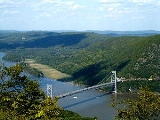
 on the Bear Mountain Bridge
Bear Mountain Bridge

The Bear Mountain Bridge is a toll suspension bridge in New York State, carrying U.S. Highways U.S. Highway 202 and U.S. Route 6 in New York, as well as the Appalachian Trail, across the Hudson River between Rockland County, New York and and Westchester counties....
, the lowest point on the entire Appalachian Trail at 124 feet (38 m). It then passes through Fahnestock State Park
Clarence Fahnestock State Park

Clarence Fahnestock Memorial State Park a 14,086 acre New York state park, in Putnam County, New York and Dutchess County, New York counties. The park has hiking trails, an environmental center, a beach on Canopus Lake, and fishing on four ponds and two lakes....
, and continues northeast until it enters Connecticut via the Pawling Nature Reserve. The section of the trail that passes through Harriman and Bear Mountain State Parks is the oldest section of the trail, completed in 1923.

The 52 miles (84 km) of trail in Connecticut lie almost entirely along the ridge
Ridge

A ridge is a geological feature that features a continuous elevational crest for some distance. Ridges are usually termed hills or mountains as well, depending on size....
s to the west above the Housatonic River
Housatonic River

The Housatonic River is a river, approximately 149 mi long, in western Massachusetts and western Connecticut in the United States. It flows south to southeast, and drains about of southwestern New England into Long Island Sound....
 valley.

The state line is also the western boundary of a 480 acre (190 ha) Connecticut reservation
Indian reservation

An Indian reservation is an area of land managed by a Native Americans of the United States tribe under the United States Department of the Interior Bureau of Indian Affairs....
 inhabited by 11 Schaghticoke Indians
Schaghticoke (tribe)

The Schaghticoke are a Native Americans in the United States tribe of the Eastern Woodlands consisting of descendants of Mahican , Potatuck , Weantinock, Tunxis, Podunk , and other people indigenous to what is now Connecticut, New York, and Massachusetts, who amalgamated after encroachment of white settlers on their ancestral lands....
. Inside it, the AT roughly parallels its northern boundary, crossing back outside it after 2,000 feet (640 m).

Mtgreylocksummit
Massachusetts has 90 miles (145 km) of trail. The entire section of trail is in western Massachusetts' Berkshire County. It summits the highest peak in the Southern Taconic Range
Taconic Mountains

The Taconic Mountains or Taconic Range are a Physiographic regions of the world of the larger New England province and part of the Appalachian Mountains, running along the eastern border of New York and adjacent New England from northwest Connecticut to western Massachusetts, north to central western Vermont in the town of Brandon, Verm...
, Mount Everett (2,602 ft., 793 m), then descends to the Housatonic River Valley and skirts the town of Great Barrington
Great Barrington, Massachusetts

Great Barrington is a New England town in Berkshire County, Massachusetts, Massachusetts, United States. It is part of the Pittsfield, Massachusetts, Massachusetts Metropolitan Statistical Area....
. The trail passes through the towns of Dalton
Dalton, Massachusetts

Dalton is a New England town in Berkshire County, Massachusetts, Massachusetts, United States. Dalton is considered by some to be a suburb of the nearby city of Pittsfield, Massachusetts....
 and Cheshire
Cheshire, Massachusetts

Cheshire is a New England town in Berkshire County, Massachusetts, Massachusetts, United States. It is part of the Pittsfield, Massachusetts, Massachusetts Metropolitan Statistical Area....
, and summits the highest point in the state at 3,491 feet (1,064 m), Mount Greylock
Mount Greylock

Mount Greylock, 3,491 feet , is the highest point in the Commonwealth of Massachusetts; it is located in the northwest corner of the state within Berkshire County, Massachusetts....
. It then quickly descends to the valley within 2 miles (3 km) of North Adams
North Adams, Massachusetts

North Adams is a city in Berkshire County, Massachusetts, Massachusetts, United States. It is part of the Pittsfield, Massachusetts Metropolitan Statistical Area....
 and Williamstown
Williamstown, Massachusetts

Williamstown is a New England town in Berkshire County, Massachusetts, in the northwest corner of Massachusetts. It shares a border with Vermont to the north and New York to the west....
, before ascending again to the Vermont state line. The trail throughout Massachusetts is maintained by the Berkshire Chapter of the Appalachian Mountain Club.

Vermont has 150 miles (241 km) of the trail. Upon entering Vermont, the trail coincides with the southernmost sections of the generally north/south-oriented Long Trail
Long Trail

The Long Trail is a hiking trail located in Vermont, running the length of the state. It is the oldest long-distance trail in the United States, constructed between 1910 and 1930 by the Green Mountain Club....
 (which is subject to a request by its maintainers to protect it in its most vulnerable part of the year by forgoing spring hiking). It follows the ridge of the southern Green Mountains, summitting such notable peaks as Stratton Mountain
Stratton Mountain (Vermont)

Stratton Mountain is a mountain located in Windham County, Vermont, Vermont, in the Green Mountain National Forest.The mountain, a monadnock, is the highest point of Windham County, and of the southern Green Mountains generally....
, Glastenbury Mountain
Glastenbury Mountain

Glastenbury Mountain is a mountain located in Bennington County, Vermont, Vermont, in the Green Mountain National Forest.The mountain is part of the Green Mountains....
 and Killington Peak
Killington Peak

Killington Peak is the second highest summit in the Green Mountains and in the U.S. state of Vermont. It is located east of Rutland , Vermont in south-central Vermont....
. After parting ways with the Long Trail at Maine Junction, the AT turns in a more eastward direction, crossing the White River
White River

Several towns and rivers are called White River....
, passing through Norwich
Norwich, Vermont

Norwich is a town in Windsor County, Vermont, Vermont, United States, located along the Connecticut River opposite Hanover, New Hampshire, New Hampshire....
, and entering Hanover, New Hampshire
Hanover, New Hampshire

Hanover is a town along the Connecticut River in Grafton County, New Hampshire, New Hampshire, United States. The population was 10,850 at the 2000 census....
, as it crosses the Connecticut River
Connecticut River

The Connecticut River is the largest river in New England, flowing south from the Connecticut Lakes in northern New Hampshire, along the border between New Hampshire and Vermont, through Western Massachusetts and central Connecticut into Long Island Sound at Old Saybrook, Connecticut....
. The Green Mountain Club
Green Mountain Club

The Green Mountain Club is a non-profit organization dedicated to preserving and protecting Vermont's Long Trail. Created in 1910 with a mission "to make the Vermont Mountains play a larger part in the life of the people", the club completed the Long Trail in 1930....
 maintains the AT from the Massachusetts state border to Route 12
Route 12 (New England)

Route 12 is a multi-state north-south state highway in the New England region of the United States, running from Groton, Connecticut through Worcester, Massachusetts and Keene, New Hampshire, to Morrisville, Vermont....
. The Dartmouth Outing Club
Dartmouth Outing Club

The Dartmouth Outing Club is the oldest and largest collegiate outing club in the United States of America. Proposed in 1909 by Dartmouth College student Fred Harris to "stimulate interest in out-of-door winter sports", the club soon grew to encompass the College's year-round outdoor activity and has had a major role in defining Dartmouth Co...
 maintains the trail from Route 12 to the New Hampshire state line.

New Hampshire has 161 miles (259 km) of the trail. The New Hampshire AT is nearly all within the White Mountain National Forest
White Mountain National Forest

The White Mountain National Forest is a forest contained within the White Mountains in the northeastern United States. It was initially established in 1918....
. For northbound thru-hikers, it is the beginning of the main challenges that go beyond enduring distance and time: in New Hampshire and Maine, rough or steep ground are more frequent and alpine
Alpine climate

Alpine climate is the average weather for a region above the tree line. The climate becomes colder at high elevations—this characteristic is described by the adiabatic lapse rate of air: air tends to get colder as it rises, since it expands....
 conditions are found near summits and along ridges. The trail reaches more than half of the four-thousand footers
Four-thousand footers

In mountaineering, the four-thousand footers refers to a group of mountains in New England of interest in the sport of "peak-bagging". Each peak is at least 4,000 feet above sea level, and also meets a more technical criterion of topographic prominence....
 of New Hampshire, including Mount Washington
Mount Washington (New Hampshire)

Mount Washington is the highest peak in the Northeastern United States at . It is famous for its dangerously erratic weather, holding the record for the highest wind gust directly measured at the Earth's surface, at on the afternoon of April 12, 1934....
, the highest point of the AT north of Tennessee. The Dartmouth Outing Club maintains the AT from the Vermont border past Mount Moosilauke to Kinsman Notch
Kinsman Notch

Kinsman Notch is a mountain pass located in the White Mountains of New Hampshire, United States. It is the westernmost of the major notches through the White Mountains ....
, with the AMC
Appalachian Mountain Club

The Appalachian Mountain Club is one of the United States' oldest outdoor groups. Created in 1876 to explore and preserve the White Mountains in New Hampshire, it has expanded throughout the northeastern U.S., with 12 chapters stretching from Maine to Washington, D.C....
 maintaining the remaining miles through the state.

Northterm
The 281 miles (452 km) of the trail in Maine are particularly difficult. More moose
Moose

File:Alces alces NA.svgThe moose or elk , , is the largest Extant taxon species in the deer family . Moose are distinguished by the palmate antlers of the males; other members of the family have antlers with a "twig-like" configuration....
 are seen by hikers in this state than any other on the trail. The northern terminus of the Appalachian Trail is on Mount Katahdin's Baxter Peak in Baxter State Park
Baxter State Park

Baxter State Park is a large wilderness area permanently preserved as a state park, located in Piscataquis County, Maine in north-central Maine....
.

The western section includes a mile-long (1.6 km) stretch of boulders at Mahoosuc Notch
Mahoosuc Notch

Mahoosuc Notch is a deep gap in the Mahoosuc Range of western Maine, traversed by the Appalachian Trail. The boulders on this mile-long section of trail present obstacles that must be climbed over and sometimes under, creating a unique hiking experience....
, often called the trail's hardest mile. Also, although there are dozens of river and stream fords on the Maine section of the trail, the Kennebec River
Kennebec River

The Kennebec River is a river, 150 mi long, in the state of Maine in the northeastern United States. It rises in Moosehead Lake in west central Maine....
 is the only one on the trail that requires a boat crossing. The most isolated portion in the state (and arguably on the entire trail) is known as the "100-Mile Wilderness
100-Mile Wilderness

The 100-Mile Wilderness is the section of the Appalachian Trail running between Abol Bridge just south of Baxter State Park and Monson, Maine, USA....
", which heads east-northeast from the town of Monson
Monson, Maine

Monson is a New England town in Piscataquis County, Maine, Maine, United States. As of the 2000 United States Census, the town had a population of 666....
 and ends outside Baxter State Park
Baxter State Park

Baxter State Park is a large wilderness area permanently preserved as a state park, located in Piscataquis County, Maine in north-central Maine....
 just south of Abol Bridge.

Park management strongly discourages thru-hiking within the park before May 15 or after October 15.

The AMC
Appalachian Mountain Club

The Appalachian Mountain Club is one of the United States' oldest outdoor groups. Created in 1876 to explore and preserve the White Mountains in New Hampshire, it has expanded throughout the northeastern U.S., with 12 chapters stretching from Maine to Washington, D.C....
 maintains the AT from the New Hampshire border to Grafton Notch
Grafton Notch

Grafton Notch is a notch, or mountain pass, located in Oxford County, Maine, Maine.The notch demarks the northeastern end the Mahoosuc Range, and thus of the White Mountains ....
, with the Maine Appalachian Trail Club responsible for maintaining the remaining miles to Mt. Katahdin.

Further reading

ATC's official Appalachian Trail guide is the , compiled by volunteers of the (available at ). Also available from the ATC is the Official AT Databook, an annually updated compilation of trail mileages, water sources, road crossings, shelter locations, and other information. The 2007 DataBook is the 29th annual edition, and is considered indispensable by many AT hikers and hiking guides. Also available through the ATC are individual state guidebooks and map sets. Another annual guide book to the AT, the Thru-Hiker's Handbook, was written by Dan "Wingfoot" Bruce since 1985 and was taken over by Bob "501" McCaw as of 2008.

Scores of books about the trail have been published by thru-hikers and others:
  • The first thru-hiker, Earl Shaffer, wrote an account of his journey titled "Walking With Spring."
  • Edward B. Garvey wrote "Appalachian Hiker" and "Appalachian Hiker II" in 1971 and 1978, respectively, telling the story of the trail and his thru-hike of it from April to October 1970.
  • Larry Luxenberg published "Walking the Appalachian Trail," a collection of interviews with thru-hikers.
  • Adrienne Hall's book, "A Journey North," published in 2001, discussed the particulars of being a female thru-hiker.
  • Bill Irwin, a blind man, wrote about walking the entire AT with his guide dog
    Guide dog

    Guide dogs are assistance dogs trained to lead blindness or Visual impairment people around obstacles.Although the dogs can be trained to navigate various obstacles, they are partially color blind and are not capable of interpreting street signs....
    , Orient, in "Blind Courage."
  • In 1997, Lynn Setzer published "A Season on the Appalachian Trail," a collection of stories and comments from hikers who attempted a thru-hike in 1996. A second edition, published in 2001, included hikers' perspectives five years after completing (or abandoning) their hikes.
  • Bill Bryson
    Bill Bryson

    William McGuire "Bill" Bryson, Order of the British Empire, is a best-selling United States author of humorous books on travel, as well as books on the English language and on science subjects....
    's 1998 book A Walk in the Woods gives a humorous view of the trail from a less-than-fit person's perspective.
  • Jeff Alt's 2007 book A Walk for Sunshine describes his 1998 thru-hike to raise money for the home where his brother with cerebral palsy
    Cerebral palsy

    Cerebral palsy is an umbrella term encompassing a group of non-progressive illness, non-Infectious diseases conditions that cause physical disability in Human development ....
     resides.


See also

  • Appalachian Development Highway System
    Appalachian Development Highway System

    The Appalachian Development Highway System is part of the Appalachian Regional Commission in the United States....
     (ADHS) (in the eastern US)
  • Eustace Conway
    Eustace Conway

    Eustace Conway is an American naturalist and the subject of the book The Last American Man by Elizabeth Gilbert and the subject of an early episode of the weekly radio show This American Life....
  • List of counties that the Appalachian trail passes through
    List of counties that the Appalachian trail passes through

    Below is a list of counties through which the Appalachian trail passes.Please feel free to add any Appalachian trail counties that are not listed here, adjacent to the appropriate state....
  • International Appalachian Trail
    International Appalachian Trail

    The International Appalachian Trail is a hiking trail which runs from the northern terminus of the Appalachian Trail at Mount Katahdin, Maine through the Gaspe Peninsula of Quebec to the northernmost tip of the Appalachian Mountains at Belle Isle , Newfoundland and Labrador....

Other long distance trails in the U.S.

  • Pacific Crest Trail
    Pacific Crest Trail

    The Pacific Crest Trail is a long-distance mountain hiking and Equestrianism trail that runs from the United States border with Mexico to its border with Canada and follows the highest portion of the Sierra Nevada and Cascade Range which parallel the Pacific Ocean by ....
  • Continental Divide Trail
    Continental Divide Trail

    The Continental Divide National Scenic Trail is a United States National Scenic Trail running 3,100 miles between Mexico and Canada. It follows the Continental Divide along the Rocky Mountains and traverses five U.S....


External links


Official sites
  • , with
  • , for Virginia, Maryland, West Virginia, Pennsylvania, and the District of Columbia


Unofficial sites and hiking guides
  • with shelters
  • - GPS data and maps
  • Interactive AT map