


Andronovo culture

Encyclopedia

Bronze Age
The Bronze Age is a period characterized by the use of copper and its alloy bronze as the chief hard materials in the manufacture of some implements and weapons. Chronologically, it stands between the Stone Age and Iron Age...
cultures that flourished ca. 21200–1400 BCE in western Siberia
Siberia
Siberia is an extensive region constituting almost all of Northern Asia. Comprising the central and eastern portion of the Russian Federation, it was part of the Soviet Union from its beginning, as its predecessor states, the Tsardom of Russia and the Russian Empire, conquered it during the 16th...
and the west Asiatic steppe
Asian Steppe
The Asian Steppe is the Asian part of the Eurasian Steppe. Some scholars wrongly use the term "Asian Steppe" to describe the vast region of steppes of Eurasia. The Pontic Steppe of western Russia and of Ukraine and the steppes of the Hungarian plain are all in Eastern Europe. The Asian Steppe...
. It is probably better termed an archaeological complex or archaeological horizon. The name derives from the village of Andronovo (55°53′N 55°42′E), where in 1914, several graves were discovered, with skeletons in crouched positions, buried with richly decorated pottery.
Two sub-cultures have been since distinguished, during which the culture expands towards the south and the east:
- Alakul (1800–1400 BCE)
- Fedorovo (1700–1300 BCE)
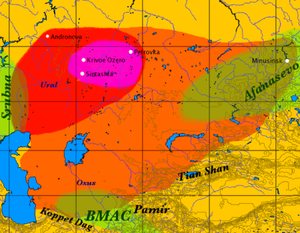
The geographical extent of the culture is vast and difficult to delineate exactly. On its western fringes, it overlaps with the approximately contemporaneous, but distinct, Srubna culture
Srubna culture
The Srubna culture , was a Late Bronze Age culture. It is a successor to the Yamna culture, the Pit Grave culture and the Poltavka culture....
in the Volga-Ural
Ural River
The Ural or Jayıq/Zhayyq , known as Yaik before 1775, is a river flowing through Russia and Kazakhstan. It arises in the southern Ural Mountains and ends at the Caspian Sea. Its total length is 1,511 mi making it the third longest river in Europe after the Volga and the Danube...
interfluvial. To the east, it reaches into the Minusinsk
Minusinsk
Minusinsk is a historic town in Krasnoyarsk Krai, Russia. It serves as the administrative center of Minusinsky District, although it is not administratively a part of it. Population: 44,500 ....
depression, overlapping with the area of the earlier Afanasevo culture
Afanasevo culture
The Afanasevo culture, traditionally dated to 2500–2000 BC , is an archaeological culture of the late copper and early Bronze Age of southern Siberia....
. Additional sites are scattered as far south as the Koppet Dag (Turkmenistan
Turkmenistan
Turkmenistan , formerly also known as Turkmenia is one of the Turkic states in Central Asia. Until 1991, it was a constituent republic of the Soviet Union, the Turkmen Soviet Socialist Republic . Turkmenistan is one of the six independent Turkic states...
), the Pamir
Pamir Mountains
The Pamir Mountains are a mountain range in Central Asia formed by the junction or knot of the Himalayas, Tian Shan, Karakoram, Kunlun, and Hindu Kush ranges. They are among the world’s highest mountains and since Victorian times they have been known as the "Roof of the World" a probable...
(Tajikistan
Tajikistan
Tajikistan , officially the Republic of Tajikistan , is a mountainous landlocked country in Central Asia. Afghanistan borders it to the south, Uzbekistan to the west, Kyrgyzstan to the north, and China to the east....
) and the Tian Shan
Tian Shan
The Tian Shan , also spelled Tien Shan, is a large mountain system located in Central Asia. The highest peak in the Tian Shan is Victory Peak , ....
(Kyrgyzstan
Kyrgyzstan
Kyrgyzstan , officially the Kyrgyz Republic is one of the world's six independent Turkic states . Located in Central Asia, landlocked and mountainous, Kyrgyzstan is bordered by Kazakhstan to the north, Uzbekistan to the west, Tajikistan to the southwest and China to the east...
). The northern boundary vaguely corresponds to the beginning of the Taiga
Taiga
Taiga , also known as the boreal forest, is a biome characterized by coniferous forests.Taiga is the world's largest terrestrial biome. In North America it covers most of inland Canada and Alaska as well as parts of the extreme northern continental United States and is known as the Northwoods...
. In the Volga basin, interaction with the Srubna culture was the most intense and prolonged, and Federovo style pottery is found as far west as Volgograd
Volgograd
Volgograd , formerly called Tsaritsyn and Stalingrad is an important industrial city and the administrative center of Volgograd Oblast, Russia. It is long, north to south, situated on the western bank of the Volga River...
.
Towards the middle of the 2nd millennium, the Andronovo cultures begin to move intensively eastwards. They mined deposits of copper
Copper
Copper is a chemical element with the symbol Cu and atomic number 29. It is a ductile metal with very high thermal and electrical conductivity. Pure copper is soft and malleable; an exposed surface has a reddish-orange tarnish...
ore in the Altai Mountains and lived in villages of as many as ten sunken log cabin houses measuring up to 30m by 60m in size. Burials were made in stone cist
Cist
A cist from ) is a small stone-built coffin-like box or ossuary used to hold the bodies of the dead. Examples can be found across Europe and in the Middle East....
s or stone enclosures with buried timber chambers.
In other respects, the economy was pastoral, based on cattle, horses, sheep, and goats. While agricultural use has been posited, no clear evidence has been presented.
Most researchers associate the Andronovo horizon with early Indo-Iranian languages
Indo-Iranian languages
The Indo-Iranian language group constitutes the easternmost extant branch of the Indo-European family of languages. It consists of three language groups: the Indo-Aryan, Iranian and Nuristani...
, though it may have overlapped the early Uralic
Uralic languages
The Uralic languages constitute a language family of some three dozen languages spoken by approximately 25 million people. The healthiest Uralic languages in terms of the number of native speakers are Hungarian, Finnish, Estonian, Mari and Udmurt...
-speaking area at its northern fringe.
Andronovo and Indo-Iranians
The Andronovo culture is strongly associated with the Indo-IraniansIndo-Iranians
Indo-Iranian peoples are a linguistic group consisting of the Indo-Aryan, Iranian, Dardic and Nuristani peoples; that is, speakers of Indo-Iranian languages, a major branch of the Indo-European language family....
and is often credited with the invention of the spoke-wheeled chariot
Chariot
The chariot is a type of horse carriage used in both peace and war as the chief vehicle of many ancient peoples. Ox carts, proto-chariots, were built by the Proto-Indo-Europeans and also built in Mesopotamia as early as 3000 BC. The original horse chariot was a fast, light, open, two wheeled...
around 2000 BCE.
Sintashta
Sintashta
Sintashta is an archaeological site in Chelyabinsk Oblast, Russia. It is the remains of a fortified settlement dating to the Bronze Age, c. 2800–1600 BC, and is the type site of the Sintashta culture...
is a site on the upper Ural River
Ural River
The Ural or Jayıq/Zhayyq , known as Yaik before 1775, is a river flowing through Russia and Kazakhstan. It arises in the southern Ural Mountains and ends at the Caspian Sea. Its total length is 1,511 mi making it the third longest river in Europe after the Volga and the Danube...
. It is famed for its grave-offerings, particularly chariot
Chariot
The chariot is a type of horse carriage used in both peace and war as the chief vehicle of many ancient peoples. Ox carts, proto-chariots, were built by the Proto-Indo-Europeans and also built in Mesopotamia as early as 3000 BC. The original horse chariot was a fast, light, open, two wheeled...
burials. These inhumations were in kurgans and included all or parts of animals (horse and dog) deposited into the barrow
Tumulus
A tumulus is a mound of earth and stones raised over a grave or graves. Tumuli are also known as barrows, burial mounds, Hügelgrab or kurgans, and can be found throughout much of the world. A tumulus composed largely or entirely of stones is usually referred to as a cairn...
. Sintashta is often pointed to as the premier proto-Indo-Iranian site, and it is conjectured that the language spoken was still in the Proto-Indo-Iranian
Proto-Indo-Iranian language
Proto-Indo-Iranian is the reconstructed proto-language of the Indo-Iranian branch of Indo-European. Its speakers, the hypothetical Proto-Indo-Iranians, are assumed to have lived in the late 3rd millennium BC, and are usually connected with the early Andronovo archaeological...
stage. There are similar sites "in the Volga-Ural steppe".
The identification of Andronovo as Indo-Iranian has been challenged by scholars who point to the absence of the characteristic timber graves of the steppe south of the Oxus River. Sarianidi (as cited in ) states that "direct archaeological data from Bactria and Margiana show without any shade of doubt that Andronovo tribes penetrated to a minimum extent into Bactria and Margianian oases".
Based on its use by Indo-Aryans in Mitanni and Vedic India, its prior absence in the Near East and Harappan India, and its 16th–17th century BCE attestation at the Andronovo site of Sintashta
Sintashta
Sintashta is an archaeological site in Chelyabinsk Oblast, Russia. It is the remains of a fortified settlement dating to the Bronze Age, c. 2800–1600 BC, and is the type site of the Sintashta culture...
, Kuzmina (1994) argues that the chariot corroborates the identification of Andronovo as Indo-Iranian. Klejn (1974) and Brentjes (1981) find the Andronovo culture much too late for an Indo-Iranian identification since chariot-wielding Aryans appear in Mitanni
Mitanni
Mitanni or Hanigalbat was a loosely organized Hurrian-speaking state in northern Syria and south-east Anatolia from ca. 1500 BC–1300 BC...
by the 15th to 16th century BCE. However, dated a chariot burial
Chariot burial
Chariot burials are tombs in which the deceased was buried together with his chariot, usually including his horses and other possessions....
at Krivoye Lake to around 2000 BCE.
Mallory (as cited in ) admits the extraordinary difficulty of making a case for expansions from Andronovo to northern India, and that attempts to link the Indo-Aryans to such sites as the Beshkent and Vakhsh cultures "only gets the Indo-Iranian to Central Asia, but not as far as the seats of the Medes, Persians or Indo-Aryans".
Eugene Helimski
Eugene Helimski
Eugene Arnoľdovič Helimski — a Russian linguist , Doctor of Philosophy , Professor...
has suggested that the Andronovo people spoke a separate branch of the Indo-Iranian group. He claims that borrowings in the Finno-Ugric languages
Finno-Ugric languages
Finno-Ugric , Finno-Ugrian or Fenno-Ugric is a traditional group of languages in the Uralic language family that comprises the Finno-Permic and Ugric language families....
support this view.
An alternative possibility for the language of Andronovo may be Burušaski (now spoken in Kašmīr
Kashmir
Kashmir is the northwestern region of the Indian subcontinent. Until the mid-19th century, the term Kashmir geographically denoted only the valley between the Great Himalayas and the Pir Panjal mountain range...
) or Ĥapirti
Elamite language
Elamite is an extinct language spoken by the ancient Elamites. Elamite was the primary language in present day Iran from 2800–550 BCE. The last written records in Elamite appear about the time of the conquest of the Persian Empire by Alexander the Great....
(ʕelamitic
Elam
Elam was an ancient civilization located in what is now southwest Iran. Elam was centered in the far west and the southwest of modern-day Iran, stretching from the lowlands of Khuzestan and Ilam Province, as well as a small part of southern Iraq...
), anciently spoken in Ĥuzistan
Khuzestan Province
Khuzestan Province is one of the 31 provinces of Iran. It is in the southwest of the country, bordering Iraq's Basra Province and the Persian Gulf. Its capital is Ahwaz and covers an area of 63,238 km²...
.
Since older forms of Indo-Iranian words have been taken over in Uralic
Uralic languages
The Uralic languages constitute a language family of some three dozen languages spoken by approximately 25 million people. The healthiest Uralic languages in terms of the number of native speakers are Hungarian, Finnish, Estonian, Mari and Udmurt...
and Proto-Yeniseian
Yeniseian languages
The Yeniseian language family is spoken in central Siberia.-Family division:0. Proto-Yeniseian...
, occupation by some other languages (also lost ones) cannot be ruled out altogether, at least for part of the Andronovo area: i. e., Uralic and Yeniseian.
Successors
The Sintashta-Petrovka culture is succeeded by the Fedorovo (1400–1200 BCE) and Alekseyevka (1200–1000 BCE) cultures, still considered as part of the Andronovo horizon.In southern Siberia and Kazakhstan, the Andronovo culture was succeeded by the Karasuk culture
Karasuk culture
The Karasuk culture describes a group of Bronze Age societies who ranged from the Aral Sea or the Volga River to the upper Yenisei catchment, ca. 1500–800 BC, preceded by the Afanasevo culture. The remains are minimal and entirely of the mortuary variety. At least 2000 burials are known. The...
(1500–800 BCE), which is sometimes asserted to be non-Indo-European, and at other times to be specifically proto-Iranian. On its western border, it is succeeded by the Srubna culture
Srubna culture
The Srubna culture , was a Late Bronze Age culture. It is a successor to the Yamna culture, the Pit Grave culture and the Poltavka culture....
, which partly derives from the Abashevo culture
Abashevo culture
Abashevo culture is a later Bronze Age archaeological culture found in the valleys of the Volga and Kama River north of the Samara bend and into the southern Ural Mountains. It receives its name from a village of Abashevo in Chuvashia. Artifacts are kurgans and remnants of settlements...
. The earliest historical peoples associated with the area are the Cimmerians
Cimmerians
The Cimmerians or Kimmerians were ancient equestrian nomads of Indo-European origin.According to the Greek historian Herodotus, of the 5th century BC, the Cimmerians inhabited the region north of the Caucasus and the Black Sea during the 8th and 7th centuries BC, in what is now Ukraine and Russia...
and Saka
Saka
The Saka were a Scythian tribe or group of tribes....
/Scythians, appearing in Assyria
Assyria
Assyria was a Semitic Akkadian kingdom, extant as a nation state from the mid–23rd century BC to 608 BC centred on the Upper Tigris river, in northern Mesopotamia , that came to rule regional empires a number of times through history. It was named for its original capital, the ancient city of Assur...
n records after the decline of the Alekseyevka culture, migrating into the Ukraine
Ukraine
Ukraine is a country in Eastern Europe. It has an area of 603,628 km², making it the second largest contiguous country on the European continent, after Russia...
from ca. the 9th century BCE (see also Ukrainian stone stela), and across the Caucasus
Caucasus
The Caucasus, also Caucas or Caucasia , is a geopolitical region at the border of Europe and Asia, and situated between the Black and the Caspian sea...
into Anatolia
Anatolia
Anatolia is a geographic and historical term denoting the westernmost protrusion of Asia, comprising the majority of the Republic of Turkey...
and Assyria in the late 8th century BCE, and possibly also west into Europe as the Thracians
Thracians
The ancient Thracians were a group of Indo-European tribes inhabiting areas including Thrace in Southeastern Europe. They spoke the Thracian language – a scarcely attested branch of the Indo-European language family...
(see Thraco-Cimmerian
Thraco-Cimmerian
Thraco-Cimmerian is a historiographical and archaeological term, composed of the names of the Thracians and the Cimmerians. It refers to 8th to 7th century BC cultures that are linked in Eastern Central Europe and in the area north of the Black Sea....
), and the Sigynnae
Sigynnae
The Sigynnae were an obscure people of antiquity. They are variously located by ancient authors.According to Herodotus , they dwelt beyond the Danube, and their frontiers extended almost as far as the Eneti on the Adriatic. Their horses were small and flat-nosed with shaggy long hair, five fingers...
, located by Herodotus
Herodotus
Herodotus was an ancient Greek historian who was born in Halicarnassus, Caria and lived in the 5th century BC . He has been called the "Father of History", and was the first historian known to collect his materials systematically, test their accuracy to a certain extent and arrange them in a...
beyond the Danube, north of the Thracians, and by Strabo
Strabo
Strabo, also written Strabon was a Greek historian, geographer and philosopher.-Life:Strabo was born to an affluent family from Amaseia in Pontus , a city which he said was situated the approximate equivalent of 75 km from the Black Sea...
near the Caspian Sea
Caspian Sea
The Caspian Sea is the largest enclosed body of water on Earth by area, variously classed as the world's largest lake or a full-fledged sea. The sea has a surface area of and a volume of...
. Both Herodotus and Strabo identify them as Iranian.
Ancient DNA
Out of 10 human male remains asigned to the Andronovo horizon from the Krasnoyarsk region, 9 possessed the R1a Y-chromosome haplogroup and one Haplogroup C (Y-DNA)Haplogroup C (Y-DNA)
In human genetics, Haplogroup C is a Y-chromosome haplogroup, defined by UEPs M130/RPS4Y711, M216, P184, P255, and P260, which are all SNP mutations. It is a sibling clade of Haplogroup F, within the more ancient grouping of Haplogroup CF...
(xC3). mtDNA haplogroups of nine individuals assigned to the same Andronovo horizon and region were as follows: U4 (2 individuals), U2e, U5a1, Z, T1, T4, H, and K2b.
90 % of the bronze age period mtDNA haplogroups were of west Eurasian origin and the study determined that at least 60 % of the individuals overall (out of the 26 bronze and iron age human remains' samples of the study that could be tested) had light hair and blue or green eyes. .
A 2004 study also established that, during the bronze/iron age period, the majority of the population of Kazakhstan
Kazakhstan
Kazakhstan , officially the Republic of Kazakhstan, is a transcontinental country in Central Asia and Eastern Europe. Ranked as the ninth largest country in the world, it is also the world's largest landlocked country; its territory of is greater than Western Europe...
(part of the Andronovo culture during bronze age), was of west Eurasian origin (with mtDNA haplogroups such as U, H, HV, T, I and W), and that prior to the thirteenth-seventh century BC, all Kazakh samples belonged to European lineages.
See also
- BMAC
- Indo-IraniansIndo-IraniansIndo-Iranian peoples are a linguistic group consisting of the Indo-Aryan, Iranian, Dardic and Nuristani peoples; that is, speakers of Indo-Iranian languages, a major branch of the Indo-European language family....
- AryanAryanAryan is an English language loanword derived from Sanskrit ārya and denoting variously*In scholarly usage:**Indo-Iranian languages *in dated usage:**the Indo-European languages more generally and their speakers...
- SomaSomaSoma , or Haoma , from Proto-Indo-Iranian *sauma-, was a ritual drink of importance among the early Indo-Iranians, and the subsequent Vedic and greater Persian cultures. It is frequently mentioned in the Rigveda, whose Soma Mandala contains 114 hymns, many praising its energizing qualities...
- Aryan
- ChariotChariotThe chariot is a type of horse carriage used in both peace and war as the chief vehicle of many ancient peoples. Ox carts, proto-chariots, were built by the Proto-Indo-Europeans and also built in Mesopotamia as early as 3000 BC. The original horse chariot was a fast, light, open, two wheeled...
, Chariot burialChariot burialChariot burials are tombs in which the deceased was buried together with his chariot, usually including his horses and other possessions.... - Kurgan hypothesisKurgan hypothesisThe Kurgan hypothesis is one of the proposals about early Indo-European origins, which postulates that the people of an archaeological "Kurgan culture" in the Pontic steppe were the most likely speakers of the Proto-Indo-European language...
External links
- Center for the Study of Eurasian Nomads (csen.org)
- The Discovery of Sintashta (a Russian-language article by two archaeologists who directed the excavations)
- Archaic Motifs in North Russian Folk Embroidery and Parallels in Ancient Ornamental Designs of the Eurasian Steppe Peoples S. Zharnikova